A yearlong Mother Jones investigation finds the U.S. Forest Service is spraying record volumes of glyphosate across burn-scarred public lands — killing the very deciduous trees that slow wildfire — while the White House uses wartime authorities to shield the chemical’s manufacturers from accountability. The pattern is not incompetence. It is policy.
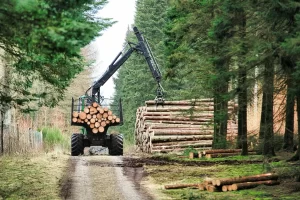
Drive through a clear-cut on private timberland in Northern California in early summer, and you will not see a forest recovering. You will see, in the words of Mother Jones reporter Nate Halverson, “a virtual dead zone where the only life consists of row upon row of manually planted, tightly packed conifer saplings.” No bees. No flowers. No aspen, no oak, no willow — only future lumber, marching in straight lines. The native vegetation has been killed not by fire but by a chemical: glyphosate, the active ingredient in Roundup, the herbicide that Bayer has paid out billions of dollars to settle non-Hodgkin lymphoma claims over.
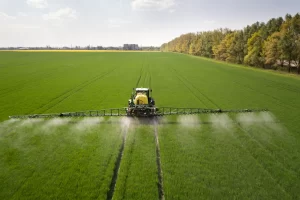
This is no longer a private-industry secret. A yearlong investigation by Halverson and Melissa Lewis, published in the May/June 2026 issue of Mother Jones in partnership with the Center for Investigative Reporting, documents that the U.S. Forest Service is now spraying glyphosate at record levels — on land that belongs to the public. The reporters analyzed more than five million California pesticide records dating back to 1990. They found 8,000 reported sprayings covering roughly a quarter-million acres between 2020 and 2022 alone. In 2023, California authorities applied 266,000 pounds of pure glyphosate to state forests — nearly five times the volume used two decades earlier.
Independent verification followed quickly. Snopes obtained the underlying records from Halverson and confirmed the agency’s spraying plans. The Forest Service does not deny the practice. It defends it.
1. What the Investigation Found
The reason for the spraying is straightforward and ugly: glyphosate kills broadleaf plants but spares conifers, because pine and Douglas fir trees have needles instead of leaves. By poisoning the deciduous understory, the Forest Service and its private-industry partners can grow commercially valuable softwood faster. The technique is called “conifer release.” It is, in effect, the conversion of a national forest into a tree farm.
The Forest Service’s own public communications celebrate timber as a national asset, but the agency has been notably less forthcoming about scale. When pressed by Snopes for the actual figures, the Forest Service replied that detailed numbers would require slow public-records requests because most spraying happens via “spot treatments” rather than large blocks. The agency added that it “relies on the Environmental Protection Agency and its rigorous evaluation of the safety of glyphosate-based herbicides.”
That deference is worth reading twice. The EPA is currently re-evaluating glyphosate. The World Health Organization’s International Agency for Research on Cancer classified it as a probable human carcinogen in 2015. Bayer has already paid out billions in U.S. courts. And, as Halverson and Lewis report, the Forest Service’s own safety assessment leaned heavily on a study that was later retracted after allegations that Monsanto employees had ghostwritten it.
This is the science the federal government is “relying on” when it sprays public land.
“The majority of glyphosate is still used in agriculture, but we were able to show that the fastest-growing use is actually now for forestry.”
— Nate Halverson, Mother Jones / Center for Investigative Reporting
2. The Fire Risk the Government Is Ignoring
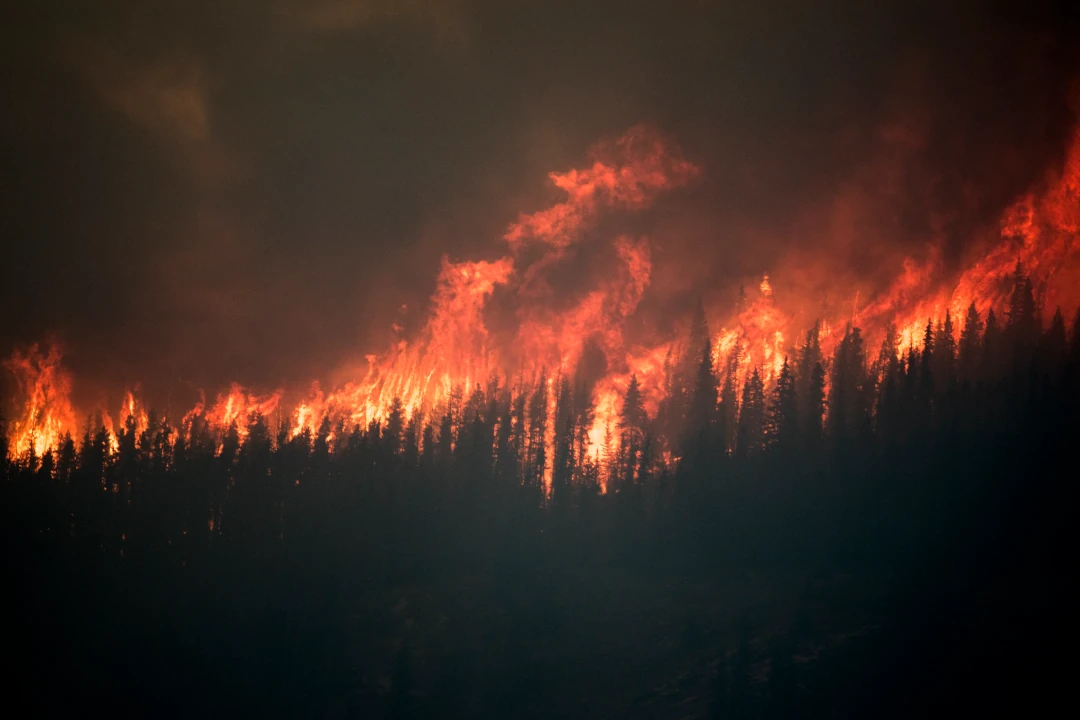
Here is where the policy collapses on its own terms. The administration justifies expanded timber operations as wildfire prevention. Yet a substantial body of fire-ecology research finds that the conifer-monoculture management glyphosate enables makes wildfires worse — sometimes catastrophically so.
Wildland fire ecologist Robert Gray, who has consulted for the British Columbia Ministry of Forests, has spent years documenting how deciduous trees act as natural firebreaks. Mature aspen groves trap moisture, shade the forest floor, and slow the spread of crown fires. “We talk about mature aspen as wet blankets or speed bumps on the landscape,” Gray told The Narwhal. “So, if we kill regenerating aspen, we’re changing the trajectory for a landscape’s potential fire behaviour.” Conifers, by contrast, are full of resins and oils. Pine and spruce burn five to ten times faster than fire-resistant leafy species, according to a 2025 analysis by the legal nonprofit Ecojustice.
The mechanism is not subtle. Glyphosate spraying does two things at once: it dries down standing biomass into kindling, and it eliminates the leafy species that would otherwise slow the next blaze. CBC News, citing peer-reviewed work, reported that glyphosate-managed cutblocks become demonstrably more flammable. In Nova Scotia, opposition to the practice has reached such pitch that critics openly accused the provincial government of compounding wildfire risk during drought. Quebec, the only Canadian province to ban the practice outright, did so for ecological reasons that now read as prescient.
The Forest Service’s plan for the Caldor Fire Restoration Project on the south shore of Lake Tahoe — roughly 11,100 acres of national forest approved in March 2026 — includes glyphosate treatments near campgrounds, trailheads, and private homes. The spraying is sold as helping the forest “recover.” What it does is help future fires move faster.
3. The Executive Orders Behind the Spray
None of this is an accident of bureaucratic drift. It is the result of two specific White House decisions.
On March 1, 2025, the President issued Executive Order 14225, “Immediate Expansion of American Timber Production,” directing federal agencies to increase timber output and “decrease timber supply uncertainty” across some 280 million acres of national forests and other public lands, in part by bypassing the Endangered Species Act and other environmental statutes. Secretary of Agriculture Brooke Rollins responded with an Emergency Situation Determination covering 112,646,000 acres — roughly 59 percent of National Forest System land. “Healthy forests require work, and right now, we’re facing a national forest emergency,” Rollins declared. The order’s stated rationale was wildfire mitigation. Its operational effect was to remove environmental review from logging across half the federal forest estate.
A Resources for the Future analysis of the order concluded that the math does not support the fire-prevention claim. The Forest Service can already harvest emergency-treatment volumes under existing law; the 25 percent expansion overwhelmingly targets areas where commercial yield, not fire risk, is the deciding variable. Defenders of Wildlife and other conservation groups have argued the “emergency” framing is a pretext.
Then, on February 18, 2026, the President signed Executive Order 14387, invoking the Defense Production Act to declare glyphosate-based herbicides essential to “national security.” The order directs Secretary Rollins to ensure that no federal regulation places “the corporate viability of any domestic producer of elemental phosphorus or glyphosate-based herbicides at risk.” It cites the Defense Production Act’s liability shield for compliant producers — a provision that, in practice, hands Bayer a federal defense against cancer plaintiffs.
Representative Chellie Pingree of Maine, who has spent years on agricultural and environmental policy, was blunt. “Calling glyphosate production a matter of ‘national security’ is absurd,” she said in a joint statement with Republican Representative Thomas Massie of Kentucky. “Invoking wartime authorities to ramp up production while opening the door to liability shields for chemical companies is dangerous and indefensible. This Executive Order has nothing to do with protecting farmers or feeding the country — it’s about protecting corporate profits and insulating polluters from accountability.”
Pingree and Massie introduced the No Immunity for Glyphosate Act (H.R. 7601) in February to block the order’s implementation. Food & Water Watch attorney Dani Replogle put it more starkly: “This is the clearest indication yet that the Trump administration is at the beck and call of the pesticide industry — Bayer specifically.”
Glyphosate sprayed in California forests in 2023 alone — roughly five times the amount applied 20 years earlier, per Mother Jones.
National Forest land placed under “Emergency Situation Determination” by Sec. Rollins, expediting logging while bypassing environmental review, per USDA.
How much faster conifers like pine and spruce burn compared with fire-resistant deciduous species like aspen and birch, per Ecojustice’s review of the fire-ecology literature.
The approximate amount Bayer has paid to settle Roundup-related cancer claims since acquiring Monsanto in 2018 — even as the company denied wrongdoing, per Snopes’ fact-check.
4. A Compromised Evidence Base
The most damning element of the Mother Jones investigation is structural, not anecdotal. Halverson and Lewis demonstrate that the safety architecture justifying federal glyphosate use is built on industry science. The Forest Service’s risk assessment depended, in significant part, on a study that was later retracted after allegations of Monsanto authorship. Internal documents released through litigation — the so-called “Poison Papers” — show that Monsanto cultivated friendly regulators and shaped the published literature.
Naomi Oreskes, the Harvard historian and co-author of Merchants of Doubt, told reporters that the pattern of corporate science influence around glyphosate was designed “to manipulate the scientific conversation and thereby the regulatory conversation, and to persuade people of the safety of a product [when], in fact, there is significant scientific evidence to raise concern.”
This is the science a federal land-management agency is invoking to defend dousing 10,000 acres of Lassen National Forest in herbicide beginning this spring. It is the science the White House cited in February when it declared glyphosate a matter of national security. And it is, in significant measure, science the manufacturer wrote.
Get Involved Today
Contribute to our mission and turn your concerns into action.
5. The Chronology of a Capture
“This is the clearest indication yet that the Trump administration is at the beck and call of the pesticide industry — Bayer specifically.”
— Dani Replogle, Senior Attorney, Food & Water Watch
6. What This Says About Leadership
Reasonable people disagree about forestry science. They do not, in serious policy circles, disagree about the following: that a president should not use the Defense Production Act to insulate a single multinational corporation from cancer plaintiffs; that an Agriculture Secretary should not declare a continent-spanning “emergency” in order to skip environmental review for commercial logging; and that federal land-management decisions should not rest on retracted, ghostwritten science.
The pattern is the point. Each of these decisions, taken alone, could be defended as a bad policy call. Taken together, in sequence, they describe an administration that has confused public stewardship with corporate service — and that is willing to compound future wildfire risk in order to deliver on a campaign promise about lumber.
What the 25th Amendment Was Designed For — and What It Wasn’t
Section 4 of the 25th Amendment, ratified in 1967, provides that the Vice President and a majority of the Cabinet — or “such other body as Congress may by law provide” — may declare the President “unable to discharge the powers and duties of his office.” It was written for incapacity, not for policy disagreement. Honest constitutional analysis has to begin there.
That said, in April 2026, real lawmakers initiated real Section 4 conversations. Rep. Jamie Raskin (D-MD), ranking member of the House Judiciary Committee, demanded a comprehensive cognitive evaluation of the President by the White House physician, citing volatile public statements about Iran. Days later, Raskin introduced legislation with 50 Democratic co-sponsors to establish the Commission on Presidential Capacity that the Amendment itself contemplates. Rep. Raja Krishnamoorthi (D-IL) went further, explicitly calling on Vice President Vance and the Cabinet to invoke Section 4.
The glyphosate decisions do not, on their own, meet the Amendment’s incapacity standard. Choosing Bayer over cancer plaintiffs is venal; it is not, in the constitutional sense, an inability to discharge office. The honest progressive case has to acknowledge that.
But the decisions do belong in the broader record that Raskin and others are assembling: a pattern of judgment in which scientific evidence is subordinated to commercial sponsors, statutory authorities are invoked outside their purpose (the DPA for an herbicide), and emergency powers are stretched to cover ordinary deregulation. That pattern is what a Section 4 fitness review would examine.
The practical barriers are real. Section 4 requires the Vice President and Cabinet — appointees of the very president to be removed. No such Cabinet has ever moved against its principal, and Vice President Vance has shown no inclination to do so. The Raskin commission bill is unlikely to pass a Republican House.
None of which negates the constitutional case for documenting the record. The Framers of the 25th Amendment did not provide its mechanism so that it could only be invoked when politically convenient. They provided it because they understood that the alternative — a country whose chief executive operates beyond accountability — is the failure mode the Constitution exists to prevent.
Editorial Conclusion
A government that sprays cancer-linked chemicals on public forests, kills the trees that slow wildfire, and then uses wartime law to protect the manufacturer is not protecting the public. It is converting a national inheritance into a corporate balance sheet — and pre-loading the next megafire while it does so.
The constitutional question is not whether environmental policy can, by itself, justify the 25th Amendment. It cannot. The question is whether a presidency that treats every public good — forests, science, regulation, courts — as a vehicle for private benefit has crossed the line the Amendment was written to defend. On that question, the record is being written in herbicide. And in smoke.
Sources & References
- Mother JonesNate Halverson & Melissa Lewis, “We Are Bombarding America’s Forests With Roundup” (May/June 2026)
- Snopes“Forest Service, timber companies are spraying weedkiller glyphosate on forests. We dug into proof” (May 2026)
- Democracy Now!“We Are Bombarding America’s Forests with Roundup: Despite Cancer Fear, Trump Admin Pushes Herbicide” (April 29, 2026)
- U.S. Government Publishing OfficeExecutive Order 14387 of February 18, 2026 — Glyphosate & Phosphorus
- The White HouseFact Sheet on EO 14387 (February 18, 2026)
- USDA“Secretary Rollins Announces Sweeping Reforms to Protect National Forests and Boost Domestic Timber Production” (April 4, 2025)
- Resources for the FutureWibbenmeyer & Wear, “Will Increased Timber Harvesting on Federal Lands Reduce Growing Wildfire Hazards?” (2025)
- Defenders of Wildlife“Trump’s Timber ‘Emergency’ Paves Way for Logging Conservation Areas and Critical Habitat” (May 2025)
- The Narwhal“Why has B.C. used glyphosate to kill aspen, a fire guard, for decades?” (February 2026)
- CBC News“Environmentalists raise concerns spraying forests with glyphosate makes them more vulnerable to wildfires”
- Ecojustice“How Toxic Pollution Intensifies Wildfires” (2025)
- Tahoe Daily Tribune“Lake Tahoe’s fire restoration plan includes controversial herbicide use across thousands of acres” (May 2026)
- Chemical & Engineering News“Farm bill and Trump’s glyphosate order magnify pesticides’ ‘watershed moment'” (March 2026)
- Congress.govH.R. 7601 — No Immunity for Glyphosate Act (Pingree, Massie, Boebert, Mace, Khanna)
- Farm Policy News (U. of Illinois)“Trump Signs Order Protecting Glyphosate, Phosphorus Production” (February 2026)
- House Judiciary Democrats“Raskin Demands White House Physician Immediately Evaluate Donald Trump’s Cognitive Fitness” (April 10, 2026)
- House Judiciary Democrats“Raskin Introduces Legislation Establishing Independent Commission on Presidential Capacity” (April 14, 2026)
- Office of Rep. Krishnamoorthi“Krishnamoorthi Calls for President Trump’s Removal Under 25th Amendment” (April 7, 2026)
- The Cool Down“A virtual dead zone: Investigation exposes heavy use of cancer-linked Roundup by US Forest Service”
Related News