The Photograph That Wasn’t: Trump’s Meloni Meltdown and a Presidency Off the Rails
An American president invents a humiliating story about a sitting head of state, lashes out over a war his allies refused to join, and shreds a decades-old partnership — all over a photo at the G7. This is not diplomacy. It is decompensation. And the United States Constitution provides a remedy for it.
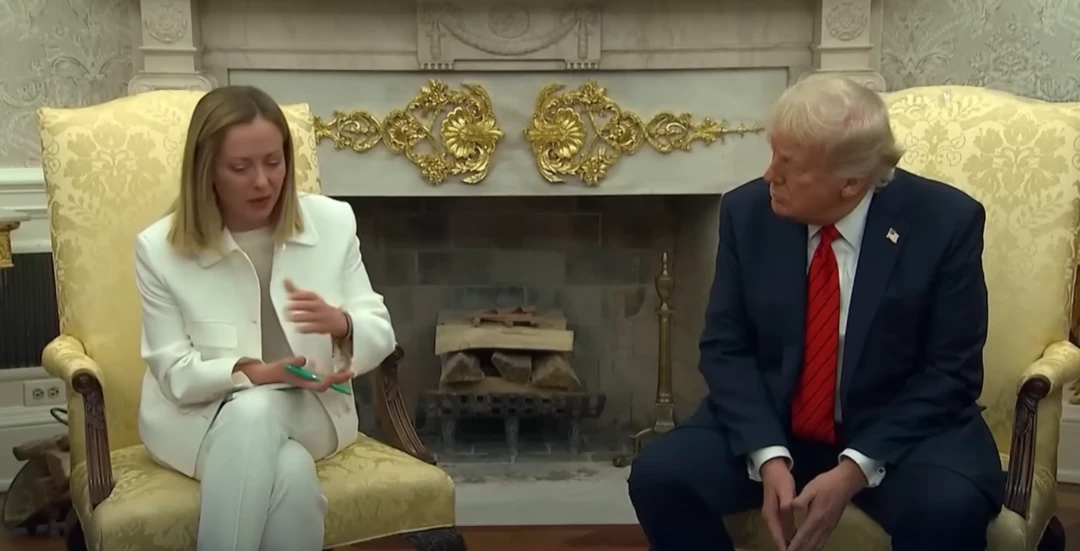
There is a particular shame in watching the leader of the free world pick a public fight with one of America’s closest allies over a photograph that, by all accounts, he himself was eager to take. And yet that is what the United States and the world have spent the last seventy-two hours watching. Speaking to the Italian broadcaster La7, President Donald Trump claimed Italian Prime Minister Giorgia Meloni had “begged” him for a picture at the G7 summit in Évian-les-Bains and that he had agreed only because he “felt sorry for her.” Meloni, who until this spring was perhaps the most reliably pro-Trump head of government in Europe, responded on video the next morning with the kind of clipped fury usually reserved for the dispatch of a foreign rival: “Donald Trump’s statements are completely fabricated. I am frankly stunned.” Italy’s foreign minister canceled his trip to Washington. The president of the United States, undeterred, took to Truth Social on Saturday morning to double down.
What follows is not, properly understood, a story about a quarrel. It is a story about a presidency in visible deterioration — about a man whose impulse control, basic dignity, and grasp of his constitutional responsibilities have so eroded that he is now willing to detonate a strategic relationship that took two administrations to build, in public, for sport, over a snapshot. And it is a story about what the Constitution says we are supposed to do when that happens.
1. What Actually Happened
The provocation was almost too petty to credit. In a phone interview with Italian broadcaster La7 — released only as a dubbed Italian translation, with no original English audio made public — Trump volunteered, unprompted, a strange and demeaning account of his interaction with Meloni at the summit. “She’s probably happy I talked to her. I didn’t have to talk to her,” Trump told the journalist. “She begged me to take a picture with her. She wanted a picture with me so badly. I wouldn’t have taken it, but I felt sorry for her.”
By Friday morning Rome had answered. In a thirty-second video posted to X and Instagram, Meloni — speaking in Italian, with measured contempt — flatly rejected the account. “I don’t know why the President of the United States is behaving this way with his allies; it’s not the first time it happens after all,” she said. “I can only say that I’m sorry he doesn’t have the same determination with the enemies of the West, with the enemies of the United States, with leaderships with which instead he appears to be way more accommodating.” Within hours, Italian Foreign Minister Antonio Tajani — a center-right ally of the prime minister who had been scheduled to meet Secretary of State Marco Rubio the following week — canceled his trip, telling the press that Trump’s “grave and offensive” words “offend the whole of Italy.”
That should have been the end of it. Any president with a functioning communications staff and a residual sense of national interest would have allowed the story to die. Instead, on Saturday morning, the President of the United States returned to Truth Social to demand the last word. “Italian Prime Minister Giorgia Meloni asked, over and over, for a picture with me during the G-7 meeting in France,” he wrote. “She is doing poorly in Italy with her level of popularity, possibly because she turned down the United States of America… Now, after the United States defeated Iran militarily, she wants to be friends again in order to get her ‘numbers up.’ No thanks!!!”
Meloni’s response, on Instagram, was as final as it was withering: “President Trump, these constant, unprovoked attacks are senseless.” Her popularity, she added, did not depend on him. “In any case, my popularity is none of your concern. I suggest you focus on yours.”
“I can only say that I’m sorry he doesn’t have the same determination with the enemies of the West, with the enemies of the United States, with leaderships with which instead he appears to be way more accommodating.”
— Giorgia Meloni, Prime Minister of Italy, June 19, 2026
2. A Friendship Trump Threw Away
To understand the magnitude of what just happened, one must understand who Giorgia Meloni was, until this spring, to this White House. Meloni is the leader of Italy’s far-right Brothers of Italy party. She is a social conservative, a nationalist, and — by ideological inclination — a natural fellow traveler of the MAGA movement. She was the only European Union leader invited to Trump’s second inauguration in January 2025. In April of that year she was received at the Oval Office. As recently as last October, during talks on a Gaza peace deal, Trump publicly described her as a “fantastic leader” and a “beautiful young woman.” She was, in Rome’s own framing, meant to be the bridge between Trumpian Washington and a wary Europe.
That bridge is now in cinders. And it was Trump who lit the match.
The break did not begin at Évian. It began in April, when Trump — frustrated by Pope Leo XIV’s condemnation of U.S. military action in Iran — attacked the pontiff on social media as “WEAK on Crime, and terrible for Foreign Policy.” Meloni, a practicing Catholic governing the country that surrounds the Vatican, called Trump’s attacks “unacceptable.” Trump’s response, delivered to the Italian newspaper Corriere della Sera, was characteristically personal: “I thought she had courage, but I was wrong.” The deeper grievance, however, was strategic. In March, Italy had declined to allow American bombers en route to the Middle East to use a base in Sicily without parliamentary approval — a decision reflecting constitutional constraints and strong domestic opposition to the war. In other words: Italy followed its own law. That, for this president, was unforgivable.
What the petty-photograph story really is, then, is a humiliation campaign against a foreign leader for the offense of having a constitution. Nathalie Tocci of the Johns Hopkins School of Advanced International Studies put it plainly to Newsweek: “It’s now clear to all European leaders, and finally to Meloni too, that having a good political relationship with Trump is impossible.”
3. The Damage to American Standing
Diplomats have a word for what just happened: own-goal. The United States gained nothing. It lost a great deal. Italy is not Belarus. Italy is a G7 economy, a founding NATO member, and — crucially — the host of two of the most strategically important U.S. military installations in the Mediterranean: Naval Air Station Sigonella in Sicily and Aviano Air Base in the north. The country that the President of the United States just publicly mocked is the country whose runways the U.S. Sixth Fleet relies on to project power into the Middle East and North Africa.
The reaction across Italy’s political spectrum tells the story. This was not a partisan scuffle. Justice Minister Carlo Nordio, a member of Meloni’s own coalition, described Trump’s comments as a “painful injury” to U.S.-Italian ties. Defense Minister Guido Crosetto said such “jokes do not benefit anyone.” On the opposition benches, center-left Democratic Party senator Filippo Sensi — a fierce Meloni critic — declared on X: “I have nothing in common with Meloni… But no one can treat Italy this way.” When the opposition rises to defend the government against a foreign attack, the foreign attack has failed.
And Italy is hardly alone. As Newsweek noted this week, even ideological allies — France’s Marine Le Pen and Jordan Bardella, Britain’s Nigel Farage — have publicly distanced themselves from Trump’s foreign policy “imperial ambitions,” with Bardella citing U.S. pressure on Greenland and Venezuela. Germany’s Chancellor Friedrich Merz has been threatened with reduced U.S. troop presence. The transatlantic alliance, which has underwritten Western security for eighty years, is being dismantled tweet by tweet — and the proximate cause this week was a picture.
Italian Foreign Minister Antonio Tajani called off his scheduled meeting with Secretary of State Marco Rubio next week. Read CNN’s reporting on a snub without modern precedent between the two NATO allies.
Italy declined in March to permit U.S. bombers to use the Sicily base for Iran strikes absent parliamentary approval. PBS NewsHour reports the decision reflected constitutional limits and domestic opposition.
Trump heads to Ankara next month for the NATO summit with allies “unsettled” — in the words of European diplomats quoted by Kurdistan24 — by his handling of Ukraine, Iran, and his European partners.
Right-wing European leaders once aligned with Trump — Le Pen, Bardella, Farage — are now openly distancing themselves. Johns Hopkins scholar Nathalie Tocci told Newsweek the political relationship with Trump is now “impossible.”
4. What This Costs the Average American
It is tempting to file all of this under “palace intrigue” — the kind of overseas drama that washes over the average American household without consequence. That would be a mistake. The costs are concrete, and they are already being paid.
Start at the kitchen table. Under the U.S.-EU tariff agreement Trump’s own administration negotiated last summer, imports from the European Union now face a 15% base tariff — a tripling of the prior average rate of 4.8%. That tariff is paid, in the first instance, by American importers and is passed through, in the second instance, to American consumers. Italian wine, prosecco, parmigiano reggiano, olive oil, prosciutto, pasta — staples of the American grocery basket — have all become more expensive. The Italian trade association Coldiretti warned the original 30% rate Trump floated would have inflicted up to €2.3 billion in damage on U.S. consumers alone. The current 15% is “better” only in the sense that a slap is better than a punch. Americans are paying more for groceries — measurably — because of a trade war the president picked with his own allies.
The second cost is security. NATO is not charity. The American bases in Italy exist because they make Americans safer and cheaper to defend. Aviano hosts the 31st Fighter Wing. Sigonella is the staging point for surveillance flights across the Mediterranean and into Africa. When the president of the United States publicly insults the prime minister of the host country — repeatedly, gratuitously, in the language of a middle-school cafeteria — he is making it harder for future Italian governments to justify that hosting arrangement to their voters. The Italian opposition is already arguing, as Senator Sensi did this week, that Italy’s accommodation of Washington has earned it nothing but humiliation. That argument will be made again. And the moment it wins, the U.S. military footprint in the Mediterranean shrinks, and the bill for American security goes up.
The third cost is the one without a dollar figure: the slow conversion of the United States from the leader of an alliance system into a country its allies must manage around. That is the trajectory we are now on. Every adult in the room — in Berlin, in Paris, in Rome, in London — is now openly planning for a world in which the American president is an unreliable narrator at best and a hostile force at worst. The damage to that reputation will outlast this administration. Some of it may be permanent.
Get Involved Today
Contribute to our mission and turn your concerns into action.
5. What This Says About Leadership
Leadership is not the absence of conflict. It is the discipline to choose which conflicts are worth having. A serious head of state, asked by a foreign journalist about a brief encounter with an ally, says something gracious and forgettable. He does not invent a humiliating story. He does not air old grievances. He does not, when the ally rebukes him, pour gasoline on the fire the next morning at sunrise from his phone.
What the country has just witnessed is not strategy. It is impulse. The behavior on display — the petty fabrication, the public sulking, the inability to let an insult pass, the projection of his own collapsing approval onto a foreign leader (“she is doing poorly in Italy with her level of popularity”) — is not the conduct of a commander-in-chief weighing the national interest. It is the conduct of someone whose emotional weather is now the foreign policy of the United States.
It also fits a pattern. In April, the same president threatened on social media to “Open the F—–‘ Strait” and warned Iran of bombing on “Power Plant Day, and Bridge Day, all wrapped up in one.” He has, by his physicians’ own reckoning, engaged in “seemingly compulsive, manic-like late-night communications.” He attacks a pope. He invents a story about a prime minister. There is no longer any serious argument that this is a stable presidency. The only argument left is what the Constitution requires us to do about it.
“We have indisputably entered the realm of profound medical difficulty and concern… When the President of the United States threatens to extinguish a civilization on social media, rants about combat missions with children at the Easter Egg Roll, and drops profane tirades on Easter morning, we have entered the realm of profound medical difficulty and concern.”
— Rep. Jamie Raskin (D-Md.), Ranking Member, House Judiciary Committee, April 10, 2026
6. A Pattern, Not An Incident
Place the Meloni episode on a timeline of the last ten weeks and a portrait emerges that no honest observer can mistake.
This is not a list of unrelated incidents. It is a deterioration curve. And it is now visible to friend and foe alike.
What the Constitution Says — and Why It Was Written for a Moment Like This
The 25th Amendment, ratified in 1967 in the wake of the Kennedy assassination, was drafted to answer a question the Framers had left dangerously unresolved: what does the country do when a sitting president can no longer discharge the duties of the office, and will not admit it?
Section 4 supplies the answer. It authorizes the vice president, together with a majority of the Cabinet — or such other body as Congress may by law provide — to declare in writing that the president is unable to discharge the powers and duties of the office. Upon that declaration, the vice president immediately assumes those powers as Acting President. The president may contest the finding; Congress then resolves the dispute. The amendment’s principal author, the late Sen. Birch Bayh of Indiana, made explicit that “inability” was intended to cover both physical and mental incapacity — including, as Rep. Richard Poff (R-Va.) put it on the floor at the time, cases in which the president “by reason of mental debility, is unable or unwilling to make any rational decision.”
Who Is Already Making the Case
The constitutional argument is not being made by fringe figures. Rep. Jamie Raskin (D-Md.), the ranking Democrat on the House Judiciary Committee and one of the country’s most respected constitutional scholars, has written formally to the White House physician demanding a public cognitive evaluation and has introduced legislation to create the “other body” Section 4 expressly contemplates. Sens. Sheldon Whitehouse and Jack Reed (D-R.I.) have entered into the Congressional Record the joint warning of 36 physicians who concluded Trump must be removed “with the greatest urgency.” Sen. Chris Murphy (D-Conn.) publicly urged Cabinet officers to “spend Easter calling constitutional lawyers about the 25th Amendment.”
The Legal and Constitutional Argument
Section 4 does not require a medical diagnosis. It requires a finding of inability. The question is functional: can this president faithfully execute the office? A president who fabricates humiliating stories about allied heads of state, who detonates strategic relationships for personal pique, who threatens to extinguish entire civilizations on social media at midnight, who cannot let a perceived slight pass without three days of public retaliation — that president is not faithfully executing anything. He is acting out. The amendment was written precisely so that the country would not have to wait for catastrophe to discover what it already knew.
The Practical Barriers — Honestly Assessed
The practical obstacles are real and worth naming. Section 4 requires Vice President JD Vance and a majority of a Cabinet hand-picked for loyalty to initiate proceedings. There is no realistic prospect that this Cabinet will act. The independent-commission route Raskin proposes would require legislation that the current Republican House will not pass. The Senate would not convict on impeachment either. These are the facts.
Why The Barriers Do Not Negate The Case
The objection that the 25th Amendment is “politically impossible” is not a constitutional argument. It is a description of cowardice. Section 4 exists in the Constitution; it is the law of the land; it was written for exactly this. The fact that the men and women constitutionally entrusted with invoking it would prefer to look away does not erase the duty. It magnifies it. The Constitution does not become inoperative because the people responsible for it lose their nerve. The case must be made — clearly, repeatedly, on the record — because a record is what posterity, and the next administration, and the historical conscience of this country, will require.
7. The Priorities of a Presidency
Consider what a functioning American presidency would have spent this week doing. There is a war in Iran in a brittle sixty-day pause. There is an unresolved trade negotiation with the European Union that is costing American consumers real money at the grocery store. There is a NATO summit in Ankara in three weeks. There is an immigration crisis, a housing crisis, an inflation problem that has not gone away, and a Supreme Court that has just thrown the legal status of much of his tariff regime into doubt.
Instead, the President of the United States spent his weekend re-litigating a photograph. That is not a description of priorities. It is a description of a man who no longer has any. The presidency is, among other things, the discipline of choosing what to attend to. A president who cannot perform that triage — who is captured, hour by hour, by whichever grievance is loudest in his own head — is not running the country. The country is running on inertia, on the residual competence of civil servants, on the patience of allies who are visibly running out of it.
That is the deepest indictment of all. Not that this president is rude. Not that he is undignified. Not even that he is wrong about Meloni — though he is. The indictment is that the office is no longer being discharged. And the Constitution has a word for that, and a remedy.
Editorial Conclusion
The President of the United States picked a public fight with the prime minister of a NATO ally over a photograph he himself was eager to take. He invented a story to humiliate her. When she corrected the record, he attacked her again. He has now driven Italy’s foreign minister to cancel a state visit, given the Italian opposition a free political weapon, weakened the American position at next month’s NATO summit, and confirmed for every European capital what they had already begun to suspect — that the word of the American president is no longer a foundation on which a serious country can build.
This is not a diplomatic style. It is a symptom. And the Constitution of the United States, in Section 4 of the 25th Amendment, provides the response. The Vice President and the Cabinet will not act. Congress, as currently constituted, will not act. But the case must be made, in public, with every incident, until the country can no longer pretend not to see it. The stakes are not partisan. They are the integrity of the office itself, and the safety of the alliances on which American power rests.
America has had enough. The remedy is in the document. Use it.
Sources & References
- NPRA rift widens between Trump and Italy’s Giorgia Meloni
- CNNTrump doubles down on feud with Italian PM Meloni
- ABC NewsTrump, Italian PM Giorgia Meloni feud online over G7 photo
- PBS NewsHourTrump deepens the dustup with Italy’s Meloni
- Al JazeeraTrump insists Italy’s Meloni sought photos with him to boost popularity
- EuronewsTrump and Meloni continue to trade jabs after G7 meeting
- The Daily BeastItalian PM Meloni humiliates Trump with brutal slapdown
- NewsweekTrump vs. Meloni ‘popularity’: What polls actually show
- NewsweekMeloni isn’t alone: The right-wing European leaders Trump has angered
- Kurdistan24Trump deepens feud with Italy’s Meloni, linking rift to Iran War and NATO disputes
- Fox NewsTrump says Meloni ‘wants to be friends again’ after Italy refused to help during Iran war
- House Judiciary DemocratsRaskin demands cognitive evaluation, calls to invoke 25th Amendment
- AxiosRaskin demands Trump cognitive test in 25th Amendment push
- The HillConcerns grow over Trump’s mental fitness for the presidency
- PBS NewsHourCould the 25th Amendment be invoked against Trump? How it works
- Italian Food NewsTariffs: US and EU agree on 15% deal
- Grassi AdvisorsU.S. reciprocal tariffs take effect: The impact on Italian companies
- EuronewsItaly calls for restraint as EU puts US tariff deal on ice
Related News