The New Delhi Declaration: How Donald Trump Handed the World to Beijing, Moscow, and New Delhi
A summit that once might have been a curiosity is now the front page of the twenty-first century. As BRICS closed ranks in India this weekend, the American president was busy proving Xi Jinping’s argument for him.
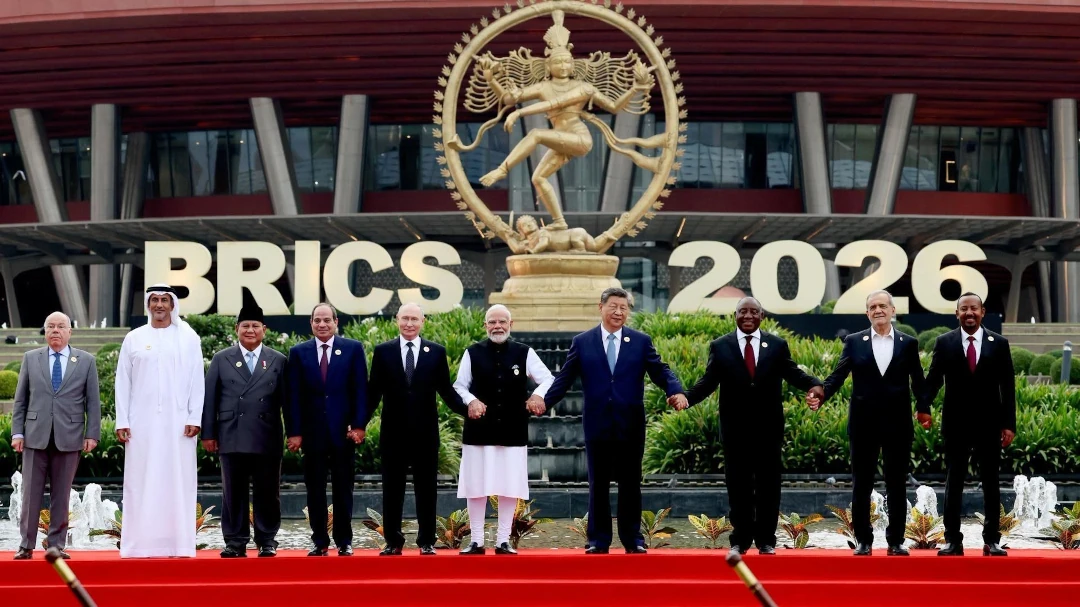
On Saturday morning in New Delhi, under the vaulted ceilings of the Bharat Mandapam convention center, Prime Minister Narendra Modi delivered a single sentence that reordered the political map of the world. “No member has raised any objection. The New Delhi Declaration 2026 is adopted unanimously,” he announced, closing weeks of tense negotiation and opening a new era. Eleven emerging economies — Brazil, China, Egypt, Ethiopia, India, Indonesia, Iran, Russia, Saudi Arabia, South Africa, and the United Arab Emirates — had signed a joint statement expressing “serious concerns” about the rise of unilateral tariffs, calling for the peaceful resolution of international disputes, and, most crucially, for a multilateral world order no longer written by Washington.
The absence in that room mattered more than any presence in it. No American delegation. No European delegation. No G7. The world’s two most populous nations, and the country holding the largest energy reserves on Earth, were setting the agenda without the United States even at the table. And they were doing it not because they had schemed to sideline America, but because America — under Donald Trump — had walked itself out of the room.
I. A Summit That Redraws the Map
By any measure, the 18th BRICS Summit is the most consequential gathering of non-Western powers in a generation. According to the IMF’s April 2026 World Economic Outlook, the bloc now accounts for 41 percent of global GDP compared with 28 percent for the G7, and its combined population approaches 3.9 billion — nearly half of humanity. Add the ten partner countries that traveled to New Delhi and BRICS’s footprint expands to a 21-country family representing 56 percent of the world’s people and 44 percent of the global economy at purchasing power parity. This is not a subcommittee of the international order. This is the international order’s new majority shareholder.
Share of World Population
Combined BRICS-11 population share in 2026, roughly 3.9 billion people. Business Today
10-Year Treasury Yield
September 11, 2026 close — the highest level since November 2023, driven by oil and inflation. CNBC
Brent Crude
Per barrel, settled September 9, 2026 as the Iran war blockades Persian Gulf tankers. CNBC
The Declaration itself is a document Trump-era Washington would not have written and could not have signed. It reaffirms a commitment to “mutual respect and understanding, sovereign equality, solidarity, democracy, openness, inclusiveness, collaboration and consensus.” It calls for reform of the United Nations, the IMF, and the World Bank to give the Global South a genuine voice. It expresses concern about a global trading system distorted by unilateral tariffs “inconsistent with WTO rules” — a paragraph so obviously aimed at the United States it might as well have carried a footnote. And it endorses ongoing work on a gold-backed BRICS Unit token and an expanded BRICS Pay network, quietly building the infrastructure of a post-dollar world one central-bank pipeline at a time.
II. Xi’s Speech and the Line Trump Cannot Cross
The moral center of the summit came in Chinese President Xi Jinping’s address to Session I on Saturday. Speaking on the 20th anniversary of BRICS cooperation, Xi warned that “unilateralism and power politics were gaining momentum, placing multilateralism and the existing international order under pressure and widening deficits in peace, development, security and governance.” Then came the line that will be quoted in diplomatic cables for years. BRICS, he said, must “firmly stand on the right side of history” and become “a pioneer of our times” in advancing innovation, upholding peace and stability, and reforming global governance.
“BRICS must firmly stand on the right side of history and strive to be a pioneer of our times.”
— Xi Jinping, 18th BRICS Summit, New Delhi, Sept. 12, 2026
Let there be no mistake about what Xi is doing here. He is not speaking to his own delegation. He is speaking over the heads of the eleven governments in that hall to a global audience of developing nations, telling them there is now another door to knock on — one that does not come with Truth Social threats attached. He is speaking to Brussels, to Ottawa, to London, and to Tokyo, letting them know that the “rules-based international order” they have publicly grieved since January 2025 is available for reformation, and China is holding the pen. And he is speaking, most pointedly, to the American president. “The right side of history” is a phrase Trump has spent nine months putting on the wrong side of, tariff by tariff, threat by threat, alliance by alliance.
III. The Bloc Trump Built
Here is the bitter irony no White House talking point can spin away: the BRICS coalition that convened this weekend is, in significant part, a product of Donald Trump’s own foreign policy. India did not travel to Tianjin last year, and did not stand shoulder-to-shoulder with Xi in New Delhi this weekend, because Prime Minister Modi has suddenly discovered a philosophical affinity for the Chinese Communist Party. India did those things because Trump imposed sweeping tariffs on Indian goods, then doubled them to 50 percent to punish New Delhi for continuing to buy Russian oil.
Even John Bolton — Trump’s former National Security Advisor, no leftist, no critic of American power — said the quiet part out loud: “The White House has set US-India relations back decades, pushing Modi closer to Russia and China. Beijing has cast itself as an alternative to the US and Donald Trump.” Carnegie’s Evan Feigenbaum, one of the most respected South Asia hands in Washington, was blunter still. “The premises and assumptions of the last 25 years — that everybody worked very hard to build, including the president in his first term — have just come completely unraveled,” he told Fox News last summer. “The trust is gone.”
Get Involved Today
Contribute to our mission and turn your concerns into action.
This is a self-inflicted wound of historic proportions. For a quarter century, presidents of both parties — Bush, Obama, Biden, and even the first-term Trump — invested American diplomatic capital in prying India loose from its Cold War closeness with Moscow and building a strategic partnership designed to counterbalance Beijing. It was, arguably, the single most durable bipartisan foreign policy achievement of the post-9/11 era. In under a year, Trump managed to unwind it. Not through negotiation. Not through strategy. Through tariff tantrums broadcast on Truth Social.
IV. The Dollar, the Debt, and the Kitchen Table
None of this would matter much on Main Street if it were merely a matter of diplomatic hurt feelings. But it is not. The consequences are landing this week — literally this week — in the yields on the ten-year Treasury note, in the price of gasoline at the pump, and in the mortgage rates confronting anyone trying to buy a home.
On Thursday, the ten-year U.S. Treasury yield closed at 4.9 percent, its highest level since November 2023. By Friday it had touched 4.98 percent. The 30-year bond crossed 5.35 percent. These are not abstract numbers. They are the interest rate on America’s credit card. Every basis point represents billions of dollars in additional debt service that will crowd out every other priority — Medicare, Social Security, infrastructure, defense, disaster relief — for the next generation of Americans. When foreign central banks stop treating U.S. Treasuries as the world’s safest asset — and Tokyo is already selling them to defend the yen — those interest rates go one direction: up.
Meanwhile, oil is above $100 a barrel and has been for weeks. Brent settled at $101.21 on September 9. West Texas Intermediate is at $96. Why? Because Trump’s Iran war has blockaded Persian Gulf tankers and forced major economies to refill inventories at panicked prices. The producer price index rose again in August. Analysts now price in a 71 percent chance that the Federal Reserve will raise rates further next week — the last thing an American middle class already crushed by tariffs on imported groceries, appliances, and electronics needs to hear.
“The White House has set US-India relations back decades, pushing Modi closer to Russia and China. Beijing has cast itself as an alternative to the US and Donald Trump.”
— John Bolton, former U.S. National Security Advisor
And in the background, BRICS is quietly building the alternative. Russia and China now settle roughly 90 percent of their bilateral trade in rubles and yuan. The BRICS Pay network is being wired into China’s CIPS system, Russia’s SPFS, India’s UPI, and the mBridge central-bank digital currency platform. The gold-backed BRICS Unit pilot launched under India’s presidency is a concrete step, not a talking point. The dollar’s status as the world’s reserve currency has been the single greatest economic gift of the twentieth century to the American middle class — it is why we can borrow so cheaply, why our imports are so cheap, why our credit cards work everywhere. Trump is spending it down for a Truth Social applause line.
V. The Allies He Kicked, the Enemies He Fed
Compare this weekend’s BRICS solidarity to the state of America’s actual alliance system. In April, Trump publicly called NATO a “paper tiger” and told reporters he was considering withdrawal. A congressional report prepared for the July NATO summit in Ankara catalogued the damage: allied governments questioning U.S. reliability, planned troop reductions in Europe, Trump’s fixation on annexing Greenland from Denmark, and public feuding over Iran policy in which France denied overflight rights to Israeli aircraft carrying U.S. munitions.
Stefano Stefanini, the former Italian ambassador to NATO, put the transatlantic reality plainly: “He doesn’t need to leave NATO to undermine it; by just saying he might, he has already eroded its credibility as an effective alliance.” A Lawfare analysis this year put it even more starkly, warning that allies now view “U.S. political volatility as a structural condition, not a one-off aberration” and are planning accordingly. When Governor Gavin Newsom traveled to the Munich Security Conference in February to reassure European partners that “Donald Trump is temporary,” Europe smiled politely. It also kept building its independent defense industrial base.
This is the shape of the world Trump inherited and is currently detonating: an American alliance system that took eight decades and unfathomable American blood and treasure to construct, being traded for the fleeting satisfaction of humiliating a Canadian prime minister or a Danish foreign minister on a live feed. The G7 met earlier this year as a collection of hostage-negotiators, not partners. BRICS met this weekend as a coalition of the confident. That is not an accident. That is a choice — his choice — and it is a choice Americans will pay for well after Trump is dead and buried.
What the Constitution Says About a President Who Cannot Steer Straight
Section 4 of the Twenty-Fifth Amendment provides that whenever the vice president and a majority of the Cabinet transmit to Congress a written declaration that the president “is unable to discharge the powers and duties of his office,” those powers pass immediately to the vice president as acting president. It is not an impeachment. It is not a criminal proceeding. It is a constitutional emergency brake, designed by the framers of the 1965 amendment for exactly the kind of moment American allies are quietly whispering about in cables from Ankara to New Delhi: a president whose judgment has become a national-security liability.
In April, after Trump posted that “a whole civilization will die tonight” in a threat aimed at Iran, more than 85 members of Congress publicly called for either impeachment or invocation of the 25th Amendment. Rep. Mike Quigley of Illinois called it “unfit for the office of the President.” Rep. Raja Krishnamoorthi pointed to “a dangerous pattern of reckless escalation, erratic decision-making, and general conduct that raises grave questions about his fitness.” Sen. Chris Murphy of Connecticut told his colleagues in the Cabinet, “If I were in Trump’s Cabinet, I would spend Easter calling constitutional lawyers about the 25th Amendment.” Rep. Yassamin Ansari of Arizona did not hedge: “The President of the United States is a deranged lunatic, and a national security threat to our country and the rest of the world.”
The constitutional argument is not narrowly about a single tweet or a single tariff. It is about a cumulative record — public threats of genocide, texts to allied heads of state grievance-tied to Nobel Prize snubs, threats to annex the territory of a NATO member, and now a pattern of foreign-policy conduct that has driven the largest democracy on Earth into the arms of two authoritarian rivals in less than nine months — that together establishes an inability to discharge the powers of the office responsibly. The framers of the 25th Amendment used the word “unable” advisedly. It is broader than “medically incapacitated.” It reaches conduct that renders execution of the office impossible without catastrophic damage to the country.
The practical barriers are real and should not be minimized. Section 4 requires Vice President JD Vance and a majority of Trump’s own Cabinet — every one of them a personal loyalist — to act. As CNN’s analysis noted in April, there are no current indications the Cabinet is considering it or that Vance would sign on. If Trump contested the removal, both chambers of Congress would need a two-thirds vote to sustain it. That is a bar the Republican-controlled Congress will not clear. This is not a mechanism that will remove Trump this year.
But the political impossibility does not negate the constitutional case, and here is why it matters. The 25th Amendment exists in our founding law to name a category — the category of a president who has become a danger to the republic he was sworn to defend. Naming that category matters. It matters that members of Congress in both chambers have gone on the record. It matters that the country’s foreign-policy establishment is on the record. It matters that when historians look back at how the American century ended — how Washington willingly traded its alliance system, its currency dominance, and its moral standing for one man’s grievance politics — the record will show that the constitutional alarm was sounded, again and again, and a Cabinet of enablers chose to look away.
VI. What Comes Next
The New Delhi Declaration will not, by itself, dethrone the dollar tomorrow. India’s foreign minister S. Jaishankar has been careful to reaffirm that “the dollar as the reserve currency is the source of global economic stability.” There are real fractures inside BRICS — between Iran and the UAE, between India and China, between Brazil’s Lula and Putin. Consensus was hard-won and remains fragile. Analysts at Seeking Alpha and the American Action Forum are right to note that reserve-currency status has survived past challenges and that dollar dominance still commands roughly 58 percent of global reserves.
But the direction of the arrow is now unmistakable. When roughly half of humanity signs a document declaring the current system unfit for purpose, that document does not vanish because the American president posts an angry meme. It becomes the starting point of every future summit, every future trade deal, every future central-bank conversation. China will assume the BRICS chair from India in 2027. The next declaration will be more assertive, not less. And by the time a future American administration attempts to rebuild the credibility Trump has burned, the world will have moved on.
Americans, meanwhile, will pay for this at the pump, at the grocery store, at the mortgage broker’s desk, and in the interest we owe on the national debt to bondholders who no longer trust us. That is not partisan spin. That is Treasury yields at 4.98 percent, oil at $101, and a BRICS payment system rerouting itself around the SWIFT network in real time.
Editorial Conclusion
The New Delhi Declaration will be studied for decades as the moment the American century ended not with a battle lost, but with a president who did not understand that alliances, credibility, and the reserve currency are earned across generations and can be squandered in a single tantrum.
What Xi Jinping did in New Delhi this weekend, Donald Trump did to himself. And what Trump has done to America, no election in 2028 and no future administration can fully undo. The Constitution provided the tools to protect the country from precisely this kind of leadership. The tragedy is not that those tools exist unused. The tragedy is that a Cabinet, a Congress, and a party have chosen the man over the republic.
That choice is a betrayal of the oath. And history — the real kind, not the Truth Social kind — will name it as such.
Sources & References
- ANI News — BRICS Summit unanimously adopts New Delhi Declaration, stresses need to engage in conflict prevention (Sept. 12, 2026)
- Organiser — New Delhi Declaration Unanimously Adopted; PM Modi Pitches Regional Peace, Global South Prosperity
- Xinhua — Xi urges BRICS to stand on right side of history, play pioneering role
- Pakistan Today — BRICS must lead Global South towards fairer world order: Xi
- Global Times — New Delhi Summit provides clear guidance for higher-quality greater BRICS co-op
- Eastern Herald — BRICS Nations Launch Dollar-Alternative Payment Network as Trump Threatens 100% Tariffs
- The Tribune — BRICS 2026: PM Modi, Xi hold bilateral talks; back “fair, reasonable” boundary settlement
- Business Today — BRICS countries have a huge share of the world’s population — how big the bloc really is
- The World Data — BRICS 2026 Statistics — BRICS Nations & Key Facts
- NBC News — Trump threatens a 100% tariff on BRICS countries if they abandon U.S. dollar
- American Action Forum — Breaking Down the BRICS Tariff
- Watcher.Guru — BRICS De-Dollarization in 2026: Turning Point for Global Dollar Use
- Fox News — Trump tariffs push India closer to America’s strategic rivals China and Russia
- TIME — China’s Xi Hosts Modi and Putin Amid Anger at Trump Tariffs
- News on Air — Former US NSA John Bolton Criticizes Trump for Pushing PM Modi Closer to Russia and China
- CNBC — 10-year Treasury yield touches highest since 2023 despite Bessent’s $6 billion buyback plan
- Trading Economics — US 10 Year Treasury Note Yield — Current Data (Sept. 11, 2026)
- Congressional Research Service — NATO: Issues for the July 2026 Ankara Summit
- Al Jazeera — “Closer to a break than ever”: Can NATO survive if Trump pulls the US out?
- Lawfare — The Transatlantic Relationship You Knew Is Gone
- TIME — What to Know About the 25th Amendment as Lawmakers Call for Trump’s Removal
- Axios — Trump 25th Amendment chatter erupts among Dems over Iran post
- CNN — Analysis: An eclectic, bipartisan group suddenly calls for removing Trump using the 25th Amendment
- Rep. Mike Quigley — Quigley Calls for Trump’s Removal Under 25th Amendment (Apr. 7, 2026)
- Rep. Raja Krishnamoorthi — Krishnamoorthi Calls for President Trump’s Removal Under 25th Amendment
Related News