Rubble and Real Estate: The Beachfront Genocide Being Sold as Peace
Eighty-two percent of Gaza’s buildings are damaged or destroyed. Twenty-one thousand children are dead. And a president who calls the war criminal running the operation his “best friend” is now assembling investors to build luxury towers on the graveyard. This is not policy. It is procurement.
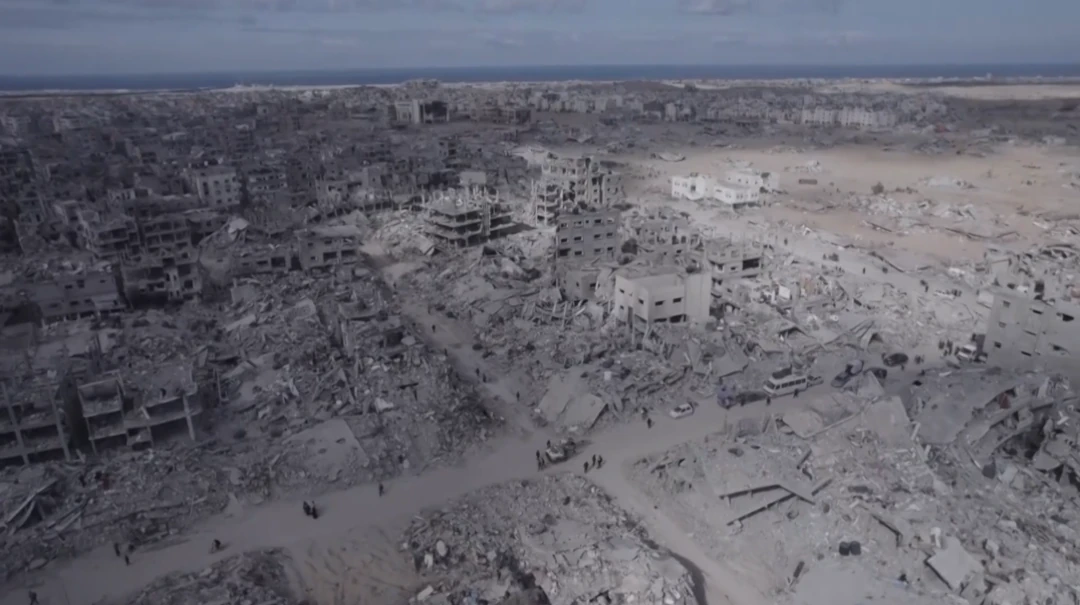
The numbers no longer register as numbers. According to the United Nations Satellite Centre and UNRWA, roughly 82 percent of the structures in Gaza — about 200,000 buildings — are damaged, with two thirds of them destroyed. Sixty-eight million tonnes of rubble now cover the strip, a quantity the UN estimates would take more than 140 years to clear at current pace. Life expectancy for the surviving population has collapsed to forty. Human development in Gaza has been set back seventy-seven years.
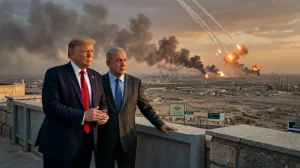
Into this graveyard, the President of the United States and his son-in-law have introduced a new word: investment. Not accountability. Not reconstruction rooted in return. Investment. The Trump-chaired Board of Peace, launched in January and formally endorsed by UN Security Council Resolution 2803, has spent the last eight months converting a ceasefire won at the price of two hundred thousand pulverized buildings into a real estate prospectus. Its executive committee — Trump, Kushner, envoy Steve Witkoff, Apollo Global Management CEO Marc Rowan, and a handful of former officials — is now selling permanent Board seats to sovereign wealth funds for one billion dollars apiece, a fee first reported by Bloomberg.
What has been lost in the transaction — deliberately, methodically, at gunpoint against reporters — is any sustained American view of the people whose homes and children the towers will be built upon. That is the story this Editorial Board wishes to report.
I. The Rubble Field
In August 2026, the UN Satellite Centre confirmed that even after the October 2025 ceasefire, the destruction of buildings in Gaza had continued to rise by nearly ten percent. Ceasefires, it turns out, are not the same as ending a war. Gaza City Mayor Yahya al-Sarraj told Al Jazeera that his city has lost “about 85 to 90 percent of our resources, our buildings and our infrastructure. We feel in many cases paralysed.”
The Gaza Ministry of Health, whose figures have been repeatedly validated by independent researchers — including a peer-reviewed study published in early 2026 — puts the confirmed death toll at more than 72,000 Palestinians. An Israeli army official, speaking to reporters in Israel in January 2026, accepted a figure of roughly 70,000. Approximately 9,500 more remain missing under the rubble. Independent modeling published in eClinicalMedicine logged 116,020 cumulative complex injuries. In the same period, according to the Gaza Media Office, Israel dropped roughly 223,000 tonnes of explosives on an enclave the size of Philadelphia — sixteen times the yield of the atomic bomb dropped on Hiroshima.
Whole villages have been erased. Not damaged — erased. UN and satellite analyses have documented the systematic leveling of Beit Hanoun, Jabalia, Khuza’a, Al-Bureij, and Rafah’s eastern quarters. Ancient neighborhoods, olive groves cultivated for a thousand years, universities, hospitals, bakeries, mosques, churches: all pulverized. The Gaza that existed before October 2023 no longer exists as a physical place. That is the precondition Kushner’s slide deck at Davos required.
II. A Manufactured Silence
You have not seen this on your evening news at anything approaching the scale of the thing itself. That is not accidental. It is engineered.
Since October 7, 2023, at least 262 journalists have been killed in Gaza — the highest toll recorded against media workers in any modern conflict. The Committee to Protect Journalists, Reporters Without Borders and the Palestinian Journalists Syndicate document that this exceeds the combined death toll of the two World Wars, Vietnam, the former Yugoslavia and Afghanistan for reporters. According to the Syndicate, Israel has additionally killed more than 700 family members of Palestinian journalists — collective punishment aimed at silencing coverage.
Foreign reporters have been categorically banned from independent entry into Gaza since the war began. On January 4, 2026, the Israeli government formally told its own Supreme Court that it will uphold the ban on foreign media entry, citing “security risks.” Reporters Without Borders filed an amicus brief calling this “an unprecedented violation of press freedom and the public’s right to reliable, independent, and pluralistic media reporting.” On September 1, 2025, more than 250 media organizations across the globe blacked out their front pages in solidarity with the murdered Gaza press corps. Most Americans never heard about it.
The result is a coverage vacuum that American cable networks have obligingly filled with the language their sources give them — “operations,” “targets,” “collateral damage” — and with the anodyne visuals of press conferences in Washington rather than the reality of what U.S.-manufactured 2,000-pound bombs do to the body of a two-year-old.
“Let us be clear about what this means. These children were not killed in a war zone. They were killed in their homes. In their schools. Playing football. Fishing.”
— James Elder, UNICEF Spokesperson, June 19, 2026
III. The Children
The most conservative accounting we have is UNICEF’s. As of a February 2026 update, the agency reports that at least 21,289 children have been killed and 44,500 injured in Gaza since October 2023. Save the Children puts the pre-ceasefire figure at over 20,000 — more than one child killed every hour on average for twenty-three months. Of those slain, at least 1,009 were under the age of one. Nearly half of those infants were both born and killed during the war.
The ceasefire has not stopped the killing of children. UNICEF’s Regional Director for the Middle East and North Africa, Edouard Beigbeder, said in August 2026 that “a ceasefire that leaves an average of one child dead each and every day is failing children.” A June 2026 UN Human Rights Council commission report described the scale of children killed and injured in Gaza as “unparalleled across contemporary armed conflicts,” documenting patterns of child detention, torture, and sexual violence by Israeli forces.
These are the children on top of whom Marc Rowan proposes to build hotels.
Get Involved Today
Contribute to our mission and turn your concerns into action.
IV. The Board of Peace, and the Real Estate Beneath It
The Board of Peace was folded into point nine of Trump’s twenty-point Gaza plan and blessed by the UN Security Council in November 2025 by a 13-0 vote, with Russia and China abstaining. Its charter, curiously, does not mention Gaza. Its Executive Committee — Trump as chairman, Kushner, Witkoff, Rubio, Deputy National Security Adviser Robert Gabriel, World Bank president Ajay Banga, former UK Prime Minister Tony Blair, and Apollo’s Marc Rowan — has been given portfolios covering “governance, regional cooperation, reconstruction, investment, funding, and long-term stability.” The Palestinian Authority has no seat. Palestinians in Gaza were not consulted.
At Davos, Kushner presented AI-generated renderings of glass towers along a re-engineered coastline. He appealed directly to private capital: “I know it’s a little risky to be investing in a place like this, but we need you to come, take faith, invest in the people.” Marc Rowan, on the same platform, described Gaza’s beachfront as “worth $50 billion,” and framed the challenge as transforming Gaza from a “destruction zone” into an “investment center.” The tell in that sentence is that the transformation from one to the other happened by American ordnance.
The Carnegie Endowment’s analysis of the Board’s funding architecture is worth quoting at length by its argument, not its words: the Board’s parallel reconstruction fund deliberately bypasses the existing World Bank multi-donor mechanisms that require Palestinian Authority sign-off and that treat Gaza and the West Bank as a single territorial unit. The Board of Peace treats “New Gaza” as a stand-alone commercial venture, severed from the West Bank, unaccountable to Palestinian governance, and answerable primarily to its investors. Whatever the intent, the effect is annexation-by-master-plan.
V. The Evidence, in Numbers
Confirmed Palestinian Dead
Killed in Gaza since October 7, 2023, per the Gaza Ministry of Health as reported by UN OCHA. Israel’s army has independently accepted the figure of roughly 70,000. UNRWA Sitrep #210.
Children Killed
Palestinian children reported killed by February 2026, including 1,009 infants under one year old. 44,500 more children injured. UNICEF State of Palestine.
Journalists Killed
The highest toll against reporters in any modern conflict. Foreign press are barred entry. Israel has killed 700+ family members of Palestinian journalists. Euro-Med Monitor.
U.S. Military Aid Since Oct. 2023
Direct U.S. military assistance to Israel through September 2025, per the Quincy Institute and Brown University’s Costs of War. Tens of billions more in future arms sales already committed. Quincy Institute report.
Buildings Damaged
Roughly 200,000 structures in Gaza damaged; two thirds destroyed. Sixty-eight million tonnes of rubble; UN estimates 140+ years to clear at current pace. UN News, Aug. 2026.
Board of Peace U.S. Pledge
U.S. taxpayer contribution announced by Trump on Feb. 19, 2026. Permanent Board membership costs $1 billion per seat. Kushner’s “master plan” projects a $25–$50 billion buildout. Spectrum News.
VI. The Man Trump Calls “Best Friend”
On November 21, 2024, the International Criminal Court unanimously issued arrest warrants for Prime Minister Benjamin Netanyahu and former Defense Minister Yoav Gallant. The charges — reviewed and confirmed by the Court’s Pre-Trial Chamber I after Israel’s jurisdictional appeals were rejected — are grave: the war crime of starvation as a method of warfare, and the crimes against humanity of murder, persecution, and other inhumane acts. The chamber found reasonable grounds to believe Netanyahu and Gallant “intentionally deprived the civilian population of Gaza of essential goods such as food, water, medical supplies, fuel, and electricity.”
Separately, South Africa’s genocide case against Israel proceeds at the International Court of Justice. Three sets of binding provisional measures have already been imposed on Israel. Amnesty International, in a September 2026 statement, concluded that Israeli authorities have “continued to commit genocide against Palestinians in Gaza, even after the so-called ceasefire of October 2025.”
President Trump’s response to this record has been to promote the accused. In February 2025, Trump rescinded National Security Memorandum 20, which had required the executive to report to Congress on whether U.S. weapons were being used in accordance with international humanitarian law. Secretary of State Marco Rubio then signed a March 2025 declaration to fast-track roughly $4 billion in additional weapons transfers. Netanyahu, on Fox News, has repeatedly called Trump “the greatest friend that Israel has ever had in the White House.” Trump has returned the sentiment publicly and often.
A president who calls an indicted war-crimes suspect his best friend, funds the operation with American treasure, protects him diplomatically at the UN, and then attempts to develop the crime scene is not conducting foreign policy. He is conducting laundering.
VII. What This Costs Americans
The financial ledger alone is grotesque. William Hartung’s authoritative accounting for the Quincy Institute and Brown University’s Costs of War Project puts direct U.S. military aid to Israel at $21.7 billion between October 2023 and September 2025, with tens of billions more in future arms sales already committed. Add the $10 billion Board of Peace pledge and the ancillary $9.65 billion the U.S. has spent on related regional military operations. The Council on Foreign Relations places direct legislated aid to Israel since October 2023 at at least $16.3 billion across three appropriations. Every American household is paying for this bombardment whether they consented to it or not.
In the same period, the Trump administration and its congressional allies have imposed the deepest cuts to the domestic safety net in modern history. The “One Big Beautiful Bill Act” signed on July 4, 2025 slashed SNAP food assistance by roughly $300 billion and Medicaid by roughly $700 billion. As of May 2026, CNBC reports that more than 3.5 million SNAP beneficiaries have already lost food assistance. The Center for American Progress documents that Trump’s April 2026 budget request cuts nondefense discretionary funding as a share of GDP to its lowest level since Eisenhower, while calling for the largest annual military increase outside of a ground war. WIC benefits for young children would be cut from $27 to $10 per month.
The transaction is legible. Bombs for Netanyahu, condos for Kushner, and empty pantries for a WIC family in Toledo. This is the priority structure. The president has told us with his budget.
VIII. The Democratic Resistance
Something has cracked in the old Washington consensus. On July 15, 2026, on an amendment offered by Rep. Thomas Massie (R-KY) to strip $3.3 billion in annual military assistance from Israel, a record 103 House Democrats voted yes — nearly a majority of the caucus. The Democratic leader in the House, Hakeem Jeffries, voted no, but the number-two Democrat crossed him. Even accounting for the amendment’s flaws — it also stripped humanitarian funding, which several Democrats cited as their reason for a difficult yes — the number is a political earthquake. PBS’s Lisa Desjardins called it exposing “a boiling divide” in the party.
The Senate has moved more slowly, but not by much. Senator Chris Van Hollen has for two years led the push to condition military aid on compliance with U.S. and international humanitarian law. Senators Bernie Sanders, Jeff Merkley, Peter Welch, Elizabeth Warren and Ed Markey have repeatedly signed on. Progressive House members including Rashida Tlaib, Alexandria Ocasio-Cortez, Ilhan Omar, Ayanna Pressley, Pramila Jayapal and Betty McCollum have introduced or co-sponsored legislation restricting weapons transfers, blocking specific bomb sales, and imposing conditions on aid tied to the detention of Palestinian children. None of these bills has become law. All of them are the record from which future accountability will be built.
Beyond Gaza specifically, House Judiciary Committee ranking member Jamie Raskin’s 25th Amendment commission bill — introduced April 14, 2026 with 50 Democratic co-sponsors — represents something more structural. It responds to a pattern of behavior, of which the president’s Gaza policy is merely the most catastrophic instance.
The 25th Amendment: What It Was Written For, and What It Now Confronts
Ratified in 1967 after the Kennedy assassination, the 25th Amendment codifies presidential succession and — in Section 4 — provides a mechanism for the Vice President together with a majority of the Cabinet, or “such other body as Congress may by law provide,” to declare the President “unable to discharge the powers and duties of his office.” Upon such declaration, the Vice President immediately assumes those powers. The President may contest; if a two-thirds vote of both houses of Congress sustains the declaration, the Vice President remains in charge.
On April 14, 2026, Rep. Jamie Raskin (D-MD) introduced legislation with 50 Democratic co-sponsors to establish a 17-member Commission on Presidential Capacity — precisely the “other body” Section 4 contemplates. Raskin’s stated argument: “We are at a dangerous precipice, and it is now a matter of national security for Congress to fulfill its responsibilities under the 25th Amendment to protect the American people from an increasingly volatile and unstable situation.” In the days preceding, more than 85 House and Senate Democrats — including Reps. Rashida Tlaib, Robert Garcia, Melanie Stansbury, Eric Swalwell, Sydney Kamlager-Dove, Yassamin Ansari and Sen. Sheldon Whitehouse — publicly called for either impeachment or 25th Amendment removal. Sen. Ed Markey had raised the same call in January 2026 over the Greenland episode.
The Constitutional Argument
Framed narrowly, the argument for a Section 4 commission is not that policy toward Gaza is wrong — many bad policies are lawful — but that the pattern of conduct evidences a functional incapacity to discharge the office. That pattern includes: publicly promising to develop as luxury real estate territory whose population his own military aid has helped kill; describing an ICC-indicted war-crimes suspect as his “best friend”; social media threats to destroy “whole civilizations”; texting a foreign head of government that a policy toward Greenland stemmed from a personal Nobel Prize grievance; the wholesale substitution of family business interest for national interest at the Board of Peace. This is not disagreement. This is derangement of the fiduciary role of the presidency.
The Practical Barriers, Honestly Named
We owe our readers no illusions. Section 4 removal requires either Vice President JD Vance and a majority of Trump’s own Cabinet — none of whom show any sign of breaking — or a Raskin-style commission enacted into law over Trump’s certain veto, which cannot pass a Republican-controlled Congress. Even if the trigger were pulled, sustaining the declaration requires two-thirds of both chambers. The 25th Amendment was written for the president who suffers a stroke, not the president who is the stroke. Its authors did not, and perhaps could not, envision a Cabinet composed entirely of loyalists selected specifically to prevent its invocation.
Why the Barriers Do Not Void the Case
None of that is an argument against making the case. The record of who called for what, and when, is how democracies preserve the possibility of accountability for a later day. When a president brands a war-crimes indictee his best friend and then attempts to develop the crime scene, silence from the legislature is not prudence — it is complicity. Raskin’s bill, the Massie amendment vote, Van Hollen’s conditions, the McCollum children’s-detention bill: these are the constitutional record on which future prosecutions, historical judgments, and — in a functioning Republic — future elections must rely. The 25th Amendment was written to make sure the machinery of accountability existed. Whether it functions depends on whether those sworn to uphold it choose to use it.
Editorial Conclusion
Eighty-two percent of Gaza is rubble. Twenty-one thousand children are dead. Two hundred and sixty-two journalists have been killed to keep you from seeing it. The president of the United States has armed the man the International Criminal Court has charged with those crimes, called him his best friend, and is now assembling billion-dollar sovereign wealth investors to build hotels on the graves.
This is not a policy dispute. It is a moral emergency and a constitutional one. A president who cannot distinguish beachfront property from a mass grave has demonstrated an incapacity to discharge the office he holds. Congress has both the mechanism and the duty to say so. The names of those who use it, and those who do not, will be remembered — by history, and by the survivors.
Sources & References
- UN News — “Gaza: Destruction of buildings rises by nearly 10 per cent since ceasefire” (August 2026).
- Al Jazeera — “Gaza war’s 1,000 days: 90% of strip destroyed” (July 2, 2026).
- UNRWA — UNRWA Situation Report #210 (February 2026).
- UNICEF — Humanitarian Situation Update, State of Palestine (February 2026).
- UNICEF USA — “More Than 64,000 Children Killed or Injured in Gaza Since October 2023” (Aug. 6, 2026).
- Save the Children — “Gaza: 20,000 Children Killed in 23 Months of War” (Sept. 6, 2025).
- The Conversation — “UN report details ‘overwhelming’ scale of children killed in Gaza” (June 29, 2026).
- International Criminal Court — Pre-Trial Chamber I decision, arrest warrants for Netanyahu & Gallant (Nov. 21, 2024).
- Amnesty International — “South Africa ICJ submission must spur states to press Israel to end its genocide in Gaza” (September 2026).
- Euro-Med Human Rights Monitor — “International community must end Israel’s media blackout on Gaza” (July 26, 2026).
- Institute for Palestine Studies — “Silencing and Censorship: Israel’s Dual Media Bans on Foreign Press” (Jan. 7, 2026).
- CNN — “180 skyscrapers for Gaza: Trump’s son-in-law Kushner unveils ‘masterplan'” (Jan. 22, 2026).
- Mondoweiss — “Trump’s ‘Board of Peace’ aims to turn Gaza into a playground for investors” (Feb. 21, 2026).
- Carnegie Endowment — “The Board of Peace and Funding for Gaza Reconstruction: On Whose Account?” (March 17, 2026).
- Arab Center DC — “Trump’s Board of Peace: Rebuilding Gaza, or Remaking the World?” (Feb. 18, 2026).
- Quincy Institute / Brown Costs of War — “U.S. Military Aid and Arms Transfers to Israel, October 2023–September 2025” by William D. Hartung.
- Council on Foreign Relations — “U.S. Aid to Israel in Four Charts” (October 2025).
- Forward — “In historic shift, nearly half of House Democrats vote to end aid to Israel” (July 16, 2026).
- Axios — “House Democrats file long-shot 25th Amendment bill targeting Trump” (April 14, 2026).
- Haaretz — “Netanyahu Breaks Ground on ‘Trump Promenade,’ Citing Gaza Riviera Plan” (Sept. 10, 2025).
- Center for American Progress — “Trump’s Budget Request Cuts Programs That Help Ordinary Americans” (April 2026).
- CNBC — “At least 3.5 million people have lost food stamp access as Trump’s ‘big beautiful bill’ cuts take effect” (May 30, 2026).
Related News