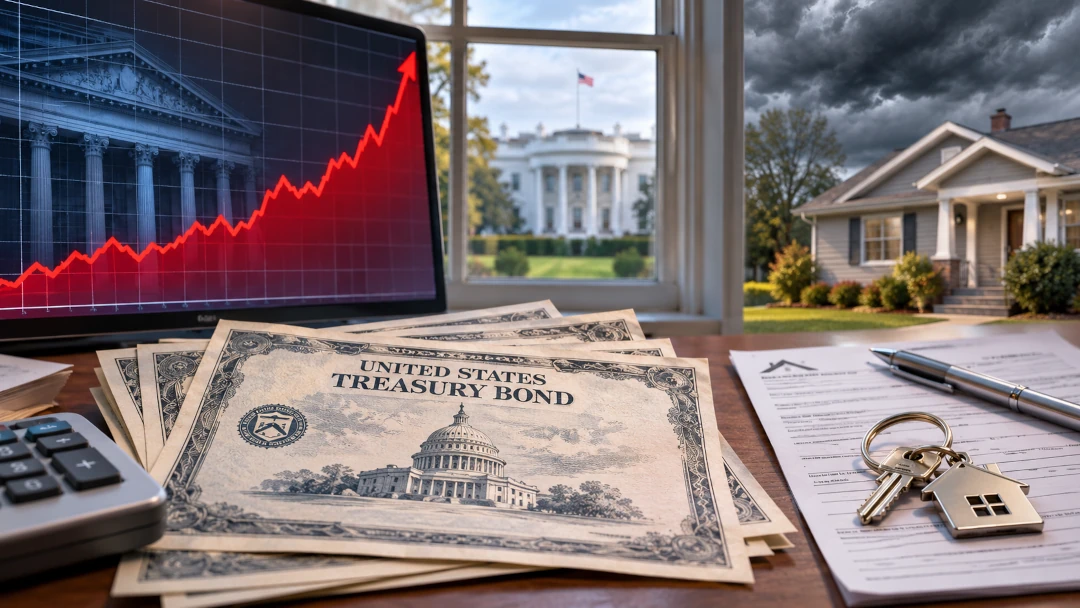
This is not a single-day crash. It is something slower and, in some ways, more dangerous: a grinding, global rout in government debt that has pushed America’s borrowing costs to levels not seen in a generation. Your mortgage, your car loan, your retirement account and the federal budget are all on the line. The president’s answer has been campaign checks, inflation talk, and threats.
Most Americans never look at the bond market, and most never need to. But for most of 2026, the world’s largest and most important market for debt has been flashing red. The 10-year Treasury, the benchmark for nearly every long-term loan in the country, closed above 5% in September for the first time since 2007, according to University of Hawaiʻi economist Peter Fuleky. At the end of February, before the war with Iran began, it was just under 4%. The 30-year bond climbed above 5.6%.
Then, just as investors started hoping the worst was over, the market broke lower again. In the week ending November 13, Bloomberg reported that the two-year yield jumped 35 basis points, its biggest weekly rise in more than two years, as stubborn inflation and tough talk from the Federal Reserve sent traders bracing for more rate hikes. The 10-year settled at 5.14%.
“Crash” is the word circulating online. The more precise word is rout, and it isn’t only an American problem. Fuleky notes that yields have also climbed in Britain, Germany and France, and that Japanese government bond yields have hit their highest level since 1996. But the U.S. Treasury market sets the baseline cost of money for the entire global economy. When it shakes, everyone feels it. And Washington, under this president, has made it shake harder.
I. Reading the Warning Lights
Bond prices and yields move in opposite directions. When investors sell government debt, prices fall and yields rise, which means the government, and everyone whose loans are priced off government debt, has to pay more to borrow. Here is what the dashboard shows right now.
10-Year Treasury
Where the benchmark closed the week of Nov. 13, up nearly 30 basis points in five sessions, per Yahoo Finance. It hit 5.34% on Sept. 30, its highest since 2002, according to Federal Reserve data cited by Moneywise.
Mortgage Rates
The average 30-year fixed rate as of Nov. 5, compared with 6.22% a year earlier, per Freddie Mac’s weekly survey.
Interest on the Debt
Net interest payments in fiscal 2026, up 8%, about $2.9 billion a day and a record 3.2% of GDP, as Fortune reported.
Annual Deficit
The fiscal 2026 shortfall, up 12% from the year before, according to CBO data reported by Fox Business. Net interest was the single fastest-growing line item.
Who Buys Our Debt
The foreign share of publicly held Treasuries, down from close to half in the early 2010s. Leveraged hedge funds, which can dump bonds fast, are now the marginal buyers.
The Fed
The policy range after September’s hike, the Fed’s first since July 2023. Markets put the odds of another hike in December above 80%, per Fox Business.
What is driving it? The honest answer is several forces at once. An energy shock from the Iran war sent diesel to record highs. The Fed, now led by Trump’s own pick, Kevin Warsh, has moved toward hikes, not cuts. A boom in AI-related corporate borrowing is competing for the same pool of savings. And, most damning for Washington, the U.S. is running deficits of about 5.5% of GDP with unemployment near 4%. Fuleky points out that before 2020, deficits in years of unemployment below 5% averaged about 1% of GDP. That is not what a country that’s managing its finances looks like. It’s what a country that’s spending on autopilot looks like.
II. What It Means for America
For the federal government, the math is starting to compound against us. Every Treasury rolled over at today’s rates locks in higher interest costs for years. Moody’s Analytics chief economist Mark Zandi has warned that “a vicious cycle threatens to take hold”: higher rates add to interest payments and the debt load, which pushes rates higher still. Interest costs, Fuleky notes, are now close to 4% of GDP, more than the country spends on defense.
Maya MacGuineas, president of the nonpartisan Committee for a Responsible Federal Budget, said the fiscal 2026 deficit ranks among the highest in American history, and is the highest ever recorded outside of a war or recession. Read that again. We are not in a recession. There is no pandemic. Yet Washington is borrowing as if there were. Every dollar spent on interest is a dollar not spent on child care, roads, Medicaid or anything else that builds the country.
There is also a systemic risk. Fuleky warns that hedge funds, which borrow in the short-term “repo” market to make large leveraged bets on Treasuries, tend to sell quickly when markets get volatile. That can turn an orderly rise in yields into a disorderly one. That is how a slow rout becomes an actual crash.
III. What It Means at the Kitchen Table
This is where the abstraction ends. The average 30-year mortgage is above 7%. On Fuleky’s math, a 7% rate on a median-priced home costs about $2,300 a month more than the same house at 3%. The figures differ by market, but the logic is the same everywhere. Because about half of all U.S. mortgages still carry rates of 4% or less, owners who locked in cheap loans have little reason to sell. That keeps inventory low and prices high for first-time buyers.
The same pressure is spreading to car loans, credit cards, small-business credit and adjustable-rate debt. Older bonds lose market value when yields rise, which hits pension funds, bank balance sheets and the bond funds in Americans’ 401(k)s. The Fed’s quarter-point hike in September landed on top of a bond market that had already tightened conditions on its own. For working families already squeezed by record diesel prices and grocery bills, this is the second blow of the same storm.
“Certain levels of inflation will also pay off that debt very rapidly.”
— President Donald Trump, Time magazine interview, Oct. 1, 2026
IV. How Trump Is Handling It — and Making It Worse
To understand why bond investors are demanding more to lend to the United States, listen to the president. In an interview with Time published October 1, Trump said that “certain levels of inflation” would pay off the debt “very rapidly.” His own National Economic Council director had just told Bloomberg the White House would “absolutely not” try to inflate its way out of debt, 24/7 Wall St. reported. Bond investors have one fear above all: being repaid in dollars worth less than the ones they lent. The president of the United States just told them that’s the plan.
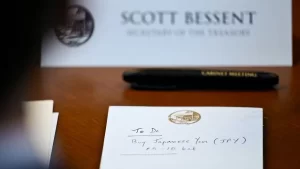
Then came the checks. On September 9, Trump promised a $5,000 “Trump dividend” to every adult if Republicans held Congress. CNN reported that the 10-year yield rose past 4.86%, then its highest level since 2023, the day after the announcement. The promise also worked against Treasury Secretary Scott Bessent’s $6 billion debt buyback announced the same day. Economists warned the checks could force the Fed to raise rates even higher. In other words, the president was bidding up the cost of every family’s mortgage in exchange for a campaign promise.
When a reporter noted that yields had risen again after Bessent’s intervention, Trump answered that there were “many types of intervention,” adding: “The ultimate intervention is our military, and if we have to use that, we will.” No serious economist can explain what military force has to do with Treasury auctions. Global investors heard a commander in chief who either doesn’t understand the market he depends on or is willing to threaten it.
Trump’s war on the Federal Reserve made things worse too. He tried to fire Fed Governor Lisa Cook over unproven mortgage-fraud allegations. In June, a 5–4 Supreme Court blocked her removal for now, but Chief Justice John Roberts left the door open for Trump to try again. Markets treat an independent Fed as the guarantor that inflation will be fought. Every attack on that independence adds to the risk premium Americans pay. Since then, Trump has spared Warsh from criticism even after the hike, blaming instead what he called “a hostile board.”
And the policy that started much of this, the tariff regime, isn’t going anywhere. One week after the midterms, CNBC reported that the White House signaled it would stay the course on tariffs. That’s despite a Reuters/Ipsos poll finding that 62% of Americans support repealing them, and October consumer prices rising another 0.4%. Even Trump’s former top economic adviser Gary Cohn warned that American consumers are paying the bill.
Get Involved Today
Contribute to our mission and turn your concerns into action.
V. What Congress Is Saying — and Doing
Democrats have been raising the alarm for months, mostly without a gavel. At a September 15 House Financial Services hearing, ranking member Rep. Maxine Waters told Bessent, “Despite your feeble efforts, there continues to be a sell-off of U.S. Treasuries.” Bessent insisted yields would have been higher without his buybacks. He also conceded that “the need to address the deficit” is one of the things the 10-year reflects, and said he was working on deficit-reduction plans.
On October 7, Sen. Elizabeth Warren, the top Democrat on the Senate Banking Committee, sent Bessent a letter calling his intervention a failure. She noted that bond yields rose on the days of his first buyback announcements, and she demanded answers by October 21. Her questions covered how higher yields were hitting mortgages, car loans and credit cards, and what else Treasury planned to do. Bessent’s reply, reported by Moneywise, opened with “It is difficult to treat your concerns as sincere,” and then didn’t directly answer any of her five questions. That is how this administration treats congressional oversight of the nation’s borrowing costs.
The voters noticed. On November 3, NBC News projected that Democrats had won control of both the House and Senate, capitalizing on voter anger over Trump and affordability. In January, the new majorities will have subpoena power, and they will have the duty to use it. Republicans can’t claim they weren’t warned, either. Fiscal hawks in their own ranks, including Sen. Rand Paul, spent the past year warning that the bond market was losing patience, while their party kept passing the spending.
VI. Why the Headlines Feel So Quiet
To be fair, the bond rout hasn’t gone unreported. Bloomberg, Fortune, CNBC and NPR have covered it closely. The problem is where it gets covered and how it’s framed. It lives on the business page and in financial newsletters. Meanwhile cable news, the place most Americans get their politics, spent the fall on the horse race. NPR put it plainly in August: many people don’t pay attention to bond markets, but they should, especially now. Bonds were tumbling even as stocks hit record highs.
That mismatch is the heart of it. A record stock market makes for easy, cheerful television, and the White House loves to point at it. A yield curve doesn’t film well. “Term premium” doesn’t trend. And a slow rout has no single dramatic day for a chyron, until it suddenly does. The result is a media environment where the most consequential economic story of the year reaches Americans in the form of a mortgage quote they can’t afford, without anyone connecting it to the decisions that produced it. Connecting those dots is the job. Too many outlets haven’t done it.
VII. A Year of Warnings: The Timeline
The full faith and credit of the United States is a legal duty, not a talking point.
Article I, Section 8 — The Borrowing Power
The Constitution gives Congress, not the president, the power “to borrow Money on the credit of the United States.” Congress also controls taxing and spending. The deficits driving this rout were written into law by lawmakers, and they can be rewritten by lawmakers. The incoming majorities can’t treat the bond market as weather. It is a verdict on their branch’s choices.
Fourteenth Amendment, Section 4 — The Public Debt
“The validity of the public debt of the United States… shall not be questioned.” A president who openly describes inflation as a strategy to shrink what the country owes is, at minimum, flirting with the spirit of that command. Paying creditors back in deliberately debased dollars is a slow-motion way of questioning the debt.
Federal Reserve Act, Section 2A — The Forgotten Third Mandate
Most Americans know the Fed’s “dual mandate.” But the statute actually directs the Fed to promote “maximum employment, stable prices, and moderate long-term interest rates” (12 U.S.C. § 225a). Long-term rates follow credibility. A Fed protected from political interference can deliver that mandate. A Fed whose governors can be purged can’t.
Federal Reserve Act, Section 10 — “For Cause” Removal
Fed governors may be removed only “for cause.” In the Cook case, the Supreme Court held that Cook was owed notice and a hearing before any removal, and it described the Fed’s independence as resting on a narrow but real legal shield. Congress can and should write that shield more firmly into statute, defining “cause” so that no future president can treat the central bank as a political appendage.
VIII. The Road Ahead
Nobody can promise where yields go next. Fuleky lays out both views fairly. Optimists argue that 5% is simply a return to the norms of the 1980s and 1990s, and that the rise so far has been orderly. Pessimists point out that debt is far larger now than it was then, and that refinancing a mountain of cheap old debt at today’s rates raises the odds of a disruptive event. The near-term path depends on energy prices and whether the Fed can bring inflation down without stalling the economy. Fed Governor Christopher Waller has already floated a half-point hike if inflation keeps its momentum. Markets are pricing in a December move.
On one point the economists agree: lasting relief requires smaller deficits, and that requires hard political choices. Fuleky’s conclusion is blunt: “the era of very cheap long-term credit appears to be over.” The question is whether Washington meets that era with a credible plan or with more promises it can’t pay for.
IX. What This Says About Trump’s Priorities
A leader’s priorities show up in a crisis. In this one, Trump has offered voters $5,000 checks the government can’t afford, called inflation a debt-reduction tool, raised the idea of military “intervention” in a financial market, tried to purge a Fed governor, and kept tariffs that most Americans want gone. His Treasury secretary answered a senator’s questions about family borrowing costs with insults. What he hasn’t offered is a plan.
That pattern isn’t new. It’s the same instinct that treats every institution as either loyal or an enemy, and every policy as a campaign prop. The bond market doesn’t vote, can’t be primaried, and can’t be intimidated. That is exactly why it’s telling the truth: the people currently running the country’s finances are not being trusted to run them. Investors around the world are charging Americans a higher price for that distrust, and families are the ones paying it.
X. What You Can Do
There is more to do here than vote. Here is a plain-language look at the real options, with an honest read on each.
Press the new Congress for oversight hearings
Call your senators and representative (the Capitol switchboard is 202-224-3121). Ask them to commit to public hearings in January on Treasury’s buyback program, the administration’s household-cost analysis, and the fiscal impact of tariffs and war spending.
Honest assessment: this is your highest-leverage move. New majorities set their agendas in the first 100 days, and constituent pressure shapes which hearings happen.
Back legislation to protect Fed independence
Urge lawmakers to define “for cause” removal in statute and to protect the Fed’s governors from politically motivated purges.
Honest assessment: any such bill would face a likely veto before 2029. But putting it on the record, and forcing a vote, matters for markets and for the next administration.
Demand a real deficit plan, paid for fairly
Tell lawmakers that fiscal responsibility shouldn’t mean cutting Social Security or Medicaid. It can mean revisiting the corporate tax cuts and other giveaways that drained revenue while deficits soared.
Honest assessment: this is the hardest fight, because both parties will be tempted to dodge it. It’s also the only path the economists say actually brings rates down.
Protect your own household balance sheet
Know which of your debts carry variable rates, such as credit cards, HELOCs and ARMs, since those reprice fastest. Shop multiple lenders before you borrow. If you hold bond funds in a retirement account, learn how sensitive they are to rate changes.
Honest assessment: this is general information, not financial advice. A fee-only fiduciary advisor can help with your specific situation. Personal prudence can’t fix a national problem, but it can blunt the damage.
Connect the dots in public
Show up at town halls, write letters to the editor, and share reporting that ties mortgage and loan costs back to the decisions behind them. Ask local news outlets to cover the bond market as a cost-of-living story.
Honest assessment: it’s slow work. But the main reason this crisis feels invisible is that too few people are explaining it, and every explanation helps.
Editorial Conclusion
The bond market is not a partisan actor. It is the world’s verdict on whether America will honor its word: whether we will repay what we borrow in honest dollars, protect the institutions that guard our currency, and govern with arithmetic instead of slogans. In 2026, that verdict has been getting harsher, and this president has answered it with promised checks, inflation talk, and threats.
The Constitution puts the power of the purse and the credit of the United States in the hands of Congress. The new majority must use that power: open the books, defend the Fed’s independence in law, and put forward a fair fiscal plan before the markets force a worse one. The full faith and credit of the United States belongs to the American people. It is not one man’s to gamble with.
Sources & References
- UHERO / University of Hawaiʻi — Peter Fuleky, “The 2026 Global Bond Sell-Off: Causes, Consequences, and Local Impacts”
- Bloomberg — “Bond Investors Expect More Pain After Week of Soaring Yields”
- Yahoo Finance / Stocktwits — “The Weekly Spread: What Shaped US Treasury Yields and the Dollar This Week”
- Freddie Mac — Primary Mortgage Market Survey, Nov. 5, 2026
- Fortune — “U.S. debt interest payments hit $3 billion a day and jumped 8% in fiscal 2026”
- Fox Business — “Federal budget deficit hits $2T as national debt costs surge”
- Fox Business — “Federal Reserve makes interest rate decision ahead of midterms”
- Fortune — “The U.S. national debt is approaching the point where bond traders see ‘mounting risk’ of a ‘vicious cycle'”
- U.S. Senate Banking Committee — Sen. Elizabeth Warren, Letter to Secretary Bessent re: Treasury yields (Oct. 7, 2026)
- Yahoo Finance / Moneywise — “Bessent roasts Warren in scathing letter but skips her 5 questions on borrowing costs”
- CNBC — “Scott Bessent defends Treasury intervention, Trump economy in contentious House hearing”
- 24/7 Wall St. — “National Economic Advisor Says Trump ‘Won’t Inflate Our Way Out of Debt.’ Trump Says, Yes We Will.”
- MS NOW / The Maddow Blog — “Trump’s comments about the military and the bond market betray his economic illiteracy”
- CNN Business — “Trump’s $5,000 checks would solve a problem that doesn’t exist – and create a new one”
- Colorado Politics / Washington Examiner — “Trump spares Kevin Warsh from criticism despite Fed rate hike”
- Bloomberg Law — “Cook Stays at Fed But Trump Wins Power Over Other Agencies”
- CNBC — “White House vows to press ahead with tariffs despite midterm backlash over rising prices”
- NBC News — “Decision 2026: Democrats capture full control of Congress”
- NPR — “The bond market is signaling trouble ahead. This is why you should pay attention”
- Board of Governors of the Federal Reserve System — Federal Reserve Act, Section 2A: Monetary Policy Objectives
Related News