In suing the nation’s paper of record for alleged discrimination against a white male employee, the Trump administration has not discovered a civil rights victim — it has manufactured a weapon. This is what the collapse of institutional leadership looks like in real time.
On May 5, 2026, the Equal Employment Opportunity Commission (EEOC) — the federal agency created by Congress in 1964 to protect workers from workplace discrimination — filed a federal lawsuit against The New York Times Company in the Southern District of New York. The EEOC, operating under the direct ideological direction of the Trump White House, alleged that the Times had violated Title VII of the Civil Rights Act by passing over a white male editor for a deputy real estate editor position. The case was not filed by the employee himself. It was filed by the government — by a president who has spent a decade calling the Times “failing,” who has already sued the paper twice, and who has made no secret of his desire to use the machinery of federal power to punish his enemies. The timing, the target, and the legal architecture of this lawsuit are not coincidences. They are a confession.
1. The Lawsuit — A Political Weapon in Plain Sight
The facts of the underlying employment dispute are, at best, contested. According to the EEOC’s complaint, a white male Times employee with extensive real estate journalism experience applied for a deputy editor role in early 2025. He was not selected for final interviews. The agency alleges that “none of the candidates who advanced to the final interview stage were white men,” and that the Times ultimately hired a non-white female candidate it describes as having “little to no experience in real estate journalism.” The Times immediately rejected the characterization, with spokeswoman Danielle Rhoades Ha calling the lawsuit “meritless and politically motivated” and stating that the selected candidate “had service journalism experience, along with time in supervisory roles” — and that she was, simply put, the most qualified person for the job.
What makes this case remarkable is not the underlying complaint — which, notably, was filed not by a lawyer representing the aggrieved employee but by the EEOC itself — but the political context in which it accelerated toward litigation. Axios reported that the EEOC had been investigating the complaint for months before the agency’s posture abruptly shifted in late April, suddenly pushing hard for a lawsuit. This is not the behavior of neutral law enforcement. This is the behavior of an enforcement agency that has received its marching orders.
“This administration has categorically refused to protect individuals that deserve the protections of the federal government and focused on one subset of the population, inviting that group only to reach out.”
— Jenny Yang, Former EEOC Chair, representing a Sheetz discrimination claimant
The EEOC chair responsible is Andrea Lucas, a Trump appointee who has according to NPR spent her tenure soliciting complaints from white men via LinkedIn posts, abandoning lawsuits on behalf of transgender workers, and redirecting the agency’s dwindling resources — the EEOC has shed hundreds of employees since Trump returned to office — toward cases that advance a single ideological narrative. Lucas has been explicit: “I am ensuring evenhanded, colorblind enforcement,” she has declared, while simultaneously dropping long-running cases against employers accused of discriminating against people of color. This is not evenhandedness. This is inversion.
2. What the EEOC Has Protected — and What It Has Abandoned
To understand what is happening at the EEOC, one must understand not only what the agency has pursued but what it has deliberately surrendered. The contrast is damning and specific. In June 2025, the EEOC dismissed a long-running discrimination case against Sheetz, a convenience store chain accused of hiring practices that disproportionately hurt people of color. The agency also dropped multiple lawsuits filed on behalf of transgender workers. At the same time, it settled a case against Planned Parenthood — requiring a $500,000 payment for alleged discrimination against white employees — and is pursuing active investigations against Nike and Northwestern Mutual over their diversity programs. The message is unmistakable and deliberate: some workers deserve federal protection. Others do not.
Abandoned — People of Color
The EEOC under Lucas dismissed the Sheetz case (June 2025) — accusing that chain of hiring practices that disproportionately excluded workers of color — and dropped several complaints alleging discrimination against transgender and nonbinary workers.
Actively Pursued — White Males
Lucas posted a personal LinkedIn video in December 2025 directly encouraging white men to contact the EEOC about potential discrimination claims — an extraordinary use of an agency chair’s platform to solicit one demographic group for legal complaints.
The NY Times Pattern
The NY Times lawsuit marks the third time Trump or his administration has sued the Times in under five years. In 2021, Trump sued over tax reporting. This latest EEOC action followed the Times’ own reporting that EEOC staff were being pressured to file politically aligned cases with “little evidence.”
The Staff Pressure Problem
The Times itself reported before the lawsuit was filed that EEOC field staff said they were being pressured to bring “politically charged cases, even with little evidence.” The lawsuit against the Times followed almost immediately after that reporting — a sequencing that speaks for itself.
A Shrunken Agency, Selective Priorities
The EEOC has lost hundreds of employees since Trump returned to office, dropping to approximately 1,740 workers. Former chair Charlotte Burrows told NPR this represents “a real radical effort to advance one ideological perspective with the resources that they have.”
DEI Reversed, Not Reformed
In his February 2026 State of the Union, Trump declared his administration had “ended DEI in America.” The EEOC’s broader campaign has included threatening 20 major law firms over their diversity policies and directing web-archive searches targeting companies that changed only their diversity language without ending their programs.
3. A Pattern, Not an Aberration — The Broader Civil Rights Rollback
The EEOC lawsuit against the Times does not exist in isolation. It is one thread in a comprehensive tapestry of dismantlement — a sustained, documented effort by the Trump administration to reverse decades of civil rights progress while cloaking that reversal in the language of equality. The Leadership Conference on Civil and Human Rights has been tracking the rollbacks in real time, and the scale is staggering: from rescinding President Johnson’s Executive Order 11246 — which had required federal contractors to take affirmative steps to end workplace discrimination — on day one of the administration, to removing civil rights protections from Department of Energy regulations, to abandoning the government’s own position in voting rights litigation.
Get Involved Today
Contribute to our mission and turn your concerns into action.
The voting rights dimension is particularly stark. Just last week, the Supreme Court issued a 6-3 ruling in Louisiana v. Callais that, as Stateline reported, “dismantled some of the final guardrails protecting the electoral power of Black, Hispanic, and other racial minority voters” enshrined in the 1965 Voting Rights Act. The Trump administration had actively backed that challenge, advocating to raise the bar for proving discriminatory voter suppression. When the ruling came down, Trump called it “a BIG WIN” and said he loved it. The same administration that claims the EEOC is protecting civil rights just cheered the gutting of the most important civil rights law of the twentieth century. Legal analysts predict the ruling will result in more white lawmakers and fewer from minority communities in every subsequent election cycle. This is not coincidence. This is strategy.
“What Trump is doing is aimed at taking down the laws of the Great Society — effectively the foundation of modern America and the path to a plural democracy.”
— Mark Updegrove, Presidential Historian, via CNN
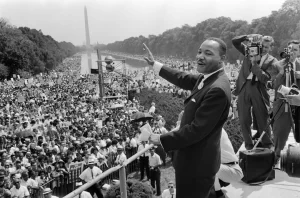
Presidential historian Mark Updegrove, speaking to CNN, described the administration’s anti-DEI campaign as “the biggest rollback” of civil rights since Reconstruction, drawing an explicit parallel between the present moment and the post-Civil War period when the gains of the 13th Amendment were undermined by the rise of Jim Crow. “So-called anti-wokeism,” he argued, “is essentially permission to accept racism.” The historical resonance is not hyperbole. It is precise.
4. The Press in the Crosshairs — Lawfare as Authoritarianism
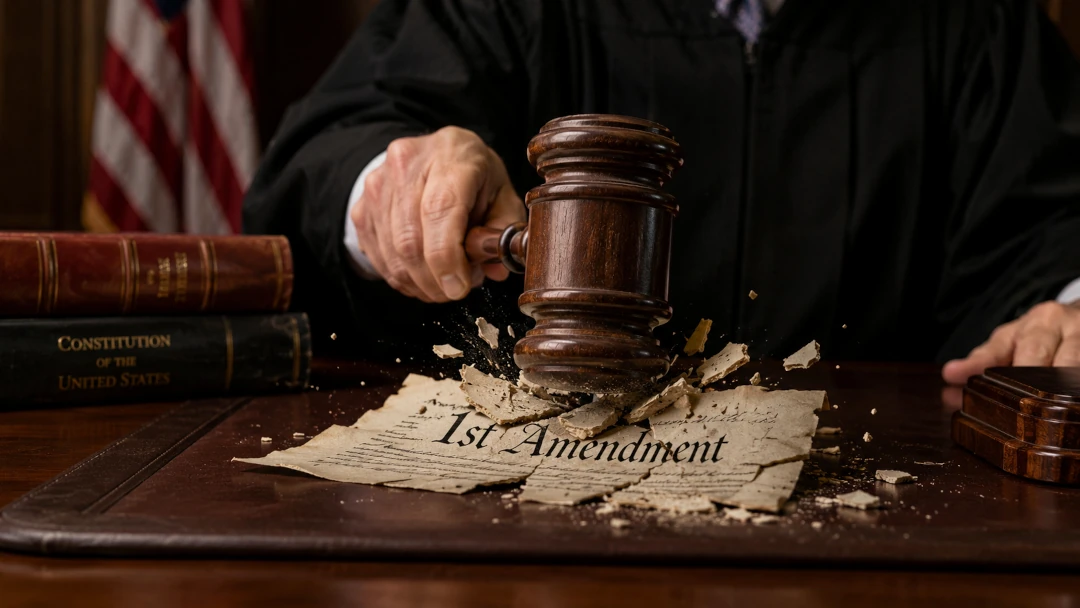
One must also name plainly what this lawsuit is in terms of press freedom: it is the use of a federal civil rights agency to attack a publication that has reported critically on the president. Trump has filed three separate legal actions against the Times in five years. He has called the paper “failing” for over a decade on social media. He has pursued a $15 billion defamation lawsuit against the paper. And now his EEOC is suing the Times — filed, remarkably, in the immediate aftermath of the Times publishing reporting critical of the EEOC itself.
This fits a pattern that scholars and journalists have documented exhaustively. The Protect Democracy retaliatory action tracker has documented dozens of instances of Trump administration agencies being deployed against the president’s political enemies. The University of Iowa Journal of Gender, Race & Justice published an analysis in November 2025 arguing that Trump’s use of the Justice Department constitutes a weaponization “beyond Nixon’s Watergate” — noting that the Due Process Clause, Equal Protection Clause, and First Amendment all “prohibit arbitrary and retaliatory prosecutions.” A poll cited by the Constitutional Accountability Center found a majority of Americans agree Trump is weaponizing the DOJ to target political enemies, with the coalition warning that “Trump’s abuse of power is eroding faith in federal institutions as neutral enforcers of the law.”
The picture that emerges from the full record is of a president who announced, before his re-election, that he would weaponize the DOJ against enemies — and has done exactly that, systematically, across multiple agencies and enforcement mechanisms. The Columbia Journalism Review documented 170 assaults on journalists in the United States in 2025 alone, with 160 of them at the hands of law enforcement. The EEOC lawsuit against the Times is not the most violent of these assaults. But it may be the most legally sophisticated — a scalpel instead of a club, deployed to signal to every newsroom in America that the machinery of civil rights law can be turned against those who challenge this president.
5. A Timeline of Targeted Retaliation
January 20, 2025
Trump issues Executive Order 14173, rescinding President Johnson’s affirmative action order and directing agencies to “end illegal discrimination and restore merit-based opportunity.” The EEOC and DOJ civil rights divisions are immediately redirected.
March 2025
EEOC Chair Andrea Lucas writes to 20 major law firms demanding details of their diversity policies, triggering widespread rollbacks. The EEOC began actively soliciting complaints from white male workers.
June 2025
EEOC dismisses the Sheetz discrimination case — a case involving hiring practices that disproportionately excluded workers of color — and drops multiple lawsuits protecting transgender employees.
July 2025
The unnamed Times employee files a discrimination complaint with the EEOC’s New York office. It is later transferred to an Alabama investigator — a geographic and jurisdictional choice that raises its own questions.
December 2025
EEOC Chair Lucas posts a personal LinkedIn video directly encouraging white men who believe they have experienced workplace discrimination to “contact the EEOC as soon as possible.” The post is described by former EEOC leaders as unprecedented in tone and scope.
Late April 2026
The EEOC’s posture on the Times investigation abruptly shifts, accelerating toward a lawsuit — in the immediate period after the Times publishes reporting on EEOC staff being pressured to bring politically charged cases.
April 30, 2026
The Supreme Court guts Section 2 of the Voting Rights Act in a 6-3 ruling. The Trump administration had actively supported the challenge. Trump celebrates the ruling and calls Justice Alito “brilliant.”
May 5, 2026
The EEOC formally files suit against The New York Times Company in the Southern District of New York — the third federal legal action Trump or his administration has taken against the paper in five years.
When Institutional Instinct Fails: The 25th Amendment and the Fitness Question
The Twenty-Fifth Amendment, Section 4 of the United States Constitution, was ratified in 1967 following the trauma of President Kennedy’s assassination and concerns about presidential succession. Its most consequential provision empowers the Vice President and a majority of the Cabinet to transmit to Congress a written declaration that the President “is unable to discharge the powers and duties of his office.” Congress then has 21 days to decide, by a two-thirds majority of both chambers, whether the president shall be removed. The amendment has never been successfully invoked against a sitting president.
The case for examining its applicability to the current moment rests not on a single action but on a documented behavioral pattern — the systematic subordination of the public interest to personal grievance. A president who deploys a civil rights enforcement agency against a news organization that has reported critically on that same agency is not exercising the powers of the presidency; he is abusing them for personal retribution. Representative Jamie Raskin (D-MD), a constitutional scholar and ranking member of the House Judiciary Committee, has previously argued that the amendment applies not only to physical incapacity but to “a demonstrated incapacity to fulfill the constitutional oath” — an oath that requires the president to “faithfully execute” the laws of the United States, not weaponize them against his critics.
Representative Alexandria Ocasio-Cortez (D-NY) and Senator Cory Booker (D-NJ) have each pointed to the accumulation of retaliatory executive actions as evidence of a presidency that has lost its constitutional moorings. The pattern — using the DOJ to prosecute political enemies, deploying the EEOC against a critical press institution, cheering the dismantlement of minority voting rights — describes a president whose decision-making is organized not around the national interest but around the personal interest of silencing opposition and securing political power.
The practical barriers to invoking the 25th are formidable and should be stated honestly: Vice President JD Vance has shown no willingness to act, and the current Cabinet is composed almost entirely of loyalists. The Republican Senate majority would be unlikely to sustain a two-thirds removal vote. These are political facts. But the 25th Amendment was designed precisely for moments when the ordinary mechanisms of accountability have failed — when a president’s conduct has drifted so far from the constitutional obligation to serve all Americans that the republic’s survival requires an alternative. The barriers to invocation do not negate the constitutional and moral case. They describe its urgency.
6. What This Presidency Tells Us About Priorities and Leadership
A president’s true priorities are revealed not in his speeches but in the deployments of his power. Donald Trump has, in the span of sixteen months of his second term, abandoned discrimination cases protecting workers of color, rescinded the most significant affirmative action executive order in American history, celebrated the gutting of the Voting Rights Act, pressured his EEOC to prioritize cases favoring white workers, and sued a newspaper for covering his administration critically. He has done all of this while claiming, without irony, to be the greatest protector of minority communities in American history.
The claim cannot survive contact with the documented record. It cannot survive the testimony of former EEOC Chair Jenny Yang, who has said this administration has “categorically refused to protect individuals that deserve the protections of the federal government.” It cannot survive the Leadership Conference’s meticulous documentation of over a hundred civil rights rollbacks. It cannot survive the fact that Trump’s response to the most consequential voting rights ruling since the original act’s passage was the single word: love it.
What this presidency tells us about leadership is this: genuine leadership requires the capacity to act on behalf of the whole — to subordinate personal grievance to public obligation, to enforce the law with neutrality rather than as a targeting system. That capacity, by the evidence of this administration’s record, is absent. What exists in its place is a transactional, retaliatory, grievance-driven exercise of power that serves the political and personal interests of one man while dismantling the legal architecture that has protected millions. The EEOC lawsuit against the Times is not the most consequential act of this administration’s civil rights dismantlement. But it may be the most nakedly confessional — a moment when the mask slipped entirely, and the inquisition showed its face.
Editorial Conclusion
The Trump administration has not found a civil rights victim at The New York Times. It has manufactured a legal instrument of retaliation against a press institution that reported on the administration’s own abuses — and deployed that instrument in the name of the civil rights laws it has spent sixteen months systematically dismantling. This is the definition of bad faith governance, and it demands a response equal to its seriousness: from a Congress that must reassert oversight authority over a weaponized executive branch, from courts that must uphold the First Amendment’s prohibition on retaliatory government action, and from citizens who must recognize that a president who uses civil rights law to punish his critics while abandoning it to protect the vulnerable is not a defender of equality. He is its most sophisticated adversary. The republic does not survive a leader who has abandoned the obligation to lead for all Americans. That is what is at stake. That is what must be named.
Sources & References
- CNN Business — “Trump’s EEOC Sues New York Times, Alleging Discrimination Against a White Male Employee” (May 5, 2026)
- Axios — “Trump Job Agency Sues New York Times for Alleged Bias Against White Man” (May 5, 2026)
- The New Republic — “Trump Admin Sues New York Times for Discriminating Against White Men” (May 5, 2026)
- Mediaite — “Trump Admin Sues NY Times Over Diversity Hiring Programs” (May 5, 2026)
- Daily Voice — “Trump Admin. Accuses NY Times Of White Discrimination In New Lawsuit” (May 6, 2026)
- NPR — “How Trump’s EEOC Is Attacking DEI and Emphasizing White People” (March 31, 2026)
- Insurance Journal / AP — “Trump Administration Targets Dismantling of Already-Weakened DEI” (May 4, 2026)
- The Leadership Conference on Civil & Human Rights — “Trump Administration Civil and Human Rights Rollbacks” (ongoing tracker)
- CNN Politics — “Trump Turns Civil Rights Upside Down in ‘Biggest Rollback’ Since Reconstruction” (May 2, 2025)
- Stateline — “Supreme Court Voting Rights Ruling Set to Reshape Local Power” (May 4, 2026)
- Al Jazeera — “Has the US Supreme Court Weakened the Voting Rights Act — and How?” (April 30, 2026)
- CBC News — “How the Supreme Court’s Ruling on the Voting Rights Act May Give Trump’s GOP a Lifeline” (May 1, 2026)
- Protect Democracy — “Tracking Retaliatory Use of Arrests, Prosecutions, and Investigations by the Trump Administration” (ongoing)
- University of Iowa Journal of Gender, Race & Justice — “Trump’s ‘Weaponization’ of DOJ: Why Using Main Justice for Presidential Retribution Is Beyond Nixon’s Watergate” (Nov. 2025)
- Constitutional Accountability Center — “Majority of Americans Agree Trump Is Weaponizing DOJ to Target Political Enemies” (Oct. 2025)
- Columbia Journalism Review — “In 2025, Press Freedom Came Under Direct Attack” (Dec. 2025)
- Milwaukee Independent — “Journalists Face Escalating Threats in 2026 as Trump Intensifies Hostility Toward the Free Press” (Jan. 2026)
- The Fulcrum — “Trump’s Petty Pursuit of His ‘Enemies'” (May 9, 2026)
Related News