The Department of Justice’s criminal indictment of the Southern Poverty Law Center is not an isolated act of prosecution — it is the culmination of a deliberate, multi-front campaign to intimidate, defund, and ultimately neutralize the legal infrastructure that holds this administration accountable to the Constitution.
On April 21, 2026, Acting Attorney General Todd Blanche stood before cameras with FBI Director Kash Patel to announce what the Trump administration framed as a historic accountability moment: the federal indictment of the Southern Poverty Law Center on eleven counts of wire fraud, bank fraud, and conspiracy to commit money laundering. The charges allege that the SPLC — an organization founded in 1971 to prosecute the Ku Klux Klan and document extremist violence for more than five decades — secretly paid informants embedded inside white supremacist groups without disclosing that financial arrangement to donors. The announcement was met not with the solemn gravity appropriate to a genuine law enforcement action, but with a political press conference in which Blanche declared that the SPLC was “manufacturing racism to justify its existence.” That single sentence reveals everything about what is truly happening here. This is not law enforcement. This is a purge.
The indictment lands against a backdrop that no serious observer can afford to ignore: the Trump administration has spent the better part of fifteen months systematically dismantling every legal mechanism that civil rights organizations use to hold it accountable. From executive orders targeting law firms by name, to demanding confidential voter data from all fifty states, to rolling back civil rights protections across federal agencies, this administration has conducted what can only be described as a coordinated assault on the rule of law — and on the people and organizations standing in its way. The SPLC indictment is the most aggressive escalation yet. It is also, legal experts say, almost certainly destined to collapse in court. But that may be precisely the point.
1. The Anatomy of a Warning Shot
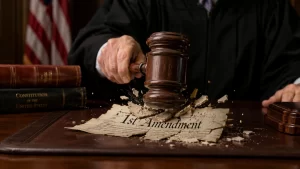
The SPLC’s informant program — the practice at the center of the federal charges — is not a secret, nor is it a departure from the organization’s stated mission. Since the 1980s, the center has paid individuals embedded in violent extremist organizations, including the Ku Klux Klan, the Aryan Nations, and neo-Nazi groups, to gather intelligence. The practice mirrors standard FBI methodology. Retired federal Judge Nancy Gertner, who reviewed the indictment, called the government’s fraud theory “preposterous,” noting that because the SPLC has long been transparent about its mission to dismantle extremist organizations, “everyone understood the way they function and why they function and how that was part of the mission.” Georgetown Law professor Abbe Smith warned that the charges “run up against the group’s First Amendment rights,” noting that what the SPLC does is “basically speech and association.”
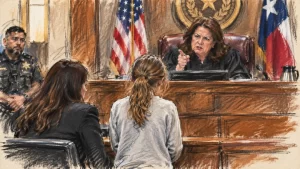
Norm Eisen, founder of Democracy Defenders Action, articulated the central absurdity of the prosecution: the indictment “essentially claims that it was a fraud on SPLC’s donors to use their funds to fight the Klan, the Neo Nazis and other white supremacist groups, when that is exactly why people gave to the organization.” And yet the charges have been filed. They are being overseen by U.S. District Judge Emily Marks in Montgomery, Alabama — a Trump appointee. The political geography of this prosecution is not incidental. It is a feature.
“We’re not backing down, but we are clear-eyed. Everyone could be in some form of jeopardy if you’re in the crosshairs of this administration. That’s what they’re looking for — they want this to have a chilling effect.”
— Juan Proaño, CEO, League of United Latin American Citizens
For civil rights leaders, the shock was minimal. Juan Proaño, CEO of the League of United Latin American Citizens — itself currently suing the Trump administration over birthright citizenship and mail-in voting executive orders — put it plainly: “We’re not backing down, but we are clear-eyed. Everyone could be in some form of jeopardy if you’re in the crosshairs of this administration. That’s what they’re looking for — they want this to have a chilling effect.” The NAACP responded with a statement calling the indictment “a chilling attack on civil rights advocacy,” warning that “every organization and individual engaged in social justice should be alarmed.” The Feminist Majority Foundation called it “DOJ’s persecution of political enemies and civil rights bulwarks.” These are not partisan talking points. They are accurate descriptions of what is happening.
2. The Campaign Before the Indictment: How the Groundwork Was Laid
To understand the SPLC indictment as an isolated act of prosecution is to miss the forest for a single, particularly dramatic tree. The Trump administration has spent more than a year building the architecture of legal suppression — methodically and in plain sight. The pattern begins with the civil rights rollbacks that commenced on Inauguration Day and accelerated through the winter and spring of 2025-2026: the reassignment of senior DOJ civil rights officials, the termination of over $600 million in equity-related federal grants, the removal of federal anti-discrimination protections from agency regulations, and executive orders effectively banning diversity and inclusion programs at any organization receiving federal funds.
The ACLU alone filed more than 230 legal actions against the Trump administration in 2025, achieving a success rate of 64 percent — delaying, diluting, or defeating administration policies in nearly two-thirds of its cases. The NAACP Legal Defense Fund tracked dozens of additional lawsuits. The Lawyers’ Committee for Civil Rights, Lambda Legal, the National Urban League, and scores of other organizations mounted legal challenges across education, voting rights, immigration, housing, and employment discrimination. The administration’s response to this flood of accountability litigation was not to defend its policies on the merits in court. It was to target the lawyers.
Beginning on March 6, 2025, President Trump signed a series of executive orders targeting major law firms by name. The orders terminated federal contracts, stripped attorneys of security clearances, and effectively barred firm employees from entering federal buildings — not because of any specific misconduct by the firms, but because of the clients they had represented or the investigations they had participated in. Perkins Coie, Jenner & Block, WilmerHale, Susman Godfrey, and Covington & Burling were among the firms targeted. The American College of Trial Lawyers said the cumulative effect of these orders was “intended to create an atmosphere of intimidation within the legal community.” Every single firm that challenged an executive order in court won. Every judge who reviewed the orders — including those at the trial and appellate levels — found them unconstitutional. And yet the administration continued to sign new ones.
3. A Timeline of Escalation
President Trump is inaugurated. The DOJ reassigns senior civil rights officials overseeing transgender rights, police misconduct, and anti-discrimination cases within five days.
The Department of Education terminates over $600 million in equity-related grants and issues guidance chilling diversity education in schools, prompting an immediate NAACP Legal Defense Fund lawsuit.
Trump signs Executive Order targeting Perkins Coie LLP by name, stripping security clearances and terminating federal contracts. The firm sues and wins in federal court within weeks.
Four additional executive orders target Jenner & Block, WilmerHale, Susman Godfrey, and Covington & Burling. The American Bar Association sues in June. All court rulings go against the administration.
The DOJ demands confidential voter rolls from all 50 states and Washington D.C. to construct a national voter database — the first such demand in American history.
Common Cause, the NAACP, Black Voters Matter, and the Lawyers’ Committee for Civil Rights file suit to block Trump’s executive order on mail-in voting, which courts have now struck down at least five times.
The DOJ indicts the Southern Poverty Law Center on eleven criminal counts. Acting AG Blanche and FBI Director Patel announce the charges in a politically charged press conference in Washington.
4. The Chilling Effect Is the Strategy
The legal merits — or lack thereof — of the SPLC indictment are almost secondary to its intended function. Criminal prosecution is expensive. It consumes institutional resources, diverts staff attention, generates reputational uncertainty that can chill donor giving, and forces organizations to devote legal budgets to defense rather than advocacy. Even if the SPLC ultimately prevails — and most legal experts believe it will — the administration will have achieved months or years of organizational disruption at a critical moment in American democratic history. A Ms. Magazine legal correspondent described the indictment as “the clearest sign yet of an escalating campaign to intimidate the nonprofit sector, criminalize civil rights advocacy, and silence dissent.”
This calculus was visible even in the law firm campaign. Paul, Weiss, Rifkind, Wharton & Garrison — one of the most powerful law firms in the world — agreed to provide $40 million in pro bono legal services to causes favored by the White House in exchange for having a Trump executive order lifted. The president himself described these agreements as “damages” for prior conduct, openly acknowledging the extortive logic at the heart of the scheme. Marc Elias, chair of the Elias Law Group, was blunt: Trump’s goal was to have “lawyers and law firms capitulate and cower until there is no one left to oppose his administration in court.” This is not the language of law enforcement. It is the language of political subjugation.
The SPLC indictment charges conduct — paying confidential informants inside extremist groups — that is standard FBI methodology. The DOJ routinely pays informants inside criminal organizations without charging itself with fraud. CNN analysis ↗
Five major law firms were targeted by executive order for representing clients the president disliked. Every judge to review the orders found them unconstitutional. Paul Weiss nonetheless paid $40M to settle. Democracy Docket ↗
The DOJ sued 30 states to compel the surrender of confidential voter files — including Social Security numbers and birth dates — to build an unprecedented national voter database. ACLU ↗
The Trump administration terminated $600M+ in equity grants, removed federal anti-discrimination protections from multiple agency regulations, and reassigned senior civil rights officials within days of taking office. CivilRights.org ↗
Despite the scale of the assault, the ACLU prevailed in 64% of its 230+ legal actions in 2025. Civil rights groups are winning in court — which is precisely why the administration is moving to eliminate those courts’ most effective advocates. ACLU ↗
Following the SPLC indictment, civil rights organizations formed a mutual defense coalition, declaring “An attack on one is an attack on all,” as legal advisors warned groups to prepare for similar criminal indictments and resource-exhausting audits. AP / U.S. News ↗
5. What This Reveals About Leadership — and Its Absence
The question of leadership is not a peripheral one here. It is central to any honest assessment of what the Trump administration is doing and what it reveals about the president’s fitness to exercise the powers of his office. A leader committed to the constitutional order does not direct the Department of Justice to indict civil rights organizations for practicing the same techniques the FBI uses every day. A leader committed to democratic governance does not issue executive orders by name targeting law firms that represented political opponents in court — orders that every federal judge who has reviewed them has found to be unconstitutional. A leader committed to the public trust does not describe the millions of dollars that intimidated law firms have paid him in pro bono pledges as “damages” for prior legal advocacy.
Get Involved Today
Contribute to our mission and turn your concerns into action.
What these actions reveal is an executive branch that has consciously decided the rules do not apply to it — and is actively working to eliminate the institutional capacity of anyone who might enforce them. The American Bar Association, in its amicus brief filed April 2, 2026, described the executive orders as part of a policy designed “to intimidate and coerce law firms and lawyers to refrain from challenging the President or his Administration in court.” Rep. Jamie Raskin, Ranking Member of the House Judiciary Committee, called the law firm campaign “a direct affront to the separation of powers enshrined in the Constitution and a chilling warning to lawyers across the country.” These are not partisan voices. These are the institutions and officers of the American legal system describing its degradation in real time.
“Donald Trump’s vindictive assault on the legal professionals upon whom Congress depends to vindicate and enforce the law strikes at the heart of the American constitutional order.”
— Rep. Jamie Raskin (D-MD), Ranking Member, House Judiciary Committee
There is also the matter of proportionality and public interest. At the same moment its DOJ is pursuing criminal charges against an organization that spent five decades fighting the Klan, the Trump administration has pardoned 23 individuals convicted of violently blockading abortion clinics, scaled back federal protections for abortion providers, and — per FBI Director Patel — terminated the bureau’s longstanding partnership with the SPLC on hate crime research. The SPLC tracked extremist networks, including those connected to clinic bombings and attacks on providers. By prosecuting the trackers while pardoning the perpetrators, the administration has revealed its actual priorities with startling clarity.
A President Who Criminalizes Accountability Tests the Limits of Fitness for Office
The Twenty-Fifth Amendment, Section 4 provides that when the Vice President and a majority of Cabinet officers — or such other body as Congress may by law provide — transmit to congressional leaders a written declaration that the President “is unable to discharge the powers and duties of his office,” the Vice President shall immediately assume those powers as Acting President. The amendment exists not for cases of physical incapacity alone, but for any circumstance in which a president cannot or will not exercise the office within the constitutional framework it requires.
On April 14, 2026, House Judiciary Committee Ranking Member Rep. Jamie Raskin (D-MD) introduced legislation establishing an independent Commission on Presidential Capacity — precisely the “other body” described in Section 4 — with 50 Democratic co-sponsors. The bill followed a week in which more than 85 House and Senate Democrats called for either impeachment or 25th Amendment removal after Trump posted apocalyptic threats regarding Iran, including what Sen. Chris Murphy (D-CT) called “completely, utterly unhinged” rhetoric about bombing civilian infrastructure. Rep. Yassamin Ansari (D-AZ) stated plainly: “The President of the United States is a deranged lunatic, and a national security threat to our country and the rest of the world.” Rep. Melanie Stansbury (D-NM) called for the Cabinet to act immediately.
The constitutional argument here is not merely about erratic rhetoric. It is about a systemic pattern: an executive who has weaponized the Department of Justice against civil rights advocates, directed prosecutors to pursue politically motivated charges that legal experts call meritless, signed executive orders that federal judges have unanimously found unconstitutional, and openly described extortion-style settlements with law firms as “damages.” The question Section 4 asks is whether a president can discharge the powers of his office within the bounds of law. When those powers are consistently deployed to destroy the legal infrastructure that exists to check them, the answer cannot comfortably be yes.
The practical barriers are real and significant: the Republican-controlled Congress would need to act, Vice President Vance would need to concur, and a president determined to resist removal would trigger a 21-day congressional review process. None of these conditions is currently met. But the barriers to removal do not negate the moral and constitutional case for naming what is happening. The 25th Amendment was written precisely for moments when those with the power to act must be called to account for the consequences of their silence. The indictment of the Southern Poverty Law Center is one more datum in a pattern that Section 4 was designed to address.
6. The Stakes Are Democratic, Not Merely Political
It would be a category error to frame what is happening as ordinary partisan conflict — Democrats and Republicans fighting over policy. What the Trump administration is conducting is something categorically different: a campaign to eliminate the legal and institutional capacity of civil rights organizations to enforce constitutional rights through the courts. The ACLU, NAACP Legal Defense Fund, Lawyers’ Committee for Civil Rights, Lambda Legal, Common Cause, LULAC — these organizations are not political appendages. They are the mechanism by which the Fourteenth Amendment, the Voting Rights Act, Title VI, and the Civil Rights Act of 1964 are given practical force in the lives of Americans who face discrimination. Strip them of resources, scare off their lawyers, prosecute their leaders on dubious fraud theories, and you do not merely weaken progressive politics. You dismantle the enforcement infrastructure of constitutional rights themselves.
This is what makes the SPLC indictment — and the broader campaign of which it is a part — so grave. It is not enough to note that civil rights groups are “suing back” or that courts have upheld most challenges. Courts cannot function without lawyers. Lawyers cannot function if their firms face federal retaliation for taking cases. Organizations cannot litigate if their resources are consumed by criminal defense. The administration has clearly identified this structural weakness and is exploiting it with ruthless efficiency. The legal ecosystem that has sustained civil rights enforcement since the 1960s is under active, coordinated demolition — and the demolition is being conducted by the very department of government charged with protecting civil rights.
Editorial Conclusion
The indictment of the Southern Poverty Law Center is not the beginning of a story. It is the culmination of one: a fifteen-month systematic campaign to silence, intimidate, and ultimately eliminate the legal organizations that enforce the constitutional rights of Americans who lack political power. A president who directs the Department of Justice to criminalize civil rights advocacy, who signs executive orders that every court in the country has found unconstitutional, who openly describes legal intimidation as a form of damage collection — that president is not governing within the constitutional order. He is dismantling it. Congress, the Cabinet, and every defender of democratic self-governance has not only the right but the obligation to name this plainly, to resist it with every constitutional tool available, and to protect what remains of the institutions that make equal justice under law something more than a motto carved in marble.
Sources & References
- CNN Politics — “What to Know About the Trump Justice Department’s Case Against the Southern Poverty Law Center” (Apr. 23, 2026)
- The Columbian / AP — “Civil Rights Groups Condemn SPLC’s Indictment and Prepare for Legal Fights” (Apr. 25, 2026)
- U.S. News & World Report / AP — “Civil Rights Groups Condemn SPLC Indictment” (Apr. 23, 2026)
- Ms. Magazine — “‘A Warning Shot’: DOJ Indictment of SPLC Sparks Outcry Across Civil Rights Movement” (Apr. 24, 2026)
- Black America Web — “The Trump Administration’s Latest Attack on Civil Rights Groups Is a Call to Action” (Apr. 22, 2026)
- American Civil Liberties Union — “Defeat, Delay, Dilute: ACLU Versus President Trump” (Jan. 20, 2026)
- NAACP Legal Defense Fund — LDF v. Trump Lawsuit Tracker (updated 2026)
- The Leadership Conference on Civil and Human Rights — “Trump Administration Civil and Human Rights Rollbacks” (2025–2026)
- Wikipedia — “Targeting of Law Firms and Lawyers Under the Second Trump Administration” (updated Apr. 2026)
- Democracy Docket — “DOJ Drops Defense of Trump Executive Orders Targeting Prominent Law Firms” (Mar. 3, 2026)
- American Bar Association — “ABA Amicus Brief Supports Law Firms Targeted by Executive Orders” (Apr. 2, 2026)
- First Amendment Encyclopedia (MTSU) — “Trump’s Executive Orders Against Law Firms” (updated Mar. 2026)
- House Judiciary Committee Democrats — Rep. Raskin Amicus Brief Press Release (Apr. 2, 2026)
- American College of Trial Lawyers — “ACTL Condemns Latest Executive Orders Targeting Law Firms” (Mar. 30, 2025)
- Axios — “House Democrats File 25th Amendment Bill Targeting Trump” (Apr. 14, 2026)
- TIME — “What to Know About the 25th Amendment as Lawmakers Call for Trump’s Removal” (Apr. 2026)
- ACLU — “Voting Rights Groups Sue DOJ to Block National Voter Surveil-and-Purge Database” (Apr. 2026)
- Common Cause — “Civil Rights Groups Sue to Stop Trump Order on Mail-In Ballots” (Apr. 3, 2026)
Related News