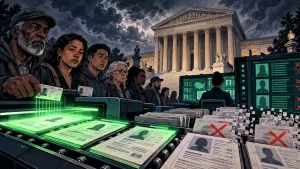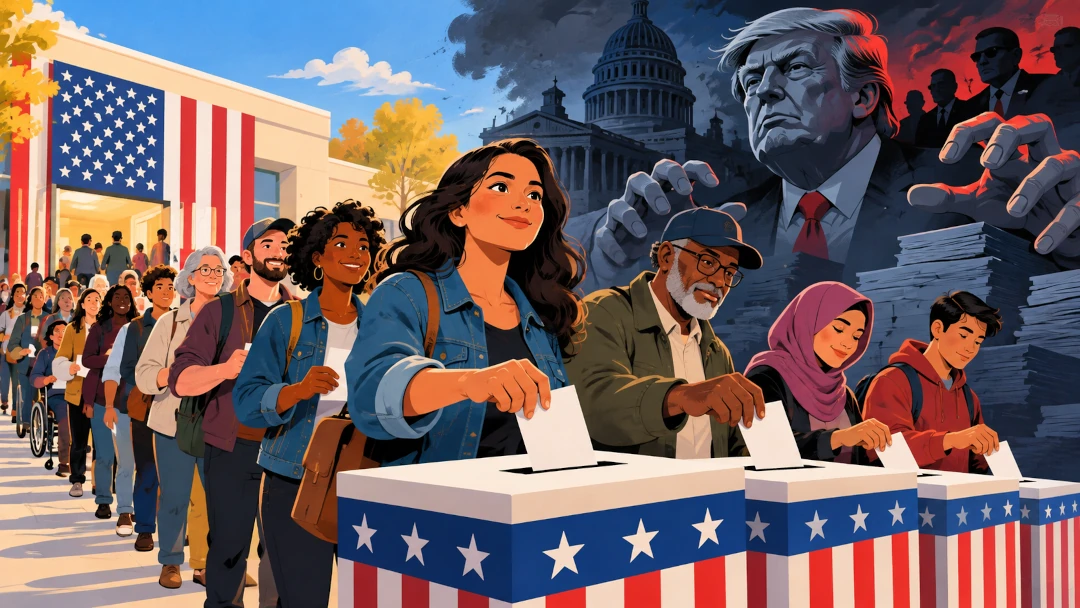
The Early Vote Is Roaring. The President Is Fighting the Count.
Thirteen days out, record lines in Texas and a lopsided Democratic surge in North Carolina match what polls and prediction markets have been saying for weeks. Republicans are betting on Election Day. The administration, meanwhile, is suing states, demanding voter rolls and refusing to rule out federal agents at the polls.
Voters are not waiting for permission. According to NBC News’ national early-vote tracker, more than 14.4 million Americans have already cast ballots, about 9.1 million by mail and 5.3 million in person, and more than 56 million mail ballots have been requested or sent. Those numbers will climb every day between now and November 3. What they already show is an electorate that is angry, organized and, in the states where we can see party registration, leaning hard toward the party out of power.
That matters because this midterm is about more than which party holds the gavel. It is a referendum on a presidency that has taken the country into a war with Iran, pushed gasoline above four dollars for months and spent its political energy trying to rewrite how Americans vote. The early vote is the first hard evidence of how the public is answering.
I. The Turnout Story: Records, Then More Records
Start in Texas, where early voting opened Monday. ABC13 Houston reports that Harris County logged 104,659 in-person voters on day one, shattering the 2018 midterm record of 63,188, then posted 99,911 on day two, another record. Counting mail ballots, 232,119 Harris County residents had voted after two days. Statewide, the Texas Secretary of State counted 911,468 early voters in the same window.
North Carolina is running even hotter. ABC11 reported 525,970 ballots cast through Sunday, more than 37% above the same point in 2022. Catawba College political scientist Michael Bitzer told the station, “These numbers are really set to break some records.”
Harris County, TX
Day-one in-person voters, versus the prior midterm record of 63,188 set in 2018. Via ABC13.
North Carolina overall
Ballots cast through Sunday compared with the same point in the 2022 midterms. Via ABC11.
NC two-party split
Democrats’ share of ballots cast by the two major parties, the most lopsided split at this point since at least 2006. Via G. Elliott Morris.
NC change since 2022
Democratic ballots up from roughly 157,000 to 240,000; Republican ballots down from about 112,000 to 103,000. Via G. Elliott Morris.
Iowa in-person turnout
Registered Democrats’ early turnout as a share of their 2024 level, against Republicans’ share. Via CNN.
Georgia
Early ballots cast so far, a record the Republican National Committee credits to the president’s visits. Via Fox News.
II. Which Way the Early Vote Leans
Most states do not register voters by party, so the clearest partisan picture comes from places that do. In North Carolina, analyst G. Elliott Morris found registered Democrats casting 45.7% of ballots, unaffiliated voters 34.6% and Republicans just 19.6%. Democrats make up under half of the state’s active two-party registrants but have cast 70% of the two-party ballots. In Iowa, CNN found registered Democrats turning out at 85% of their 2024 early pace while Republicans managed only 52%.
We should be honest about what this does and does not prove. Democrats have voted early in larger numbers than Republicans since 2020, and Morris himself notes that North Carolina’s final 2024 electorate came in less Democratic than its registration and that Trump carried the state. Party registration is not vote choice. Some of the shift is also a change in method. The Hill reports that an NBC News analysis found North Carolina Democrats’ mail-ballot requests are 40% lower than at this point in 2022, as voters shift from the mail to early in-person voting.
Even with every caveat applied, the Republican problem is visible. Their ballots are not merely being outnumbered; in North Carolina they are below their own 2022 pace. A party that is counting on Election Day to make up a deficit this large is counting on voters who, so far, have chosen to stay home.
III. What the Polls and the Markets Say
Every major indicator points the same direction. Nate Silver’s forecast, summarized by The Conversation, gives Democrats a 94% chance of winning the House and a 75% chance of winning the Senate, with a likely-voter generic ballot lead of 9.6 points, 51.3% to 41.7%. The model treats Democrats as Senate favorites with a lead of just five to six points nationally, and it puts their odds at 88% if the polls are basically right.
Bettors agree. Kalshi traders on October 21 priced Democratic control of the House at 91% and the Senate at 65%. Polymarket showed nearly identical odds on October 19, with seat projections of 234 Democrats to 201 Republicans in the House and a 52–48 Democratic Senate.
| Projection | House: Dem. chance | Senate: Dem. chance | Source |
|---|---|---|---|
| Kalshi (Oct. 21) | 91% | 65% | Prediction market |
| Polymarket (Oct. 19) | 91% | 65% | Prediction market |
| Silver Bulletin model (Oct. 18) | 94% | 75% | Polling forecast |
The Senate map has blown open. The Cook Political Report now rates seven races as toss-ups: Alaska, Iowa, Kansas, Maine, Michigan, Ohio and Texas. Six of those seats belong to Republicans. New polling from Cook and its partners, reported by Political Wire, shows Democrat James Talarico leading Ken Paxton 49% to 44% in Texas, Sherrod Brown ahead of Sen. Jon Husted 49% to 43% in Ohio, and Josh Turek edging Ashley Hinson 46% to 44% in Iowa.
Behind all of it sits the president’s own standing. The Silver Bulletin approval average hit a new all-time low this week at a net −24.3, and the New York Times has noted that only Harry Truman entered a midterm since 1946 with a worse rating. Sen. Thom Tillis, the North Carolina Republican who is retiring, has gone further than any pollster: in a new book, reported by Spectrum News, he predicts an electoral bloodbath for his party and says he regrets voting to confirm Robert F. Kennedy Jr. and Pete Hegseth.
IV. The Fight Over the Ballot Itself
The most alarming story of this election is not about who is winning. It is about an administration using the machinery of the federal government to reach into an election already underway. The record of the past seven months reads like a campaign against the count.
- March 2026Trump signs an executive order targeting mail voting, directing the Postal Service to restrict mail ballots, citing fraud claims that have never been substantiated. (The Hill)
- September 2026The Supreme Court refuses to restore the Postal Service plan, the administration’s third trip to the emergency docket, with Justice Brett Kavanaugh joining the majority. (The Hill)
- October 9A federal judge rules the Justice Department’s voter-roll program unlawful, finding that running state lists through the SAVE citizenship database violates voter privacy and intrudes on state authority. The department has sued 30 states and D.C. for their rolls. (Brennan Center)
- October 13DOJ mails Los Angeles County a thumb drive said to list 20,000 “likely noncitizens,” with its password written on a sticky note, and demands action within 48 hours. (Votebeat)
- October 15DOJ sues California, asking a judge to segregate up to 20,000 live ballots, and threatens to prosecute election officials who count them. (Votebeat)
- October 19A federal judge leaves North Carolina’s new mail-ballot restrictions in place, rules changed just before ballots went out in September, saying it is too close to the election to change them again. (The Hill)
- October 21Democrats sue Trump and the Justice Department, alleging a “persistent stream of threats and intimidation” aimed at forcing states to purge voters. (Washington Post)
Get Involved Today
Contribute to our mission and turn your concerns into action.
The California episode deserves particular scrutiny. Votebeat reports that the administration claimed in July to have found more than 190,000 potential noncitizens on California’s rolls, never handed over that list, and then arrived at 20,000 without explaining the drop. When similar lists were checked in Nevada, few if any of the names turned out to be noncitizens. Stephen Richer, a former Republican election official in Arizona now at the Cato Institute, called the effort to sequester live ballots new territory for this administration. David Becker of the Center for Election Innovation and Research said the department appeared to wait until the last minute to cause maximum chaos.
“A totally unprecedented request that should scare the hell out of every American.”
— California Gov. Gavin Newsom, on the DOJ lawsuit, via Votebeat
Then there is the threat of federal agents at the polls. In a survey of 31 election experts by Votebeat, 19 said it was at least somewhat likely the federal government would deploy military or law enforcement personnel at or near polling places, and 18 thought it at least somewhat likely Trump would ask agents to seize ballots or equipment after the election. The administration has said it has no plans to do so but has declined to rule it out. Every expert surveyed expects at least one congressional or statewide result to be challenged in court, and 23 expect a significant number of losing candidates to claim fraud. The same experts, to their credit, are confident the results will hold: 26 of 31 say it is unlikely any result will be overturned.
Who actually runs American elections
- The Elections Clause (Art. I, § 4)
- The Constitution gives states the power to set the “times, places and manner” of congressional elections and gives Congress, not the president, the power to alter those rules. An executive order cannot rewrite how a state conducts its vote. That is why the Postal Service plan to carry out the mail-ballot order remains blocked for this election.
- Troops and armed agents at the polls (18 U.S.C. §§ 592–593)
- Federal law makes it a crime for anyone in federal civil or military service to station troops or armed men at a polling place, except to repel armed enemies of the United States, and separately bars the armed forces from interfering with voting.
- Voter intimidation (18 U.S.C. § 594; 52 U.S.C. § 20511)
- Intimidating, threatening or coercing anyone to interfere with their right to vote in a federal election is a federal crime. Threatening to prosecute local officials for counting lawful ballots sits uneasily beside these protections, which exist to shield the people who run elections as much as the people who vote in them.
- Privacy and the federal-state line
- Courts in at least 11 states have refused to force voter lists into federal hands, and on October 9 a federal judge held the SAVE-matching program itself unlawful. Election law experts Michael Morley of Florida State and Richard Hasen of UCLA both predict the courts will reject the California ballot request. The law is on the side of the count. The danger is that the administration does not have to win in court to sow doubt; it only has to make the attempt.
V. The Democratic Ground Game
Democrats have built their closing argument around costs and around Trump himself. Since the war with Iran began in late February, gasoline has stayed above $4 a gallon for a record 158 consecutive days, according to GasBuddy data reported by Yahoo News, after averaging $2.98 just before the first strikes. Inflation climbed from 2.4% in February to 4.2% by May. The president’s answer has been to insist that prices “are lower than when Biden was president.”
The Democratic National Committee began its turnout push early. Its “100 Days Out” weekend in July launched more than 400 canvassing, phone-banking and registration events across 42 states, with Chair Ken Martin declaring that Democrats were “all gas, no brakes,” according to the DNC. Candidates are making Trump’s record the center of the race, tying Republican control of Congress to higher costs and the war. Outside money has arrived as well: Fox News reports that Michael Bloomberg has put an estimated $80 million behind Democrats.
VI. The Republican Bet on Election Day
Republicans have a real financial edge. Fox News reports that the RNC has dramatically outraised the DNC this cycle, even as many individual Democratic candidates have outraised their opponents. The party’s field strategy, detailed by NOTUS, focuses on “low propensity” voters, mostly blue-collar men and Hispanic voters who backed Trump in 2024 but often skip midterms. Their closing message centers on immigration, affordability and disaster recovery, and on the warning that Democrats would unwind the president’s agenda.
The party insists the early numbers will turn. RNC spokesperson Natalie Baldassarre told Fox News that “Republicans are energized to get to the polls” because of the president’s visits. Yet the money tells a quieter story: ABC11 reports Republicans shifted funding away from North Carolina before Trump’s Tuesday rally there, a retreat from a state the party once expected to hold. Swing Left’s Yasmin Radjy, whose group is helping Democrats, told NOTUS the GOP operation is “a consulting revenue stream dressed up as a turnout program.”
VII. The President’s Priorities
Trump promised to campaign in the 35 most competitive districts. He started instead in Durant, Oklahoma, and Mobile, Alabama, two of the safest Republican places in the country, as the AP reported via PBS. White House officials have since told NBC News he will push through at least 17 states. In a high school gym near Dayton, rallying for Sen. Jon Husted and gubernatorial nominee Vivek Ramaswamy, he predicted Republicans would defy expectations. On Tuesday he was back in Greenville, North Carolina, for his second visit to the state.
“When I run, we win.”
— President Donald Trump, Vandalia, Ohio, Oct. 3, via NBC News
That line explains the whole campaign. The president is not running on what he has delivered for voters; he is running on himself, in rooms full of people who already agree with him. When his Energy Secretary, Chris Wright, said gas might not fall below $3 until 2027, Trump called him wrong, The Hill reports, rather than address the cause. And while Americans pay for an open-ended war at the pump, the administration’s energy has gone to a monumental arch in Washington and lawsuits against state election officials. Western Carolina University political scientist Christopher Cooper, one of the experts in Votebeat’s survey, put the mood plainly: “It just seems that Trump has moved on,” pointing to the arch the president wants built.
This is the leadership question on the ballot. A president who sees an election he is likely to lose and responds by attacking the count, rather than by changing course on prices or the war, is telling the country what he values. Voters are telling him what they value in return.
VIII. What Comes Next
Expect the early-vote gap to narrow as Republicans who prefer to vote in person turn out on November 3. Expect slower counts in states that cannot process mail ballots before Election Day, and expect the president and his allies to treat that delay as evidence of wrongdoing, as they did in 2020. Expect courtroom fights over California’s ballots and over voter rolls, and expect at least one close race to end up before a judge. None of that changes the math that voters are writing right now. It only means that the vote has to be protected all the way to certification.
IX. What You Can Do
The single most powerful act is to vote, early if you can. But the people running this election are also asking for help, and there is more to do than cast one ballot. Here is an honest look at the options.
- Vote early and make a plan.
Rules and deadlines differ by state and they change, so check your state’s official election site or vote.gov for early-voting hours and locations. Early in-person voting avoids Election Day lines and any mail delays. - If you vote by mail, track it and return it in person if you can.
Most states let you track your ballot online and return it at a drop box or election office. Given the attacks on the Postal Service, hand delivery removes one point of failure. - Know your rights at the polls.
Federal law bars armed agents from polling places and makes voter intimidation a crime. If anyone tries to block or frighten voters, report it immediately to poll workers and your local election office, and write down what you saw. - Bring infrequent voters with you.
The early data show the electorate is decided by who shows up. A text, a phone call or a ride to the polls for a neighbor who usually skips midterms is worth more than any yard sign. - Defend the count after November 3.
Volunteer as a poll worker or with a nonpartisan election-protection group, and be ready to call your senators if federal officials try to seize ballots or delay certification. Sen. Alex Padilla and two colleagues have already asked Attorney General Todd Blanche to publicly commit not to seize ballots; public pressure keeps that commitment alive.
Editorial Conclusion
The voters have started talking, and they are speaking loudly. Record lines in Texas, a Democratic surge in North Carolina and a president at historic lows all point to an electorate demanding a check on power. The administration’s answer has been to sue states, demand voter files and threaten the officials who count. That is not how a confident government behaves; it is how a government afraid of its own citizens behaves. The task for the next thirteen days is simple and non-negotiable: vote, bring others to vote, and make sure every lawful ballot is counted and certified. A free election is not a gift from the president. It belongs to the people, and the people are using it.
Sources & References
- NBC News · Tracking the 2026 early vote
- ABC13 Houston · Harris County sets early-voting records
- ABC11 Raleigh-Durham · Trump returns to North Carolina as early turnout surges
- G. Elliott Morris / Strength In Numbers · Republicans are skipping early voting
- CNN · Early voting data shows Democratic advantage in two states
- Fox News · Trump heads to North Carolina as GOP fights to hold Senate
- The Hill · NC mail-ballot restrictions to remain through midterms
- The Conversation · Democrats remain clear favourites to gain control of Congress
- Kalshi · 2026 midterm election odds
- Yahoo News · Latest midterm polls and election odds
- Cook Political Report · 2026 Senate race ratings
- Political Wire · Democrats lead in key red-state Senate races
- Silver Bulletin · How popular is Donald Trump?
- Spectrum News · Tillis book predicts GOP losses, criticizes Trump appointees
- The Hill · Supreme Court won’t restore Trump’s mail-in voting plan
- Brennan Center for Justice · Tracker of DOJ requests for voter information
- Votebeat · Trump lawsuit against California heads for uncharted territory
- Votebeat · 31 election experts on whether Trump will interfere
- The Washington Post · Democrats sue Trump, DOJ over effort to remove voters
- Yahoo News · Trump’s Iran war leads gas prices to a dreadful new record
- Democratic National Committee · DNC launches 100 Days Out Weekend of Action
- NOTUS · Inside Republicans’ plan to win the midterms
- PBS NewsHour / AP · Trump starts in deep red states instead of battlegrounds
- NBC News · Trump, campaigning in Ohio, predicts a ‘big surprise’
- The Hill · Wright defends gas-price record amid Iran war
Related News