The Purge Machine Gets a Green Light: Six Justices Hand Trump the Keys to the Voter Rolls
The Supreme Court has revived a citizenship database that has already flagged real Americans as foreigners, and it did so with the midterms weeks away. The ruling is narrower than the White House will claim, but it arms a president who has spent two years insisting that any election he loses must be stolen.
On Friday, a divided Supreme Court handed Donald Trump one of the tools he has wanted most in his crusade against the American ballot. In a 6–3 emergency order, with the Court’s conservatives in the majority, the justices permitted the administration to use an expanded federal database of citizenship information even as the president urges states to purge people from their voter rolls. The order pauses a June ruling by U.S. District Judge Sparkle Sooknanan, who found that the administration had “knowingly trampled on the privacy rights of American citizens” in a way that threatens the right to vote.
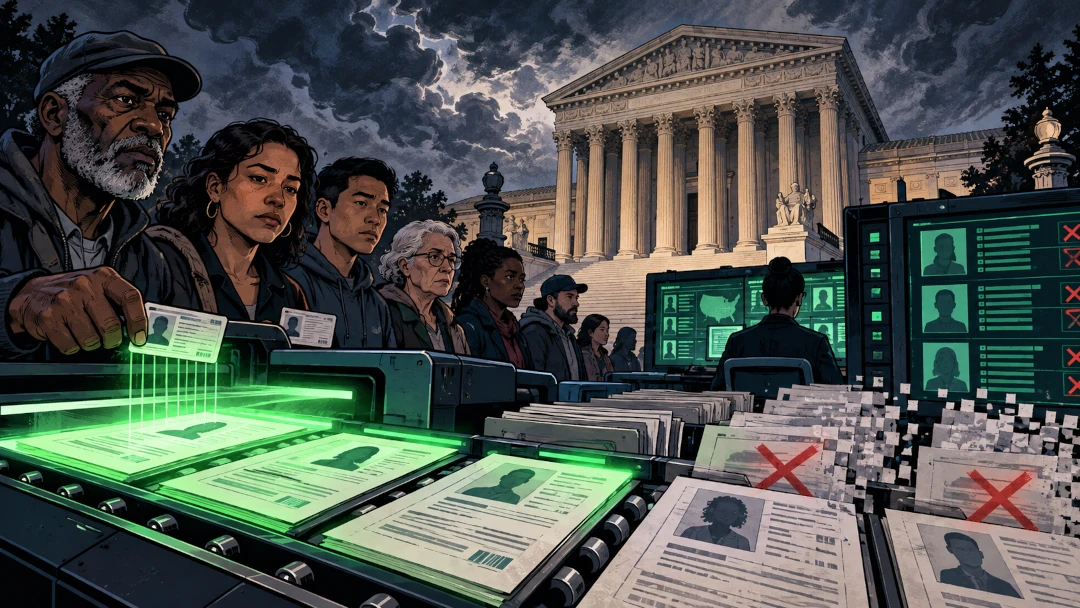
The database is called SAVE, the Systematic Alien Verification for Entitlements program. Congress created it in 1986 for a modest purpose: letting agencies check a person’s immigration status when they applied for public benefits. Under Trump, it has been rebuilt into something its creators never imagined, a national dragnet that runs the names of American voters against federal records. According to the Associated Press, at least 67 million voter registrations have already been scanned through the overhauled system.
Sixty-seven million. That is roughly one of every three registered voters in the country, fed into a machine that the administration’s own officials concede is imperfect, operated by a president who has made the fantasy of mass noncitizen voting a cornerstone of his political identity. The Court’s order does not end the legal fight. It does, however, tell us a great deal about where power is flowing in this country, and about the priorities of the man wielding it.
I. What the Court Allowed, and What It Didn’t
Precision matters here, because the administration will not offer it. The Court did not rule that voter purges are lawful, and it did not rule on the final merits of the case. It granted a stay, an emergency pause, while the litigation continues. The Guardian reports that the order sends the case back to the D.C. Circuit Court of Appeals to be heard.
But the majority’s reasoning was sweeping, and it should alarm anyone who cares about privacy or the franchise. The unsigned order said the voting-rights groups’ legal claims are likely to fail on the merits and signaled the Court expects to reverse the lower court’s finding that the revamped system broke federal law. The majority leaned on a 1996 immigration statute, reasoning that the federal government is obligated to answer state and local election officials who ask it to verify a voter’s citizenship. As the majority put it, “Congress necessarily authorized DHS to request and receive that information” from other agencies, including Social Security.
Allowed: Individual Checks
States and localities may again run individualized inquiries through the revamped SAVE system. The majority faulted the lower court for blocking even these case-by-case checks, which NPR reports the justices said federal law permits during the pre-election window.
Allowed: Cross-Agency Data
The majority concluded that federal law lets DHS pull citizenship data from other agencies, such as the Social Security Administration, into SAVE. That was the heart of the privacy challenge, and the Court signaled it will side with the administration.
Not Allowed: Mass Purges Now
The National Voter Registration Act bars systematic removals from the rolls within 90 days of a federal election. Democracy Docket notes the country is already inside that “quiet period,” so wholesale purges before November 3 remain illegal.
Not Required: State Participation
States’ use of SAVE is voluntary. Maine’s Democratic Secretary of State Shenna Bellows, who has refused to participate, said the ruling “does not force states to change the way we run our elections.”
So the immediate midterm impact may be limited. That is the good news, and it is real. The bad news is that the Court has blessed the architecture. Individualized challenges can still knock eligible citizens into bureaucratic limbo in the final weeks of an election. And once November passes, the 90-day shield falls away, leaving a federally sanctioned purge tool in the hands of any secretary of state willing to use it.
II. The Machine Trump Built
To understand what this ruling unlocks, it helps to see the database as one gear in a larger mechanism. In March 2025, Trump signed an executive order that, as ProPublica and The Texas Tribune documented, required DHS to give states free access to federal citizenship data. The same investigation found that DHS rushed the rebuilt tool into service while it was still adding data, and that the department has had to correct information sent to at least five states after SAVE misidentified voters as noncitizens.
Meanwhile, the Justice Department has been demanding complete state voter files. The Brennan Center’s tracker reports that at least 16 states have handed over, or pledged to hand over, full registration lists that include driver’s license and Social Security numbers, and that a DOJ official told a federal court the department planned to run that data against SAVE. Common Cause sued in April to stop what it describes as the construction of a national voter database. Once uploaded, NPR reported, voter data is retained in SAVE for ten years, and a DHS notice said it could be shared with other agencies for purposes including auditing voter registration records.
Then came the whistleblower. In August, DHS launched its own hunt for noncitizens on state rolls. A federal whistleblower alleged, according to ABC News, that Citizenship and Immigration Services employees were directed to pose as individual voters to pull records from state lookup tools, and that when officers worried about legal liability, leadership told them to proceed. The Justice Department subsequently acknowledged in court filings that DHS agents had used Social Security data in the search, even while SAVE’s expansion was blocked.
- March 2025Trump signs an executive order directing DHS to open federal citizenship data to states for voter checks.
- Late 2025DHS publishes a belated notice saying SAVE data may be shared for voter-roll auditing and kept for a decade.
- December 2, 2025Rep. Nikema Williams and nine House Democrats warn DHS the overhaul violates the Privacy Act.
- February 2, 2026Trump says Republicans should “nationalize the voting” in at least 15 places.
- April 21, 2026Common Cause sues DOJ to block a national voter database run through SAVE.
- June 22, 2026Judge Sooknanan blocks the revamped SAVE; the D.C. Circuit declines to pause her ruling.
- August 2026DHS opens its own noncitizen-voter probe; a whistleblower calls it rushed and error-ridden.
- Early September 2026DHS Secretary Markwayne Mullin says ICE agents could be stationed at polling places nationwide.
- Mid-September 2026The Supreme Court rejects Trump’s bid to restrict mail-ballot procedures before the midterms.
- September 25, 2026The Court, 6–3, stays Sooknanan’s order and revives the expanded SAVE system.
III. The Voters in the Crosshairs
Defenders of the program talk about “clean rolls” as if the only people who could be caught are noncitizens. The evidence says otherwise. In Travis County, Texas, officials investigated 97 voters that SAVE flagged as apparent noncitizens and found that at least 10 percent, and likely as many as 21 percent, were U.S. citizens. Travis County urged the Supreme Court to reject the administration’s appeal.
Behind those percentages are people. In Denton, Texas, a 29-year-old South African-born voter named Anthony Nels, who became a citizen more than a decade ago, was flagged by SAVE and had his registration temporarily canceled until he could replace an expired passport, the Associated Press reported. The pattern is not random. Naturalized citizens have been disproportionately and falsely flagged, because immigration records often fail to reflect that a green-card holder later became an American.
Even Republicans who administer elections are uneasy. Stephen Richer, the former GOP recorder of Maricopa County, Arizona, said the ruling could help if handled carefully, but warned that SAVE has repeatedly proven to be “a highly-imperfect tool” that should be only a starting point, never a verdict on anyone’s citizenship.
Now weigh that error rate against the problem it purports to solve. The AP notes that Georgia found 20 noncitizens among 8.2 million registered voters before 2024, and that even with the administration laser-focused on the issue, DHS’s nationwide investigations have produced 160 arrests. Secretary Mullin’s summertime suggestion that as many as 250,000 noncitizens might be registered across four states was unsubstantiated and baffled the very election officials who keep those rolls. A system that wrongly flags citizens at double-digit rates to hunt for a problem measured in the dozens is not an integrity measure. It is a filter, and we should ask who it is designed to catch.
IV. The Constitutional Fault Lines
The legal challenge to SAVE rests on several pillars, and the Supreme Court’s order touched only some of them. The first is statutory privacy. Voting and privacy groups, led by the League of Women Voters, argue that folding Social Security and other agency records into a voter-screening tool violates the Privacy Act of 1974. Judge Sooknanan agreed. So did Justice Ketanji Brown Jackson, who wrote in dissent, joined by Justices Sotomayor and Kagan, that the database has long been understood to fall under federal privacy law.
The second is structural. The Constitution’s Elections Clause gives the “times, places and manner” of congressional elections to state legislatures, subject to Congress. It gives the president no such role. As the AP observed, most of Trump’s second-term attempts to overhaul elections have been struck down precisely because the Constitution grants election authority to the states and Congress, not to the president. The plaintiffs frame the SAVE overhaul as an unconstitutional attempt to usurp that authority through the back door of data.
“The harm caused by burdening or disenfranchising even a few lawful voters…”
— Justice Ketanji Brown Jackson, dissenting, as quoted by PBS News / AP. She concluded that such harm outweighs any injury to a government blocked from acting beyond its likely authority.
The third pillar, which we believe courts will ultimately have to confront, is equal protection and due process. When a government tool systematically misidentifies naturalized Americans as foreigners, it creates two classes of citizens: those born here, whose registrations are presumed valid, and those who took the oath, whose registrations are presumed suspect. Requiring the second group to produce fresh documentary proof on short notice, as some Texas counties have done, imposes a burden on the franchise that falls along lines of national origin. The Fourteenth Amendment was written to forbid exactly that kind of second-class citizenship.
Finally, there is the NVRA’s 90-day quiet period. It is the strongest shield voters have this fall, and the Court acknowledged it. But a shield that expires every November is not a guarantee. It is a countdown.
V. Congress Responds, and Divides
Democrats reacted swiftly. Democratic National Committee chair Ken Martin called the ruling “an outright attack on the sacred right to vote” and accused Trump of trying to suppress the vote through gerrymandering, purges, and debunked conspiracy theories. The plaintiffs’ coalition, meanwhile, pledged to keep fighting to restore the district court’s ruling on the merits.
In the Senate, the resistance has been led by Alex Padilla of California, the top Democrat on the Rules Committee. Just two days before the ruling, Padilla again blocked a Republican attempt to advance the SAVE Act, warning that changing voting rules mid-election would sow chaos over mail and absentee ballots. Padilla and Senate Democratic Leader Chuck Schumer had already written to Secretary Mullin demanding that DHS halt its voter probe, and Padilla and Sen. Adam Schiff this week asked California Attorney General Rob Bonta to investigate how DHS obtained Californians’ voter information after the DOJ failed to compel the state to hand it over.
In the House, Rep. Nikema Williams of Georgia and nine colleagues, including Reps. Paul Tonko of New York and Lloyd Doggett of Texas, warned DHS nearly a year ago that the overhaul was an assault on the Privacy Act and an affront to congressional power. Events have vindicated them.
Republicans, by contrast, cheered. Jason Snead of the conservative Honest Elections Project said the ruling simply makes it easier for states to get citizenship data to “clean up voter rolls,” and DHS general counsel James Percival mocked the need to go to the Supreme Court at all. Texas filed a brief defending the database. What Republican leaders have not offered is any account of the citizens their tool has already wrongly flagged, or any commitment to protect them.
Get Involved Today
Contribute to our mission and turn your concerns into action.
VI. The Midterms, the Parties, and the Long Game
Why the urgency? Consider the political terrain. A PBS News/NPR/Marist poll released this week found Democrats leading the generic congressional ballot 53 percent to 41 percent, with independents favoring Democrats by 25 points. Trump’s approval stands at 39 percent, and 53 percent of voters strongly disapprove of his performance, the highest share Marist has recorded across both his terms. Inflation sits at 3.4 percent, driven in part by tariffs and the war in Iran.
A president confident in his record would campaign on it. This one is working the referees and the rulebook. In February, Trump told Dan Bongino that Republicans should seize control of elections in at least 15 places, declaring in words recorded by Yahoo News:
“The Republicans ought to nationalize the voting.”
— President Donald Trump, February 2, 2026, via Yahoo News / YouGov
His allies filled in the rest. Steve Bannon told his podcast audience that “ICE surround the polls” would be the plan come November. Secretary Mullin has since said ICE agents could be stationed at polling places nationwide, prompting Denver and a coalition of advocacy groups to sue; federal law forbids armed men at polling sites except to repel enemies of the United States. CNN has catalogued the more extreme scenarios Trump allies have floated or lobbied for, from seizing ballot boxes to declaring a national election emergency, while the president stays coy.
Put the pieces side by side: a national citizenship database, federal agents at the polls, a demand to “nationalize” voting, and an unbroken insistence that elections he loses are fraudulent. Each piece alone can be explained away. Together they describe a strategy. If Republicans hold on in November, the database will have “confirmed” the integrity of the vote. If they lose, the same database will supply thousands of flagged names to wave as “proof” the election was stolen. Either way, the machine produces the narrative Trump needs.
For the Republican Party, this is a dangerous bet. Its brand is now fused to a president whose tactics a majority of voters reject; 59 percent of Americans oppose his call for a federal takeover of voting. For Democrats, the lesson is that polling leads are not self-executing. Registration checks, voter education in naturalized-citizen communities, legal observers, and fierce state-level defense of the rolls are now as essential as any campaign ad.
And for the country, the question is simpler. With gas prices up, inflation stubborn, and a war dragging on, the federal government has poured personnel, data, and emergency Supreme Court petitions into hunting a phantom menace of noncitizen voters. Those are the priorities of a leader focused not on governing Americans, but on choosing which of them get to vote.
When the Commander of the Government Turns It Against the Governed
The mechanism
Section 4 of the 25th Amendment allows the vice president and a majority of the Cabinet to declare in writing that the president is “unable to discharge the powers and duties of his office.” The vice president immediately becomes acting president. If the president contests the declaration, Congress decides, and keeping him sidelined requires a two-thirds vote of both chambers. Section 4 has never been invoked.
Who has called for it
More than 85 House and Senate Democrats called for Trump’s impeachment or removal after his April threat that “a whole civilization will die” in Iran, and House Democrats led by Rep. Jamie Raskin introduced a bill to create a commission to assess invoking the amendment, Axios reported. Rep. Raja Krishnamoorthi called on Vice President JD Vance and the Cabinet to act, citing “a dangerous pattern of reckless escalation, erratic decision-making” that raises grave questions about his fitness. Rep. Jasmine Crockett sent Vance a formal letter urging Section 4, and Sen. Ed Markey and Reps. Yassamin Ansari, Eric Swalwell, and Sydney Kamlager-Dove made similar calls in January.
The argument this episode adds
Those calls centered on war and erratic threats. The voter-database saga adds a different and quieter kind of evidence. “Unable to discharge the powers and duties” is not limited to physical collapse; the duties include taking care that the laws be faithfully executed, and the first of those laws is the Constitution, which keeps election administration out of the president’s hands. A chief executive who remains fixated on a noncitizen-voting epidemic that his own agencies cannot find, who directs federal machinery against his own citizens on the strength of that fixation, and who publicly demands a partisan takeover of elections is displaying the kind of sustained detachment from fact that the amendment’s framers had in mind when they worried about a president who could no longer govern in reality. The judgment it demands is about capacity to lead lawfully, and the record raises that question with growing force.
The honest barriers
The obstacles are formidable. CNN notes that removal requires the vice president and a majority of the Cabinet, and there is no sign that any Cabinet officer or Vice President Vance is considering it. Congress is controlled by Republicans, and a two-thirds threshold in both chambers is out of reach. Scholars and critics also warn, with some force, that Section 4 was designed for incapacity rather than for policy disagreement, and that stretching it risks turning a safety valve into a partisan weapon. The voters, not the Cabinet, will render the most consequential verdict this fall.
Why the case still matters
None of that makes the question illegitimate. The 25th Amendment is a statement of what the Constitution expects of those closest to the president: that they will not look away when the office is being used against the republic it serves. Every official who helps build a purge machine on a fantasy, and every Cabinet member who stays silent while federal agents are threatened at the polls, is making a choice. Naming the constitutional remedy, even when it is out of reach, keeps that choice visible and keeps the burden where it belongs.
Editorial Conclusion
A database that mistakes citizens for foreigners has no business deciding who votes.
The Supreme Court has given Donald Trump a tool; it has not given him a mandate. Between now and November 3, the 90-day quiet period stands between his administration and mass purges, and every state that refuses to feed its voters into SAVE stands with it. Congress must write explicit privacy protections into law, states must refuse to treat a federal “flag” as proof of anything, and every eligible American should confirm their registration today.
The right to vote is not a privilege the president dispenses to citizens he trusts. It belongs to the people, and it is the one power he cannot take unless we surrender it. We will not.
Sources & References
- NBC News — Supreme Court allows Trump administration to use expanded database for potential voter purges
- CBS News — Supreme Court allows Trump administration to use SAVE database to check voter citizenship for now
- PBS News / AP — Supreme Court lets Trump administration use revamped federal voter eligibility database for now
- OPB / AP — Supreme Court lets Trump administration use revamped database (full AP report)
- NPR — The Supreme Court revives the controversial SAVE data system
- Democracy Docket — Supreme Court revives DHS use of flawed immigration database for voter purges
- The Washington Times — Supreme Court revives DHS’ database letting states check voters’ citizenship
- The Guardian (via inkl) — US supreme court lifts restrictions on controversial voter database
- NBC4 Washington / AP — Supreme Court lets Trump administration use revamped voter eligibility database
- ProPublica / The Texas Tribune — SAVE voter citizenship tool: mistakes and confusion
- NPR — SAVE voting data and U.S. citizens
- Brennan Center for Justice — Tracker of Justice Department Requests for Voter Information
- ABC News / AP — Voter probe may break state laws, wrongly implicate citizens, whistleblower alleges
- Democracy Docket — DOJ partially confirms DHS whistleblower allegations in new notice to federal court
- Office of Sen. Alex Padilla — Padilla once again defeats Republican efforts to advance SAVE Act
- Office of Rep. Nikema Williams — Williams leads opposition to DHS use of private data to purge voter rolls
- PBS News — Democrats hold midterm lead with independents breaking sharply against Trump
- Yahoo News / YouGov — Just 23% of Americans are confident the vote will not be ‘rigged’
- Newsweek — Trump’s voter fraud claims explained as he aims to “nationalize” elections
- U.S. News & World Report — Mail ballots, voter rolls and ICE: How Trump has tried to change the 2026 election
- CNN — Last-minute doomsday scenarios for the 2026 election
- Axios — House Democrats file long-shot 25th Amendment bill targeting Trump
- Office of Rep. Raja Krishnamoorthi — Krishnamoorthi calls for President Trump’s removal under 25th Amendment
- Office of Rep. Jasmine Crockett — Crockett calls on Vice President Vance, Cabinet to invoke the 25th Amendment
- Office of Rep. Sydney Kamlager-Dove — Media coverage: lawmakers call to invoke the 25th Amendment
- CNN — An eclectic, bipartisan group suddenly calls for removing Trump using the 25th Amendment
Related News