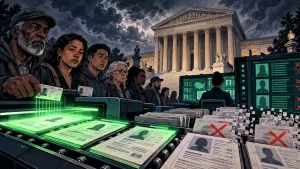
Eleven days before the election, the administration asked a federal court to stop Alaska from certifying its U.S. Senate race if the Republican incumbent loses narrowly. The president says he ordered it. It is the sharpest edge yet of a year-long campaign to put federal hands on the machinery of state elections, and it arrives as Democrats lead nationally and billionaire money floods in to save the GOP majority.
There is a word for a lawsuit that asks a court to block an election result only if one particular candidate loses. It is not “integrity.” On Thursday, the Department of Justice filed suit against Alaska’s election officials, asking a federal judge to bar the state from certifying its U.S. Senate race if Republican Sen. Dan Sullivan loses to Democrat Mary Peltola, and if the votes cast for a second, unrelated candidate named Daniel J. Sullivan would have changed the outcome. On Friday, President Trump removed any doubt about who was steering the department. Speaking to reporters as he landed for a Florida rally, he told the Associated Press that the lawsuit was his idea.
“I’m the one that said do it.”
— President Donald Trump, on the DOJ’s Alaska lawsuit · Oct. 23, 2026
The suit is not a one-off. It is the latest and most explicit step in a campaign that began with an FBI raid on Georgia ballots in January, moved through executive orders, voter-roll lawsuits and armed federal agents at Americans’ front doors, and now reaches the final act of any election: certification. For the first time, the federal government has asked a court, in advance, to hold a state’s result hostage to the president’s preferred outcome.
I. The Lawsuit: A Preemptive Strike on Alaska’s Count
The facts are narrow, which is what makes the lawsuit so revealing. Daniel J. Sullivan, a retired teacher from the fishing town of Petersburg, filed to run for the Senate in May. Republicans immediately alleged he was a Democratic plant. Sen. Sullivan himself accused the newcomer of running to confuse voters; both Peltola’s campaign and the Alaska Democratic Party denied any involvement. Alaska’s Division of Elections, run under Republican Lt. Gov. Nancy Dahlstrom, initially moved to keep him off the ballot. A state trial judge disagreed, and on June 29 the Alaska Supreme Court ordered that he be allowed to run.
He did. In the August primary, the senator drew more than 68,000 votes and Daniel J. Sullivan drew 4,107, about 2 percent of the total. On the general-election ballot, the incumbent appears as the Republican; the other Sullivan appears with no party label at all. And because Alaska uses ranked-choice voting, a confused voter can simply rank both men.
None of that stopped the department. Its complaint, signed by Associate Attorney General Stanley Woodward, who represented Trump allies and January 6 defendants before joining DOJ, asks the court to block certification pending an “investigation” into whether ballots cast for Daniel J. Sullivan were meant for the senator. The department says it is acting under the National Voter Registration Act and calls the second Sullivan’s candidacy frivolous. The senator’s own campaign, notably, declined to say whether it supports the intervention; a spokesman told the AP only that it would let the complaint play out.
Hours before the suit was filed, Attorney General Todd Blanche told reporters it was never the department’s intention to improperly interfere with state certification, even as he left the door open to blocking certification in what he called a “doomsday scenario.” The timing speaks for itself. The challenge came months after the ballot was finalized, after Alaska’s highest court had ruled, and just as public polling showed the Republican trailing.
II. Standing, Statute, Constitution: Does DOJ Have Any Claim at All?
Election-law scholars across the spectrum have been unusually blunt. Justin Levitt, a former Justice Department official who served in the Obama administration, told NBC News that no law authorizes the department to challenge ballots or delay certification, adding that the administration has “absolutely no authority to tell Alaska when or how to certify” its Senate results. Notre Dame law professor Derek Muller told the AP the statute simply does not allow DOJ to enjoin certification, and predicted the case will either be mooted by the margin or dismissed next month. Another election-law professor told Newsweek the suit was meritless and frivolous and would likely be thrown out quickly.
Why the federal executive has no seat at Alaska’s certification table
- Art. I, §4 — The Elections Clause
- The Constitution assigns the “times, places and manner” of congressional elections to state legislatures, subject only to laws passed by Congress. The president appears nowhere in that clause. As courts have repeatedly reminded this administration, an executive order or a DOJ press release is not an act of Congress.
- Art. I, §5 — The Senate Judges Its Own Members
- Each chamber is the judge of the “elections, returns and qualifications” of its own members. If a genuine dispute about Alaska’s result existed, the Constitution routes it through state courts and, ultimately, the U.S. Senate, not through a pre-election injunction sought by the president’s lawyers.
- The National Voter Registration Act
- The statute DOJ invokes governs voter registration and the maintenance of voter rolls. It says nothing about which candidates may appear on a ballot, how a state tallies ranked-choice preferences, or when a state may certify. Experts quoted by NBC and the AP agree it provides no authority to freeze certification.
- Standing & Ripeness
- The injury DOJ alleges is hypothetical and contingent: it exists only if Sullivan loses, only by a narrow margin, and only if one assumes voters could not tell the “Republican” incumbent from an unaffiliated candidate. Federal courts do not decide speculative disputes, and the core question, whether Daniel J. Sullivan belongs on the ballot, was already answered under state law by the Alaska Supreme Court.
- The Late-Intervention Problem
- Federal courts have long been wary of changing election rules on the eve of voting. A suit filed eleven days out, after ballots are printed and mailed, asks a judge to do exactly what that caution forbids.
To be fair to the administration’s argument: crowding a ballot with a confusing name is a real tactic, and Alaska’s own Republican officials initially believed it was happening here. But that question had a forum, Alaska’s courts, and it got an answer. Nor is the tactic a one-party sin. The same AP report noted that Republicans have been linked to an effort to boost a socialist candidate in Ohio’s Senate race to help GOP Sen. Jon Husted. There is no federal lawsuit about Ohio. The only certification the Justice Department wants paused is the one its boss expects to lose.
III. A Pattern, Not an Accident: The Administration’s War on the 2026 Vote
Taken alone, the Alaska suit might be dismissed as a legal stunt. Taken in sequence, it is the capstone of a ten-month escalation in which nearly every federal lever available has been pulled toward the machinery of state elections.
IV. California: Threatening the People Who Count the Votes
If Alaska shows the endgame, California shows the method. On October 15 the Justice Department sued Secretary of State Shirley Weber and Los Angeles County Registrar Dean Logan, seeking to stop them from tabulating about 20,000 mail ballots the government flagged as belonging to “likely” noncitizens. The next day, acting Deputy Attorney General Trent McCotter sent a letter warning that election workers who knowingly process such ballots could face federal criminal investigation. The president reposted the letter with his own verdict.
“They will all go to jail for a long period of time!!!”
— President Donald Trump, on California election workers · Oct. 16, 2026
No one has been charged. Logan has said DOJ provided no underlying evidence or methodology for its list, and California’s attorneys argue the statute DOJ cites criminalizes noncitizen voting, not the clerks who process ballots. As States Newsroom calculated, even if every name on the list were a noncitizen, it would amount to roughly 0.08 percent of California’s 23.2 million registered voters. Asked about the suit, Attorney General Blanche told PBS, “We’re not trying to create chaos.” The track record suggests otherwise.
Voter-Data Lawsuits
All 23 federal district courts that have ruled on DOJ’s demands for state voter files have dismissed them. NPR
Mail-Ballot Order
The Supreme Court kept Trump’s Postal Service restrictions from applying to the midterms, with only Justices Alito and Thomas dissenting. FOX 10
DHS “Noncitizen” Lists
In Nevada, every person on one federal list sent back to the state turned out to be a U.S. citizen, PBS reported. PBS NewsHour
Door-to-Door Questioning
A federal judge limited DHS field interviews in nine states after finding citizens’ names on agency lists. PBS NewsHour
Alaska Ballot Access
Alaska’s Supreme Court already ruled that Daniel J. Sullivan could stay on the ballot, the question DOJ now wants a federal judge to relitigate. Ballotpedia
Scale of the “Problem”
DOJ’s California list, even if entirely accurate, equals about 0.08% of the state’s 23.2 million registered voters. States Newsroom
V. The National Map: Why Alaska Could Decide the Senate
The administration’s urgency is easiest to understand by looking at the polls. Democrats hold 47 Senate seats and need to flip four to take control. As of this week, Yahoo News’ polling roundup shows Democrats with a wave-sized lead of more than nine points on the generic congressional ballot, a lead that has grown over the past month. October surveys show Peltola ahead in Alaska by two to seven points. Sherrod Brown is edging Husted in Ohio, Roy Cooper leads comfortably in North Carolina, and Jon Ossoff holds a solid lead in Georgia, while Maine remains close.
In a chamber that could be decided by a single seat, a Senate race where Republicans expect to lose by a sliver becomes the most valuable piece of ground in the country. That is precisely the scenario the Alaska suit was drafted to cover: Notre Dame’s Muller noted it would only matter if Republicans narrowly lost. In other words, the lawsuit is not a response to confusion. It is a contingency plan for defeat, and it signals how the administration may treat any other close race that slips away on November 3. Alaska’s count, slowed by ranked-choice tabulation, is expected to take weeks, which gives a pending federal case ample time to cast a shadow over the result.
Get Involved Today
Contribute to our mission and turn your concerns into action.
VI. Democrats Fight Back: In Court, in Congress, at the Polls
Democrats have not waited for November. On October 20, Senate Minority Leader Chuck Schumer and House Minority Leader Hakeem Jeffries joined Democratic committees and a California voter in a federal lawsuit in Washington accusing the administration of intimidating election officials and asking the court to bar it from purging registered voters or interfering in the midterms. The Justice Department responded that its actions are grounded in law; DHS called the suit a political stunt.
That suit builds on months of preparation. In April, Schumer launched a Senate Democratic elections task force of at least 11 senators, and election lawyer Marc Elias, a member, told NPR his firm has been fighting what he views as early-stage interference across 87 lawsuits in 43 states. Sens. Alex Padilla, Mark Warner and colleagues have pressed DOJ on how its monitors are vetted and supervised, and a group of Democratic senators demanded Blanche publicly pledge that the department will not seize ballots or voting equipment before counting and certification are complete.
On Alaska specifically, the Democratic Senatorial Campaign Committee’s executive director, Devan Barber, called the filing “a sham lawsuit to overturn the will of Alaska voters.” State officials are holding the line too: Colorado Secretary of State Jena Griswold has called DOJ hostile to free and fair elections, while Los Angeles County says it has not stopped processing ballots. Even Kansas’s Republican secretary of state, Scott Schwab, chuckled to PBS that 1,000 monitors is not many for a country with so many voting jurisdictions.
VII. Follow the Money: A Few Billionaires Bankroll the Majority
While the Justice Department works the courts, a tiny circle of the ultra-rich is working the airwaves. Elon Musk poured more than $276 million into Republican groups in a single quarter, including $158 million to the Senate Leadership Fund, making him the biggest known donor of the midterms. CNBC notes he is doing so while his companies hold business ties to the federal government. His disclosed total for the cycle has reached at least $366 million, according to the Brennan Center, the largest giving by any donor in modern history.
The broader picture is just as stark. Outside spending by super PACs and other groups hit a record $2 billion through September, up 51 percent from the last midterms after inflation, and dark money has topped $1 billion. The Senate Leadership Fund raised a record $272.9 million last quarter, about $122 million more than its Democratic counterpart. The irony is telling: Democratic candidates are out-raising Republicans in most key Senate races and in 13 of 21 House toss-ups, powered by ordinary donors. The GOP’s answer is not more voters. It is more billionaires. And the president’s own super PAC, MAGA Inc., which he has openly described as his money, has become a major midterm player for the first time.
Put the two halves together and the strategy comes into focus. Where persuasion fails, outspend. Where outspending fails, contest the count. That is not a governing philosophy. It is an insurance policy against the voters.
VIII. What This Means for the Average American
You do not have to live in Alaska for this to be your fight. The principle the administration is testing, that the federal executive may ask a court to freeze a state’s election result until it is satisfied, would not stay in Alaska. If it works there, the template is ready for Georgia, Michigan, Maine, or anywhere a margin is thin. The tools have already been built: federal lists of “suspect” voters that courts have found riddled with citizens, threats of prison for the clerks who count ballots, and more than a thousand federal monitors assigned by a department whose leadership answers to a president who has now admitted ordering a lawsuit against a state’s count.
For ordinary voters, the practical danger is less about any one lawsuit succeeding, which experts doubt, and more about the cumulative chill: naturalized citizens hesitant to vote because an agent knocked on a neighbor’s door, election workers quitting under threat of prosecution, results delayed long enough for doubt to curdle into distrust. Each of those outcomes damages democracy without a judge ever ruling in the administration’s favor. That is why the most important safeguard is not in a courtroom. It is turnout so decisive that the “margin of litigation” disappears.
IX. What You Can Do
So far, courts have blocked nearly every major federal move against the midterms, and experts expect the Alaska suit to fail. But litigation is a backstop, not a strategy. Large, early, well-documented turnout, plus patience while officials count every lawful ballot, is the surest defense. Rules and deadlines differ by state, so confirm yours with your official state or county election office.
- Confirm your registration and make a plan todayCheck your status, polling place and deadlines through your state’s official election site via vote.gov. Decide when, where and how you will vote, and bring any ID your state requires.
- Vote early and track your ballotIf your state offers early voting or mail voting, use it, and return a mail ballot as soon as possible. Most states offer online ballot tracking so you can confirm your vote was received and counted.
- Know your rights at the pollsFederal monitors may observe, but federal law against voter intimidation applies to them too. If you face intimidation, are wrongly turned away, or are told you are not on the rolls, ask for a provisional ballot and call the nonpartisan Election Protection hotline at 866-OUR-VOTE.
- Report pressure at your doorIf anyone comes to your home questioning your right to vote, write down names, agencies and times, and report it to Election Protection and your local election office. Your eligibility is determined by your election officials, not by whoever knocks.
- Strengthen the system, and be patient with the countVolunteer as a poll worker through your county, support the local officials being threatened for doing their jobs, and refuse to share unverified fraud claims. In states like Alaska, full results take weeks. A slow count is a careful count, not a stolen one.
Editorial Conclusion
A government that asks a court to stop an election result only if its side loses has told the country exactly what it intends to do. The Alaska lawsuit has no footing in the Constitution, which hands elections to the states and seats to the Senate, and none in the statute it cites. It exists to manufacture doubt, to buy time, and to build a precedent for overruling voters anywhere a margin runs thin.
The answer must come from every direction at once: courts that dismiss these suits swiftly, state officials who certify lawful results on schedule, a Congress that refuses to seat anyone by federal fiat, and voters who turn out in numbers no lawsuit can erase. The question on November 3 is not only who wins. It is whether Americans still choose their leaders, or whether the president chooses which of our choices count.
Sources & References
- NBC News — Trump administration sues to block Alaska Senate certification if Republican Sen. Dan Sullivan loses in November
- PBS News / Associated Press — Trump says he ordered DOJ lawsuit over Alaska Senate race
- CNBC — Trump says he ordered DOJ suit to block Alaska Senate race certification if Republican loses
- The Hill — Justice Department sues to block Alaska results if Sullivan loses
- Newsweek (via Yahoo News) — Trump admin seeks to block Alaska Senate result if Dan Sullivan loses
- Ballotpedia News — Alaska Supreme Court orders second Dan Sullivan onto U.S. Senate ballot
- PBS NewsHour — DOJ monitoring plans and DHS voter checks raise concerns of election interference
- PBS News / Associated Press — Trump administration sues California to block counting of alleged noncitizen mail ballots
- ABC News — Trump administration threatens to prosecute local California election workers
- States Newsroom — Dems sue Trump, alleging election interference, as DOJ battles with California
- NPR — How Democrats in Congress are preparing for Trump midterm election interference
- Democracy Docket — Todd Blanche must confirm DOJ won’t seize ballots, senators demand
- WABE / Associated Press — Fulton County seeks return of 2020 election documents seized by FBI
- Reuters (via Yahoo News) — Trump says Republicans should ‘nationalize’ voting in at least 15 places
- FOX 10 Phoenix — Supreme Court rejects Trump’s mail-in ballot restrictions for now
- Yahoo News — The 2026 midterms are just 11 days away: what the latest polls say
- CNBC — Elon Musk gives $276 million to Republican groups, becomes biggest known 2026 midterm donor
- CNBC — 5 midterm money takeaways: Democrats have candidate cash. Republicans have Elon Musk
- Brennan Center for Justice — Big Money Breaks Records, Boosts GOP: 5 Things to Know About the Midterms
- Campaign Legal Center — Everything You Need to Know About DOJ Election Monitors
Related News