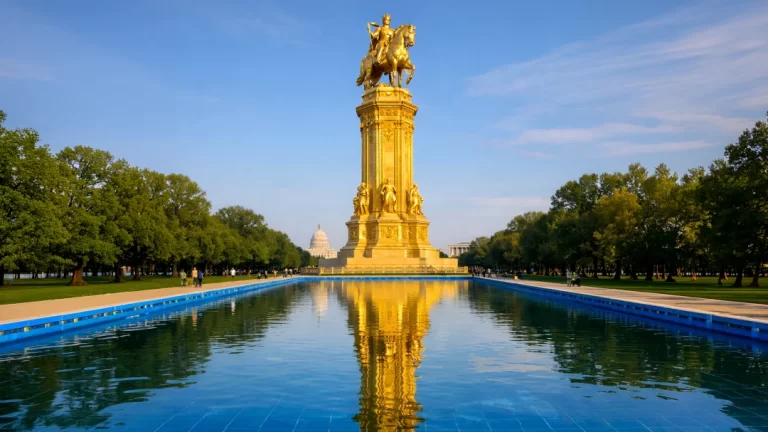
Six bills in the 119th Congress propose to chisel Donald Trump’s face into Mount Rushmore, print his portrait on a new $250 bill, rename airports in his honor, make his birthday a federal holiday, create a “Trump Peace Prize,” and force taxpayers to fund NIH research into his critics’ supposed mental illness. While lawmakers perform loyalty rituals for a president obsessed with his own legacy, Americans are drowning in healthcare costs and an imploding economy.
There is a scene that would be funny if the stakes were not so dire: while more than half of Americans lie awake worrying about whether they can afford their next medical bill, while the cost of living has climbed for eight in ten families, while Trump’s own approval rating on the economy has cratered to a historic low of 31 percent, a gallery of Republican House members is busy at their desks drafting legislation to immortalize their president in stone, in currency, in federal holidays, and in the name of every airport that services the nation’s capital. This is not governance. This is court pageantry. This is what a legislature looks like when it has abandoned its constitutional role and become, in the plainest sense of the word, a vassal assembly.
The six bills examined here — H.R. 792, H.R. 691, H.R. 1395, H.R. 1761, H.R. 3432, and H.R. 5766 — represent more than legislative vanity. They represent a documented, systematic effort by a Republican caucus to reorient the machinery of the United States government away from public service and toward the gratification, glorification, and permanent iconographic installation of a single man. Taken together, they constitute an anatomy of authoritarianism at the bill-introduction stage. They are also, given the concurrent evidence of the president’s cognitive and emotional deterioration, a case study in why the Twenty-Fifth Amendment exists.
1. Six Bills, One Throne
Understanding what Congress has actually produced requires setting the bills side by side. The timeline is not incidental — it is damning. The very first week of Trump’s second term, Republican lawmakers were not crafting healthcare legislation, not addressing tariff volatility, not proposing infrastructure funding. They were filing bills to carve the president’s face into a national monument and rename the airports through which Washington receives the world.
H.R. 792 — Rep. Anna Paulina Luna (R-FL) introduces legislation directing the National Park Service to carve Donald Trump’s likeness into Mount Rushmore National Memorial alongside Washington, Jefferson, Lincoln, and Roosevelt. Geologists and the monument’s own engineering experts have concluded the addition is physically impossible without causing serious damage to the existing structure.
H.R. 691 — Rep. Addison McDowell (R-NC) introduces legislation to rename Washington Dulles International Airport as “Donald J. Trump International Airport.” Co-sponsors include Reps. Guy Reschenthaler (R-PA), Brandon Gill (R-TX), Brian Jack (R-GA), and Riley Moore (R-WV). The bill has stalled in committee.
H.R. 1395 — Rep. Claudia Tenney (R-NY) introduces legislation to designate June 14 as a federal holiday called “Trump’s Birthday and Flag Day.” The date is both Flag Day and Trump’s birthday. The bill has attracted zero co-sponsors and has not advanced.
H.R. 1761 — Rep. Joe Wilson (R-SC) introduces the Donald J. Trump $250 Bill Act, directing the Treasury to print a new $250 denomination currency note featuring Trump’s portrait. The bill would also amend a 19th-century law prohibiting living presidents from appearing on American currency — a tradition George Washington himself endorsed. The bill has attracted 15 Republican co-sponsors.
H.R. 3432 — Rep. Warren Davidson (R-OH) introduces the TDS Research Act of 2025, directing the National Institutes of Health to spend federal research dollars studying what the bill calls “Trump Derangement Syndrome” — defined as “intense emotional or cognitive reactions” to the president. The bill would redirect NIH funding toward investigating the president’s political critics.
H.R. 5766 — Rep. Andy Barr (R-KY) introduces the President Donald J. Trump Peace Prize Act, directing the Secretary of State to establish an annual award — explicitly named after Trump — with Trump himself designated as the inaugural recipient. The bill has been referred to the House Committee on Foreign Affairs and has not advanced.
No single one of these bills would pass a laugh test in a functioning legislature. Together, they constitute a pattern: a Republican caucus engaged in a sustained, documented legislative campaign to inscribe the president’s identity into the permanent landscape, currency, calendar, and institutional memory of the United States — not in response to any public demand, not in service of any constituent need, but as an ongoing performance of personal loyalty to a man who has made clear he values tribute above governance.
2. What America Actually Needs
The distance between what these lawmakers are proposing and what the American people are asking for is not subtle. It is a chasm, documented in poll after poll, that represents one of the most striking misalignments between legislative activity and public need in recent memory.
A March 2026 KFF Health Tracking Poll found that more than seven in ten Americans believe the president is not paying sufficient attention to domestic concerns. The same poll found that healthcare costs are the single top financial worry for American families, with the Democratic Party holding a double-digit advantage over Republicans on every healthcare issue tested. Meanwhile, a CNN poll from April 2026 found that roughly two-thirds of Americans believe Trump’s policies have worsened economic conditions — up ten points from January. Around three-quarters say the U.S. economy is in poor shape.
These are the conditions under which Rep. Wilson of South Carolina was shepherding legislation to put the president’s face on a $250 bill. This is the context in which Rep. Luna of Florida was directing the National Park Service to begin demolition studies on Mount Rushmore. This is the backdrop against which Rep. Davidson of Ohio wanted the National Institutes of Health to spend federal research dollars proving that the president’s critics have a diagnosable psychiatric condition. If these bills were not real — if they were not findable on Congress.gov with bill numbers and co-sponsor lists — they would read as satire too blunt to publish.
“While monarchs put their faces on coins, America has never had and never will have a king. Our legislation would codify this country’s long-standing tradition of not putting living presidents on American coins.”
— Sen. Catherine Cortez Masto (D-NV), on the Change Corruption Act, December 2025
3. The Anatomy of a Loyalty Ritual
Political scientists and legislative analysts have noted for decades that Congress members routinely introduce bills with no expectation of passage — bills designed primarily as messaging vehicles, as signals to a constituency or, more precisely, as signals to a single powerful figure whose endorsement can determine a primary outcome. But the sheer density of Trump vanity legislation in the 119th Congress represents something qualitatively different: not individual messaging bills scattered through the session, but a coordinated, rolling campaign of legislative tribute that began on Day 8 of the term and has continued uninterrupted.
Consider the political logic at work. Rep. Luna introduced the Mount Rushmore bill eight days into Trump’s second term. Not a healthcare proposal. Not an infrastructure authorization. Not a child nutrition bill. A bill to carve stone. Rep. Tenney filed her Trump birthday holiday legislation on Valentine’s Day — a date chosen, one presumes, for its symbolic resonance of affection. Rep. Davidson’s TDS bill was introduced with language that reads less like scientific inquiry and more like a presidential talking point rendered in legislative format, defining the supposed disorder as “intense emotional or cognitive reactions to Donald J. Trump, his actions, or his public presence.” In other words: criticism of the president, medicalized.
The Las Vegas Sun reported in April 2026 that analysts view these bills as “a reliable vehicle for demonstrating loyalty to a president whose endorsement carries decisive weight in primary races.” That framing is accurate, but incomplete. These bills are not merely loyalty signals to a primary electorate. They are a documented record of a legislative body that has reoriented its fundamental purpose. The question the framers designed the Twenty-Fifth Amendment to answer — whether the executive is capable of discharging the duties of the office — applies with equal force, in a democratic system, to whether the legislature is capable of discharging its own.
Engineers and geologists have concluded Trump’s addition to Mount Rushmore is physically impossible. The monument’s lead sculptor wrote in 1936 that “stone limitations are so serious that I doubt if it would be possible to change the composition in any way to include a fifth head.” The bill has not advanced. Congress.gov →
Rep. Wilson’s bill would not only print a $250 note bearing Trump’s likeness — it would amend existing law to permit living presidents on U.S. currency, overturning a tradition that George Washington himself endorsed. 15 Republican co-sponsors, zero Democratic support. GovTrack →
Rep. Davidson’s bill directs NIH to study what it calls “Trump Derangement Syndrome,” defined as intense emotional responses to the president — effectively asking federal health researchers to medicalize political opposition. Full text →
Introduced on Valentine’s Day 2025, this legislation would make June 14 — Flag Day and Trump’s birthday — a federal holiday. Rep. Tenney compared Trump to George Washington. The bill has attracted zero co-sponsors. Congress.gov →
Rep. McDowell’s bill would rename Washington Dulles International Airport — one of the two major airports serving the nation’s capital — after the sitting president. Referred to committee, stalled. Congress.gov →
Rep. Barr’s bill directs the Secretary of State to create a new annual diplomatic award called the “Trump Peace Prize,” with Trump named as the inaugural recipient. The bill was introduced days after the Nobel Peace Prize was awarded to Venezuelan opposition leader María Corina Machado rather than Trump. Full text →
4. The Leadership Void These Bills Reveal
There is a clinical term for an individual who requires continuous, escalating external affirmation of their greatness — whose self-conception depends not on accomplishment but on monument, on official recognition, on the permanent inscription of their name into institutional history. The psychiatric literature does not name this condition “Trump Derangement Syndrome.” It uses other terms. But the legislative record assembled above is not primarily a document about the president’s psychology. It is a document about leadership failure — about what happens when those charged with holding executive power accountable instead compete to burnish it.
Get Involved Today
Contribute to our mission and turn your concerns into action.
Genuine executive leadership, by every measure available, does not look like this. A president focused on the American people does not need a bill to carve his face in granite eight days into his term. An administration with a serious economic agenda does not produce a Treasury proposal to print its own portrait on currency. A foreign policy built on actual diplomatic achievement does not require Congress to manufacture an award, name it after the president, and designate him its first recipient — in direct response to losing a prize he did not win. These are not the behaviors of a chief executive managing a $28 trillion economy through a moment of historic pressure. They are the behaviors of a man who, as House Democratic Leader Hakeem Jeffries observed in February 2026, offered “no substance” and “no vision for the future of the country” while his congressional allies channeled their legislative energy into an extended exercise in presidential vanity.
“Public trust in Donald Trump’s ability to meet the duties of his office has dropped to unprecedented lows as he threatens to destroy entire civilizations, unleashes chaos in the Middle East while violating Congressional war powers, and sends out artistic renderings online likening himself to Jesus Christ.”
— Rep. Jamie Raskin (D-MD), Ranking Member, House Judiciary Committee, April 14, 2026
A Pew Research Center survey conducted April 20–26, 2026, found that confidence in Trump to make good decisions on economic policy had dropped to 42 percent — with declines coming even among Republican-leaning respondents. The CNN poll from April 1, 2026 found that 58 percent of the public believes Trump has gone too far in using the power of the presidency and executive branch — up from 52 percent near the start of his term. Against this backdrop, the vanity legislation is not incidental. It is diagnostic.
The Provision the Founders Wrote for This Moment
Section 4 of the Twenty-Fifth Amendment to the United States Constitution provides that whenever the Vice President and a majority of the principal officers of the executive departments transmit to Congress a written declaration that the President is unable to discharge the powers and duties of his office, the Vice President shall immediately assume those powers. The mechanism was designed precisely for moments when a president’s conduct — not criminal, not impeachable in the traditional sense, but fundamentally incompatible with the demands of the office — requires the constitutional order to intervene.
The case for at least formally examining this mechanism has been made, as of April 2026, by more than seventy Democratic lawmakers, by Rep. Jamie Raskin of Maryland — the Ranking Member of the House Judiciary Committee — who introduced legislation on April 14, 2026 with fifty co-sponsors to establish a Commission on Presidential Capacity to Discharge the Powers and Duties of Office. The commission would be composed of 17 members and carry out a medical examination within 72 hours of adoption. That case has also been made, with evident alarm, by voices well outside the Democratic caucus. Tucker Carlson, who campaigned for the president in 2024, publicly called Trump’s Easter Sunday social media posts “vile on every level” and urged administration officials to secure the nuclear codes. Candace Owens described the president as a “genocidal lunatic.” Alex Jones asked his broadcast audience, in evident sincerity, how to invoke the Twenty-Fifth Amendment.
Sen. Chris Murphy of Connecticut, after Trump’s April 5, 2026 Truth Social post threatening to destroy Iranian power plants and bridges on a specific day using language that shocked constitutional and military experts, stated that he would spend Easter consulting constitutional lawyers about the Amendment — calling the president’s conduct “completely, utterly unhinged.” Sen. Murphy’s assessment is not partisan hyperbole. It reflects a documented pattern: escalating volatility, incoherence in public statements about active military engagements, threats directed at specific foreign infrastructure on specified dates, and a consistent prioritization of personal image management over the substantive demands of the office.
The practical barriers to Section 4 are real and significant. The Vice President and Cabinet have shown no appetite for its invocation. Congress cannot compel them. The political reality of a Republican-controlled legislature makes even the Raskin commission bill a long-shot. But the constitutional argument is not weakened by the political obstacles. The framers placed the Amendment in the Constitution precisely because they understood that political calculation might prevent its use even when its use was most clearly warranted. That a president’s allies choose not to invoke it does not mean the standard is not met. It means the standard is being applied through a political filter the Amendment was designed to overcome. When a president’s conduct draws alarm from his own most loyal supporters, the moral and constitutional case for examination does not disappear. It becomes more urgent.
5. The Democratic Response and the Stakes for 2026
Democrats have not been passive. Sen. Catherine Cortez Masto of Nevada, joined by Sens. Jeff Merkley, Ron Wyden, Richard Blumenthal, Bernie Sanders, and Elizabeth Warren, introduced the Change Corruption Act in December 2025 — legislation that would codify the long-standing tradition of prohibiting living presidents from appearing on American currency. As of this writing, the bill has not advanced in the Republican-controlled Senate. In April 2026, Cortez Masto and six Democratic colleagues sent a letter to the Senate Appropriations Subcommittee on Financial Services urging language in next year’s funding package banning Trump’s likeness from any U.S. coin and his signature from currency.
The KFF tracking data makes the electoral stakes unmistakable. With midterm elections approaching in November 2026, Democrats hold a double-digit advantage over Republicans on every healthcare issue tested. On the question of who voters trust to handle Medicaid, the Democratic advantage is 18 points. On the ACA, it is 16 points. On Medicare, it is 14 points. On the overall cost of healthcare, it is 13 points. These numbers exist because, while Republicans have been filing bills to carve faces into mountains and name airports after a living president, Democrats have been making the argument — with increasing evidence on their side — that the party in power is not governing for the American people. They are governing for one man’s legacy portfolio.
House Democratic Leader Hakeem Jeffries summarized the contrast at the February 2026 Issues Conference with characteristic directness: the Republican legislative agenda offers “no substance,” “no vision for the future of the country” — only performance and tribute. The American people, by every available measure, appear to agree. A March 2026 Gallup survey found that healthcare has reclaimed its position as the top domestic concern. Cost of living, healthcare access, and personal financial security dominate the list of what Americans worry about. The Mount Rushmore bill does not appear anywhere on that list. Neither does the Trump Peace Prize.
Editorial Conclusion
Six bills. One throne. A Congress that cannot pass a prescription drug cost cap has found time to direct the National Park Service to dynamite a national monument for a presidential portrait. A legislature that watched 10.9 million Americans lose health insurance under the One Big Beautiful Bill has devoted floor space to legislation making a sitting president the inaugural recipient of an award named after himself. This is not a failure of priorities. It is a declaration of them. The American constitutional order provides two formal mechanisms — the Twenty-Fifth Amendment and impeachment — for a legislature that has not lost its nerve to check an executive who has lost his way. The political obstacles are real. The moral and constitutional obligation is not diminished by them. What is required now is a Congress willing to govern for the people who sent it there — and a citizenry that, in November 2026, holds accountable those who chose to build monuments instead.
Sources & References
- Congress.gov — H.R. 792, Mount Rushmore carving bill, 119th Congress (2025)
- GovTrack — H.R. 1761, Donald J. Trump $250 Bill Act (2025)
- Congress.gov — H.R. 1395, Trump Birthday and Flag Day Federal Holiday Act (2025)
- Congress.gov — H.R. 691, Dulles Airport Renaming Act (2025)
- Congress.gov — H.R. 3432, TDS Research Act of 2025
- Congress.gov — H.R. 5766, President Donald J. Trump Peace Prize Act (2025)
- Las Vegas Sun — “Partisan battles heat up over Trump honor bills,” April 23, 2026
- KFF Health Tracking Poll — Healthcare Costs and the 2026 Midterms, March 2026
- Marist Poll — 2026 Economic Outlook, December 2025
- CNN/SSRS — Trump Approval Rating on Economy Hits New Low, April 2026
- CNN — Majority Say Trump Focused on Wrong Priorities, January 2026
- Pew Research Center — Trump Loses Ground on Personal Traits, May 2026
- Gallup — Healthcare Reclaims Top Spot Among Domestic Worries, March 2026
- House Judiciary Committee Democrats — Raskin Demands Cognitive Evaluation of Trump, April 10, 2026
- NBC News / MS Now — Raskin Introduces 25th Amendment Bill with 50 Co-Sponsors, April 14, 2026
- House Democrats — Aguilar, Jeffries: Democrats Focused on Costs, February 2026
- Snopes — Is Trump Being Added to Mount Rushmore? Fact Check, April 2026
- PBS NewsHour / Marist — Americans Most Dissatisfied Ever with Trump Economy Handling, December 2025
Related News