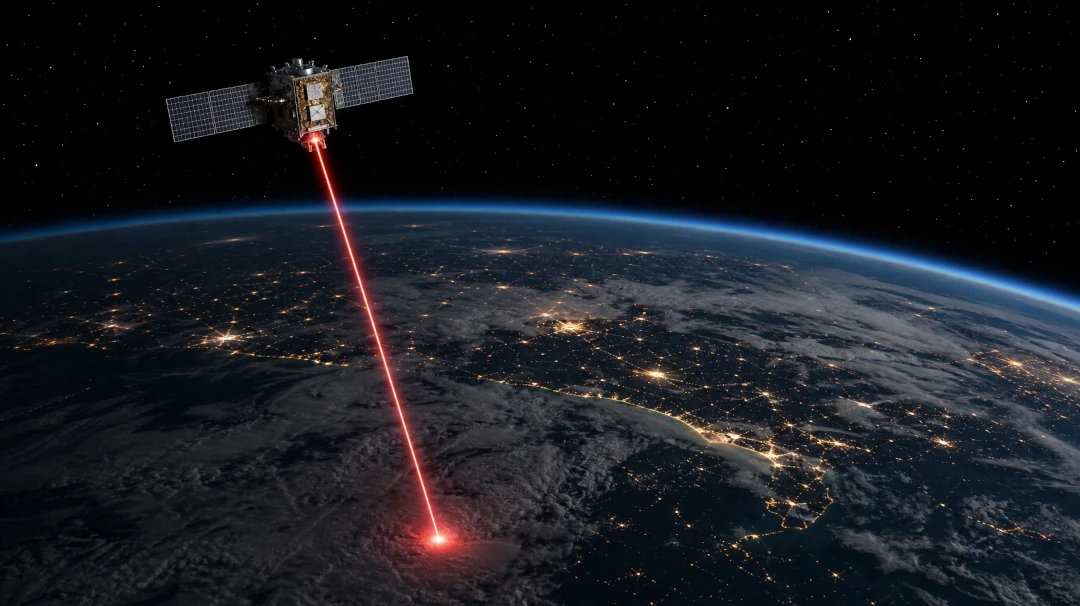
The Sky Has Been Weaponized: Trump’s Space Force Just Started a Cold War America Cannot Win
On Monday, in a five-second sentence at a Maryland convention hall, Air Force Secretary Troy Meink ended sixty years of American restraint in orbit. There was no congressional debate. There was no treaty renegotiation. There was no vote. There was only a president who cannot resist a trillion-dollar toy — and a nation that will pay the bill for a generation.
They said the quiet part out loud. Standing before an industry-friendly crowd at the Air & Space Forces Association’s annual conference in National Harbor, Maryland, on September 14, Secretary of the Air Force Troy Meink calmly announced that the United States has deployed “on-orbit space control weapons capable of defending the Joint Force against hostile adversary action.” Meink refused to say what kind of weapon. He refused to say when it was launched. He refused to say whether it is kinetic or non-kinetic, whether it has been tested, or whether Congress had ever been briefed on the specifics. “That phrase was very well thought out,” he told a reporter afterward, refusing to elaborate.
Meink is right about one thing: the phrasing was carefully engineered. What it was engineered to do was rewrite six decades of American nonproliferation policy without ever asking the American people, or their representatives, for permission. As The Washington Post reported the same day, this marks the first time in the history of the space age that the United States has publicly confirmed it has offensive weapons in orbit. And it did so not through a treaty, not through a vote of Congress, but through a single, deliberately vague sentence spoken by a Trump appointee at an industry trade show.
I. The Announcement: Sixty Seconds That Broke Sixty Years
The announcement was designed to shock. It came less than two weeks after U.S. Space Command completed Apollo Maneuvers 2026, the military’s first live-fly orbital warfare exercise, in which American satellites maneuvered against one another across low, medium, and geosynchronous orbit to rehearse combat tactics. It came, as The Washington Examiner noted, just days before Donald Trump’s scheduled meeting with Chinese President Xi Jinping — a meeting whose stakes just multiplied in a way the administration appears not to have thought through, or worse, thought through and welcomed.
In the same speech, Meink revealed that space-based interceptors — the crown jewel of Trump’s “Golden Dome” fantasy — are now, in his words, “flight ready.” He announced that the first launch of satellites for a new space-based air moving target indication network would take place this month. He announced a first-ever launchpad test of the Sentinel intercontinental ballistic missile in 2027. Taken together, the message was unmistakable: the United States has now openly militarized space, and the administration has decided to broadcast that fact to the world.
The experts who study this domain for a living were stunned. Victoria Samson, chief director of space security and stability at the Secure World Foundation, told Defense One the admission was “huge, because I don’t think any US government official has ever said that before.” She added the warning that this administration seems incapable of hearing: “The US also now has to accept the Chinese and Russians doing/saying the same. I don’t think that this is going to be in the interest of US national security.”
II. What Is It? The Weapon the Pentagon Will Not Describe
Meink’s refusal to describe the weapon is itself the story. The Pentagon has deployed something in orbit — something it now claims can defend American forces from hostile action — but it will not tell the American public what it is, how it works, or what it can do. What we know is what independent analysts have inferred from Space Force’s follow-on statement, which described the weapon’s mission as encompassing “kinetic and non-kinetic means to affect adversary capabilities.”
Translated from Pentagon-ese: this could be a laser designed to blind Chinese reconnaissance satellites. It could be an electronic jammer built to sever Russian military communications. It could be a co-orbital “inspector satellite” designed to physically approach and disable an adversary spacecraft. Or, most alarmingly, it could be a kinetic interceptor — a weapon capable of physically destroying an enemy satellite in orbit, generating fields of debris that would remain hazardous to every satellite, including our own, for decades. According to a U.S. official cited by The Washington Post via The Hill, the weapon could be used to “take out an enemy’s satellite” targeting American troops.
Possibility One — Directed Energy
Ground- or space-based lasers capable of dazzling or blinding an adversary’s optical satellites. Non-destructive in the debris sense, but escalatory — and, critically, difficult to attribute, which is a feature, not a bug, for the Pentagon.
Possibility Two — Co-orbital Interceptor
A weapon satellite that shadows or grapples with a target. Both Russia and China have flown similar systems. Deployment marks a categorical escalation from surveillance to combat.
Possibility Three — Kinetic Kill Vehicle
The most destabilizing option. Anti-satellite tests by China (2007), the U.S. (2008), India (2019), and Russia (2021) already produced debris still in orbit. A deployed kinetic weapon crosses a line no U.S. administration ever dared cross.
Possibility Four — Electronic Warfare
Jammers or cyber payloads that disable adversary satellites without destroying them. Cleaner in debris terms, murky in international law, and easy to escalate — an adversary cannot see it happen until it happens.
Whatever the technology, the significance is not the payload. The significance is the announcement. As the German Institute of International and Security Affairs’ Juliana Suess observed on CNBC, Meink’s disclosure is “very destabilizing” precisely because it upends the tacit understanding that has kept the domain fragile-but-functional for decades. Now every major power has cover to announce the same, and every major power will.
III. The Broken Peace What the Outer Space Treaty Actually Said
To understand why this is unprecedented, one must first understand the peace it just shattered. Signed in Washington, London, and Moscow on January 27, 1967, and ratified by the United States Senate later that same year, the Treaty on Principles Governing the Activities of States in the Exploration and Use of Outer Space — the Outer Space Treaty, OST — has served for sixty years as the foundational legal framework governing human activity in orbit. It has 115 states-parties. It has been called the Magna Carta of space law.
Article IV of the OST bans the placement of “nuclear weapons or any other kinds of weapons of mass destruction” in Earth orbit. It reserves the Moon and other celestial bodies for exclusively peaceful purposes. It expressly prohibits weapons testing, military maneuvers, or military bases on the Moon. Its animating idea, in President Lyndon B. Johnson’s words upon signing, was to leave behind on Earth the “conflicts that have plagued humans throughout history” as we ventured into the cosmos.
The treaty is, its defenders will note, technically silent on conventional weapons in orbit. A crafty administration lawyer could, and clearly has, argued that a laser or a kinetic interceptor does not constitute a “weapon of mass destruction” and therefore falls outside Article IV’s prohibition. That is legally arguable. It is morally and strategically indefensible. The treaty’s purpose was to prevent an arms race in orbit — not merely a nuclear one, but any race that would turn the shared commons of space into a battleground. Meink’s announcement, and the Trump administration’s decade-long march toward it, spits on that purpose while claiming to respect its letter.
And the international community knows it. Russia and China have for over twenty years pressed at the United Nations for a legally binding treaty banning the placement of any weapons in outer space — the so-called PPWT. The United States has blocked it, at every step, on the grounds that it would constrain American capabilities. On September 15, we learned exactly which capabilities we were unwilling to give up.
IV. Congress Was Never Asked A Trillion-Dollar Decision Made in a Convention Hall
Here is the constitutional heart of the outrage. The Constitution of the United States, Article I, Section 8, vests in Congress — not the president, not the Air Force secretary, not a defense contractor — the power to declare war, to raise and support armies, to provide and maintain a navy, and to make rules for the government and regulation of the land and naval forces. It vests in the Senate the sole authority to ratify treaties, and by extension to unmake them.
Congress has never voted to place weapons in orbit. It has never voted to withdraw from, or to reinterpret, the Outer Space Treaty. It has never voted to authorize an offensive American capability in the commons of space. What it did do, in the Republican reconciliation package of 2025, was appropriate roughly $24 to $25 billion for Trump’s “Golden Dome” missile defense project — buried in a bill sold to the public as a tax cut. That is not authorization. That is a slush fund. And even the general in charge of Golden Dome, Space Force’s Michael Guetlein, has publicly warned Congress that the program is starved for follow-on funding and its long-term feasibility is in doubt.
Meanwhile, the nonpartisan Congressional Budget Office estimates that a Golden Dome architecture consistent with Trump’s executive order will cost taxpayers $1.2 trillion over the next twenty years — nearly seven times the $175 billion price tag the president himself put on it. The CBO further noted that the space-based interceptor layer alone will account for roughly 60 percent of the program’s cost, requiring a constellation of approximately 7,800 satellites in low-Earth orbit merely to provide continuous coverage against ten simultaneous ballistic launches. The Pentagon has, per CBO, refused to share key architectural details with Congress or with CBO itself, meaning even that trillion-dollar figure is generous to the administration.
What does $1.2 trillion buy? It buys, per the CBO, a system whose feasibility remains unproven. It buys enrichment for SpaceX, which — as Senator Elizabeth Warren and Representative Greg Casar warned in a May 2025 letter demanding an inspector general investigation — has emerged as the “frontrunner” for Golden Dome contracts under the shadow of Elon Musk’s role in the government. And it buys, we now know, a permanent state of orbital confrontation with China and Russia that no serious defense analyst believes the United States can indefinitely sustain.
“The president’s so-called ‘Golden Dome’ is nothing more than a massive giveaway to defense contractors paid for entirely by working Americans. It will do little to advance American national security, while wasting at least $1.2 trillion of taxpayer dollars.”
— Sen. Jeff Merkley (D-Ore.), on the CBO’s $1.2 trillion estimate
V. Cold War in Orbit The Race We Chose to Start
The most predictable consequence of Meink’s announcement began the very next morning. On September 15, China’s Foreign Ministry spokesperson, Guo Jiakun, told reporters in Beijing that his country “opposes the weaponization of outer space, turning it into a battlefield, as well as an arms race there,” and urged the United States to “stop expanding its military capabilities and preparing for war in outer space.” Hours later, Kremlin spokesperson Dmitry Peskov added Russia’s demand that space be kept “free of any weapons” and called for “broad international consolidation to continue working toward the complete demilitarization of space.”
Diplomats and defense analysts who study this domain view these statements as the opening pages of a well-worn playbook. Both governments will now accuse the United States, at the UN General Assembly and in every multilateral forum available, of being the aggressor in space. Both will invoke Washington’s own announcement as legal and moral cover to accelerate — and, crucially, to openly announce — their own orbital weapons programs. Beijing, in particular, will treat this as a gift. It has spent two decades arguing that the United States is the true militarizer of space. On September 14, an American Air Force secretary handed China the evidence.
What comes next is not speculation. It is history. In 1957, Sputnik triggered a decade of arms racing that only ended when both superpowers exhausted themselves at the negotiating table. In 1983, Ronald Reagan’s Strategic Defense Initiative — “Star Wars” — triggered a Soviet economic panic that hastened the collapse of the USSR but also cost the United States, in inflation-adjusted terms, over $200 billion in a program that never worked. Golden Dome, at $1.2 trillion and counting, is Star Wars on steroids, and this time the adversary on the other side is a solvent, technologically capable China whose GDP is projected to surpass America’s by 2035. That is not a race we can bankrupt them out of. It is a race we can bankrupt ourselves in.
Can the United States defend itself against a Chinese or Russian orbital weapon? The honest answer, from every serious analyst, is that there is no perfect defense — only escalation. Every American satellite is a target. Every commercial satellite Americans depend on for GPS, banking, agriculture, weather forecasting, and emergency communications is a target. The debris field created by a single kinetic engagement in low-Earth orbit could render entire orbital bands unusable for decades — the Kessler syndrome scenario long feared by NASA. Deterrence in space, in other words, works only until it doesn’t. And when it fails, it fails for everyone at once.
Get Involved Today
Contribute to our mission and turn your concerns into action.
VI. Democrats Sound the Alarm The Constitutional Opposition
The congressional Democrats who have spent the last year sounding warnings about Golden Dome now find their warnings vindicated by their subject matter. In June 2026, following the CBO’s damning cost estimate, Senators Ed Markey (D-Mass.), Jeff Merkley (D-Ore.), and Representatives John Garamendi (D-Calif.) and Don Beyer (D-Va.), co-chairs of the bicameral Nuclear Weapons and Arms Control Working Group, led a letter to Defense Secretary Pete Hegseth demanding answers. The letter was co-signed by Senators Chris Van Hollen (D-Md.), Elizabeth Warren (D-Mass.), Bernie Sanders (I-Vt.), Chris Murphy (D-Conn.), Ron Wyden (D-Ore.), and Representatives Jim McGovern (D-Mass.) and Bill Foster (D-Ill.).
The lawmakers’ questions were basic. What is the intended purpose of Golden Dome? How many missiles is it being designed to intercept? What is the twenty-year cost? And, most tellingly: how does the administration expect China and Russia to react to Golden Dome, and how does it plan to reconcile its arms control goals with those reactions? The June 30 deadline for answers came and went. The Pentagon has, per its own testimony, refused to share architectural information with the CBO, Congress, or the American people. Ninety days after Meink’s announcement, that refusal is no longer bureaucratic. It is a coverup.
VII. The Price What This Costs the American Family
The $1.2 trillion CBO figure is a twenty-year number, which the administration will treat as reassuring. It is not. Spread across roughly 131 million American households, that is more than $9,100 per household — for a program the CBO itself warns may not deliver the capabilities advertised, and whose central premise, per the same report, is that it can defend against just ten simultaneous ballistic launches. Ten. Russia alone has roughly 1,700 deployed nuclear warheads. China is expanding its arsenal past 1,000. The math of Golden Dome is not the math of homeland defense. It is the math of political theater at industrial scale.
Consider the opportunity cost. $1.2 trillion is more than the federal government spends on Medicaid in an entire year. It is nearly triple what it would cost to make community college free for every American for two decades. It is more than the entire projected ten-year cost of expanding the Child Tax Credit — a program that demonstrably reduces child poverty. Every dollar spent on Golden Dome is a dollar not spent on the ordinary American family whose interests this administration claims to defend.
And the announcement itself carries costs that will not appear on any Pentagon spreadsheet. Beijing has already signaled it will respond diplomatically. Serious analysts expect a wave of resolutions at the UN General Assembly framing the United States as the aggressor, additional Chinese pressure on Global South nations to distance themselves from Washington, and — most dangerously — political cover for Beijing and Moscow to openly test and deploy their own orbital weapons. The diplomatic cost of Meink’s announcement is China’s Belt and Road narrative gaining a decade of moral ammunition. That, too, comes out of American pockets in the form of contracts lost, alliances strained, and influence surrendered.
VIII. The Silence at the Top Trump’s Priorities in Plain Sight
Where has the president been in all this? Not, notably, at the microphone explaining a decision of this magnitude to the country he was elected to lead. Trump has campaigned, in his first term and now in his second, on the fantasy of “space-based interceptors” and “American dominance in space” — a phrase he repeats reflexively, as if the vastness of the cosmos were a real-estate deal to be won by whoever puts up the tallest building. In his December 2025 executive order, he called American space superiority “a measure of national vision and willpower.” He said Golden Dome would be operational before the end of his term. Neither is a serious defense doctrine. Both are slogans.
What Trump has demonstrated — repeatedly, in Iran, in Ukraine, in his transactional bullying of NATO allies, in his affection for the flattery of authoritarian leaders — is that he does not view international diplomacy as a system of relationships to be tended, but as a series of confrontations to be won. He has no theory of deterrence beyond his own presence. He has no theory of arms control beyond his own dominance. And he has no theory of what happens after the announcement — the day after, the year after, the decade after — because the announcement itself is the point.
Meink’s disclosure on Monday was not an accident. It was, by his own admission, “very well thought out.” That means someone in the White House decided that the diplomatic, financial, and strategic cost of this announcement — the cold war in orbit, the trillion-dollar bill, the international backlash, the constitutional questions about Congress’s role — was worth paying for whatever domestic political benefit accrues from looking strong in a Maryland ballroom five days before a summit with Xi Jinping. That someone is either the president or acting in his name. Either way, the American people should demand to know which.
“With the U.S. sort of becoming more open about it, it’s now a question of will these states follow suit in that sense and respond and be more open also about their own activity?”
— Juliana Suess, German Institute for International and Security Affairs
The 25th Amendment and a Presidency Governing by Announcement
The Twenty-Fifth Amendment to the Constitution, ratified in 1967 in the wake of the Kennedy assassination, provides in Section 4 a mechanism for the vice president and a majority of the cabinet — or a body Congress may by law establish — to declare in writing to the president pro tempore of the Senate and the speaker of the House that the president is “unable to discharge the powers and duties of his office.” Upon that declaration, the vice president immediately assumes the presidency as acting president.
The mechanism was written with medical incapacity in mind. But its text — “unable to discharge the powers and duties” — has never been read as strictly medical. Constitutional scholars, most notably Rep. Jamie Raskin (D-Md.), who authored 2017 legislation to create a standing 25th Amendment commission, have long argued that a president who systematically abdicates the constitutional deliberative process, ignores statutory reporting requirements to Congress, and commits the nation to trillion-dollar strategic postures without notifying the legislative branch is, in a meaningful sense, unable to discharge his duties as the Constitution defines them. The question is not whether the president is medically fit. The question is whether the office is being discharged at all.
This week’s announcement makes the case with unusual clarity. The deployment of an offensive American weapon in orbit — the first such deployment in the history of the space age — was made public not through a message to Congress, not through a National Security Strategy submission, not through a treaty renegotiation, but through a scripted remark by a subordinate at an industry conference. Congress was not consulted. The Senate, which alone can bind or unbind the nation to a treaty, was not consulted. The intelligence committees, which by statute must be kept “fully and currently informed” of significant covert programs, appear to have been given no prior notice a public disclosure was coming.
The Practical Barrier
An honest accounting requires an honest concession: invocation of Section 4 requires the vote of the vice president. Vice President J.D. Vance has, by every public indication, staked his political future on unwavering allegiance to Donald Trump. The votes of a majority of the cabinet, all Trump appointees, are similarly implausible. In the present configuration of the executive branch, Section 4 is a dead letter as a matter of realpolitik. That is a fact.
Why the Barrier Does Not Absolve the Question
But the barrier does not extinguish the constitutional analysis; it merely relocates it. The framers of the 25th Amendment anticipated exactly this problem, which is why they authorized Congress to establish, “by law,” an alternative body empowered to make the incapacity determination. That statutory authority still exists. Rep. Raskin’s bill can be reintroduced. Congressional Democrats can, and must, force a debate on what it means for a president to govern by ambush — committing the nation to a trillion-dollar orbital arms race through the mouth of a service secretary, in a Maryland convention hall, on a Monday morning, without a single democratic sign-off. That is not the exercise of executive power. That is its abandonment. The 25th Amendment framework, whatever the political arithmetic, is the constitutional vocabulary through which that abandonment must be named.
Editorial Conclusion
The Outer Space Treaty did not fail on September 14. It was broken. Not by Beijing. Not by Moscow. By an American president who could not tell the difference between deterrence and swagger, and by a Congress that has, for too long, allowed him to spend a trillion dollars of the American future to look strong in a ballroom.
The stakes are not partisan. The stakes are the shared commons of orbit — the satellites that route your bank transactions, guide your ambulance, warn you of the hurricane, and keep your grandchildren’s economy running. Those satellites are now targets, because we announced, on the world’s behalf, that targeting is what satellites are for.
There is one path back. Congress must reassert its Article I authority. The Senate must demand a full accounting of what has been deployed, by whose order, and at what cost. The House must open hearings. Every Democrat and every Republican who took an oath to the Constitution — not to the man — must be asked, on the record, whether a trillion-dollar arms race in orbit is what they voted for. And the American people, whose money and whose future is being spent, must be told the truth by the president who owes it to them. If he cannot, or will not, provide it, the Constitution provides a name for that failure. It is time to say it out loud.
Sources & References
- Washington Post — “U.S. has deployed first space-based weapon, Air Force secretary says” (Sept. 14, 2026)
- ABC News — “Air Force secretary acknowledges the US has weapons in space” (Sept. 15, 2026)
- CNBC — “U.S. confirms for first time it has weapons deployed in space” (Sept. 15, 2026)
- CNN — “The US military said it has deployed weapons in space. Here’s what that could mean” (Sept. 15, 2026)
- The War Zone — “U.S. Admits It Has Weapons In Orbit” (Sept. 14, 2026)
- Aviation Week — “U.S. Has Space Weapons On Orbit Now, Air Force Secretary Says” (Sept. 14, 2026)
- Defense One — “US military has ‘on-orbit’ space weapons, Air Force Secretary reveals” (Sept. 14, 2026)
- Space News — “U.S. has deployed space-control weapons in orbit” (Sept. 14, 2026)
- Tech Times — “Pentagon Admits Space Weapons Exist; Experts Say Move May Invite Attack” (Sept. 15, 2026)
- Daily Sabah / AFP — “China warns of orbital ‘battlefield’ after US confirms space weapons” (Sept. 15, 2026)
- Dawn — “US confirms deployment of orbital weapons, draws ire of Russia and China” (Sept. 15, 2026)
- The Hill via FOX8 — “US official confirms launch of space-based weapon for first time” (Sept. 15, 2026)
- NPR — “Trump’s proposed ‘Golden Dome’ estimated to cost $1.2 trillion” (May 13, 2026)
- Federal News Network — “CBO estimates Golden Dome could cost $1.2 trillion over 20 years” (May 2026)
- TIME — “Trump’s Golden Dome Projected to Cost $1.2 Trillion and May Not Work as Advertised” (May 12, 2026)
- Sen. Markey (Official) — Letter from Markey, Merkley, Warren, Sanders et al. to Sec. Hegseth on Golden Dome (June 17, 2026)
- Sen. Warren (Official) — Warren-Casar letter demanding IG probe of Musk/SpaceX Golden Dome contracts (May 1, 2025)
- Arms Control Association — “The Outer Space Treaty at a Glance”
- Al Jazeera — “Trump says US will put weapons in space as part of ‘Golden Dome’ plan” (May 20, 2025)
- Orbital Radar — “Outer Space Treaty Explained — The 1967 Foundation of International Space Law”
Related News