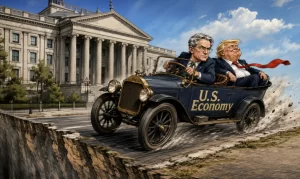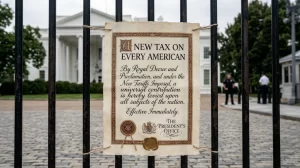
A unanimous Federal Reserve — led by a chair Donald Trump personally installed — just raised interest rates to fight an inflation crisis fueled by Trump’s tariffs and Trump’s war. The president’s answer was an all-caps demand for cheap money. Nowhere in it was a plan to fix what he broke.
For the first time in three years, the Federal Reserve has admitted that the American economy is no longer safe from inflation — and, in the same breath, that a president who campaigned on “vanishing” inflation is now the largest single reason it has returned. On Wednesday afternoon, the twelve voting members of the Federal Open Market Committee raised the federal funds rate by a quarter percentage point, to a target range of 3.75% to 4.00%. Every single one of them voted yes. The last time the Fed hiked rates, Joe Biden was president, gas was under $4, and the phrase “war with Iran” was still a hypothetical on cable news. On Wednesday, it was the reason the central bank moved. The president responded not with a policy, not with a plan, and not with an appearance in the briefing room, but with a Truth Social post shouted in capital letters.
The decision was, on its own terms, the most modest rate hike the Fed can make — 25 basis points, exactly as markets expected. But the vote itself was a political earthquake: a Federal Reserve stocked with Trump-era appointees, chaired by a Trump handpick, voting unanimously to defy a president who spent the past month publicly threatening to halt trade with any country whose central bank did not cut rates. There is no world in which this hike happens if the underlying economic case were even marginally weaker. The Fed knew what was coming. It moved anyway.
I. The Vote — and Who Owns It
The Federal Open Market Committee voted 12–0 to raise the benchmark federal funds rate to a target range of 3.75%–4.00%. There were no dissenters. There were no abstentions. The unanimity is what matters, and it matters politically as much as economically. As The Washington Times noted in its coverage, the vote “undercuts Mr. Trump’s claim that Mr. Warsh was hamstrung by holdover Democratic appointees on the Fed” — the very argument the White House had been constructing for weeks in advance of a hike it saw coming.
Chairman Kevin Warsh, whom Trump installed in May 2026 after souring on Jerome Powell, told reporters at his post-meeting press conference: “The plain fact is that inflation is too high and has been for too long.” He added that the Fed “must be confident that underlying inflation is moving to our objective clearly and at sufficient speed.” Warsh — who was confirmed in the face of unanimous Democratic opposition, and whom Senator Elizabeth Warren had memorably called a “sock puppet” — cast the deciding vote against the president who selected him. In its updated Summary of Economic Projections, the Fed signaled that 16 of 18 policymakers see the possibility of at least one more quarter-point hike this year, with four penciling in two. Warsh, per Fed convention when a chair does not want his individual forecast tracked, declined to submit his own dots.
The Vote
12–0
Every voting member of the FOMC — Trump appointees included — voted to raise rates. There were no dissents. The unanimity of the vote makes it impossible to blame “Biden holdovers.”
The New Rate
3.75–4.00%
Up from 3.50–3.75%. The first Fed hike since July 2023. Markets had priced in a 66% probability after the Jackson Hole speech; the hike itself was expected. The unanimity was not.
Inflation, August 2026
3.4%
Headline CPI, year-over-year. Core inflation at 2.4%. Both above the Fed’s 2% target. Diesel has climbed to roughly $6 a gallon amid the ongoing conflict with Iran.
Fed Forecast
2027
The Fed’s own projections do not see PCE inflation returning to the 2% target until 2027 or later — with core inflation projected at 2.5% at the end of next year.
II. Why the Fed Moved
The Fed’s post-meeting statement was clinical, as these statements always are. “Inflation remains elevated,” it read. “Today’s policy action will support a timelier return to the Committee’s 2 percent goal. The Committee will deliver price stability.” What the statement did not say — but what every economist reading it understood — is that the Fed is now confronting a supply-side inflation shock that its most powerful tool cannot actually fix. As CNN reported, Warsh himself acknowledged during the press conference that the central bank “has no real capability of cutting off the main source of inflation: higher energy prices” driven by the war with Iran.
This is the trap. Interest rate hikes work by cooling demand — by making Americans borrow less, spend less, and hire less. They do not build oil pipelines, do not un-tariff imported washing machines, and do not end wars. Warsh is raising rates because it is the only lever he has, not because he believes it will bring inflation down quickly. The Fed’s own projections quietly concede the point: PCE inflation is now seen at 3.7% for 2026, up from 3.6% in the June projection. The unemployment rate is now projected at 4.1% for both 2026 and 2027. The Fed is preparing the country for a slower, more painful glide path down — because the man in the Oval Office refuses to lift a finger on the two forces actually driving prices up.
“Hiking was the right move, and it restores Fed credibility that the central bank will curb inflation no matter what the White House or anyone else says. The big news is that the vote was unanimous.”
— Heather Long, Chief Economist, Navy Federal Credit Union, to CBS News
III. What This Costs You
A quarter-point rate hike is, in isolation, a small thing. Stacked on top of what Americans already pay, it is not. Credit card interest rates — which now average roughly 22%, up from 16% in 2021 — will float higher within weeks, because most cards carry variable rates that track the prime rate. TransUnion vice president Michele Raneri estimated that a consumer carrying the average Q2 2026 credit card balance of $6,610 at a 22% APR could see roughly $1.38 more in minimum monthly payments as the higher rate flows through. That sounds small; it is not, in aggregate. Multiplied across the roughly $1.2 trillion in U.S. revolving credit card debt, it is billions in additional interest paid this year alone — a hidden tax collected from working households and remitted to Wall Street.
Auto loans are already brutal. According to CNBC’s reporting on the hike, the average new-car loan is currently running around 7% and the average used-car loan at 10.6%. Experian reports the average monthly new-car payment now sits at $765, on an average transaction price of $50,089 — a figure that would have been unthinkable a decade ago. Mortgage rates, meanwhile, do not move directly with the federal funds rate, but they move on the bond market’s expectations of Fed policy, and the 10-year Treasury yield spiked to its highest level since 2007 in the hours after Warsh spoke. Realtor.com chief economist Danielle Hale told CNN that the “higher rate environment is a marked contrast to fall 2025, when rates dropped below 6.5%, and likely means less year-over-year momentum in home sales.” Translation: the American dream of owning a home just got further away.
And this all comes on top of the tariff bill Americans are already paying. The nonpartisan Tax Foundation estimates that Trump’s tariff regime is raising taxes on the average U.S. household by roughly $820 in 2026 alone, and previously estimated $1,000 per household in 2025 before a Supreme Court ruling struck down the IEEPA-based tariffs (which the administration promptly began replacing under other statutory authority). When the Federal Reserve Bank of New York published research in February 2026 concluding that 90% of the tariffs’ economic burden had fallen on American consumers and businesses, the White House’s response was to suggest that Fed staff be “disciplined” for producing it.
IV. The Causes — and the Man Who Made Them
To understand why the Fed had to break with a president who selected its chairman, you have to understand what is actually driving prices up. It is not, as Warsh’s statement obliquely acknowledged, some abstract macroeconomic force. It is two specific policy choices, both belonging to one specific man.
Get Involved Today
Contribute to our mission and turn your concerns into action.
Every major independent economic analysis published in the past twenty-four months has arrived at the same conclusion: Trump’s tariff regime and his foreign policy are the proximate causes of the re-emergence of inflation. Sixteen Nobel Prize-winning economists warned in June 2024 that Trump’s platform would “reignite” inflation. The Peterson Institute for International Economics estimated the same year that Trump’s policies could push inflation as high as 9.3% by 2026 — a forecast that looked hysterical then and prescient now. Goldman Sachs concluded that tariffs added a full half point to inflation in 2025. And Jerome Powell — the Fed chair Trump fired, in effect, by installing Warsh — stated last year that Trump’s tariffs were responsible for “the entirety” of inflation’s rise above target.
V. The Response
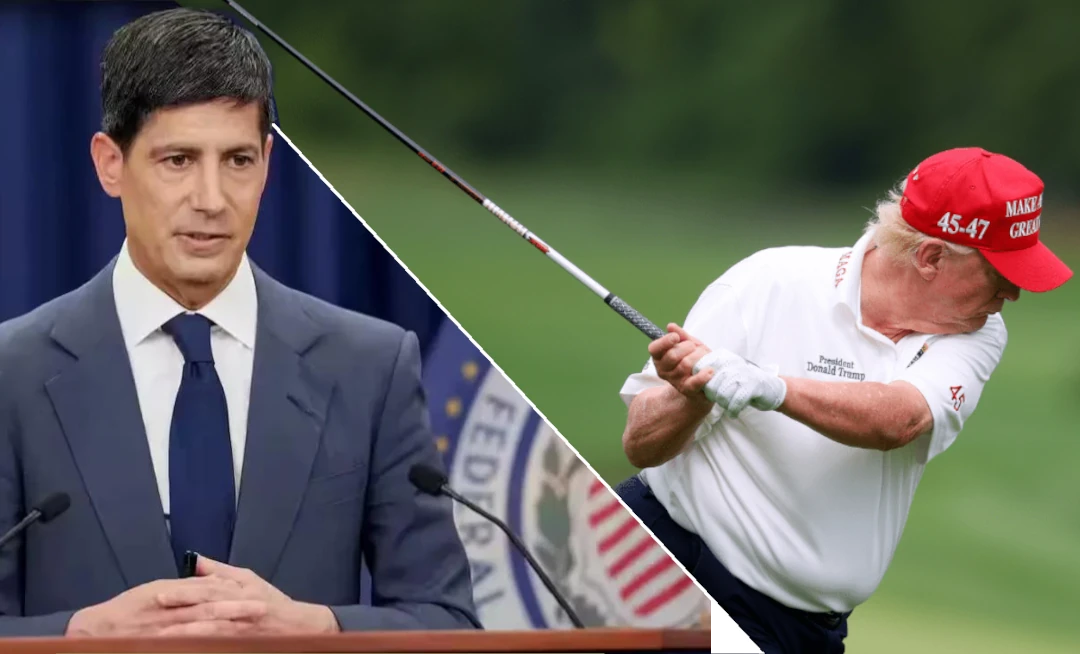
From the White House. The president was not in the West Wing. He was not in the Roosevelt Room. He was not in the briefing room. He was, per his usual practice, on Truth Social. Within hours of the Fed announcement, Trump posted: “Interest Rates in the United States should be 1%, or less, because we are the Best Credit in the World — BY FAR. Our Country is BOOMING with new Investment! LOWER THE INTEREST RATES FOR THE UNITED STATES OF AMERICA, AND FAST!” He then threatened, again, to halt trade with “every country that we have a Deficit with,” claiming this would generate “at least” $1.5 trillion per year — a figure with no basis in any economic analysis published anywhere. Trump has now golfed on 137 confirmed days of his second term — roughly 22.7% of all days in office. He was last on the course in Doonbeg, Ireland, three days before the Fed decision.
From the GOP. Senior Deputy Press Secretary Kush Desai went on Fox News to call the hike an “unfortunate decision” that was “not backed by a particularly compelling economic case,” and asserted that inflation was being driven by oil prices which “have nothing to do with and are not affected by interest rates.” That statement contains, buried inside it, the entire indictment: the White House is now conceding that oil prices — which is to say, the war with Iran — are the main driver of American inflation, while continuing to blame the Federal Reserve for responding to them. Congressional Republicans, meanwhile, cut the House session short and went home. Speaker Johnson’s caucus decided today would be the last day in session until after the November elections, meaning the House will not vote on Rep. Thomas Massie’s resolution to impeach Defense Secretary Pete Hegseth until after voters return.
From the Democrats. Senator Elizabeth Warren issued a statement even before the vote was official. If it weren’t for Trump’s policies, she said, “the Fed might actually be talking about bringing down rates.” That is a devastating framing, and it is true. Senate Minority Leader Chuck Schumer and Senators Angela Alsobrooks, Ron Wyden, and Warren had already spent months documenting the White House’s efforts to suppress Fed research showing tariffs were driving up consumer prices. Their February 2026 letter to NEC Director Hassett laid out the emerging pattern: an administration that first breaks the economy, then attacks the officials who diagnose the damage, then screams at the doctors trying to treat it.
“If it weren’t for Trump’s policies, the Fed might actually be talking about bringing down rates.”
— Sen. Elizabeth Warren (D-Mass.), Ranking Member, Senate Banking Committee
VI. When Does This End?
The Fed’s own economic projections, released with the rate decision, are the honest answer, and they are grim. PCE inflation is now projected at 3.7% for 2026 and does not return to the 2% target until sometime in 2027 or later, with core inflation still at 2.5% at the end of next year. The dot plot indicates 16 of 18 committee members see the possibility of at least one more hike this year; four see two more. Bank of America expects three additional increases. Every month between now and the return to target is a month in which the average American household pays more for a mortgage they cannot afford, a car they must have, groceries priced higher because diesel is at $6, and credit card debt that compounds a little faster. If a typical American family carries $10,000 in variable-rate consumer debt and the Fed hikes three more times over the next twelve months, that family will pay somewhere between $75 and $150 in additional interest per year — for as long as Trump’s tariffs stay in place, and as long as the Iran war continues to disrupt global energy markets. Those two policies are not being reconsidered. On present course, Americans will be paying a Trump surcharge on borrowed money into 2028.
What the 25th Amendment Was Built For — and Why This Case Is Genuinely Different
The 25th Amendment, ratified in 1967 after the assassination of President Kennedy, provides in Section 4 that the Vice President, together with a majority of the Cabinet, may declare in writing to Congress that the President is “unable to discharge the powers and duties of his office.” Power then transfers immediately to the Vice President as Acting President. The mechanism was designed for physical or mental incapacity — for a president who cannot govern — not, in the strict legal reading, for a president whose governance is destructive. That is the good-faith objection to invoking it here, and it deserves to be stated plainly.
But the objection assumes a president who is at least attempting to govern. Wednesday’s Federal Reserve action documents something different. The president publicly demanded, in the middle of an inflation crisis he caused, that the central bank cut rates to 1% or lower. He proposed halting trade with most of America’s trading partners. He offered no plan on the two documented drivers of inflation — his own tariffs and his own war. He responded to the most consequential monetary policy decision in three years by golfing in Ireland the Sunday before and posting in all caps the Wednesday of. This is not a policy disagreement with the Federal Reserve. This is a refusal to engage with the economic reality the Fed is responding to.
The 25th Amendment has already been formally invoked in public letters against this president by Rep. Jasmine Crockett of Texas, and by more than 80 members of Congress including Reps. Alexandria Ocasio-Cortez, Rashida Tlaib, and Ilhan Omar, and Senators Ed Markey and Ron Wyden, in the wake of Trump’s April 2026 threats to destroy “a whole civilization” in Iran. The organization Common Cause has issued a formal public call for Cabinet action. Even a striking roster of once-loyal Republicans — Marjorie Taylor Greene, Anthony Scaramucci, Ty Cobb, Joe Walsh — have publicly said the amendment should be invoked.
The Legal Argument
A president who has, by his own tariffs and his own foreign war, forced the Federal Reserve into an emergency defense of the currency, and who then responds to that defense not with a corrective policy but with a demand that the Fed capitulate to an economically illiterate target — 1% rates in the middle of 3.4% inflation — is a president whose economic decision-making is no longer connected to observable reality. Constitutional scholars including Michigan State’s Brian Kalt have long argued that “unable” in the amendment’s text refers to incapacity, not policy failure. That reading is defensible. But the framers of the amendment could not have anticipated a president who publicly threatens the independence of the central bank while golfing during the largest monetary policy shift in three years.
The Practical Barriers
Section 4 requires Vice President J.D. Vance and a majority of Trump’s Cabinet — a Cabinet Trump personally selected — to sign the letter. That will not happen. Every honest analyst acknowledges it. Vance has shown no daylight from the president on any question of consequence. The Cabinet is composed of loyalists selected precisely because they will not do this. Even the eight-year impeachment record of Trump’s first term shows the sitting party will protect him from any process, however constitutional. The 25th Amendment path, at the Cabinet level, is currently closed.
Why the Case Still Matters
Because the mechanism exists in the Constitution for a reason, and because a democracy that will not name what is in front of it forfeits its capacity to defend itself. The barriers to invoking the amendment do not negate the moral and constitutional case; they clarify who is refusing to act. It is worth stating on the record, in September 2026, that a Federal Reserve had to defy a president who selected its chair, that the president responded with capital letters and a demand for 1% rates, that the country pays for this in every mortgage and every credit-card statement, and that the officials who could invoke the constitutional remedy have chosen not to. The failure now belongs to them, not to the amendment.
VII. What This Says About Leadership
There is a version of American conservatism — a real one, once — that would have understood what happened on Wednesday. It would have grasped that a Federal Reserve raising rates against the wishes of a Republican president is not a partisan act but an institutional one. It would have understood that a central bank willing to defend its mandate is worth more to a country than a central bank willing to be flattered. That conservatism does not currently govern this country. What governs this country is a man who breaks the economy with tariffs he cannot defend and a war he cannot end, then screams at the institutions trying to hold the pieces together. Warsh understood the moment. His committee understood it. The president, if he understood it, said nothing that would suggest he did. Instead, he proposed a course of action — 1% rates in the face of 3.4% inflation — that would, in the judgment of every mainstream economist alive, immediately reignite the very crisis he is refusing to address.
The most damning fact of Wednesday is not the Truth Social post. It is the silence around what the president will actually do. There is no proposed tariff review. There is no diplomatic initiative to end the Iran war. There is no economic address to the country. There is no plan. There is only a demand that someone else absorb the political cost of policies the president will not revise. That is not leadership. It is not, in any recognizable sense, governance. It is a man watching a fire he started, and blaming the fire department for using water.
Editorial Conclusion
On Wednesday, the Federal Reserve did the job the President of the United States refuses to do. It named the fact — inflation is too high — and it moved, unanimously, to defend the currency against the people who broke it. The people who broke it are, at this moment, in the White House. They are the source of the tariffs. They are the authors of the war. They are the reason a Fed chair Donald Trump selected voted against a president Donald Trump is.
Every American paying $6 for diesel, $765 a month for a car, and 22% on a credit card is paying for the failure of the man who promised inflation would “vanish completely.” That failure is not a mystery. It is not a misfortune. It is a policy — chosen, defended, continued. And a Constitution that provides a remedy for a president who cannot discharge the duties of his office should not be dismissed as unusable simply because those closest to him refuse to use it. The Federal Reserve did its job on Wednesday. The rest of the government has not done theirs. That is the accountability question the country must now answer.
Sources & References
- NBC NewsFed raises interest rates for first time since 2023, defying Trump as inflation mounts
- CNBCFed rate decision September 2026: Rates rise to 3.75%–4%
- CNBC · AnalysisWarsh rate hike reinforces Fed independence after Trump pressure
- CNN BusinessFed raises interest rates for the first time since 2023
- CBS NewsFederal Reserve raises interest rates for the first time since 2023
- Washington TimesFed raises rates by quarter-point to tame inflation, risking Trump’s ire
- CNBC · Consumer ImpactFed raises rates: what it means for your credit cards, mortgages, savings and auto loans
- Yahoo FinanceWhat a Fed rate hike means for your bank accounts, loans, credit cards, and investments
- Yahoo Finance · Politics‘Interest Rates in the United States should be 1%’: Trump reacts to Fed’s rate hike
- GizmodoTrump Flips Out on Truth Social as Fed Hikes Interest Rates
- Talking Points MemoTrump’s Threats to Stop Trade Couldn’t Keep the Fed from Hiking Interest Rates
- NBC News · Live BlogTrump lashes out at Federal Reserve after first rate hike in 3 years
- Boston GlobeIt’s put up or shut up time on inflation for Fed chair Kevin Warsh
- BloombergFed Seen Hiking Rates in Defiance of Trump: Decision-Day Guide
- CNN BusinessTariffs could really sting in 2026 — Powell attributes inflation to Trump tariffs
- Tax FoundationTrump Tariffs Tracker: Rates, Revenue, and Impact
- Senate DemocratsSchumer, Warren, Wyden blast White House for Fed interference on tariff research
- TIME · Constitutional AnalysisWhat to Know About the 25th Amendment as Lawmakers Call for Trump’s Removal
- PBS NewsHourCould the 25th Amendment be invoked against Trump? Here’s how it works
- Rep. Jasmine CrockettCrockett calls on VP Vance, Cabinet to invoke the 25th Amendment
- Common CauseCommon Cause: Calls on the Cabinet to Invoke the 25th Amendment
- NBC4 WashingtonCalls grow for the 25th Amendment to be invoked against Trump
- Trump Golf TrackerTrump Golf Tracker — confirmed rounds, second term
Related News