Sealed Out: How North Carolina’s GOP Board Is Spoiling Thousands of Ballots
On the very morning the first mail ballots went out, a Republican-controlled elections board rewrote the rules for counting them. Now rejection rates are rising, a federal judge has let the rules stand, and the voters paying the price are disproportionately older, disabled, and living in Democratic counties. It is one front in a much larger war on the vote.
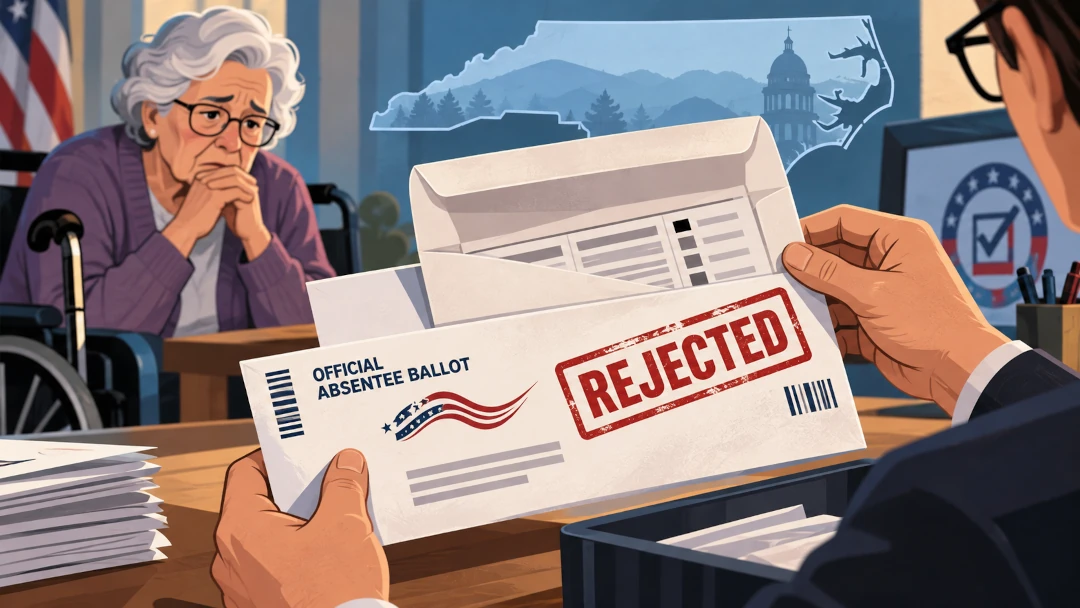
The ballots arriving at county election offices across North Carolina this month are not fraudulent. Nobody serious claims they are. They were cast by registered voters, witnessed as state law requires, and returned on time. Many of them will be thrown out anyway — not because of who cast them, but because of how a flap of paper was folded. Under rules adopted on a party-line vote by the state’s Republican-controlled Board of Elections, a ballot tucked into the outer return envelope without its inner envelope being sealed is no longer accepted. The voter must start over with a new ballot — if they find out in time.
Data compiled by Common Cause North Carolina and the Southern Coalition for Social Justice from 27 of the state’s 100 counties shows mail ballots being rejected at roughly 3% — with Democratic strongholds Mecklenburg and Forsyth seeing rates as high as 7 to 8%. Democracy Docket estimates that, if the statewide trend holds, nearly 4,000 ballots could be tossed. At the September meeting where the rule passed, board member Siobhan O’Duffy Millen warned the change could discard about 9,000 votes in a state where elections are routinely decided by razor-thin margins.
I. The Rules That Spoil the Ballot
To understand how North Carolina got here, start with who now runs its elections. In late 2024, the Republican legislative supermajority stripped Democratic Governor Josh Stein of the power to appoint a majority of the State Board of Elections and handed it to Republican State Auditor Dave Boliek, overriding a veto to do it. North Carolina is now the only state in the nation where the auditor controls election administration. The result, as American Oversight documents, is that the State Board and all 100 county boards are under Republican control. The board’s executive director, Sam Hayes, is a former GOP aide to a top state lawmaker.
That board has moved fast. In July it approved a rule requiring voters to explain “irregularities” in writing before their ballots count — a reversal of prior practice, under which ballots returned unsealed or signed in the wrong place were simply accepted. Then on September 4, hours before North Carolina became the first state in the nation to mail midterm ballots, the board voted along party lines to require signature verification and disqualify ballots not sealed in the inner envelope. A separate rule now limits who may help a voter with an absentee ballot to “near-relatives” only.
The sealing rule is the one doing the damage. In Guilford County, more than 2% of ballots received over three weeks were thrown out for that reason alone; Wake and Durham each reported 2.5%. Mecklenburg elections director Mike Dickerson told WBTV that roughly 250 of 572 spoiled absentee ballots there traced to the new requirements. Advocates point out who struggles most with a small, fiddly inner envelope: voters with arthritis, limited mobility, or failing eyesight — precisely the people who rely on voting by mail.
“It’s infuriating. North Carolinians, please make a plan to vote this year.”
— Gov. Josh Stein, Oct. 20, 2026, via Democracy Docket
II. The Excuses: “Integrity,” “Chain of Custody,” and Mickey Mouse
The justifications offered for these rules are worth taking at face value, because they collapse under their own weight. The board and its defenders invoke election integrity and chain of custody. In upholding the rules, U.S. District Judge Thomas Schroeder agreed, citing the state’s interest in protecting absentee ballots from tampering. On signature verification, he warned that without it a voter could sign any name to the certification — even “Mickey Mouse”. But North Carolina already requires absentee voters to include a copy of photo ID and to have a witness sign the envelope. As the plaintiffs’ attorney argued in court, signature review is notoriously error-prone, and the state’s existing safeguards already verify identity. No one has identified a wave of tampering via unsealed inner envelopes — the outer envelope is sealed, and until this year, the state counted such ballots without incident. The “problem” these rules solve is not fraud. It is the existence of valid ballots cast by the wrong kind of voters. The same pattern runs through the board’s other moves. New state-issued signs posted at curbside-voting spots warn that the service is for voters who cannot come inside due to age or disability “ONLY,” and that voters attest “under penalty of law.” Rep. Pricey Harrison (D-Guilford), who saw one in Carteret County, called them intimidating and urged the board to “stop suppressing the vote”; she said in decades of working polls she had never seen anyone abuse curbside voting. Hayes insisted the signs are not “some type of tactic to intimidate or suppress voting”, citing an uptick in curbside use. Voters with invisible disabilities may reasonably see it differently. And then there is the hunt for noncitizens. Earlier this month the board mailed letters to 1,392 registered voters flagged by the federal SAVE database — about 0.02% of the state’s nearly 8 million voters — just before early voting began. Democracy Docket reported the letters were so vaguely worded that recipients could not tell whether they were still allowed to vote. (They are.) SAVE’s track record should give anyone pause: when Texas ran the same check, 578 of 2,724 flagged “noncitizens” turned out to be citizens.How We Got Here: A Timeline
III. The Stakes for the Midterms
North Carolina this fall will choose 14 members of the U.S. House, 170 state legislators, a state Supreme Court justice, and a U.S. senator. The Senate race is the one national Democrats are watching most closely: former Governor Roy Cooper is running for the seat left open by retiring Republican Thom Tillis against Michael Whatley, the former chair of the Republican National Committee. The final Elon University Poll had Cooper ahead 52% to 39% among likely voters, and a WRAL/WSOC survey put him up 14. The same Elon poll put President Trump’s approval in the state at just 34%.
A double-digit lead will not be erased by a few thousand spoiled ballots — and complacency is exactly the wrong lesson to draw. The races where these rules can decide the outcome are further down the ballot: the state Supreme Court contest between Justice Anita Earls and Republican Sarah Stevens was within the margin of error in a September High Point University poll; competitive congressional districts like NC-11; and the legislative seats that determine whether Republicans keep the veto-proof power that made all of this possible. North Carolinians remember 2024, when a state Supreme Court race was decided by a few hundred votes and the losing Republican spent months trying to throw out ballots after the fact. The new rules simply move the disqualifying to the front of the process, where it attracts less attention.
IV. In the Courts
The North Carolina Alliance for Retired Americans, North Carolina Asian Americans Together, Down Home North Carolina, and two individual voters sued the State Board and the Guilford and Durham county boards in September, challenging both the sealing rule and the signature-verification requirement. They argued that valid ballots would be tossed over immaterial defects, and that some affected voters would have no chance to cast a replacement if the problem surfaced on Election Day.
On October 19, Judge Schroeder, a George W. Bush appointee, refused to block the rules. He faulted the plaintiffs for waiting 18 days to sue, noted that 31,582 ballots had already been cast under the new regime, and concluded they were unlikely to win on the merits because voters can cure defects, request a new ballot, or vote in person. The state board’s own lawyer had argued an injunction would cause confusion with counting underway — an argument that conveniently rewards the board for having changed the rules at the last possible moment in the first place.
Schroeder’s record matters. A decade ago he upheld North Carolina’s 2013 voter-ID law; the Fourth Circuit reversed him, finding the law targeted Black voters “with almost surgical precision.” This March he allowed a 2023 law making it easier to cancel voter registrations without notice; that ruling is now on appeal at the Fourth Circuit, and this one likely will be too. But realistically, any appellate relief will come after November 3. For this election, the rules stand.
Who Gets to Make the Rules — and What They Cannot Do
Article I, §4: The Elections Clause
The Constitution assigns the “Times, Places and Manner” of congressional elections to state legislatures, subject to override by Congress. The President appears nowhere in that clause. That is why federal courts keep striking down Trump’s election orders, and why Judge Indira Talwani concluded that no party could identify “any delegation Congress has made that would permit the USPS to regulate election mail.”
Fourteenth Amendment: Equal Protection & Due Process
Under the Anderson-Burdick balancing test, courts weigh the burden a rule imposes on voters against the state’s justification. Plaintiffs argued that a rule whose consequence is a ballot not counted is a severe burden. When a state already requires photo ID and a witness signature, the marginal integrity benefit of an inner-envelope seal is vanishingly small.
The Materiality Provision, 52 U.S.C. §10101(a)(2)(B)
Federal civil-rights law bars denying the right to vote over an error or omission on a record or paper that is “not material” to determining whether a person is qualified to vote. An unsealed inner envelope says nothing about a voter’s eligibility. Whether that statute reaches ballot-envelope rules is unsettled across the circuits — which makes it a fight worth having on appeal.
The Purcell Principle — Turned Upside Down
Purcell v. Gonzalez (2006) cautions federal courts against changing election rules close to an election, to avoid confusing voters. Here, it was the state board that changed the rules on the day ballots went out — and then courts invoked the timing to shield that change. A doctrine meant to protect voters from confusion has become a shield for officials who create it.
Voting Rights Act §11(b)
Section 11(b) prohibits intimidating, threatening, or coercing anyone voting or attempting to vote. It is the basis for lawsuits now seeking to keep armed federal agents away from polling places, and a yardstick against which signage and citizenship letters should be measured.
V. Who Is Defending the Vote
The fight to protect North Carolina voters is being waged largely by organizations most Americans have never heard of. Common Cause North Carolina and the Southern Coalition for Social Justice deployed volunteer “absentee review monitors” and attorneys to gather the county-level data that exposed the rejection spike. Common Cause state director Sailor Jones called the rules part of a “systematic effort to make voting by mail more difficult.” SCSJ attorneys have stressed that citizens who received SAVE letters can vote regardless of whether they respond.
The plaintiffs themselves — retirees, Asian American organizers, and the rural grassroots group Down Home North Carolina — are represented by the Elias Law Group. American Oversight has used public-records requests to pry loose the Woodhouse texts and to secure an admission that some of his messages were deleted. Wake County Board of Elections member Gerry Cohen has been publishing his county’s rejection data and coaching voters on deadlines. And Gov. Josh Stein, stripped of his power over the board, has used his platform to urge voters to vote in person and seal both envelopes.
“shove our new Granville early voting plan down their throats”
— Dallas Woodhouse, State Auditor’s elections liaison, in a May 2026 text to a county board chair, per records obtained by American Oversight
VI. Congress and Democrats Fight Back
In Washington, Democrats are preparing for something no party has had to plan for in modern history: a president actively working to undermine the midterms. Senate Minority Leader Chuck Schumer has convened a task force of at least 11 senators, plus outside experts, to counter what he calls “direct threats posed by President Trump and MAGA Republicans.” Rep. Joe Morelle, the top Democrat on the House Administration Committee, has catalogued more than 150 possible threats to Election Day — from immigration agents appearing at polling places to influencers spreading fake polling-location changes — and Democrats have launched a program to send congressional observers to polling sites.
Legislatively, Democrats have used the one tool a minority has: the ability to say no. Senate Democrats have repeatedly blocked the SAVE America Act, Trump’s elections overhaul, which the House passed in February and which would require documentary proof of citizenship to register and force states to turn voter data over to the Department of Homeland Security. Sen. Tammy Baldwin (D-Wis.) has introduced a bill to bar federal law enforcement from coming within a quarter-mile of a polling place, and Democrats and civic groups have filed suits under the Voting Rights Act to keep armed federal agents away from the polls. Twenty-three Democratic-led states joined voting-rights groups in the litigation that ultimately stopped Trump’s mail-voting order for this cycle.
The honest limitation: none of this federal work reaches a state board’s ballot-envelope rule. Congress could set national standards for counting mail ballots — it has that power under the Elections Clause — but not with Republicans in control of both chambers. That is one more reason the midterms matter.
Get Involved Today
Contribute to our mission and turn your concerns into action.
VII. The National Playbook
North Carolina is not an aberration. It is a laboratory. Across the country, the Trump administration and its allies are pursuing the same goal through every available lever: fewer mail ballots, more suspicion of the ones that arrive, and a ready-made pretext for contesting results.
The Postal Service Power Grab
Trump’s March 31 executive order directed USPS to refuse ballots for voters not on pre-submitted federal lists. The Supreme Court blocked it for 2026, with only Justices Alito and Thomas dissenting. A USPS whistleblower warned the system risked “catastrophic failure.”
DOJ vs. California’s Voters
With voting underway, the Justice Department sued to stop California from counting ballots of about 20,000 people it calls likely noncitizens. Gov. Gavin Newsom called it a “sad, desperate attempt” to suppress voters. The administration is now pressing an appeals court to set those ballots aside.
Phantom Noncitizen Numbers
DHS once claimed 190,000 potential noncitizen voters in California; its lawsuit names 20,000. The administration has lost 23 lawsuits seeking state voter data. In Nevada, a claimed 1,500 noncitizen registrants turned out to be zero.
The SAVE Database Dragnet
The administration has folded driver’s license and Social Security data into DHS’s SAVE system and urged states to run voter rolls through it. North Carolina sent its entire voter list. SAVE routinely flags eligible citizens, especially naturalized Americans.
Federal Agents Near the Polls
The administration has floated sending armed federal personnel to voting sites. Democrats and civic groups have sued under the Voting Rights Act’s anti-intimidation provision, and the White House has dismissed concerns as fears stoked by Democrats.
A War on Mail Voting Itself
In August 2025, Trump vowed he was “going to lead a movement to get rid of MAIL-IN BALLOTS.” His stated rationale, widespread cheating, is contradicted by Brookings research finding mail-voting fraud is negligible.
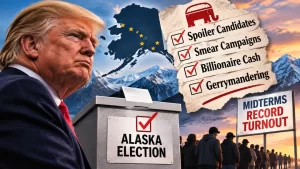
Add the DOJ’s eleventh-hour lawsuit in Alaska arguing that two candidates named Dan Sullivan could “taint” a Senate result — a case legal experts told Votebeat appears to have no precedent — and a pattern emerges. The point is not to win every case. The point is to build a record of “irregularities” that can be waved around after November 3 if the results disappoint.
VIII. What This Says About Trump’s Priorities
A president confident in his record would want as many Americans as possible to vote. This one has spent his second term trying to decide which Americans get to. He signed one election executive order in March 2025 and another in March 2026; both were blocked by courts because, as the Brennan Center put it, the president has no authority to run elections. He has pushed Congress to pass a bill that would make registering harder for tens of millions of eligible citizens who lack ready access to a passport or birth certificate. His Justice Department has turned the machinery of federal law enforcement against state election officials weeks before an election. His allies on North Carolina’s election board rewrote ballot rules on the morning ballots went out.
The through-line is not security. As California Attorney General Rob Bonta has noted, every count, recount, lawsuit, and audit has failed to find the widespread fraud Trump insists is everywhere. The through-line is control — the conviction that elections are legitimate only when he and his party win them. With his approval sagging in battleground states, the incentive to shrink the electorate rather than persuade it has only grown. That is not leadership. It is the posture of a man who has stopped trying to earn the consent of the governed and started trying to engineer it.
IX. What You Can Do
Here is the plain-language version. If you vote in North Carolina, the single most effective thing you can do is make sure your ballot is counted — and help one other person do the same. If you live elsewhere, the playbook being tested in North Carolina is coming to your state, and the tools to fight it are the same.
Vote in person if you can
Early in-person voting is underway across North Carolina, and in-person ballots are not subject to the envelope-sealing rule. Gov. Stein has urged voters to choose this option where possible. Find early voting sites and hours through the State Board of Elections.
If you vote by mail: seal both envelopes — and hurry
Place the ballot in the inner envelope, seal it, then seal the outer envelope. Your ballot must be received by your county board by 7:30 p.m. on Election Day, with no grace period. Wake’s Gerry Cohen advised mailing by October 26 — today — or returning it in person to your county office.
Track your ballot and cure it if flagged
Check your ballot status on the state’s BallotTrax portal. If it has been rejected, contact your county board immediately to cure the problem, get a replacement, or vote in person. Few voters follow up on rejected ballots — don’t be one of them.
Got a SAVE “citizenship” letter? You can still vote.
State officials have confirmed recipients’ registrations were not canceled, and SCSJ attorneys stress eligible citizens can vote whether or not they respond. If anyone tells you otherwise at the polls, call the nonpartisan Election Protection hotline at 866-OUR-VOTE.
Volunteer, watch, and pressure
Sign up with groups like Common Cause NC or SCSJ to monitor absentee review or call voters with flagged ballots. Wherever you live, confirm your registration at vote.gov, tell your senators to oppose the SAVE America Act and support keeping armed agents away from polls, and attend your county election board’s meetings — that is where rules like North Carolina’s are made.
Editorial Conclusion
A ballot cast by an eligible citizen, verified by photo ID and a witness, and returned on time is a vote. Any rule that throws it away over an unsealed flap of paper is not protecting the election; it is subtracting from it.
North Carolina’s Republican board chose the morning ballots went out to change the rules, and a federal court rewarded the timing. Across the country, Donald Trump is running the same play on a larger field. The answer is not despair and not hyperbole. It is precision: seal both envelopes, check your status, vote in person if you can, and bring someone with you. The franchise belongs to the people, not to the officials who count it — and on November 3, the people must show up in numbers too large to spoil.
Sources & References
- Democracy Docket — Exclusive: Thousands of North Carolina ballots set to be rejected after GOP imposed strict new rules
- Democracy Docket — North Carolina governor slams ‘infuriating’ ballot rejections
- PolitiFact — Fact-checking Stein’s claims about mail-in ballot rejections
- WRAL — More NC mail-in ballots are being rejected. What voters can do about it
- NC Newsline — A federal judge lets North Carolina’s new absentee ballot rules stand
- Courthouse News Service — North Carolina mail ballot changes challenged
- Courthouse News Service — North Carolina voters seek to stop mail-in ballot changes before midterms
- WBTV — Are thousands of absentee ballots in North Carolina being rejected?
- American Oversight — Challenges to 2026 Midterm Election Administration in North Carolina
- Democracy Docket — Judge who approved NC ballot restrictions also upheld GOP law targeting Black voters
- NC Newsline — NC state rep calls state’s new curbside voting warning signs ‘intimidating’
- WUNC — NC sends letters to nearly 1,400 voters flagged as potential noncitizens
- NC Newsline — NC has a list of nearly 1,600 people flagged as noncitizens. How will it be used?
- Elon University Poll — Final poll before Election Day: Cooper has double-digit lead over Whatley
- Votebeat — Supreme Court blocks Trump’s mail ballot restrictions from taking effect in 2026
- Brennan Center for Justice — Analyzing the President’s Executive Order on Mail Voting
- Al Jazeera — Trump administration sues California over noncitizens on voter rolls
- States Newsroom — Last-minute Trump DOJ suit in California targeting noncitizen voters alarms advocates
- NPR — How Democrats in Congress are preparing for Trump midterm election interference
- CNN — Inside Democrats’ efforts to secure Election Day
- Democracy Docket — Democrats, voting advocates mobilize to stop federal agents at the polls
- Newsweek — Mail ballot rejections tick up under GOP-backed rules in North Carolina
Related News