Ordered Into the Fire: How a 1930s Doctrine and a Hotter Planet Made 2026 Deadly for the People Who Fight Our Fires
The Trump administration revived a policy of putting out every wildfire, fast — then gutted the agencies, science, and prevention work that make that possible. In one of the deadliest seasons for wildland firefighters in a decade, the bill has been paid in lives. Here is what the policy is, who defends it, what climate change has done to it, and what it reveals about who this administration is willing to put at risk.
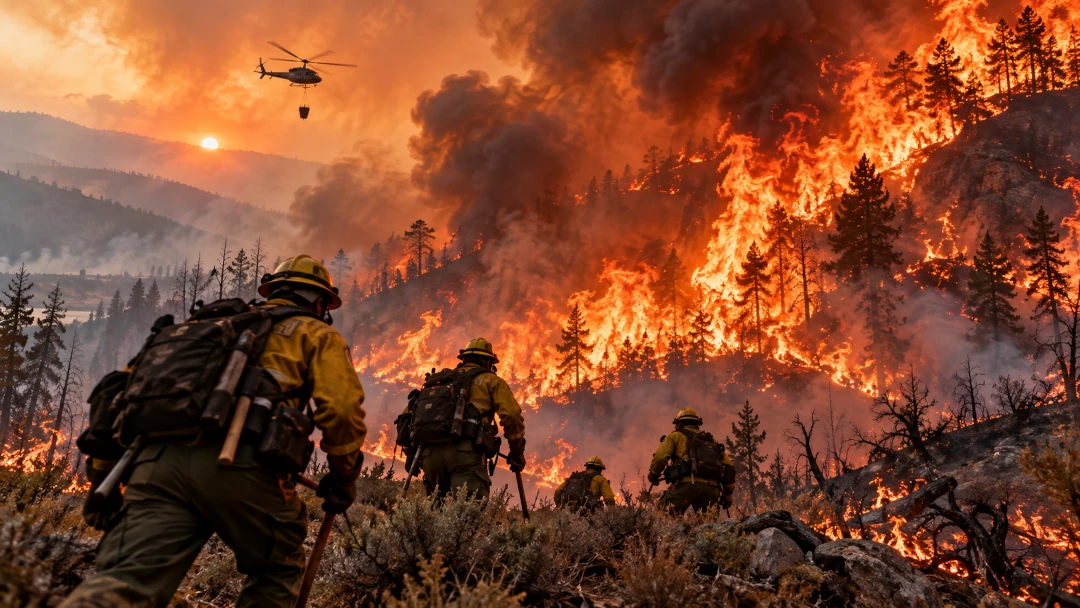
They were helicopter-borne firefighters — a helitack crew — dropped near a fast-moving blaze on the Colorado-Utah border on June 27 to stop it at the start. That day, Emily Barker, Sydney Watson and Nick Hutcherson were dead, and their colleague Nathan Matthews would die of his injuries a month later. It was the deadliest single incident of a season that ranks among the deadliest for wildland firefighters in a decade — and it happened under a federal directive that every new wildfire be met with what officials call “full suppression.”
As NBC News reported, 2026 has been one of the deadliest years in a decade for those on the fireline, as the administration’s suppress-everything posture collides with a climate that is producing fires our tactics were never designed to meet. The question this board asks is simple: when the government changes the rules of engagement for the people it sends into the flames, and then strips away the support behind them, who answers for the result?
I. A Season of Funerals
The numbers are stark. By mid-October, the federal Wildland Fire Lessons Learned Center had logged 18 fireline deaths, against a ten-year annual average of 15.5 — six in entrapments, five in helicopter crashes. Boise State Public Radio’s Mountain West News Bureau, counting more broadly, put the toll at 20 and found that this year’s seven entrapment deaths account for more than half of all such fireline deaths since 2020.
- January 2026The administration launches the U.S. Wildland Fire Service, folding fire crews from four Interior Department agencies into one — an agency the Associated Press notes was established without customary congressional approval.
- April 16 & 29Forest Service Chief Tom Schultz tells a House budget hearing the agency will pursue a full suppression strategy for every fire; Agriculture Secretary Brooke Rollins issues a readiness memo declaring USDA “prepared to continue our full suppression strategy.”
- June 27A helitack crew is overrun on the Snyder Fire near the Colorado-Utah line. Three die that day; a fourth dies a month later.
- July 18The nation goes to Preparedness Level 5 — every available federal crew and aircraft committed — and stays there until early September, with requests for help going unanswered.
- August 13Reuters reports 12 entrapments so far — more than the 20-year full-year average of nine, and the highest year-to-date figure since 2006. Some 6.4 million acres have burned, a record for that date.
- September 2–10Federal agencies have spent nearly all of their $6 billion suppression budget. Five Western senators demand to know whether full suppression contributed to the deaths.
- October 13Former Forest Service Chief Vicki Christiansen publicly names the “aggressive suppression at all costs” posture as a likely factor in the season’s toll.
II. What “Full Suppression” Actually Means
For most of the last generation, federal land managers had a choice when lightning struck in the backcountry. A fire far from homes, burning at moderate intensity, could be monitored and allowed to clear out decades of accumulated brush — doing the work that prescribed burns are meant to do. The Associated Press describes the administration’s new approach as a sharp reversal of that decades-long trend: under an order from Interior Secretary Doug Burgum, the new fire service applies full suppression to every wildfire it manages, and the Forest Service operates under the same posture.
Critics compare it to the Forest Service’s 1935 “10 a.m. policy,” which required crews to control any new fire by the next morning. Retired Forest Service fire director Michael Dudley told the AP that the old policy is precisely why Western forests are so overgrown today. The administration also changed who decides: at the Interior Department, fire officials — not the land managers responsible for forest health — now hold the final call on whether a fire may burn.
Meanwhile, the preventive half of the equation has been squeezed. NPR found that prescribed burning was being banned or stalled across the country, including through new federal conditions on partners tied to immigration and diversity-hiring rules that have nothing to do with fire. Oregon prescribed-fire leader Carson States, a former Forest Service firefighter, put it plainly: “The suppression only policies are very regressive.”
Entrapments
Twelve entrapments by mid-August, with roughly a quarter involving helitack crews, per Reuters.
Fireline Deaths
This year’s toll against the ten-year annual average, according to federal data reported by the Mountain West News Bureau.
Workforce
Share of the Forest Service workforce lost since 2024, as cited in the Colorado Sun’s reporting on the reorganization.
Fire Science
The president’s proposed budget zeros out Forest Service research and development, including fire and smoke science.
Suppression Budget
Nearly the entire federal suppression budget was exhausted by September 2, senators reported.
Prevention
Prescribed burns delayed or banned as new federal policies limit burning on public lands.
III. The Case For — and the Case Against
Fairness demands we lay out the administration’s argument in its strongest form, because it is not frivolous. This was an extraordinarily dry year, and officials argue that hitting fires hard and early is the safest course in such conditions.
The Administration's Case
Chief Schultz has argued full suppression is essential in a summer this hazardous, and he assured House members in July: "I assure you every fire has a full-suppression strategy."
The Forest Service told the Mountain West News Bureau that aggressive initial attack is the most effective way to keep small fires from becoming long, complex, more dangerous incidents, and that its posture never compromises field safety standards.
Utah's natural resources director, Jamie Barnes, backed the policy, citing historic drought, dry fuels and fire intensity. USDA also notes it fielded more than 11,800 firefighters by July — 104% of its hiring goal.
The Critics' Case
Seven active and retired firefighters told Reuters they worried crews were taking unusual risks under the all-out mandate. Even Brian Fennessy, who now runs the new fire service, said he had been confused by 2025 policies pushing more aggressive initial attack, Reuters reported.
Former Forest Service researcher David Calkin told the AP that the belief that trying harder will make fires go away is false. And the National Association of Forest Service Retirees' Bill Avey warned: "We don't think wildfire should be divorced from the land."
A Forest Service official noted the agency already extinguishes more than 95% of fires on its land — making a blanket mandate both unrealistic as a permanent strategy and a signal to push harder on the riskiest few.
Intellectual honesty requires one more point: investigations into this season’s deaths are ongoing, and no official report has concluded that the full-suppression directive caused any specific fatality. But that is exactly why the senators’ question matters. When the people who ran the Forest Service, the people who now run the fire service, and the people on the line all describe the same pressure, the burden of proof belongs to the officials who issued the order.
“We’re going backwards, not forwards, on how we manage risk.”
— Vicki Christiansen, former U.S. Forest Service Chief, via Mountain West News Bureau
IV. Climate Change Rewrote the Rulebook
Full suppression assumes a fire can be caught. Climate change is making that assumption deadly. Reuters attributes this season’s intensity to a historically low winter snowpack, record temperatures and decades of drought across the West. Firefighter advocate Riva Duncan, president of Grassroots Wildland Firefighters, told the outlet that ground conditions were so volatile that inserting crews was not always appropriate.
That is the collision at the heart of this story. A policy built for the fires of the 1930s is being executed in the fire environment of the 2020s — hotter, drier, faster — where small starts can explode beyond any crew’s ability to outrun them. And the remedy that ecologists and fire managers have spent thirty years building toward — clearing fuels with deliberate, controlled fire in cooler months — is precisely what the administration has deprioritized. Every fire snuffed out in a mild year is fuel left standing for a worse one.
The administration’s response has been to deny the premise. When Canadian wildfire smoke choked the Midwest and Northeast this summer, President Trump blamed Canada’s forestry, claiming “Canada has refused to engage in basic Forest Management and Debris Removal.” Experts on both sides of the border told FactCheck.org that climate change, not mismanagement, is the main driver of worsening fires there.
Get Involved Today
Contribute to our mission and turn your concerns into action.
V. What Leaders in Fire Country Are Saying
On September 10, Sen. Michael Bennet (D-Colo.) led Sens. John Hickenlooper (D-Colo.), Ron Wyden (D-Ore.), Alex Padilla (D-Calif.) and Adam Schiff (D-Calif.) in a letter to Secretaries Burgum and Rollins. They asked directly why fatalities, entrapments and shelter deployments were so high, and to what extent full suppression had contributed. They also reported that crews were being run past safe limits and supervised through makeshift structures because qualified personnel were not available.
“…teams have worked more fires than is safe.”
— Sens. Bennet, Hickenlooper, Wyden, Padilla & Schiff, letter to the Interior and Agriculture secretaries
In the House, Rep. Joe Neguse (D-Colo.), who has led House Democrats’ push for wildfire legislation, has accused the administration of “irresponsible and reckless staffing and budget cuts” that he says have worsened working conditions, overloaded crews and eroded trust in agency leadership. In the Senate, Martin Heinrich (D-N.M.), the ranking member of the Energy and Natural Resources Committee, labeled the president’s 2027 Forest Service budget a “Roadmap on How to Dismantle the Forest Service,” noting it eliminates the Forest and Rangeland Research program entirely.
California’s leaders have pushed back too. When the administration moved to roll back the Roadless Rule, opening more than 4 million acres of California national forest to logging and road-building, state Natural Resources Secretary Wade Crowfoot said the rule had not hindered the state’s forest work — and Forest Service research shows roads are a major source of wildfire ignitions. The Wilderness Society’s Josh Hicks called more backcountry roads “not a wildfire solution, and never will be.”
Not every response has been partisan. Sen. John Curtis (R-Utah) and Padilla co-sponsor the bipartisan Fix Our Forests Act — though as of August it had cleared committee but still awaited a final Senate vote. Bipartisanship on forest management is welcome; it is no substitute for accountability on the fireline.
VI. Why This Reaches Every American’s Doorstep
If you live nowhere near a national forest, it is tempting to treat this as a Western tragedy. It is not. Smoke does not respect state lines: a study published in Nature estimated that wildfire smoke already contributes to roughly 40,000 U.S. deaths a year, a figure that could climb to around 70,000 annually with weaker climate action — and residents of the East, Midwest and South increasingly breathe it.
Then there is the household budget. A recent analysis found more than 2.6 million homes across 14 Western states at moderate or greater wildfire risk, with private insurers cutting coverage and raising premiums. And every dollar of the $6 billion burned through this summer is a taxpayer dollar — spent at the expensive back end of the problem rather than the cheap front end, where prevention, research and fuels work live.
Finally, there are the people we ask to stand between us and the flames. Federal wildland firefighters are, in Neguse’s framing, working under unsustainable loads with dwindling trust in leadership. A nation that cannot retain them will eventually find it cannot protect its towns.
Congress Holds the Purse — and the Duty to Ask Who Gave the Order
Article I, Section 9 of the Constitution is unambiguous:
“No Money shall be drawn from the Treasury, but in Consequence of Appropriations made by Law.”
That clause, and Congress’s power to create and organize federal agencies by statute, frame three questions lawmakers must now press:
- Reorganization by fiat. The Wildland Fire Service was stood up without customary congressional approval, and Congress blocked the president’s attempt to fold in Forest Service firefighters. Yet the 2027 budget again proposes transferring Forest Service fire operations to Interior. Congress should not fund by appropriation what it has declined to authorize by law.
- Policy without process. A directive that changes the risk calculus for thousands of federal employees — and removes land managers from the final decision — was issued by secretarial order. Oversight committees are entitled to the underlying risk assessments, and the five senators’ 10-day deadline for answers should be enforced with subpoenas if ignored.
- The suppression reserve fund. The Wildfire Suppression Operations Reserve Fund, created in Division O of the Consolidated Appropriations Act of 2018, is the mechanism that keeps firefighting from cannibalizing prevention. Any reauthorization should require transparent reporting on how suppression posture affects firefighter safety and long-term costs.
VII. The Forecast — and What Is (and Isn’t) Being Built
The science on the future is sobering, though not uniform. Most projections show burned area in the West rising substantially as the climate warms. A study highlighted by the American Geophysical Union this April argued some earlier projections may be overstated by as much as an order of magnitude — but even its more conservative soil-moisture approach still projects burned area roughly doubling at 3°C of warming. The disagreement is over how much worse, not whether.
What is being invested to meet that future? There is some real good news. Wildland firefighters secured a permanent pay increase enacted in 2025, and the administration’s 2027 Interior budget requests full funding for those raises plus incident-response premium pay. The White House formally endorsed the Senate’s Fix Our Forests Act in August. Rollins’s April memo even directs the Forest Service to remove barriers to prescribed fire.
But set beside the rest of the ledger, those steps look like a bucket brigade working in front of a bulldozer. The same budget zeros out the research that tells crews how fires behave, while the agency that does fuels reduction has shed staff. A country that is serious about the next decade of fire would be expanding science, prescribed burning and community hardening at the same moment it raises firefighter pay. This administration is doing one of the four.
VIII. What Trump’s Choices Say About His Priorities
Strip away the press releases and a pattern emerges. The president’s public framing of wildfire has, for years, centered on blaming “forest management” — from California to, this summer, Canada — while dismissing the role of a warming climate. His administration has prioritized the visible, muscular act of attacking every fire and opening forests to timber and roads, while cutting the slow, unglamorous work that actually reduces risk: science, staff, and planned burns.
Leadership in a crisis means telling people the truth about the threat and resourcing the people you send to meet it. What we have instead is a doctrine that demands more from firefighters while giving them less: fewer colleagues, less science, fewer prescribed burns to tame the fuels in front of them, and an agency structure reorganized around them without Congress’s consent. When senators asked whether that doctrine contributed to the dead, the country deserved an answer, not a statement that the posture “never compromises” safety.
This is what it looks like when ideology outranks evidence. It is a governing philosophy that treats climate science as an inconvenience and civil servants as a cost to be cut — and the consequences fall on twenty-somethings in yellow shirts, on families breathing smoke a thousand miles away, and on homeowners who can no longer buy insurance.
IX. What You Can Do
Voting matters, but it is not the only lever. Here are five concrete steps, with an honest read on what each can achieve.
Demand answers from your senators
Call your senators and ask them to back the Bennet letter’s demand for a public accounting of whether full suppression contributed to this year’s deaths, and to oppose funding the transfer of Forest Service firefighting until Congress authorizes it in law.
Honest assessment: Oversight moves slowly, but constituent pressure is what turns a letter into a hearing.
Fight for the fire-science budget
Tell your House member and senators to restore Forest Service research and development funding in the FY2027 appropriations process. Congress, not the White House, writes the final budget.
Honest assessment: This is the most winnable fight here — Congress has already rejected parts of the administration’s fire reorganization once.
Harden your own home
If you live near wildland, follow the National Fire Protection Association’s Firewise USA home-ignition-zone guidance: keep the first 5 feet around your home free of anything that burns, thin and space vegetation out to 30 feet, and manage fuels to 100 feet. Organize your neighbors to become a recognized Firewise site.
Honest assessment: Embers ignite most homes; this is the single most effective thing an individual can do — and it can help with insurers.
Prepare for smoke — wherever you live
Buy or build a HEPA air filter, keep N95 masks on hand, and push your city and school district to create clean-air centers for smoke days.
Honest assessment: You cannot stop the smoke, but you can sharply cut your family’s exposure.
Support prescribed fire — and prevent ignitions
When your community proposes a prescribed burn, show up and support it rather than opposing it over a few days of haze. And never become the spark: obey fire restrictions, secure trailer chains, and skip fireworks in dry country.
Honest assessment: Most wildfires are human-caused; every ignition prevented is a crew that doesn’t have to go in.
Editorial Conclusion
Wildland firefighters do not get to choose which fires they fight or how. Their government chooses for them. This year, the Trump administration chose a 90-year-old doctrine of total suppression, imposed it by order, and paired it with cuts to the staff, science and prescribed fire that make suppression survivable — all while denying the climate reality driving the flames.
Congress must exercise the power the Constitution gives it: demand a full public accounting of every death this season, refuse to fund a reorganization it never authorized, and restore the research and prevention work that keeps crews out of harm’s way. A government that sends people into danger owes them the truth, the tools, and the most honest science available. Anything less is not leadership. It is abandonment.
Sources & References
- NBC News — Why so many firefighters have been killed in wildfires this year
- Utah Public Radio / Mountain West News Bureau — This year’s deadly fire season has slowed down, but larger policy worries remain
- Boise State Public Radio — In lives and homes, 2026 wildfire season exacted a high toll
- Reuters — In record US wildfire season, firefighter entrapments hit 20-year high
- Associated Press (via NBC26) — ‘Full suppression’: Trump administration revives policy to stomp out all fires quickly
- The Colorado Sun — The Trump administration upended how we fight wildfires. Then came the West’s worst fire season in years.
- Montana Free Press — A changed world for wildland firefighting under the Trump administration
- NPR — New burn bans and Trump’s battle with immigration and DEI are impacting forest fires
- U.S. Department of Agriculture — Secretary of Agriculture issues 2026 Wildfire Readiness Memorandum
- NPR — Trump is taking aim at forest and wildfire research just as the West is poised to burn
- Office of Sen. Michael Bennet — Senators sound the alarm on lack of firefighting resources during the 2026 wildfire season
- Times of San Diego — They fight wildfires. Housing is another battle
- Senate Energy & Natural Resources Committee — Heinrich labels Trump’s FY27 Forest Service budget a “roadmap” to dismantling the agency
- KPBS — Forest fires follow roads. The Trump administration wants to build more
- Deseret News — Can preventing wildfires be a rare bipartisan issue?
- FactCheck.org — Major driver of worsening Canadian wildfires is climate change, not forest mismanagement
- NPR (via KJZZ) — Wildfire smoke is killing Americans. A new study quantifies how much
- ABC News (via AOL) — Western wildfires creating strain on insurance industry, homeowners
- American Geophysical Union — Future wildfires may burn less of the American West than expected
- U.S. Department of the Interior — FY2027 Budget in Brief: U.S. Wildland Fire Service
- The White House (OMB) — Statement of Administration Policy: S. 1462, Fix Our Forests Act
- National Fire Protection Association — Firewise USA program
Related News