A cyberattack blinded the nation’s campaign-finance watchdog a week before the midterms — landing on an election-security apparatus the president himself spent two years dismantling. Now, with ballots still uncounted, Donald Trump and his Justice Department are building the case that any result they dislike is illegitimate. The courts have held the line. Today, it’s our turn.
Late on the night of Monday, October 26, the Federal Election Commission’s electronic filing system went dark. According to Al Jazeera, citing Reuters, an FEC filings officer told campaign compliance firms that a bad actor was attempting to breach the agency’s systems and that its web-facing services had been suspended. The timing could hardly have been worse. As CNBC reported, the outage blocked time-sensitive disclosures in the campaign’s final days — the 24- and 48-hour reports that let voters see who is pouring late money into their races — just as AdImpact pegged total 2026 spending and reservations at a record $11.21 billion.
Let us be precise, because precision is what separates journalism from the disinformation we are about to describe. The FEC does not run elections. Nextgov/FCW noted that the commission plays no role in how votes are cast or counted, and Democratic FEC Commissioner Dara Lindenbaum wrote that the incident has “NOTHING to do with voter files or voter registration,” which are maintained by the states. No vote was touched. But a successful strike on the federal government’s money-in-politics watchdog — with the FBI and CISA deflecting questions back to the FEC — is a warning shot. It tells us where the walls are thin. And it tells us that the people who should be reinforcing those walls have spent two years tearing them down.
I. The Defenders Who Were Sent Home
The Cybersecurity and Infrastructure Security Agency was created in 2018 — during Trump’s first term — in response to Russia’s interference in 2016. For six years it was the connective tissue between federal intelligence and the thousands of local offices that actually run American elections: penetration tests, tabletop exercises, threat briefings, and a shared early-warning network. Under Trump’s second term, that tissue has been cut away piece by piece.
In March 2025, CISA terminated $10 million in funding to the Center for Internet Security, which ran the Election Infrastructure Information Sharing and Analysis Center (EI-ISAC). As Pennsylvania Capital-Star reported, the agency said the work no longer advanced department priorities, and the EI-ISAC — the system that once warned 15 states about white-powder envelopes mailed to election offices — was left fully defunded. The Brennan Center documented that Attorney General Pam Bondi disbanded the FBI’s Foreign Influence Task Force almost immediately after taking office, while CISA staff working on foreign influence were placed on leave. Congress tried to restore the network: in a September 2 letter, Sen. Alex Padilla and colleagues noted that CISA had still not released any of the more than $39.6 million lawmakers appropriated for the EI-ISAC in fiscal 2026.
Then came the coup de grâce. The administration’s FY2027 budget proposal, released April 7, would eliminate CISA’s election-security program outright. In a May 6 letter to Homeland Security Secretary Markwayne Mullin, Sen. Mark Warner, vice chairman of the Senate Intelligence Committee, warned that the plan would cut fourteen election-security employees and the entire information-sharing program for state officials — even as the head of U.S. Cyber Command and the NSA testified that foreign adversaries are expected to target these elections, Nextgov reported.
“I am gravely concerned about the lack of critical federal support to state and localities ahead of the 2026 midterms.”
— Sen. Mark Warner (D-Va.), letter to DHS, May 6, 2026
CISA did eventually publish a 2026 Election Infrastructure Security Plan on September 24 — just 40 days before the election. But Nextgov observed that the plan never explained how its promises square with a budget that zeroes out the very program delivering them. The Center for Democracy & Technology found something even more chilling: remaining CISA cybersecurity staff report hesitating to help election officials at all, fearing professional retribution.
II. Where the Walls Are Thin
With federal support hollowed out, the vulnerabilities are not hypothetical. They are the predictable stress points of a decentralized system now asked to defend itself alone.
Campaign-Finance Transparency
The FEC outage blinded voters to late-breaking super PAC and dark-money spending in the costliest midterm ever. Previously filed reports stayed searchable, but new disclosures stalled. CNBC
Local Election Offices
State and local officials told reporters that services CISA once provided — tabletop drills and penetration tests — simply weren’t available ahead of the midterms. SOCRadar
Foreign Influence Operations
China, Iran, and Russia all remain capable and motivated to meddle — and the FBI task force and CISA teams built to flag their campaigns have been disbanded or sidelined. Brennan Center
Voter-Roll Data
The Justice Department has sued dozens of states to force them to hand over voter lists containing driver’s license and Social Security numbers — a centralized honeypot of sensitive data. Stateline
Seized Ballots & Chain of Custody
In January, the FBI hauled away hundreds of boxes of Fulton County’s sealed 2020 ballots without notice to county officials. A federal judge later called the raid “unprecedented” but let the government keep them. Atlanta News First
Disinformation & Fakes
A viral “Truth Social” screenshot claiming Trump declared a GOP sweep and called ballot-counting a waste of time was fabricated by a satire account. Fakes cut both ways — verify before you share. Full Fact
III. The Arsonist Running the Fire Department
A government that disarms the nation’s election defenses while insisting elections are riddled with fraud is not confused. It is consistent. The goal is not secure elections; the goal is elections the administration can control — or, failing that, discredit.
Consider the record. In March 2026, Trump signed a second elections executive order giving the U.S. Postal Service unprecedented authority over mail ballots: states would have to upload lists of eligible mail voters to an untested federal portal and redesign envelopes with unique barcodes, or the Postal Service would refuse to deliver their ballots. An anonymous USPS whistleblower, Spotlight PA and Votebeat reported, described the system as rushed and fundamentally flawed — one bad barcode could have bounced an entire batch of ballots back to the state.
At the same time, the Justice Department under Attorney General Todd Blanche became an engine of suspicion. In mid-October it delivered a thumb drive to Los Angeles County’s registrar — with the password handwritten on a note — listing 20,000 people it called “likely” noncitizens, gave officials 48 hours, then sued to stop California from counting their mail ballots, the Associated Press reported. That number had already shrunk from the 190,000 DHS claimed over the summer. California Attorney General Rob Bonta said the administration was in “unprecedented, baseless, lawless territory.”
And the president has supplied the soundtrack. At the Republican midterm convention, Mother Jones noted, he led the crowd in a performatively jokey pledge to “cheat like hell.” The joke landed differently coming from a man whose Justice Department has, by that outlet’s count, gone 0-for-25 in court on its voter-roll demands.
IV. The Final-Week Squeeze
The last stretch before Election Day has delivered a concentrated campaign of pressure — some of it aimed at officials, much of it aimed at voters’ confidence that showing up is safe and that their ballots will matter.
The monitors deserve particular attention. Monitoring itself is not new; the Biden DOJ sent observers to 64 jurisdictions in 24 states in 2022. What is new is the scale, the secrecy, and the context. DOJ spokesperson Kiersten Pels told States Newsroom that the monitors’ reports would be reviewed after Election Day — which is to say, they will generate raw material for whatever narrative follows. Even Wyoming’s Republican governor, Mark Gordon, voiced reservations after DOJ personnel watched voting in his state’s primary. Maine Secretary of State Shenna Bellows put it plainly: her office “will monitor the monitors very carefully.”
Then there is the specter of armed federal agents. DHS has said ICE is not planning operations targeting polling places, but, as Votebeat reported, it has left open the possibility of agents responding to threats or serving warrants nearby. Arlington County, Virginia, has sued to keep armed federal agents away from polling places, Newsweek reported. The point of such ambiguity is not enforcement. It is fear — the hope that a naturalized citizen, a young voter of color, or a mixed-status family decides that voting today is not worth the risk. Do not give them that victory.
Get Involved Today
Contribute to our mission and turn your concerns into action.
V. The Courts Hold the Line
If there is a reason for confidence on Election Eve, it is this: the rule of law has, so far, held. Again and again, federal judges — appointed by presidents of both parties — have told this administration that the Constitution gives the power to regulate elections to the states and Congress, not to the president.
In June, U.S. District Judge Indira Talwani declared key pillars of Trump’s March executive order unconstitutional. When the Supreme Court lifted that injunction on procedural grounds and the Postal Service rushed out its final rule, Talwani blocked it again, finding that disenfranchisement of mail voters was “practically inevitable” if the rule took effect. On September 14, the Supreme Court left her order in place through the election. Earlier rulings by Judge Denise Casper in Massachusetts and Judge John Chun in Washington had already blocked the 2025 order’s proof-of-citizenship mandate and its attack on postmarked ballots.
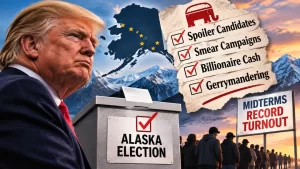
And on Sunday, Judge Sharon Gleason threw out the DOJ’s Alaska lawsuit, calling the requested relief “infeasible”. As NPR reported, she found the federal government lacked the ability to bring the case at all; Alaska’s own Republican-led state government had asked her to dismiss it, arguing that divining voters’ intent would violate ballot secrecy.
What the Law Actually Says About Who Runs Elections
Article I, Section 4 — The Elections Clause
- The “Times, Places and Manner” of congressional elections are set by state legislatures, subject only to laws passed by Congress. The president is not mentioned. This is the textual foundation on which Judges Talwani, Casper, and Chun rejected Trump’s executive orders as violations of the separation of powers.
Article I, Section 5 — Each House Judges Its Own Members
- Disputes over who won a House or Senate seat are resolved by state certification processes and, ultimately, by the chamber itself — not by the Justice Department. A preemptive federal lawsuit to halt a state’s certification has no clear footing, as the Alaska dismissal shows.
18 U.S.C. §§ 592–593 — Troops and Armed Agents at the Polls
- Federal law makes it a crime for federal officers to station troops or armed men at polling places, and to interfere with election officials’ duties, except to repel armed enemies of the United States. These statutes are the basis for Arlington County’s suit against armed DHS deployments.
52 U.S.C. § 20507(c)(2)(A) — The NVRA’s 90-Day Quiet Period
- The National Voter Registration Act bars systematic programs to remove voters from the rolls within 90 days of a federal election. California’s attorney general invoked this protection against the DOJ’s last-minute noncitizen list.
52 U.S.C. § 10101(b) and § 20511 — Voter Intimidation
- Federal law prohibits intimidating, threatening, or coercing any person for voting or attempting to vote. These protections bind federal officials as surely as private citizens.
The Twentieth Amendment — January 3
- The terms of the new Congress begin at noon on January 3, 2027. No executive action, lawsuit, or “investigation” changes that date.
VI. Wednesday Morning: Surveying the Damage
What happens when the polls close? We don’t have to guess, because the president and his attorney general have told us.
Asked whether he would accept the outcome no matter what, Trump said he would — conditionally:
“I will, if they’re honest elections.”
— President Donald Trump, October 27, 2026, via Newsweek
Blanche, pressed on whether the Justice Department could try to block states from certifying results, would not rule it out. “I mean, is there any scenario? Yes,” he told reporters, according to The Daily Beast, invoking hypothetical doomsday scenarios while insisting he had no intention of improperly interfering. This is the same attorney general who, as AlterNet summarized from reporting by The Atlantic’s Quinta Jurecic, told a conservative podcaster that he works for President Trump — and whose department appears less interested in winning its election lawsuits than in manufacturing a spectacle of alleged fraud that supporters can use to question the results.
The raw materials are being stockpiled: DOJ monitor reports earmarked for post-election review; a criminal investigation into Alaska’s second Dan Sullivan; a $1 million bounty for fraud tips; prosecutions of roughly 180 alleged illegal voters — a figure Jurecic contrasts with the hundreds of thousands the administration once claimed, and among whom, per a USA Today review, many cited honest mistakes. Earlier this year, the Washington Post reported that pro-Trump activists claiming White House coordination were circulating a draft executive order to declare a national election “emergency,” and the New York Times reported that Heather Honey — now in a DHS “election integrity” post — had floated the same idea. Trump has declined to rule it out.
Here is the good news, and it bears repeating: legal experts told Forbes that the president has no viable legal path to overturn midterm results — though they expect him to try anyway. And CNN reported on Monday that election officials have spent months rehearsing for ballot seizures, federal agents, and post-election challenges, and have so far rebuffed federal demands to set ballots aside. The danger on Wednesday is less that the count will be stolen than that a loud enough lie will persuade millions it was.
VII. On the Front Lines: Democracy Docket and the Defenders
While the federal government retreated from protecting elections, a coalition stepped forward to do the work. Marc Elias — founder of Democracy Docket and chair of Elias Law Group — has been in court against nearly every one of these maneuvers. Back in June, he warned voters to brace for maximum chaos. “It’s just gonna be a knife fight from here to the end,” he said. He was right, and his side has been winning the knife fight: Democracy Docket has chronicled every injunction, every dismissal, every collapsing DOJ number, giving ordinary voters a real-time map of the battlefield.
Democrats have built the infrastructure to match. The DNC has hired lawyers and trained tens of thousands of voter-protection volunteers and poll observers, staffed a voter hotline since October, and kept its IWillVote.com resource hub running. Democratic secretaries of state and attorneys general — Bellows in Maine, Weber and Bonta in California, Colorado’s Jena Griswold, and the coalition of states that won before Judge Talwani — have refused to be bullied. They have been joined by Republicans of conscience: Utah Lt. Gov. Deidre Henderson refused to hand over voter data, and Alaska’s GOP-led government asked a federal judge to throw out its own administration’s case.
Beyond party lines, the nonpartisan Election Protection coalition, led by the Lawyers’ Committee for Civil Rights Under Law, has partnered with the National Bar Association and National Urban League to deploy attorneys and staff the 866-OUR-VOTE hotline, the Lawyers’ Committee announced. The ACLU, League of Women Voters, NAACP Legal Defense Fund, and Brennan Center won the Supreme Court mail-ballot fight. This is what a democracy’s immune system looks like when the head of government becomes the infection.
VIII. “Rigged” Before a Single Vote Is Counted
Nothing reveals a leader’s priorities like what he says before the results are in. Trump has spent the campaign’s closing weeks not making a case to voters, but making a case against the vote itself. In early October, he compared American vote-counting to Brazil’s, writing on Truth Social that “Voting in America is CORRUPT!!!” — the slower counts in Detroit, Philadelphia, and California offered as proof of nothing. He has told Republicans to deliver a victory “too big to rig.” When a Republican slipped to third in the Los Angeles mayoral primary as mail ballots were tallied, he called that race rigged too. According to MS NOW, citing Washington Post analysis, Trump has made nearly 300 statements questioning election integrity in his second term alone.
And on Election Eve, facing polls that show Democrats well positioned to retake the House, he dismissed the surveys themselves. “I think they’re rigged,” he said of the polls, adding that the country would be finished if Democrats won power — and promising, if they take Congress, to answer with vetoes.
Consider what this says about leadership. A president who believed in American democracy would spend Election Eve urging every eligible citizen to vote and pledging to honor the result. A president who cared about election security would have funded CISA, protected the EI-ISAC, and demanded answers about who attacked the FEC. Instead, this president has defunded the defenders, deputized his attorney general, put a bounty on suspicion, and pre-written his excuse. His priority is not the integrity of the vote. It is the preservation of his power regardless of the vote.
The White House has said Trump's executive order takes lawful steps to ensure election security, and spokeswoman Lauren Bis argued Americans deserve to know winners on election night. DOJ says its monitors will only observe and report, will not approach voters, and must not interfere. DHS says ICE is not planning operations targeting polling places. Blanche has called claims that DOJ is trying to sway the election "crazy." Justice Brett Kavanaugh, while agreeing the USPS rule couldn't fairly take effect this year, wrote there was "at least a fair prospect" it falls within the Postal Service's authority. And in Alaska, a New York Times report suggesting the second Dan Sullivan may have been recruited as a spoiler has prompted ongoing state and federal investigations — a question the courts have not resolved.
We report these positions because readers deserve the full record. None of them explains why the administration gutted the agencies that protect elections from foreign attack, or why its fraud numbers keep collapsing under scrutiny.
IX. What You Can Do
Voting is the floor, not the ceiling. The honest assessment: Election Day itself is likely to run smoothly in the vast majority of the nation’s roughly 95,000 polling places, and election officials are prepared. The real fight is over confidence and the count. Here is how to win both.
- Make a plan and vote — or track the ballot you already cast. Confirm your polling place with your state or county election office. If you voted by mail, use your state’s ballot tracker and respond immediately if officials ask you to “cure” a signature or other issue.
- Know your rights at the polls. If you’re in line when polls close, stay in line. If your name is missing, ask for a provisional ballot. Federal monitors may observe, but no one may question your citizenship, block your path, or tell you how to vote.
- Report problems instantly — don’t just post about them. Intimidation, armed agents, long lines, or broken machines go to the nonpartisan Election Protection hotline and to your local election officials, who have tools to act.
- Be patient — and refuse premature verdicts. Counts in big states take days by design. Slow is not fraud. Do not share screenshots of “declarations” until you verify them; the fake Trump post circulating last week is proof that disinformation comes from every direction.
- Stay in the fight after Tuesday. Volunteer for ballot-curing and canvass observation, follow certification in your county, contact your members of Congress to demand restoration of CISA and EI-ISAC funding, and support the litigators — Democracy Docket, the ACLU, the Brennan Center, the Lawyers’ Committee — who have been winning in court.
Editorial Conclusion
A hacker took aim at the FEC a week before the midterms, and the federal government that should have been standing guard had already sent its sentries home. That is not an accident of budgeting; it is the logic of a president who wants elections weak enough to doubt and loud enough to dispute.
But the Constitution is clear: states run elections, Congress sets the rules, voters choose, and the new Congress takes its seats on January 3. Judges have enforced those lines all year. Today, the American people enforce them at the ballot box — and on Wednesday, we must insist that every lawful vote is counted, every certification proceeds on schedule, and no president’s grievance outranks the consent of the governed.
Sources & References
- CNBC — FEC campaign finance system offline days before midterms after hackers reportedly target site
- Al Jazeera — Hackers target US campaign finance system days before midterm elections
- Nextgov/FCW — FEC takes down electronic filing platform after attempted hack
- Office of Sen. Mark Warner — Warner presses DHS on reports CISA is failing to provide election security support
- Nextgov/FCW — Senator warns CISA election security pullback could leave midterms vulnerable
- Nextgov/FCW — CISA pledges election security support after cuts weakened ties with states
- Center for Democracy & Technology — Countdown to the Midterms: Mapping the Rapid Evolution of Election Security
- Brennan Center for Justice — The Trump administration is going after our elections too
- Pennsylvania Capital-Star — Election officials face limited options as federal security resources fall away
- Sen. Alex Padilla et al. — Letter to DHS/CISA on withheld EI-ISAC funding (Sept. 2, 2026)
- Votebeat — Federal judge blocks key pillars of Trump executive order restricting mail voting
- Democracy Docket — In major win for voters, judge blocks Trump’s mail voting restrictions for midterms
- Spotlight PA / Votebeat — U.S. Supreme Court blocks mail ballot restrictions from taking effect in 2026
- Ballotpedia News — Supreme Court leaves order blocking USPS mail-in voting rules in place
- Stateline — Trump’s DOJ sends 1,000 election monitors to 50 states
- Associated Press (via ABC30) — Trump administration sues California to block counting of alleged noncitizen mail ballots
- Roll Call — Judge tosses DOJ lawsuit seeking to delay Alaska vote certification
- NPR — Judge tosses Trump’s attempt to block Alaska Senate results
- Newsweek — Three ways Donald Trump appears primed to dispute midterm results
- The Daily Beast — Todd Blanche refuses to rule out election interference
- MS NOW — Trump is ready to cry election fraud again
- AlterNet — Throwing everything at the wall: Inside Trump’s 24-hour plan (on The Atlantic’s reporting)
- Forbes — Trump’s legal options are limited if GOP loses midterms
- CNN (via KEYT) — How officials are preparing for Election Day disruptions — including from Trump
- Common Dreams — Officials plot to have Trump declare national emergency in 2026
- Mediaite (via Yahoo) — Trump reportedly mulling plan to declare “national emergency”
- Votebeat — What to know about ICE and federal agents at polling places
- Newsweek — Trump warns of rigged US elections as GOP braces for midterm hammering
- Mother Jones — “Cheat like hell”: Can Trump actually rig the 2026 midterms?
- ProtoThema — Trump claims midterm polls are “rigged”
- AlterNet — Election lawyer details game plan to stop Trump from sabotaging the midterms
- Lawyers’ Committee for Civil Rights Under Law — Partnership to protect voters during the 2026 midterms
- Full Fact — Trump did not post on Truth Social about Republicans already winning the midterms
- Atlanta News First — Federal judge rules the FBI can keep Fulton County’s 2020 ballots, for now
Related News