The World Says End the Siege. Trump Is Drawing Up Invasion Plans.
From the floor of the United Nations to the Vatican, leaders are demanding Washington lift a 64-year embargo that has become a fuel blockade starving an island of electricity, medicine and water. The White House answer: Army Reserve logistics requests, a murder indictment of a 94-year-old, and a Secretary of State who sees Havana as his path to the presidency.
Last week, the leaders of the world gathered in New York and heard the President of the United States describe a small island ninety miles from Florida as a failed state whose government, he promised, would soon fall. The Cuban delegation walked out. Brazil’s President Luiz Inácio Lula da Silva, who by tradition opens the General Debate, had already said what much of the room was thinking: that Cuba is enduring “collective punishment imposed on 10 million people” through an illegal economic embargo and energy blockade.
That is not a fringe view. It is the settled position of nearly every nation on earth. Last October the General Assembly voted 165 to 7, with 12 abstentions, for the 33rd consecutive year, to call for an end to the embargo — and in July the Assembly took the extraordinary step of reopening the debate mid-session, at Havana’s urging, as conditions on the island deteriorated. The U.S. envoy objected that the session was a waste of U.N. money and blamed the Cuban government for the island’s misery. The world listened, and was not persuaded.
Now, as Cuba’s foreign minister Bruno Rodríguez tells the Associated Press that his country faces “the total oil siege imposed on our country,” and the State Department weighs strict new controls on the Cuban diplomats who will return for next month’s vote, a darker story is unfolding inside the Pentagon. It is time to tell it plainly.
I. Sixty-Four Years of a Policy That Never Worked
The embargo was born of the Cold War. After Fidel Castro’s 1959 revolution toppled a U.S.-backed regime and nationalized American-owned property, President John F. Kennedy imposed a congressionally authorized trade embargo in 1962. The Council on Foreign Relations notes that the United States has sanctioned Cuba longer than any other country on earth. Each generation added a new layer: Ronald Reagan placed Cuba on the State Sponsors of Terrorism list in 1982; George H.W. Bush signed the Cuban Democracy Act of 1992; and Bill Clinton signed the 1996 Helms-Burton Act, which wrote the embargo into statute so that no president could fully lift it without Congress.
Only one president seriously tried to break the cycle. Beginning in December 2014, Barack Obama met with Raúl Castro, restored full diplomatic relations, reopened embassies, removed Cuba from the terrorism list in 2015, and eased restrictions on travel, remittances, telecommunications and banking. The private sector on the island began, tentatively, to grow.
Donald Trump dismantled that opening almost entirely. His first administration rolled back travel, activated the long-dormant Title III of Helms-Burton to let Americans sue foreign firms doing business on confiscated property — a move that drew protests from Canada and the European Union — and, nine days before leaving office, returned Cuba to the terrorism list. Joe Biden loosened some travel limits, then waited until his final week to rescind the terrorism designation. Trump, back in office, reinstated it within days — the second time he had reversed a predecessor on the same question — citing Cuba’s alleged harboring of terrorists.
Why? The stated reasons are human rights and security. But the pattern tracks something else: the electoral weight of South Florida, and the career of one Florida politician in particular. We will come to him.
II. From Embargo to Siege: The Toll on Cubans — and Americans
What distinguishes 2026 from the previous six decades is that the embargo has become, in effect, a blockade. After U.S. forces seized Venezuela’s Nicolás Maduro in January, cutting off Cuba’s main oil supplier, Trump’s January 29 executive order threatened tariffs on any country that sells or provides oil to the island. Mexico, Cuba’s remaining major supplier, halted shipments under the threat. When Mexican President Claudia Sheinbaum warned that halting oil could produce a humanitarian crisis, Trump brushed the concern aside aboard Air Force One, suggesting Cuba would simply come to Washington to make a deal.
It did not have to be a humanitarian crisis. It became one. In May, after a three-day visit to the island, officials from the U.N. Office for the Coordination of Humanitarian Affairs and the World Health Organization reported that hospitals were suspending surgeries, struggling to keep life-saving equipment running, and running short of medicine, with blood banks, laboratories, vaccination programs and maternal care all disrupted.
Delayed surgeries
Procedures postponed, including roughly 12,000 for children, according to Sen. Peter Welch’s statement for the Congressional Record.
Children with cancer
The fall in pediatric cancer survival rates Welch cited — which he described as thousands of children who would otherwise be alive.
Hospitals in crisis
OCHA and WHO officials described emergency care, immunization and maternal health services under severe strain in UN News reporting.
Economic damage
Cuba’s estimate of losses from March 2025 to February 2026, a 7% annual increase, as presented to the General Assembly (a Cuban government figure).
Welch, a Vermont Democrat, was careful in his statement. He called the Cuban government repressive and acknowledged its economic mismanagement. But he concluded that the present depth of misery is “largely due to the oil blockade,” for which the United States bears responsibility. That is the honest position, and it is the one this editorial board shares: a government can be authoritarian and a policy can still be cruel. Starving hospitals of electricity does not free a single political prisoner.
Pope Leo XIV saw the danger in February, echoing Cuba’s Catholic bishops by calling for “a sincere and effective dialogue” to avoid violence and any action that would add to Cubans’ suffering. Washington chose escalation instead.
The embargo does not only punish Cubans. It punishes American farmers, businesses and travelers — and it has done so for decades with nothing to show for it. The libertarian Cato Institute, hardly a progressive outfit, put it bluntly: “The embargo has been a failure by every measure.” Cato notes that after Congress allowed cash sales of food in 2000, American farmers at one point sold more to Cuba’s 11 million people than to Brazil’s 200 million, and that the U.S. International Trade Commission estimated farm exports would grow by another $250 million if financing restrictions were lifted. Instead, those markets go to Canada, Europe, China and Russia.
The costs now go well beyond lost trade. A collapse on an island of 11 million people just off the Florida Keys is a direct threat to American interests — the very migration crisis that hardliners claim to fear. And a military adventure, as we will see, carries a bill that no farm subsidy could cover.
III. The Invasion File — and Its Architect
The administration insists it wants a deal. On Saturday, Trump told reporters he did not think military force would be needed and that Cuba and the United States would come to terms. But the paper trail says the Pentagon is preparing for the other outcome.
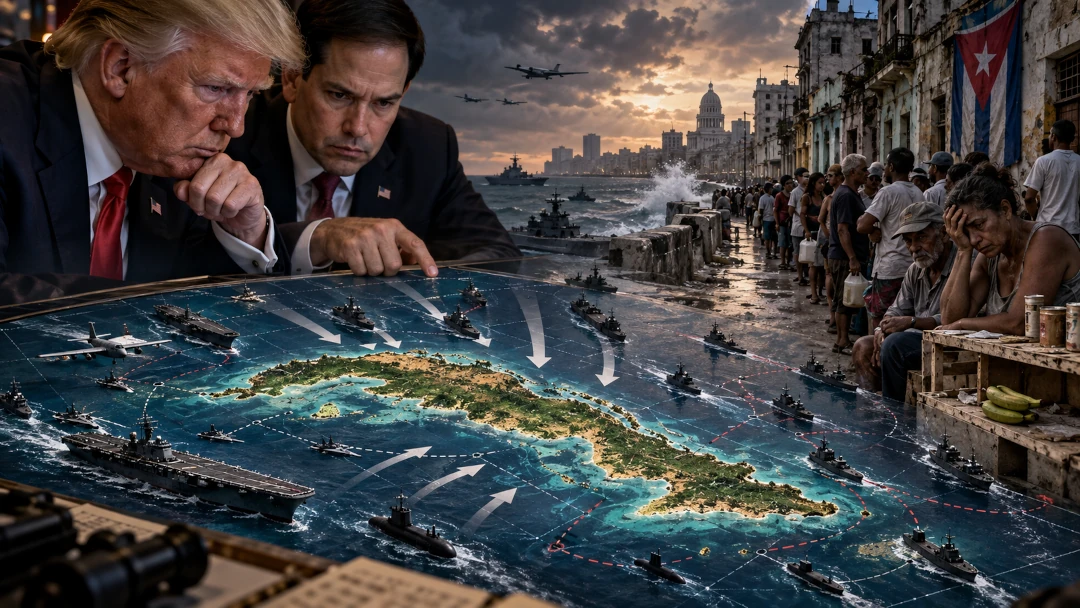
On September 26, CBS News reported on an internal Army message asking Army Reserve commands whether they could supply U.S. Southern Command with six types of formations that might be needed within 90 to 120 days: a military police brigade to handle security and detention, a medical brigade, a forward surgical and resuscitation team for trauma care near the front, an engineer battalion, and two logistics commands to run fuel, transport and supply across a theater of operations. The message does not name Cuba, but multiple U.S. officials told CBS it supports continued planning aimed at the island. These are not the units of a diplomatic mission. They are the units of an occupation.
The same report says American forces earlier conducted reconnaissance of the seafloor and maritime approaches around Cuba, that air units were placed on heightened readiness and told to pre-stage personnel, and that in July planners briefed options including an Army-led air assault by thousands of soldiers from the 101st Airborne Division. Meanwhile, the U.S. intelligence community’s own 2026 threat assessment, CBS notes, largely portrays Cuba not as an independent strategic threat but as a space exploited by larger rivals.
“I think I could do anything I want with it.”
— President Donald Trump on Cuba, March 2026, via CBS News
Trump’s own words have been escalating all year. In March he said he expected to have the honor of taking Cuba, and later that month declared that Cuba would be next. In May, Axios reported he mused that an aircraft carrier returning from the Iran war could park about 100 yards offshore until Cuba surrendered. And on May 20, the Justice Department unsealed a murder and conspiracy indictment against Raúl Castro over the 1996 shootdown of two Brothers to the Rescue aircraft that killed four men. Acting Attorney General Todd Blanche insisted “this isn’t a show indictment” and hinted there were many ways to bring a foreign defendant to court. The families of those victims deserve justice. But Americans remember that Maduro was indicted in 2020 — and that the indictment later became the legal pretext for a military raid on Caracas.
If there is an architect of this policy, it is Secretary of State Marco Rubio, the son of Cuban immigrants, who told reporters in May that Cuba’s leaders are not merely communists but incompetent ones — “The only thing worse than a communist is an incompetent one.” Trump himself told the U.N. that Rubio is deep in negotiations with Havana.
Rubio’s convictions on Cuba are longstanding and, by his own account, shaped by the exile community in which he grew up. But conviction and ambition are not mutually exclusive. CNN reported in June that Cuba is Rubio’s most personal challenge as he weighs another presidential run in 2028, and that its outcome could define him. Lawrence Gumbiner, who led the U.S. Embassy in Havana during Trump’s first term, put it this way: “This is the golden ring for Marco Rubio.”
That should alarm every American. A foreign policy built around one official’s legacy and one state’s primary electorate is not a national security strategy. Sen. Ruben Gallego of Arizona said as much, warning that Americans want lower prices and affordable homes, not “a new war to satisfy neoconservatives in South Florida.”
IV. The Price in Treasure, Blood and Standing
Experts interviewed by Responsible Statecraft described a full ground invasion as the least attractive option of all — and warned that even a limited airborne assault would put hundreds of American troops at high risk of death or capture. Air power alone cannot hold territory; holding territory requires large numbers of troops. Beyond the fighting lies the aftermath: a possible migration crisis 90 miles from Florida, openings for armed groups to exploit chaos, and a prolonged U.S. occupation fighting insurgents in Cuba’s mountains — a mission analysts warn cannot be won with bombs alone.
Americans have already paid for this administration’s appetite for force. Sen. Tim Kaine noted in April that the Iran war had cost the lives of 13 U.S. service members and thousands of civilians while sending gas prices soaring — and that the regimes in Caracas and Tehran remain largely in place despite the removal of their leaders. The diplomatic bill is mounting too. When 165 nations vote against your policy, and the leaders of Brazil and Mexico and the Pope all plead for restraint, an invasion would not project strength. It would confirm that the United States no longer considers itself bound by the rules it spent 80 years writing.
Get Involved Today
Contribute to our mission and turn your concerns into action.
V. Congress and the Democrats: Trying to Hold the Line
Democrats have not been silent. In March, Sens. Tim Kaine of Virginia, Adam Schiff of California and Ruben Gallego filed a war powers resolution requiring congressional approval for any hostilities against Cuba. On April 28, Senate Republicans killed it on a procedural point of order raised by Florida Sen. Rick Scott, who argued there were no active hostilities to restrain. The vote was 51 to 47. Kaine answered that cutting off an island’s fuel is itself a form of military action.
“…we would definitely regard it as an act of war.”
— Sen. Tim Kaine (D-Va.), on how Americans would see a fuel siege of the U.S. · April 2026, via Al Jazeera
The trio reintroduced the resolution in May after the Castro indictment. Welch has entered the humanitarian record into the Congressional Record. But in a Congress controlled by Republicans who have repeatedly deferred to the president on Venezuela, Iran and now Cuba, the minority can force votes and force accountability onto the record — it cannot yet force a change of course. That is what November is for.
VI. A Peace Prize Pursued Through War
Hovering over all of this is a president who wants, more than almost anything, to be remembered as a peacemaker. In January he complained on Truth Social that “I single-handedly ENDED 8 WARS” and that Norway had foolishly denied him the Nobel Peace Prize — even as analysts pointed out that several of those conflicts were still active. He accepted Venezuelan opposition leader María Corina Machado’s medal as a gift, though the Nobel committee has made clear the prize cannot be transferred.
Count the ledger since: a raid on Venezuela, a war on Iran, lethal strikes on boats in the Caribbean that CBS reports have killed more than 230 people, and a fuel blockade of Cuba now shading toward invasion planning. A president sincerely interested in peace would take the offer of dialogue from the Vatican, from Mexico, from Brazil. This one treats peace as a trophy to be claimed and war as a tool to be used whenever a rival looks weak. That tells us his priorities: personal glory first, the lives of soldiers and civilians somewhere after.
“Anything I Want”: Cuba and the Question of Fitness
How the mechanism works
Section 4 of the 25th Amendment allows the Vice President and a majority of the Cabinet to declare in writing that the President is “unable to discharge the powers and duties of his office.” The Vice President immediately becomes Acting President. If the President contests the finding, Congress decides — and keeping him sidelined requires a two-thirds vote of both chambers.
Who has called for it
After Trump threatened in April that an entire Iranian civilization would die, more than 70 lawmakers called for his removal by impeachment, the 25th Amendment, or both, NBC News reported. They included Sen. Ed Markey of Massachusetts, Rep. Ro Khanna of California, and Sen. Chris Murphy of Connecticut, who said the threat came from “No President in control of his senses.”
The argument, applied to Cuba
The case is not that Trump holds the wrong Cuba policy — presidents are entitled to bad policies. It is that his conduct reveals a man who believes, in his own words, he can do “anything” he wants with a sovereign nation; who announces wars at press conferences and in jokes about aircraft carriers; who ignores his own intelligence community’s assessment that Cuba is not an independent threat; who tolerates a humanitarian catastrophe his own neighbors warned him of in advance; and whose stated obsession with a peace prize coexists with an expanding list of military operations. The 25th Amendment speaks of inability to discharge the duties of office. The first duty is to execute the laws faithfully — including a Constitution that gives Congress, not the President, the power to declare war.
The honest barriers
The obstacles are enormous. Vice President JD Vance shows no sign of acting, and a majority of the Cabinet would have to join him — a Cabinet that includes Marco Rubio himself, the very official most invested in the Cuba campaign. Many constitutional scholars also argue the amendment was written for incapacity, not for reckless judgment, and that impeachment and war powers resolutions are the proper tools for policy abuses.
Why the case still matters
None of those barriers makes the concern less real. The framers designed multiple safeguards precisely because they feared a single person deciding on war. When the war powers check is procedurally blocked, the impeachment check is politically blocked, and the Cabinet check is personally conflicted, every safeguard has failed at once. Naming that failure — on the record, repeatedly — is how the public learns what is at stake before, not after, the first soldier dies on a Cuban beach.
Editorial Conclusion
The embargo on Cuba has failed for 64 years, and its transformation into a fuel siege has turned failure into cruelty — dark hospitals, delayed surgeries, children dying of treatable cancers. The world has asked the United States to stop. The President’s answer has been to canvass military police brigades and surgical teams for a possible deployment.
Congress must reclaim its sole power to declare war, pass the Kaine-Schiff-Gallego resolution, and open a humanitarian corridor for fuel and medicine now. Americans must make clear at the ballot box that no president — and no ambitious Secretary of State — may start a war for a legacy. A republic that lets one man decide he can do “anything he wants” with another nation has already surrendered something it cannot easily get back.
Sources & References
- UN Press — General Assembly Resumes Debate on Ending Cuban Embargo
- AP via CP24 — US weighs new limits on Cuban travel at the UN as Havana decries Trump’s economic squeeze
- The Real News Network — President Lula’s full speech at the 81st UN General Assembly
- Catholic Review / OSV News — Pope Leo laments rising U.S.-Cuba tensions, calls for “sincere” dialogue
- Council on Foreign Relations — U.S.-Cuba Relations Explained
- Baker McKenzie Sanctions Blog — Cuba’s SST Designation Rescinded by Biden, Then Reinstated by Trump
- UN News — Blackouts and shortages disrupt healthcare across Cuba
- Office of Sen. Peter Welch — Statement on the Humanitarian Crisis in Cuba
- Cato Institute — The US Embargo of Cuba Is a Failure
- CBS News — U.S. military lays groundwork for potential action around Cuba
- CBS News — U.S. indicts Cuba’s Raúl Castro on murder and conspiracy charges
- Axios — Trump’s and Rubio’s escalating rhetoric on Cuba
- Responsible Statecraft — What a US war with Cuba would really look like
- CNN — Can Marco Rubio convince Trump that a free Cuba is America First?
- Al Jazeera — US Senate blocks bid to stop Trump using military against Cuba
- Office of Sen. Ruben Gallego — Gallego, Kaine, Schiff Announce Vote on Cuba War Powers Resolution
- Al Jazeera — Venezuela’s Machado gives Trump her Nobel Peace Prize: Is it his now?
- NBC News — Dozens of Democrats call for Trump’s removal after his Iran threats
Related News