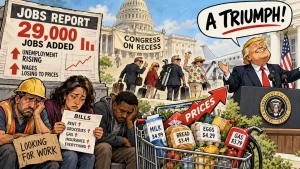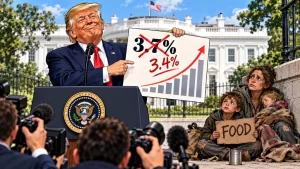
The July jobs report exposed what the S&P 500’s record close obscured — an American labor market visibly weakening, wages losing to inflation, savings collapsing, and a president attacking the referee while workers cover the shortfall with credit cards.
The Bureau of Labor Statistics published a single number on Friday morning and, in an act of bureaucratic understatement, folded it into a routine release. The number was negative 23,000 — the first monthly decline in U.S. nonfarm payrolls since February. Economists surveyed by Dow Jones had expected a gain of roughly 83,000. Instead, the American economy lost jobs, and the two prior months’ totals were revised down by a combined 103,000. That is a full quarter of jobs vanishing off the ledger in one release.
The unemployment rate, in a cruel little irony, ticked down to 4.1% — but not because more people found work. It fell because 264,000 Americans left the labor force altogether. Participation slid to 61.4%, its lowest level, outside the pandemic, since 1976. “While the unemployment rate is falling, that is mostly for the wrong reason — not enough workers,” Bill Adams, chief U.S. economist at Fifth Third Commercial Bank, told CNBC. “Immigration compensated for the aging of the workforce in the first few years of the post-pandemic expansion, but that’s not happening anymore.” Behind the sunny headline number is a labor market that has stopped growing and started shrinking.
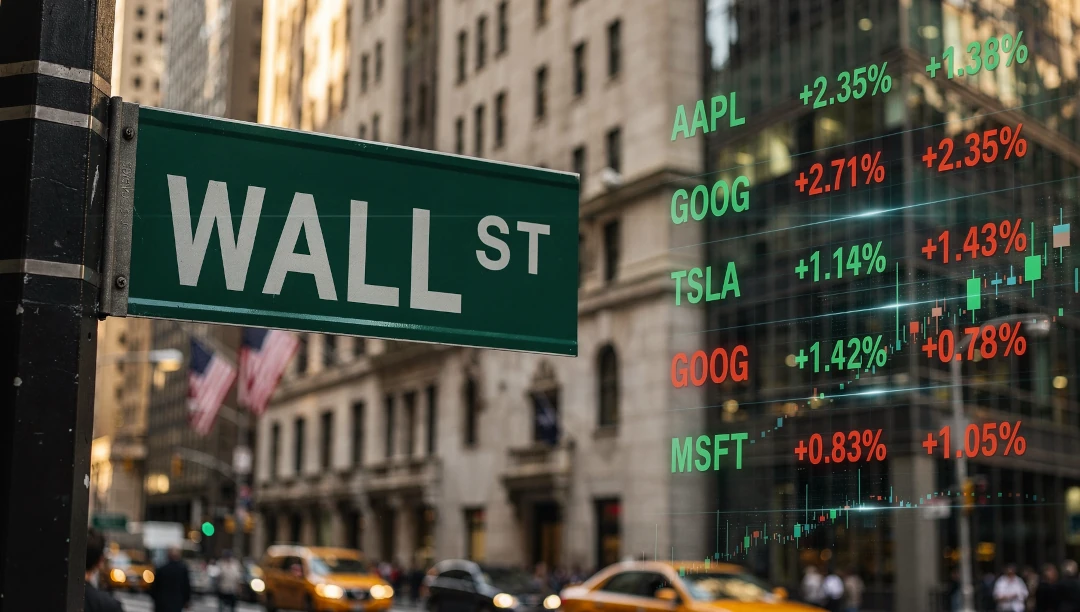
Wall Street’s response was to throw a party. The Dow and S&P 500 closed at fresh all-time highs. The Nasdaq gained roughly 5% on the week. The market’s logic is coldly rational: fewer jobs means less wage pressure means the Federal Reserve is less likely to hike rates in September, which is good for the price of capital assets. That logic is also a confession. The two Americas — one that owns the S&P 500 and one that fills out unemployment claims — are no longer even pretending to move together.
I. What the Numbers Actually Show
The headline loss of 23,000 jobs is bad. The context around it is worse. Wage growth over the last twelve months has slipped to 3.2%, the lowest since May 2021 — and once you subtract inflation, which has been pushed higher by the administration’s tariff regime, workers are losing purchasing power in real terms. The employment-to-population ratio has fallen to 58.9%, the lowest reading since May 2014. The number of Americans on temporary layoff jumped by 153,000 in a single month. Long-term unemployment — those out of work for 27 weeks or more — now accounts for 25.5% of all unemployed people.
The industries doing the bleeding are not obscure sectors. Local government education shed 50,000 jobs. Retail trade lost 14,000, with general merchandise retailers alone losing 21,000. Financial activities dropped 14,000. Leisure and hospitality lost 40,000. These are the workplaces where ordinary Americans clock in — schools, stores, restaurants, hotels. What is still adding jobs is a narrow set of sectors dominated by health care and business services. The rest of the economy is contracting under our feet.
“While the unemployment rate is falling, that is mostly for the wrong reason — not enough workers.”
— Bill Adams, Chief U.S. Economist, Fifth Third Commercial Bank
II. The Stock Market’s Divorce From Reality
An honest reading of Friday’s market action goes like this: a weak jobs report is now bullish, because it takes a rate hike off the table. That is not a healthy economy communicating with a healthy market. That is a financial system that has learned to root against the labor market it depends on. And it is not an accident.
Corporate profit margins are sitting at levels that would embarrass a Gilded Age industrialist. In the first quarter of 2026, after-tax non-financial corporate profit margins hit 7.6%, just shy of the pandemic-era peak. Labor’s share of national income has fallen to 51% — the lowest level ever recorded — while corporate profits have climbed to 12.1% of national income, the highest since 1950. Analysts at Bank of America and Goldman Sachs expect margins to expand further in 2026 and 2027, to 13.2% and beyond. Wall Street is not celebrating an economic miracle. It is celebrating a redistribution.
The mechanism is straightforward. When the labor market cools, workers lose the leverage to demand raises. When workers lose that leverage, wage growth slows. When wage growth slows, corporate margins expand. The stock market prices this transfer forward, in real time, and calls it “good news.” The middle class experiences the same event as a stagnant paycheck.
III. The Fed in a Vise — What Powell Can and Cannot Do
The Federal Reserve entered August in an impossible position. At its July meeting, the FOMC voted to hold rates in the 3.5%–3.75% range, with three members dissenting — not because they wanted to cut, but because they wanted to hike. Inflation remains sticky, partly because the administration’s tariff regime has, by Goldman Sachs’s estimate, added roughly a full percentage point to headline inflation in the six months from the second half of 2025 through the first half of 2026. GDP growth has decelerated to 1.5% in the second quarter, down from 2.1% in Q1, with investment in structures contracting for the tenth consecutive quarter.
This is the textbook definition of stagflation risk: cooling growth, weak hiring, and tariff-driven price pressure all at once. The Fed’s dual mandate — maximum employment and price stability — has been pulled into direct conflict. Cutting rates to help the labor market risks re-igniting the inflation that tariffs are already fueling. Holding rates to fight inflation risks pushing hiring further into contraction. There is no clean answer. There is only which set of Americans absorbs the pain.
Into this fragile situation, President Trump has inserted himself with a wrecking ball. He has threatened repeatedly to fire Chair Jerome Powell, whose term ended in May but who remains on the Board of Governors. He has tried to remove Governor Lisa Cook over allegations of mortgage fraud. His Department of Justice launched a criminal investigation into the ongoing renovation of the Fed’s headquarters — an investigation Powell himself, in an unprecedented video response, described as a “pretext.” “This is about whether the Fed will be able to continue to set interest rates based on evidence and economic conditions,” Powell said, “or whether instead monetary policy will be directed by political pressure or intimidation.” That question, in August 2026, is genuinely open.
IV. The Household Ledger — Debt Up, Wages Flat, Savings Gone
To understand why “the economy” and “the household” have become different countries, look at the ledger of an ordinary American family. Credit card debt hit a record $1.277 trillion at the end of 2025. The personal savings rate has collapsed from 6.2% in early 2024 to 4.0% by Q1 2026 — a 51% decline in three years, according to an analysis by researcher Stephen Semler. The average credit card APR sits at 20.94%. Delinquency has climbed to 4.8% of all household debt. Student loan delinquency is 9.6% at ninety days late. The University of Michigan consumer sentiment index fell to 53.3 in March 2026 — a level historically associated with recessions, not “record highs.”
Total U.S. credit card balances hit a record $1.277 trillion in Q4 2025 — a 5.5% annual increase driven by middle- and lower-income households using plastic to cover routine bills. Yahoo Finance
The personal savings rate has fallen 51% since 2019, from a healthy 6.2% in early 2024 to just 4.0% in Q1 2026 — the buffer against emergency is gone. Semler / Fed data
Nominal wage growth slid to a five-year low in July — and once you subtract tariff-fueled inflation, workers are losing purchasing power in real terms. CNBC
Late-payment delinquency has climbed to 4.8% of all household debt. Student loans are 9.6% delinquent at 90+ days. The pipeline of household distress is expanding. Yahoo Finance
Grocery prices are 33% higher than in 2019. Bain’s May survey found 80% of Americans are actively trying to spend less; 56% are trading down to cheaper brands. CNBC
The University of Michigan consumer sentiment index sits deep in recession territory. Americans, according to the survey data, do not believe the “boom” they are told they are living in. Yahoo Finance
The behavioral signal is unambiguous. Dollar Tree posted 6.5% comparable-store sales growth in Q2 2026 as shoppers “prioritized necessities over discretionary merchandise.” Ibotta’s 2026 State of Spend report found that 62% of shoppers prioritize price over brand, and 44% report buying more private-label products than a year ago. Walmart executives have publicly noted that affluent customers are now showing up at discount retailers — a sign, in the words of shopping analyst Trae Bodge, that “things are getting expensive all around.” When Walmart is the trade-down destination, the trade-down floor has caved in.
V. The Structural Fight — Wages vs. Profits
What is playing out in the July data is not a mystery. It is the American economy’s oldest fight — the tug-of-war between labor share (wages) and capital share (corporate profits) — being resolved decisively, and quietly, in favor of capital. When corporate margins are sitting near historical highs and prices have already been passed on to consumers, any attempt by workers to catch their wages up to past inflation runs directly into a corporate reluctance to sacrifice a single point of margin. The result is a stalemate that looks, from the boardroom, like discipline, and looks, from the checkout line, like a slow strangulation.
Goldman Sachs’s own strategists, in an early 2026 note, said the quiet part out loud: “Our economists expect the U.S. economy will continue to expand … but slow job growth will keep a lid on wage growth.” Read that sentence carefully. It is a forecast that treats weak wage growth as a business virtue. And it is why Wall Street rallied on Friday. Every worker who stops looking for a job is one less worker who can bargain for a raise. Every raise not given is a basis point that flows to margin, to earnings, and to the P/E multiple.
“You can’t just keep mowing through one part of our economy after another, sucking out all the profits for yourselves and leaving nothing but misery behind.”
— Sen. Elizabeth Warren (D-Mass.), on the housing crisis, June 2026
VI. Congress and the Democrats’ Response
Congressional Democrats have not been silent. In April, the Congressional Progressive Caucus released its New Affordability Agenda — a slate of proposals for universal childcare, housing supply expansion, prescription drug price caps, and antitrust enforcement against corporate consolidation. “At a time when 60% of Americans live paycheck to paycheck and billionaires and large corporations have never had it so good,” Sen. Bernie Sanders said in the release, “the Congressional Progressive Caucus is putting forward bold ideas this country desperately needs.” Rep. Greg Casar, the caucus chair, put it more bluntly: “Affordability is not a ‘hoax,’ and it also has to be more than just a slogan.”
Sen. Elizabeth Warren, working with Republican Sen. Tim Scott of South Carolina, shepherded the 21st Century ROAD to Housing Act through both chambers in June — a rare piece of bipartisan legislation that passed the House 358–32 and the Senate 85–5, designed to boost supply through streamlined permitting and, notably, to end federal tax breaks that have subsidized Wall Street’s mass acquisition of single-family homes. In February, Senate Democrats introduced the American Homeownership Act, sponsored by Warren, Sen. Jeff Merkley, and Sen. Ed Markey, to strip further tax preferences from corporate landlords.
These are not perfect bills. They are not the transformative agenda the moment calls for. But they exist, and they name the fight — Wall Street’s extraction of the residential housing supply — that mainstream Republican economic discourse continues to pretend is not happening. The problem is not the absence of Democratic proposals. It is the political geometry that keeps most of them from becoming law. Warren and Schumer, in January, released a “Broken Promises” report cataloging the administration’s failure to deliver on Trump’s own campaign pledge to “cut the cost of a new home in half.” That report, and the affordability agenda around it, is the record Democrats will run on. Whether they can build a governing coalition to enact it is another question entirely.
Get Involved Today
Contribute to our mission and turn your concerns into action.
VII. The President’s Response — Tariffs, Threats, and Firing People Who Say No
The White House’s response to the pressure cooker forming beneath its own economy has been, to put it charitably, incoherent. The president’s public statement following Friday’s jobs report was posted on Truth Social: “We are going to be encouraging the Good Market to get better, rather than make it impossible for it to do so. We are going to see numbers that are far more natural, and far better, than they have ever been before.” What the administration is actually doing is a different thing entirely.
This is not economic policy. It is a public tantrum being conducted in the direction of the one institution — the Federal Reserve — whose independence has, since the mid-twentieth century, been the single most important defense against politically-motivated inflation. And it is happening in tandem with a tariff regime that is, by the estimate of the president’s own appointed Fed chair, the reason inflation remains sticky. The administration is fueling the fire and demanding the fire department stop responding to alarms.
What is conspicuously absent is anything resembling an affordability agenda. There is no White House proposal to cap credit card interest rates. There is no proposal to expand the earned income tax credit. There is no proposal to protect the SNAP benefits that have been trimmed. There is no proposal to address the Wall Street residential real estate acquisition that both parties, in the recent housing bill, at least acknowledged was a problem. What there is, instead, is a president using economic statistics as a mirror in which to admire himself, and firing officials who disagree with the reflection.
Economic Malfeasance and the Question of Capacity
Ratified in 1967 in the wake of the Kennedy assassination, the Twenty-fifth Amendment establishes the constitutional mechanism for a president who is “unable to discharge the powers and duties of his office.” Section 4, which has never been formally invoked, allows the Vice President and a majority of the Cabinet to notify Congress in writing that the president is incapable of performing his duties — at which point the Vice President immediately assumes his powers as Acting President.
Multiple sitting members of Congress have already publicly called for the amendment’s invocation against President Trump this year — not on economic grounds directly, but on grounds of judgment and stability that bear directly on the current moment. Rep. Madeleine Dean (D-Pa.) wrote in April that Trump is “unhinged and unwell” and formally called on Vice President Vance and the Cabinet to act. Rep. Yassamin Ansari (D-Ariz.) was more direct: “The President of the United States is a deranged lunatic, and a national security threat to our country and the rest of the world.” Rep. Melanie Stansbury (D-N.M.), Sen. Ed Markey (D-Mass.), Rep. Eric Swalwell (D-Calif.), and Rep. Sydney Kamlager-Dove (D-Calif.) have each added their voices.
The constitutional argument, as it applies to the economy, is this: presidential capacity is not merely a question of mental status in a clinical sense. It is a question of whether the officeholder can, in fact, execute the duties his oath requires. The oath commits him to preserve, protect, and defend the Constitution — which in turn establishes a Federal Reserve whose independence has been foundational to price stability for two generations. A president who publicly threatens to remove central bankers because they will not lower rates on his political timetable, and who levies broad tariffs that his own appointed Fed chair says are fueling the very inflation those rate cuts would worsen, is not exercising executive judgment. He is abdicating it.
The practical barriers to Section 4 are, admittedly, formidable. It requires the Vice President and a majority of the Cabinet — all Trump appointees — to act against the man who appointed them. It requires Congress, upon the president’s counter-notification, to muster a two-thirds vote in both chambers to sustain the removal within 21 days. In a Republican Congress that has defined itself by loyalty to this president, that vote does not exist today. Section 4 is a lock, and there is no key on the ring.
But those barriers do not negate the constitutional and moral case. They only measure it. The framers included Section 4 not because they expected it to be used routinely, but because they understood that a republic must, in extremis, retain the power to remove an executive who has become a danger to the institutions he swore to defend. That the current Cabinet is unwilling to act, and that the current Congress is unwilling to sustain such an action, is not a verdict on whether the case exists. It is a verdict on whether we are still, in any functional sense, a self-correcting democracy. The July jobs report — and the president’s response to it — is a data point in that ongoing verdict.
Editorial Conclusion
The July jobs report is not a statistical footnote. It is a portrait of an economy where working Americans are losing ground in real terms while corporate profit margins grind higher, where the labor share of national income has fallen to its lowest recorded level, and where the president’s response is to attack the one institution capable of managing the situation.
Wall Street’s record close on Friday was not a signal that the economy is healthy. It was a signal that the market has learned to prefer a weakening labor force over a strengthening one, and that the redistribution from labor to capital has become the operating logic of the U.S. political economy.
What is required is not another round of tariff theater and Truth Social broadsides against the Federal Reserve. What is required is a president willing to govern — to defend the independence of the central bank, to acknowledge the affordability crisis his own administration is worsening, and to place the wages of American workers above the margins of American shareholders. That the current officeholder is manifestly unwilling and unable to do any of these things is not a partisan observation. It is the constitutional question of the year.
Sources & References
- NBC News — “July jobs report: US economy shed 23,000 jobs, a sudden reversal,” August 7, 2026.
- Bureau of Labor Statistics — “The Employment Situation — July 2026,” August 7, 2026.
- CNBC — “U.S. economy unexpectedly lost 23,000 jobs in July,” August 7, 2026.
- Axios — “U.S. economy surprisingly lost 23,000 jobs in July,” August 7, 2026.
- Kiplinger — “Stocks Hit New Highs as Jobs Data Mutes Rate Hike Talk,” August 7, 2026.
- Yahoo Finance / QZ — “S&P 500 rallies after July jobs report misses forecasts,” August 7, 2026.
- CNBC — “Fed meeting recap: July 2026,” July 29, 2026.
- Trading Economics — “United States GDP Growth Rate — Q2 2026 Advance Estimate,” released July 30, 2026.
- Stanford SIEPR — “The U.S. economy in 2026: What to watch for,” 2026.
- Tax Foundation — “Tracking the Economic Impact of the Trump Tariffs,” updated July 2026.
- Edward Conard / Macro Roundup — “US corporate profit margins at 7.6%, near historic highs,” July 2026.
- Sam Ro / TKer — “Profit margins expected to expand in 2026,” January 6, 2026.
- Yahoo Finance — “Credit Card Debt Hit $1.28 Trillion as Americans Save Less,” May 6, 2026.
- LendingTree — “2026 Credit Card Debt Statistics,” updated July 2026.
- Stephen Semler — “Falling wages, spiraling credit card debt,” May 16, 2026.
- CNBC — “U.S. grocery spending slows in hit to food companies,” July 16, 2026.
- Yahoo Finance / TheStreet — “Dollar Tree sees big shift in consumer behavior,” May 29, 2026.
- Congressional Progressive Caucus — “Progressive Caucus Announces ‘New Affordability Agenda’,” April 29, 2026.
- Boston Globe — “Housing affordability brings Democrats and Republicans together,” June 23, 2026.
- Sen. Jeff Merkley (D-Ore.) — “Senate Democrats Introduce The American Homeownership Act,” February 24, 2026.
- The Hill — “Trump fumes as Powell plots future at Federal Reserve,” May 3, 2026.
- The Conversation — “How Trump’s repeated efforts to fire Powell harm the economy,” June 16, 2026.
- Motley Fool — “Powell’s Inflation Warning Rings Truer Than Ever,” July 28, 2026.
- PBS NewsHour — “Could the 25th Amendment be invoked against Trump? Here’s how it works,” April 6, 2026.
- TIME — “What to Know About the 25th Amendment as Lawmakers Call for Trump’s Removal,” April 6, 2026.
- WHYY — “Pa., Del., N.J. lawmakers consider 25th Amendment for Trump,” April 7, 2026.
- Center for American Progress — “A Year in Review: How the Trump Administration’s Economic Policies Made Life Less Affordable,” February 23, 2026.
- Senate Banking Committee (Minority) — “Warren, Schumer Take On Trump’s Broken Promise on Housing,” January 7, 2026.
Related News