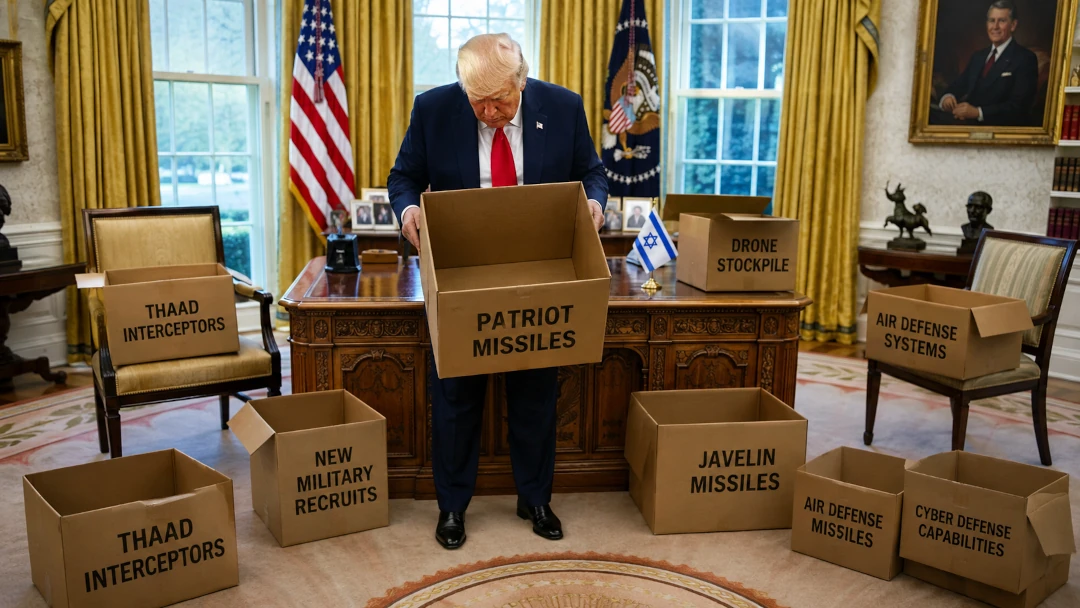
An Empty Arsenal, a Purged General Staff, and a President Who Wants to Jail the Messenger
The most powerful military on earth has burned through four-fifths of its top missile-defense interceptors in a single war of the president’s choosing. His response is not to fix it — it is to hunt down the officials who let America know. The pattern is not incompetence. It is a slow-motion national-security emergency, engineered from the top.
The disclosure landed on a Tuesday night and it should have ended a presidency. According to CNN’s Zachary Cohen, Jim Sciutto and Haley Britzky, the United States military has expended nearly 80 percent of its THAAD missile-defense interceptors and roughly half of its Patriot inventory in five months of fighting Iran. Two sources familiar with the latest Pentagon assessment described the reserves as “dangerously low.” The Center for Strategic and International Studies estimates the pre-war stockpile at roughly 2,200 Patriots and 452 THAAD missiles; there are now, by outside estimate, fewer than 830 Patriots and fewer than 280 THAADs remaining, according to reporting summarized by The Independent. Rebuilding the THAAD arsenal alone, CSIS assesses, will take three or more years.
The president’s answer to that disclosure was not a plan. It was a threat. Just after midnight, on his own social-media platform, Donald Trump declared the leak “treasonous” and vowed that those responsible would be “hunted down.” “Long term jail sentences will be sought!” he wrote — a sentence that will, one day, be studied by historians as the moment an American commander-in-chief chose to prosecute the truth rather than address it.
“The ‘leakers’ of these treasonous statements are being hunted down. Long term jail sentences will be sought!”
— President Donald J. Trump, Truth Social, August 6, 2026
The president’s fury was, by all serious accounts, misdirected. The Washington Post reported that at a Cabinet meeting at Camp David on August 1, Trump confronted Defense Secretary Pete Hegseth after learning the munitions shortfall he had been assured was “fixed” was, in fact, catastrophic. Hegseth, per two sources cited by the Post, blamed Deputy Secretary Stephen Feinberg. The pattern is now familiar: crisis metastasizes, the president is misled by loyalists installed for their loyalty, and the punishment lands on whoever revealed the crisis, not on those who created it.
I. The Munitions Emergency
The numbers are not opinions. They are the accumulated cost of the president’s decision, taken without congressional authorization on February 28, to open a wide-scale bombing campaign — Operation Epic Fury — that he initially told the public would take four to five weeks. It has now entered its sixth month. In the first month alone, reporting cited by Benzinga notes the military fired more than 850 Tomahawk cruise missiles and more than 1,000 Patriot and THAAD interceptors. CNN’s analysts say current production yields only about 15 new Tomahawks and 20 new Patriot missiles per month — a rate at which the shelves will remain half-empty for years.
Of the pre-war Terminal High-Altitude Area Defense interceptor stockpile burned through in five months, per two sources to CNN. CSIS estimates rebuilding will take at least three years.
Of the roughly 2,200 modern Patriot missiles the U.S. held before the war have been fired, largely at Iranian missiles and drones, per CNN’s inventory report.
Reuters reported the Army’s stockpile of Army Tactical Missile Systems and Precision Strike Missiles is now “virtually all” depleted, as detailed in coverage the president has since attacked as “fake news.”
CSIS’s estimate to rebuild the THAAD inventory to pre-war levels. Current fiscal-year deliveries: roughly 15 Tomahawks and 20 Patriots per month, per CNN analysts.
What the numbers mean, in plain English, is this: the United States has spent, in one theater, a share of its most sophisticated air-defense arsenal that would take the better part of a decade of peacetime production to replace. Joint Chiefs Chairman Gen. Dan Caine reportedly raised the stockpile issue directly with the White House last month; sources told CNN the depleted inventory could compromise the U.S. ability to fight a future war involving China, Russia, or North Korea. “The lack of interceptors means that conventional attacks can backfire if the suicide drones start making it through in-masse,” one source told the outlet. “Tit-for-tat will never end this.”
The president’s response is to shoot the messenger. Literally the messenger. A White House capable of clear-eyed decision-making would be in emergency consultation with defense contractors and congressional appropriators. This one is threatening reporters with prison.
II. The Pentagon Purge
To understand why the president was, by his own admission, misled about his own arsenal, one must understand who Pete Hegseth has spent eighteen months systematically removing from the building. A CNN investigation published June 9, 2026, based on interviews with 15 current and former Pentagon officials, described a defense secretary who cultivated “a culture of suspicion that has fractured the department’s leadership and disrupted its operational decision-making.” A Pentagon official quoted in that reporting described the atmosphere with precision: “A year-plus later, there is a lack of clear internal processes within the Pentagon … caused by mass paranoia. Everything is a case-by-case basis because there’s no delegation, there’s no trust.”
That is not a description of a functioning war department. It is a description of a court, and a paranoid one at that.
Since taking office, Hegseth has fired or sidelined nearly three dozen general officers and admirals and blocked the promotion of roughly forty senior colonels and Navy captains selected for flag rank, a pace that The Daily Beast and MS NOW both describe as unprecedented in modern American history. The roll call reads like the deliberate demolition of institutional memory:
“He just has this deep-seeded distrust of the Army. A year-plus later, there is a lack of clear internal processes within the Pentagon … caused by mass paranoia.”
— Anonymous Pentagon Official to CNN, June 9, 2026
III. The Recruiting Illusion
The administration is quick to point at the recruiting numbers as vindication. The Army reached its FY2026 goal of 61,500 enlistment contracts more than four months before the end of the fiscal year. The Air Force and Space Force hit their combined 32,000-recruit target five months early. The official press releases read like a comeback story. The reality is quieter, and more troubling.
The comeback rests on three levers, and none of them addresses the underlying problem. First, the Army lowered its own goal. Second, roughly a quarter of Army enlistments now flow through the Future Soldier Preparatory Course, a paid 90-day remedial program that helps applicants who initially fail either academic or fitness standards get across the line. Third, the maximum enlistment age was raised to 42 in March 2026. These are legitimate operational adjustments. They are not evidence that America’s young people are lining up to fight.
The structural numbers, tracked by the Department of Defense’s own Joint Advertising Market Research and Studies unit and analyzed by think tanks like the Center for a New American Security, tell a different story. Only about 23 percent of Americans aged 17 to 24 can qualify for military service without a waiver — the rest are ruled out by obesity, medical history, drug use, or academic testing. Youth propensity to serve, as measured by the DoD’s own Youth Poll, has collapsed from a recent high of 16 percent in 2003 to around 9 to 11 percent in the most recent surveys. The pool of “familial connectors” — young people with a parent or close relative who served, historically the single strongest predictor of enlistment — is shrinking as the veteran share of the adult population falls below 6 percent.
What the headlines report and what the underlying data show are two different countries. When a target is reduced and a paid remedial course carries a quarter of the class over the bar, “goal met” is technically accurate and structurally hollow. The Army stabilized short-term numbers. It did not solve the crisis. And it is now sending those recruits into a force run by a defense secretary who has explicitly rolled back a decade’s worth of reforms — combat roles for women, anti-harassment reporting, protections against toxic leadership — that were originally adopted, per former Defense Secretary Ash Carter, because the military “cannot afford to cut ourselves off from half the country’s talents and skills.” The pool is already shrinking. The administration is deliberately narrowing it further.
Get Involved Today
Contribute to our mission and turn your concerns into action.
IV. Multiplying Fronts, Depleting Force
Even as the arsenal empties and the general staff is decapitated, the president is stacking new commitments on the pile. In the Caribbean, U.S. Navy and Air Force surveillance flights near Havana and Santiago de Cuba have surged since early February, with more than two dozen missions flown by P-8A Poseidon maritime patrol planes, RC-135V Rivet Joint signals-intelligence aircraft, and MQ-4C Triton drones — the same platforms, as analysts have noted, that mapped the ground before U.S. special-forces operations in Venezuela and Iran. Trump has repeatedly musing publicly that “Cuba is next,” and the USS Nimitz and other assets have been redirected toward the region.
The Soufan Center and Newsweek have both documented the buildup as consistent with pre-intervention posture. Sebastian Arcos, interim director for the Institute for Cuban Studies at Florida International University, told Axios that intervention appeared possible in January, was shelved when Iran drained assets, and is now being “refocused” as Iran drags on. This is a president opening a potential third theater — Venezuela, Iran, now Cuba — while his own commanders warn the arsenal cannot sustain the current one.
The cost is landing, meanwhile, on the sailors and Marines already deployed. The USS Abraham Lincoln has now been at sea for 208 days — a modern Navy record. On August 5, MS NOW interviewed a dozen family members who described crew members serving on half-cups of rice and two tortillas per meal, working through moldy showers, broken toilets, and weeks without laundry service. “The morale is not good,” Bonnie York, whose stepson serves aboard the Lincoln, told the outlet. “Apparently, the ship’s doctor or therapist said they need to hit port soon or people are going to start, you know, losing their minds.” Nicole Conrad, another Navy mother, delivered a message to Hegseth directly: “Go visit. If you want to sit here and you want to say that Trump is taking care of the soldiers, go yourself.”
These are the concrete costs of a president who fights the messenger instead of the problem. The interceptors are gone. The generals who would speak plainly are gone. The sailors are exhausted, hungry, and running on fumes. And the president wants to open another front.
The 25th Amendment and a Commander-in-Chief Unfit to Command
Section 4 of the Twenty-Fifth Amendment provides that whenever the Vice President and a majority of the Cabinet transmit to Congress their written declaration that the President is “unable to discharge the powers and duties of his office,” the Vice President immediately assumes them as Acting President. It was drafted after the assassination of John F. Kennedy and ratified in 1967. It has never been used against a sitting president. It exists precisely for the moment the country now confronts.
What “unable to discharge” means is contested — deliberately so — but the framers of the amendment made clear it was not limited to physical incapacity. As TIME reported in April, the mechanism was designed for a president who is “unable or unwilling to declare himself incapacitated.” A president who is misled by his own subordinates about the state of his arsenal because he built a Pentagon that punishes candor; who threatens war crimes against a “whole civilization” on social media at midnight; who responds to inventory disclosures by promising to jail journalists — is a president whose ability to discharge the powers of the office is, at minimum, an open question.
He is not alone in that judgment. More than 80 House Democrats — including Reps. Alexandria Ocasio-Cortez (D-NY), Rashida Tlaib (D-MI), and Ilhan Omar (D-MN) — and Senators Ed Markey (D-MA), Chris Murphy (D-CT), and Ron Wyden (D-OR) have publicly called on Vice President JD Vance and the Cabinet to invoke Section 4, as Newsweek documented. Rep. Ro Khanna (D-CA), Rep. Eric Swalwell (D-CA), Rep. Sydney Kamlager-Dove (D-CA), and Rep. Yassamin Ansari (D-AZ) joined the calls in January after the Greenland episode and again in April after the “whole civilization” threat. Ty Cobb, who served as White House counsel during Trump’s first term, told The Jim Acosta Show that the situation “highlights the level of his insanity and depravity.” Sen. Murphy put it most bluntly: “If I were in Trump’s Cabinet, I would spend Easter calling constitutional lawyers about the 25th Amendment. This is completely, utterly unhinged.”
The Practical Barrier
Let us be honest about the mechanism. Section 4 requires the Vice President’s cooperation, and JD Vance will not provide it. It requires a majority of a Cabinet composed of loyalists chosen specifically because they will not provide it. The votes are not there, and no serious analyst believes they will be there absent a still-more-catastrophic breakdown. The path is politically closed.
Why the Barrier Does Not Negate the Argument
The moral and constitutional case does not depend on whether the mechanism will be used. It depends on whether the conditions the amendment contemplates have been met. That the Vice President and Cabinet will not act does not mean they should not act. It means the country has a Cabinet that has abandoned its constitutional duty. That is itself the story. Naming it clearly — that the man in the Oval Office is presiding over the arsenal’s collapse, the general staff’s demolition, and the deployment of exhausted sailors to a war his own commanders say he can no longer supply — is the beginning of any honest reckoning. Silence is complicity. The Cabinet is choosing complicity.
V. What Leadership Would Look Like
A leader confronted with the CNN report would have spent Wednesday morning on the phone with Lockheed Martin, RTX, and the Senate Armed Services Committee. A leader would have publicly thanked the Joint Chiefs Chairman for raising the alarm and asked Congress for an emergency supplemental. A leader would have ordered a review of the deployment cycle for the USS Abraham Lincoln and personally visited the sailors on that ship. A leader would have retained the generals with the deepest institutional knowledge of air-defense procurement — not fired them for insufficiently enthusiastic loyalty. A leader would have paused any consideration of a Cuba operation until the arsenal for the current war was restored.
Instead, at 12:47 a.m. on August 6, the president of the United States sat in front of a screen and typed the word “treasonous” about American journalists. This is not incidental. This is the temperament that emptied the arsenal in the first place. The war was launched without congressional authorization, told to the public it would last four to five weeks, extended without explanation into a sixth month, and is now being managed by a defense secretary reduced to blaming his deputy while the aircraft carriers ration food. Every accountability mechanism the constitutional order provides for a moment like this — congressional oversight, cabinet governance, an inspector general, a free press — is being either bypassed, purged, or explicitly threatened.
This is what a leadership failure looks like at the scale of a superpower. Not a single dramatic mistake, but a pattern: the missiles, the generals, the sailors, the recruiters, the leakers, the newspapers, the constitutional amendment. Each thread pulled by the same hand.
Editorial Conclusion
The United States has, in five months, spent a share of its most sophisticated air-defense arsenal that will take three or more years to replace. It has done so under a defense secretary who has removed the officers most capable of rebuilding it. Its sailors are hungry. Its recruits are being shepherded through remedial courses to meet lowered targets. Its president, informed of all this, has chosen to threaten American reporters with prison rather than address a single cause of it.
The Twenty-Fifth Amendment exists for precisely this. That the Cabinet will not invoke it does not diminish the case for invoking it — it indicts the Cabinet. The country is being placed, deliberately and traceably, in a dangerously vulnerable position by the man sworn to defend it. Name it that way. The Republic depends on Americans who are willing to.
Sources & References
- CNN — Nearly 80% of interceptors for a key missile defense system depleted, sources say (Cohen, Sciutto, Britzky; Aug. 4, 2026).
- The Washington Post — Trump, Hegseth clashed at Camp David over Iran missile depletion concerns (Aug. 6, 2026).
- Fox News — Trump says US has ‘massive’ munitions stockpile, vows ‘treasonous’ leakers being hunted down (Aug. 6, 2026).
- The Independent (via AOL) — Trump vows jail for ‘treasonous leakers’ over missile shortage report (Aug. 6, 2026).
- The Hill — Donald Trump rips media reports of spat with Pete Hegseth at Camp David over munitions (Aug. 6, 2026).
- CNN — Inside Hegseth’s Pentagon, where distrust and suspicions of loyalty are rampant (Jun. 9, 2026).
- The Daily Beast — Pentagon Pete Hegseth Purge Victims Expose Petty Reason They Were Ousted (Jul. 23, 2026).
- The Daily Beast — Defense Secretary Pete Hegseth’s Purge Chaos Spirals With Top General C.D. Donahue’s Shock Exit (Jun. 24, 2026).
- MS NOW — Hegseth’s ‘Pentagon Purge’: 2 officers say they were forced out for questioning policies (Jul. 23, 2026).
- Yahoo News / CNN — Exclusive: Three-star general pushed out amid tensions with Hegseth.
- MS NOW — Moldy showers and no soap: Military families are outraged by conditions on USS Lincoln (Aug. 5, 2026).
- MS NOW / Maddow Blog — As questions intensify over U.S. weapons shortfalls, Trump trips over his contradictions (Aug. 6, 2026).
- Stars and Stripes — Army reaches recruiting goal for 2026 more than 4 months early (May 23, 2026).
- Military.com — Army Future Soldier Prep Course 2026: Eligibility, Tracks, and Benefits.
- CNAS — Short Supply: The role of low propensity in the U.S. military’s recruiting difficulties.
- Truthout — US Surveillance Flights Over Cuba Have Increased Since Early February (May 11, 2026).
- Newsweek — Will the US Invade Cuba? Spy Flights Surge, New Sanctions, Havana Fumes (May 11, 2026).
- The Soufan Center — The U.S. is Setting its Sights on Cuba (Jun. 2, 2026).
- TIME — What to Know About the 25th Amendment as Lawmakers Call for Trump’s Removal (Apr. 2026).
- Newsweek — Lawmakers Demand 25th Amendment Be Invoked Against Donald Trump: Full List (Apr. 8, 2026).
Related News