Our Stealth Secrets Sit in Beijing — and the President Rolled Out the Red Carpet
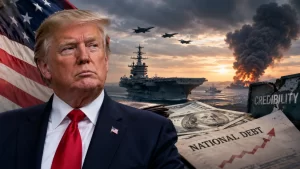
Radar-evading F-35 components vanished into Hong Kong this summer, and China reportedly will not give them back. When Xi Jinping arrived in Washington this week, Donald Trump had American service members on their knees grooming his carpet instead of demanding them. A hollowed-out Pentagon, a defense secretary facing impeachment articles, and a commander in chief who flattered rather than confronted: this is what a leadership failure looks like.
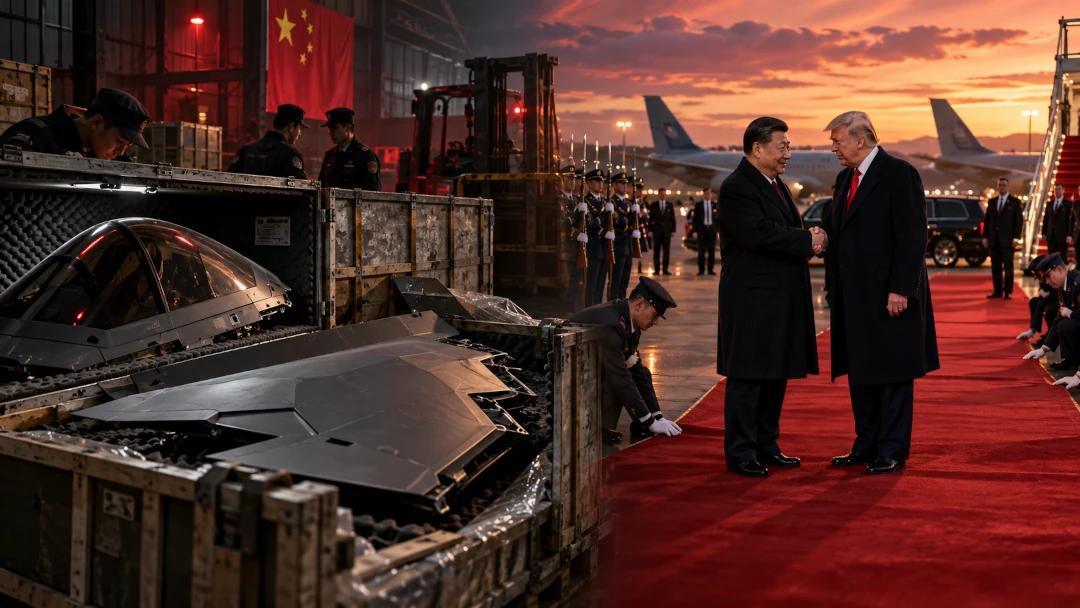
Sometime in late May, a UPS shipment left Australia carrying two pieces of the most advanced fighter jet the United States has ever built: a cockpit canopy and a weapons-bay door from a Royal Australian Air Force F-35, both coated in the radar-absorbent material that makes the aircraft hard to see. They were supposed to land in the United States for inspection and possible repair. Instead, according to Bloomberg, the shipment stopped in South Korea, was rerouted to Hong Kong without explanation, and ended up in the custody of the Chinese government, which has not returned the parts.
That news broke on the very day Chinese President Xi Jinping arrived in Washington for a three-day state visit. What followed should alarm every American who cares about the safety of our troops and the credibility of our country. The president did not publicly demand the parts back. He did not make Beijing’s possession of American stealth technology a condition of the pageantry. Instead, he staged one of the most lavish welcomes any foreign leader has received in modern memory, down to uniformed service members kneeling on the tarmac to brush the red carpet smooth.
This is not a story about one misrouted box. It is a story about a government that has lost the habits of vigilance, a Pentagon stripped of its experienced leadership, and a president whose instincts run toward flattery of autocrats rather than defense of the nation he swore to protect.
I. How American Stealth Technology Ended Up in Chinese Hands
Politico first reported on September 18 that F-35 parts bound for repair in the U.S. had been rerouted over the Pacific while an intermediary was moving them on behalf of manufacturer Lockheed Martin. Congressional staff, it turned out, had been quietly briefed by the State Department and Pentagon since June. On September 22, Australian Defence Minister Richard Marles confirmed to reporters in Adelaide that the parts had been mistakenly sent to Hong Kong and that Canberra was helping the U.S. and Lockheed investigate. Lockheed, for its part, told CNN the components were “unserviceable and deemed low risk for exploitation.”
The next day, Bloomberg added the details that transformed a logistics embarrassment into a national-security scandal: the carrier was UPS, the plane carrying the parts stopped in South Korea, and Chinese authorities took possession of the components afterward. CBS News reported that the Pentagon declined to confirm China’s possession but acknowledged a “shipment issue” and said it was working to recover the parts. China’s Foreign Ministry, meanwhile, claimed it was not aware of the situation.
The chain of custody raises its own questions. Australian Defence Magazine reported that CEVA Logistics, Lockheed’s primary logistics provider and a company that runs storage at RAAF Base Williamtown, is owned by the French shipping group CMA CGM, which in late August signed a strategic framework agreement with China Communications Construction Company, a state-owned firm on the U.S. Entity List (a trade restriction list published by the Bureau of Industry and Security (BIS) under the U.S. Department of Commerce) for building military outposts in the South China Sea. CEVA says no one has contacted it about the incident and that it knows of no facts linking it to the shipment. We note its denial. But the fact that the F-35’s supply chain runs through companies doing business with a blacklisted Chinese military contractor is itself a warning that should have been heeded long before a canopy went missing.
What was lost
A cockpit canopy and a weapons-bay door, both coated with radar-absorbing material that contributes to the jet’s stealth, per CNBC, citing Bloomberg’s sources.
Who holds it
The Chinese government took possession after the diversion and has not returned the parts, according to people briefed on the matter, the Jerusalem Post reports.
Who is investigating
The House Armed Services and House Foreign Affairs committees, plus the Senate Armed Services airland subcommittee. UPS reported the incident to the State Department’s export-control directorate (JPost).
A pattern, not a fluke
A 2023 GAO report found more than one million F-35 parts went missing over five years amid Lockheed spare-parts mismanagement, The Aviationist notes.
- Late May 2026UPS ships the canopy and weapons-bay door from an Australian F-35 toward the U.S.; the flight stops in South Korea and the cargo is rerouted to Hong Kong.
- June 2026State and Pentagon officials brief congressional staff behind closed doors. The public hears nothing.
- September 18Politico breaks the story of the diversion, reporting the shipment included a stealth canopy.
- September 22Australia’s Richard Marles confirms the parts ended up in Hong Kong, while insisting they were not sensitive.
- September 23Bloomberg reports China holds the parts and has not returned them. Hours later, Xi Jinping lands at Joint Base Andrews to a plane-side welcome from Trump.
- September 24–25State dinner and summit; the White House publicizes friendship and a trade-truce extension. No public account shows the president demanding the parts’ return.
II. Kneeling for Xi: The Pageant That Said Everything
The Daily Beast described the scene at Joint Base Andrews on Wednesday: American service members on their hands and knees, brushing and smoothing a roughly 100-foot red carpet while members of Xi’s delegation looked down from the aircraft door. The welcome featured F-16s and F-22s arrayed on the tarmac, a salute battery, an honor cordon and a B-1 bomber flyover. Presidents almost never greet foreign leaders plane-side at Andrews; the last well-known precedent is John F. Kennedy meeting Britain’s Harold Macmillan.
The 12-second clip of troops grooming the carpet spread across social media within hours. Amy McGrath, a former Marine fighter pilot, said service members did not swear an oath to be “props in some authoritarian ego-stroking spectacle.” She is right. Honor guards serve the dignity of the nation. Here, they were staged to serve the vanity of a president eager to impress a rival.
“The Chinese are holding some of our most sensitive technology.”
— Sen. Elissa Slotkin (D-Mich.), on the F-35 parts during Xi’s state visit
Sen. Elissa Slotkin, a former CIA analyst and Pentagon official, went on to observe that the United States was rolling out the red carpet for Xi even as Beijing held that technology, and warned that China is a competitor and adversary always hunting for information on American military equipment. Inside the White House, the tone could not have been more different. According to Bloomberg’s summit coverage, Trump gave Xi a bald-eagle statue, declared the two had “never gotten along better,” and invited dinner guests to tour the construction site of his White House ballroom. The same report listed China’s grip on the F-35 parts among the unresolved grievances hanging over the summit. No deal, no demand, no public mention.
III. What the Breach Means for Our Troops and Our Edge
It is worth being precise about the stakes, because precision is what separates a serious argument from panic. Australia’s government and Lockheed both say the parts were unserviceable and low-risk. Analysts such as Bradley Bowman of the Foundation for Defense of Democracies have pointed out that U.S. systems are continuously upgraded, which can blunt the value of older secrets, The Week notes. No U.S. or Australian official has alleged that Beijing engineered the diversion.
But none of that reassures as much as officials would like. Stealth is not a single secret; it is an accumulation of materials, coatings and shapes, and physical samples let an adversary test what spies could only describe. Australian Defence Magazine warned that a canopy could help China copy its radar-resistant design for its own fighters or validate intelligence it has already stolen. Earlier generations of canopy coatings were classified. China has targeted the F-35 for years, and U.S. prosecutors described Chinese efforts to obtain F-35 data as recently as 2024.
Former Pentagon deputy press secretary Sabrina Singh put the timing problem bluntly on CNN: the summit was a chance to raise the matter, but it was likely too late, since she would assume “Chinese intelligence has at least taken photographs of this.” Every week the parts sit in Chinese custody is another week for materials scientists to study them. For the pilots of 19 nations who fly or have ordered the F-35, including American airmen and Marines flying combat missions today, the survivability of their aircraft rests on the edge that stealth provides. Any erosion of that edge is measured, ultimately, in risk to their lives.
The damage also extends to alliances. The F-35 program depends on partners trusting that Washington guards its crown jewels. That trust is already strained by the administration’s approval of a $24 billion F-35 sale to Saudi Arabia over the objections of lawmakers like Rep. Raja Krishnamoorthi, who cited intelligence warnings that the deal could put the technology within China’s reach, CNBC reports. When the United States cannot keep a canopy out of Hong Kong, and will not ask for it back, allies are entitled to wonder what else we will let slip.
IV. A Pentagon Gutted from the Top Down
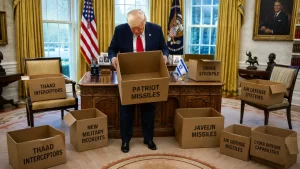
An incident like this is supposed to trigger an instant, disciplined response from a mature military bureaucracy. That bureaucracy has been systematically dismantled. Defense Secretary Pete Hegseth has fired or blocked the promotions of more than 80 generals and admirals, roughly one in ten of the military’s top officers, according to a New York Times count discussed on PBS. The Army has had no chief of staff since Hegseth fired Gen. Randy George without explanation in April, the Times reported, leaving the service rudderless as drones and missiles strike U.S. bases in the Middle East. Army Secretary Dan Driscoll resigned this month.
The alarm is bipartisan. Sen. Thom Tillis, a North Carolina Republican who voted to confirm Hegseth, has called on Trump to replace him, and House Armed Services Chair Mike Rogers, also a Republican, said he was tired of the churn, Military.com reports.
“Creating a leadership void at the top of our military ranks.”
— Sen. Thom Tillis (R-N.C.), on Secretary Hegseth
Morale has followed leadership down. A nonpartisan Partnership for Public Service survey found that satisfaction among Navy and Marine Corps civilian workers collapsed from 68.1 to 36.4 out of 100 between 2024 and 2025, and only 9.1 percent of Army civilians said Hegseth’s political leadership team motivates the workforce, Defense One reported. The Pentagon’s response was to accuse the pollsters of bias. Those civilians are the logisticians, program managers and export-control specialists who are supposed to catch a stealth canopy before it lands in the wrong hemisphere.
Congress has begun to respond. On September 15, Rep. Thomas Massie, a Kentucky Republican, took the House floor to read eight articles of impeachment against Hegseth, centered on the unauthorized war with Iran, abuse of power and violations of the law of armed conflict. Massie said his goal was that “there needs to be a marker in history,” ABC News reported. Rather than allow a recorded vote, Speaker Mike Johnson sent the House home early for a seven-week campaign recess, burying the question until after the November 3 midterms. A party confident in its defense secretary does not flee the chamber to avoid defending him.
Get Involved Today
Contribute to our mission and turn your concerns into action.
V. Silence at the Summit, and Who Is Actually Investigating
What has the administration done to recover the parts and prevent the next breach? The honest answer is: less than the moment demands, and nothing visible from the president himself. The F-35 Joint Program Office has said it is working to “retrieve these components, investigate the incident, and place safeguards” against a recurrence, per CBS News. That same outlet reported it is not clear whether the U.S. even raised the missing parts with China during Xi’s visit.
We know what the president did raise. U.S. Ambassador to China David Perdue told CNBC that Trump pressed Xi on Chinese help to Iran, according to The Hill. Treasury Secretary Scott Bessent announced a two-month extension of the trade truce. The summit ended with pledges of two more meetings this year. Yet in three days of toasts, gifts and ballroom tours, the administration has offered no public account of a demand that China return stolen American stealth technology, no deadline, and no consequence.
The real investigative work is happening elsewhere: in Canberra, where Marles says Australia is examining everything that happened on its end; at the State Department’s export-control directorate, where UPS filed its report; and on Capitol Hill, where three committees are digging in. That Congress had to learn of this in closed briefings in June, and that the public learned of it only through leaks in September, tells you how little urgency the executive branch brought to it. Americans still do not know why a stealth canopy traveled on a commercial courier, who authorized the South Korea routing, or what safeguards now govern F-35 spares moving through the Pacific.
The 25th Amendment and a Commander in Chief Who Will Not Defend His Own Arsenal
How the mechanism works
Section 4 of the 25th Amendment, ratified in 1967, allows the vice president and a majority of the Cabinet to declare in writing that the president is “unable to discharge the powers and duties of his office.” The vice president then becomes acting president. If the president contests the declaration, Congress decides, and keeping him sidelined requires a two-thirds vote of both the House and the Senate. Section 4 has never been invoked.
Who has called for it
This is not a fringe demand. In April, after the president’s threats against Iran, more than 70 Democratic lawmakers called for his removal by impeachment, the 25th Amendment, or both, NBC News reported. Sen. Ed Markey urged the Cabinet and vice president to act. Sen. Chris Murphy said “no President in control of his senses would publicly promise to eradicate an entire civilization.” Rep. Ro Khanna called for invocation outright, and Rep. Raja Krishnamoorthi, a senior member of the House Intelligence Committee, formally asked Vice President JD Vance and the Cabinet to act.
The constitutional argument
The amendment speaks of inability, not bad policy, and we take that distinction seriously. The case its proponents make is that a president who cannot perceive, or will not act on, a live threat to the nation’s most sensitive military technology is failing at the core function of the office. Consider the pattern: a stealth breach known to his government since June; an adversary head of state on American soil holding those parts; and a president who responded with plane-side flattery, a bald-eagle statue and a ballroom tour, while his defense secretary’s purges left the Army without a chief of staff in wartime. The argument is that this is not a policy disagreement but an inability to prioritize the defense of the United States over personal spectacle.
The honest barriers
The obstacles are enormous. Section 4 requires Vice President Vance and a majority of Trump’s own Cabinet, officials he appointed and can fire, to act against him. A contested declaration would need two-thirds of a Congress in which the president’s party controls both chambers. As recent history shows, officials who dissent in this administration tend to be removed. Realistically, invocation is not imminent.
Why the barriers do not erase the case
The framers of the 25th Amendment built it for the moment when a president cannot do the job and the people closest to him know it. Its difficulty is a safeguard against abuse, not proof that its purpose is obsolete. Every Cabinet member swore an oath to the Constitution, not to Donald Trump. When stealth technology sits in Beijing and the commander in chief will not so much as ask for it back, those officials must at minimum answer, publicly, whether they believe he is fulfilling his duties. Silence from them is itself a choice, and history will record it.
VI. What This Says About His Priorities
Strip away the pageantry and the pattern is plain. When forced to choose between the discomfort of confronting Xi and the pleasure of hosting him, the president chose pleasure. When his defense secretary hollowed out the officer corps in the middle of a war, he shrugged that the firings were Hegseth’s call. When his own party offered him a chance to defend Hegseth on the House floor, the leadership ran. When American stealth technology fell into Chinese hands, the most visible thing the administration produced was footage of American troops on their knees.
Leadership in national security is mostly unglamorous. It means demanding answers from contractors, holding couriers and program offices accountable, and telling a rival to its face that it will pay a price for keeping what is ours. It means protecting the people who wear the uniform, not using them as set dressing. On every one of those measures, this week was a failure, and the costs will be borne by the pilots who fly these aircraft and the allies who trusted us to guard them.
Editorial Conclusion
A president’s first duty is to defend the nation, and this week Donald Trump chose flattery over defense while Beijing kept pieces of America’s most advanced warplane. Congress must use its investigations to force a full public accounting of how the parts were lost and why no one demanded them back. It must hold Secretary Hegseth to a recorded impeachment vote the moment it returns. And the vice president and Cabinet must answer, on the record, whether they believe this president is able to discharge the duties of his office.
The Constitution gave us tools for precisely this kind of failure. A republic that refuses to use them when its security is compromised does not deserve the name.
Sources & References
- Bloomberg — China Holds Sensitive F-35 Parts Diverted to Hong Kong From Australia
- CNN — Australia confirms F-35 fighter jet parts were mistakenly diverted to Hong Kong
- CBS News — Pentagon probing how shipment of F-35 fighter jet parts was diverted
- CNBC — Chinese authorities reportedly in possession of F-35 components in Hong Kong
- The Jerusalem Post — US investigating how sensitive F-35 parts diverted to Hong Kong ended up in China’s hands
- Australian Defence Magazine — F-35 freight provider partnered with blacklisted Chinese company
- The Aviationist — F-35 Spare Parts Diverted to Hong Kong, Prompting U.S. and Australian Investigations
- The Week — F-35 fighter jet parts in Hong Kong: How sensitive are they?
- The Daily Beast — U.S. Troops Get on Hands and Knees to Welcome Communist Tyrant
- Free Press Journal — Video of US Military Adjusting Red Carpet for Xi Sparks Backlash
- Bloomberg via Business Standard — Trump-Xi summit goes big on pomp, but key US-China deals remain elusive
- The Hill — 5 takeaways from Trump and Xi’s ‘Made for TV’ summit
- Raw Story — Former Pentagon spokesperson Sabrina Singh on the F-35 parts
- ABC News — Rep. Thomas Massie forcing vote on Pete Hegseth’s impeachment
- PBS · Amanpour and Company — Fired, Resigned, Promotions Halted: Hegseth’s Military Purge
- Political Wire / The New York Times — Hegseth’s Purge of Top Generals Leaves Army Rudderless
- Military.com — Hegseth Is Removing Military’s Senior Leaders Faster Than Any Defense Secretary in Recent History
- Defense One — Defense workers’ morale has plunged under Trump, survey finds
- NBC News — Dozens of Democrats call for Trump’s removal after his Iran threats
Related News