Peace on Paper, Impunity in Practice
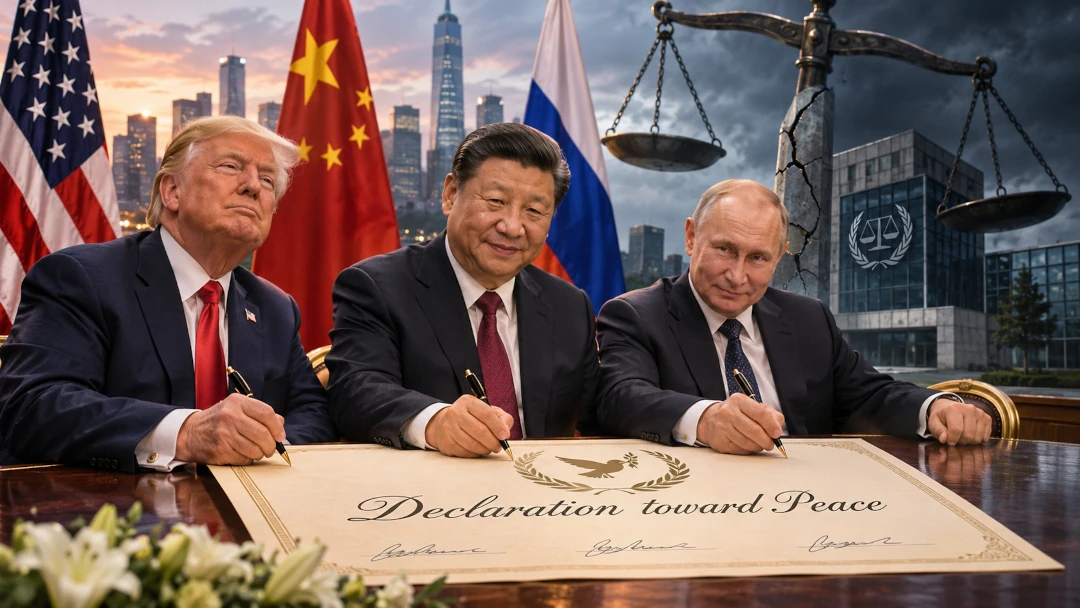
Donald Trump stood beside Xi Jinping and an indicted war-crimes suspect, Vladimir Putin, and signed a four-point “Declaration toward Peace.” Read closely, it is a charter for weaker international institutions, protection for leaders the courts want to try, and more oil for a burning planet. And nearly every line of it describes something Trump himself has done.
The photographs from Kylin Villa in Shenzhen will be the part people remember: three men at one round table, the first formal three-way meeting between the leaders of the United States, China and Russia. The document they released afterward, the China-Russia-US Heads of State Declaration toward Peace, came out of a meeting that ran roughly 80 to 90 minutes on the sidelines of the APEC summit. It is short, nonbinding and carefully worded. It also says a good deal about what the President of the United States is willing to trade away, and with whom.
The White House is calling it historic. Trump told Reuters the gathering was more important than Yalta, the 1945 conference where the great powers settled the shape of postwar Europe. That comparison should alarm Americans more than reassure them. As Reuters reported via The Korea Times, analysts said Trump went to Shenzhen looking to shore up his standing after his party lost control of Congress in this month’s midterm elections. The question is what he was willing to sign to get the picture.
I. The Four Points, Read Plainly
Strip away the diplomatic phrasing and the declaration commits its three signatories to four things. Each sounds reasonable on its own. Read together, and against the record of the men who signed them, they look very different.
Point 1 · The United Nations
As permanent Security Council members, the three countries pledged to reform the UN so it can respond more effectively to global challenges. As Newsweek’s Shane Croucher notes, the text never says what is broken. That leaves room for a UN even less able to check the three veto powers.
Point 2 · Energy
The three countries plan to increase production and supply of refined petroleum products and reaffirmed the importance of stable energy flows, according to the text as reported by The Hill. There is not a word about renewables, efficiency or climate.
Point 3 · International Justice
The leaders declared state consent and immunity for state officials to be of paramount importance, and warned that the International Criminal Court and similar bodies must not abuse their jurisdiction. One signatory has been wanted by that court since March 2023.
Point 4 · Nuclear Weapons
The three reaffirmed that a nuclear war cannot be won and must never be fought, and promised talks on reducing nuclear risk. According to The Nation (Thailand), the text sets no date for those talks and commits no one to cutting an arsenal.
Just as telling is what the text leaves out. It never mentions Russia’s war in Ukraine, now in its fifth year, or the U.S. war with Iran, according to ABC News, even though Trump said the leaders discussed Ukraine at length. It is a “peace” declaration that leaves out both of the wars it would need to end.
II. The Real Agenda: Hollowing Out the UN
On its face, “UN reform” is something Democrats and Republicans have both supported for decades. But this administration’s record shows what it means by reform. In January, Trump signed a presidential memorandum pulling the United States out of 66 international organizations. The list included the UN Framework Convention on Climate Change, the Intergovernmental Panel on Climate Change and the UN’s International Law Commission. Thirty-one of the 66 were UN bodies.
At the same time, Trump has been building a rival institution that he controls. His “Board of Peace,” chartered at Davos in January, names him chairman for life. According to the Associated Press, he has floated the idea that it “might” replace the UN, which put off major powers and was dismissed by UN officials. The climate group 350.org called the arrangement “global governance by extortion,” citing reports that permanent seats were being offered for billion-dollar payments.
So when three veto-holding powers jointly promise to “reform” the United Nations, the reasonable reading is not that they want the UN to do more. It is that they want it to do less to them. Xi and Putin have said as much for years, calling for a world order with fewer Western-led constraints. Shenzhen is the first time an American president has signed on to that project.
Get Involved Today
Contribute to our mission and turn your concerns into action.
III. Immunity for the Accused: The ICC Clause
The third point is the most revealing. The International Criminal Court has issued an arrest warrant for Vladimir Putin over the unlawful deportation of Ukrainian children. In November 2024 it issued warrants for Israeli Prime Minister Benjamin Netanyahu and his former defense minister Yoav Gallant, accusing them of war crimes and crimes against humanity in Gaza, including, as RFE/RL reported, starvation as a method of warfare. A declaration that holds up the immunity of state officials as “paramount” and warns the court against “abuse” amounts to a shield for exactly these men.
Al Jazeera laid out why each signatory dislikes the court. Washington objected to its investigation of alleged abuses by U.S. troops in Afghanistan and to its Netanyahu warrant. Moscow objects to the Putin warrant. Beijing turned against the court after the court’s arrest warrant for former Philippine president Rodrigo Duterte and in the face of genocide petitions over Xinjiang. None of the three is a member, and each has its own reason to want the court weaker.
The American contribution has been the most aggressive. In July, Secretary of State Marco Rubio announced a government-wide campaign to “disable” the court. By August, the administration had sanctioned the ICC’s own president. According to the Associated Press, nine of the court’s 18 judges, both deputy prosecutors and the former chief prosecutor are now under U.S. sanctions. The court called the move “a flagrant attack against the independence of an impartial judicial institution.” In October, Washington imposed sanctions on the institution itself.
“Either the ICC will end its threats, or we will end the ICC.”
— Secretary of State Marco Rubio, October 2026 · via Gulf News / AFP
At the UN General Assembly in September, Trump called on every ICC member state to quit what he called a rogue institution, telling its supporters, “You’re an evil group of people,” as Foreign Policy reported. Shenzhen takes that one-country crusade and makes it a three-power position. That matters for every war criminal still at large. The message to Moscow, and to anyone who wants to commit atrocities without consequences, is that the most powerful countries on Earth will now stand together against the court trying to hold them accountable.
The principle is also applied selectively. Newsweek points out that U.S. forces seized Venezuela’s Nicolás Maduro in a raid on Caracas on January 3, and he is now asking a federal judge in New York to dismiss the charges against him on grounds of head-of-state immunity. Washington says it stopped recognizing him in 2019. But if immunity applies only to leaders Trump likes, it is not a principle. It is a list of friends.
A Declaration That Runs Against U.S. Law
Article II, Section 2.
A binding international commitment requires the advice and consent of two-thirds of the Senate. The Shenzhen text is, by the parties’ own description, political and nonbinding. That limits its legal force, but it also means the President has put America’s name to a position on international justice that Congress never debated, without any vote at all.
22 U.S.C. § 7433 — the Dodd Amendment.
Even the 2002 American Servicemembers’ Protection Act, Congress’s most ICC-skeptical law, includes an explicit exception. As Just Security explains, it allows U.S. help for international efforts to bring foreign nationals accused of genocide, war crimes or crimes against humanity to justice. In its FY2023 appropriations law, Congress widened that exception so the U.S. could help the ICC investigate crimes in Ukraine. Congress made a deliberate bipartisan choice that foreign war criminals, Putin included, should face justice. The President has now signed a document with Putin that points the other way.
Article I, Section 8.
Congress, not the President, holds the power to “define and punish … Offences against the Law of Nations” and controls spending. The new Democratic majorities can use both powers: oversight hearings, limits on funds for sanctions against international judges, and a firm statutory rule that U.S. policy is to support accountability for atrocities.
IV. Oil Over Air: The Fossil-Fuel Pledge
The second point, a joint pledge to produce and supply more refined petroleum, is the clearest signal of whose interests the declaration serves. The three signatories are among the world’s largest producers and consumers of fossil fuels. Their one concrete economic commitment is to sell more of them.
For Americans, the pledge comes after a year of fuel-price pain. The war with Iran began with U.S. and Israeli air strikes on February 28. As the International Air Transport Association documented, the strikes and Iran’s retaliation effectively closed the Strait of Hormuz to commercial shipping. The Bipartisan Policy Center found that the closure took about 14 million barrels a day off the market, pushing diesel up 58 percent and jet fuel up 106 percent from a year earlier. The Conversation reported that U.S. diesel had risen more than 78 percent since the war began. Diesel moves freight, runs farms and heats homes, so that increase shows up in grocery bills and on every shipping invoice.
Oil climbed from about $70 a barrel before the war to as high as $126 before easing back toward $90 this month, according to Sinclair’s national desk, and Iranian attacks have knocked refineries across the region offline. In other words, the refined-fuel shortage the declaration promises to fix is one that Trump’s own war created.
Meanwhile, the administration has been paying companies to abandon clean energy. In March it agreed to refund TotalEnergies $928 million for two offshore wind leases, on condition the money be reinvested in fossil fuels, according to The Christian Science Monitor. In January the Energy Department canceled $83.6 billion in clean-energy loans. Representatives Jared Huffman and Jamie Raskin called the wind buyouts outrageous and unlawful. Taken together, Shenzhen’s energy plank is the administration’s domestic energy policy written into an international agreement: more oil and gas, no clean-energy transition, and the costs passed to consumers and the climate.
V. The Mirror: A Declaration Against Its Own Author
The deepest irony of Shenzhen is that each of its four points works as a charge against the man who signed it. The declaration calls for stable energy flows from the president whose war shut the world’s most important oil chokepoint. It calls for respect for the immunity of state officials from the president who seized a sitting foreign leader and flew him to New York to stand trial. It calls for nuclear restraint from the president who ordered nuclear testing to resume. It promises to strengthen the UN from the president who has pulled the country out of dozens of its bodies. The record speaks for itself:
To be fair, the War Department has not publicly announced a change in nuclear employment policy. Last month, Trump told Newsmax he would not use a nuclear or tactical nuclear weapon on Iran. But making nuclear weapons easier to use while promising “dialogue” on nuclear risk is not restraint. It is hedging. Trump himself said in Shenzhen that giving up nuclear weapons is not an easy thing to do. Xi, according to Chinese state media, called for a comprehensive ban. Neither position is written into the document they signed.
Whether Trump fails to see the contradiction or simply does not care, the result is the same. The document describes a world in which a reckless great power wrecks energy markets, threatens nuclear catastrophe, bullies international judges and walks away from the UN. That is a fair description of American foreign policy in 2026.
VI. What Congress Is Saying
Democrats answered quickly and in strong terms. Senate Democratic Leader Chuck Schumer also accused Trump of betraying the country by deferring to adversaries for a photo op.
“A historic embarrassment that people will remember long into the future.”
— Senate Democratic Leader Chuck Schumer · via Reuters
Senator Jeanne Shaheen of New Hampshire, the top Democrat on the Senate Foreign Relations Committee, said Trump was “without a doubt” played by Xi and Putin. She called the summit a photo op that produced nothing for Americans. Shaheen and Senators Chris Coons and Tim Kaine warned against putting diplomatic appearances ahead of U.S. interests. The criticism also came from Republicans: in the same coverage, Fox News reported that North Carolina Republican Thom Tillis criticized Putin and Xi and warned that “world peace” is not on their agenda.
Those statements carry more weight now than they would have a month ago. Republicans lost control of Congress in this month’s midterms, so the next session will give Democrats subpoena power, committee gavels and control over appropriations. They will be able to pursue the declaration’s ICC language, the tactical-nuclear strategy and the clean-energy buyouts with more than press releases.
VII. What It Means for Our Allies
America’s allies were not in the room in Shenzhen, and they noticed. According to Reuters, European leaders met in Berlin the same day to show support for Ukraine. They were angered that Trump called Putin a “friend” and that Europe had been left out. German Chancellor Friedrich Merz said a Yalta-style arrangement would not bring peace. Ukraine’s foreign minister, Andriy Sybiha, insisted that the summit was not the Yalta Putin wanted and told the Russian leader to accept that he cannot win the war.
In Asia, the snub was less direct but still visible. Reuters noted that Japan’s Prime Minister Sanae Takaichi arrived in Shenzhen without the welcoming ceremony Xi gave Trump, at a time when Tokyo’s ties with Beijing have soured over Taiwan. Japan, South Korea, the Philippines and Taiwan rely on American guarantees. They watched the U.S. president sit as an equal with the two governments they most fear, and sign a text that says nothing about either country’s aggression.
Jonathan Eyal of the Royal United Services Institute summed up what this means for smaller countries: the great powers set the terms and everyone else pays. He judged Putin the summit’s winner and said Trump came away with a photo opportunity he did not need. For the 125 member states of the ICC, most of them American allies, the declaration is a direct challenge. They must now decide whether to keep defending a court that their closest security partner has joined Russia and China in attacking.
VIII. The Average American, and the Global Citizen
For a family in Ohio or Arizona, the costs of Shenzhen are concrete. Recommitting to fossil fuels leaves household budgets exposed to the next oil shock, the same kind that has driven up the price of diesel, airfares and groceries since February. Abandoning offshore wind and clean-energy loans means fewer domestic jobs in the industries growing fastest worldwide. Weakening arms control, at a time when no treaty limits the U.S. and Russian arsenals, makes the risk of nuclear catastrophe more real than it has been since the Cold War.
For people elsewhere, the stakes are higher still. The international justice system protects civilians in Ukraine, Gaza, Sudan and Myanmar who have no army of their own. When the three most powerful governments on Earth declare that their officials’ immunity comes first, the people most likely to suffer are those whose only remaining recourse is a courtroom in The Hague. Pacific island nations, already the hardest hit by climate change, now face three superpowers pledging more oil.
IX. The Administration’s Case, and Why It Falls Short
The White House’s argument deserves a fair hearing. Trump has said that the “old school” approach of refusing to talk with rivals has not worked, and that leaders should keep talking even when they disagree. Vice President JD Vance has said the president will talk to anyone, anywhere, if it advances peace. The administration argues that its shift back to fossil fuels will lower costs and improve energy reliability. On the ICC, it argues that the United States never joined the court and that a tribunal Americans never consented to should not be able to try their citizens or those of their allies. Even arms-control advocates found something to welcome: the Arms Control Association’s Daryl Kimball called the nuclear reaffirmation positive, while insisting that rhetoric must be followed by real disarmament diplomacy.
Talking to adversaries is not the problem. Reagan and Gorbachev talked, and they produced verifiable arms cuts. The problem is what Trump agreed to. Shenzhen produced no arms limits, no ceasefire in either war and no timetable for anything. It did produce a joint attack on international accountability and a joint pledge to sell more oil. Even a skeptic of the ICC should be troubled when the United States stands with Moscow, the government whose leader the court has charged with abducting children, and calls the court the abuser.
X. What You Can Do
The declaration is nonbinding, so there is no vote to defeat it. It works by setting direction, and direction can be resisted. Here is an honest look at where citizens actually have leverage.- Demand oversight from the new Congress. Call your senators and representative (Capitol switchboard: 202-224-3121). Ask them to back hearings in the Foreign Affairs and Foreign Relations committees on the ICC clause, the tactical-nuclear strategy and the Hormuz fuel crisis once the new majority is seated.
- Defend the Dodd Amendment and the ICC. Urge your members to oppose any funding for sanctions on international judges and to put into law that the U.S. supports prosecuting foreign war criminals. That law already exists, and Congress expanded it in 2023.
- Push for a binding nuclear testing moratorium. Support legislation that bars funds for explosive nuclear testing and restricts deployment of new tactical warheads without congressional approval. Groups such as the Arms Control Association track these bills.
- Back state-level clean energy. Seven states led by New York sued the administration over a canceled wind lease. Contact your governor and state legislators to support similar suits and state renewable mandates that federal policy cannot easily reverse.
- Make it a 2028 issue now. Ask every presidential candidate where they stand on the ICC, nuclear testing and the fossil-fuel pledge in Shenzhen. Put it in writing at town halls and campaign events. Positions taken early are harder to walk back.
Editorial Conclusion
The Declaration toward Peace is not a peace plan. It is an agreement among three powerful men to weaken the institutions that limit power: a UN that can hold them to account, courts that can try their friends, and climate commitments that would cost their oil industries.
Nearly every promise in it describes a harm that Donald Trump has already done. Congress must answer it with oversight, with law and with the power of the purse. The principle established at Nuremberg, that no official is above the law of nations, was an American achievement. It is now Americans’ responsibility to defend it.
Sources & References
- CGTN — Full text: China-Russia-US Heads of State Declaration toward Peace
- The Hill (via Yahoo News) — Trump, Xi, Putin issue 4-point ‘declaration toward peace’ after summit
- ABC News (via Yahoo News) — Trump China trip: Iran and Ukraine not in ‘peace declaration’
- Newsweek — Trump, Xi and Putin’s Warless Peace Declaration: Dissected
- Reuters (via The Korea Times) — Trump, Xi and Putin release ‘peace declaration’ from unprecedented summit
- Reuters (via Club of Mozambique) — Schumer reaction to the trilateral summit
- Al Jazeera — ‘Groundbreaking’ Trump-Xi-Putin summit: Five key takeaways
- The Nation (Thailand) — Trump, Xi and Putin issue four-point peace pledge
- MS NOW — Top Senate Democrat: Trump ‘without a doubt’ got played by Xi and Putin
- Fox News — Live coverage: Shenzhen summit reactions
- VOZ — Trump reaches a ‘Declaration toward Peace’ with Xi and Putin
- JURIST — Trump orders US withdrawal from 66 international organizations
- AP (via News4Jax) — Trump’s ambitions for Board of Peace spark new support for the UN
- 350.org — ‘Board of Peace’ risks undermining international cooperation
- Euronews — ICC warrant for Netanyahu and France’s immunity claim
- RFE/RL (via GlobalSecurity) — ICC arrest warrant will dog Netanyahu
- Al Jazeera — Trump administration vows to ‘disable’ the ICC
- AP (via Local10) — ICC slams US sanctions on court’s president
- Washington Examiner — ICC condemns Rubio’s sanctions targeting court president
- Gulf News / AFP — US imposes sweeping sanctions on ICC
- Foreign Policy — Trump’s UNGA speech targets the ICC
- Just Security — ASPA and the Dodd Amendment
- Just Security — Unpacking new legislation on US support for the ICC
- IATA — Global Outlook for Air Transport: Energy in Crisis
- Bipartisan Policy Center — Why the Iran conflict hits diesel and jet fuel hardest
- The Conversation — Iran war pushes diesel to record high prices
- NBC Montana / Sinclair — Iran war could leave consumers facing years of uncertainty
- Christian Science Monitor — Where Trump has canceled wind farms
- Solar Power World — DOE cancels $83 billion in clean energy loans
- Office of Rep. Jared Huffman — Trump administration blocks US wind projects in switch to oil and gas
- POWER Magazine — Trump’s campaign against wind vs. oil, gas and nuclear
- CBS News — Trump orders Pentagon to restart nuclear weapons testing
- Nation (Kenya) — Kimball reacts to nuclear testing order
- NBC News (via Yahoo News) — Pentagon plots new tactical nuclear options for Trump
- Fox News — Pentagon nuclear options report
- Al Jazeera — Trump rules out using a nuclear bomb on Iran
- Wikipedia — New START · Nuclear blackmail · 2026 Iran war fuel crisis · SLCM-N
Related News