Mocha Falls, and Trump Calls It Small Potatoes
The Iran war Donald Trump launched in February has now leapt to a second ocean. Iran-aligned Houthis have seized Yemen’s port of Mocha and pushed onto Perim Island in the mouth of the Bab el-Mandeb Strait — handing Tehran a stranglehold on both of the Middle East’s great oil corridors. The president says it’s fine. The region, the markets, and the Constitution disagree.
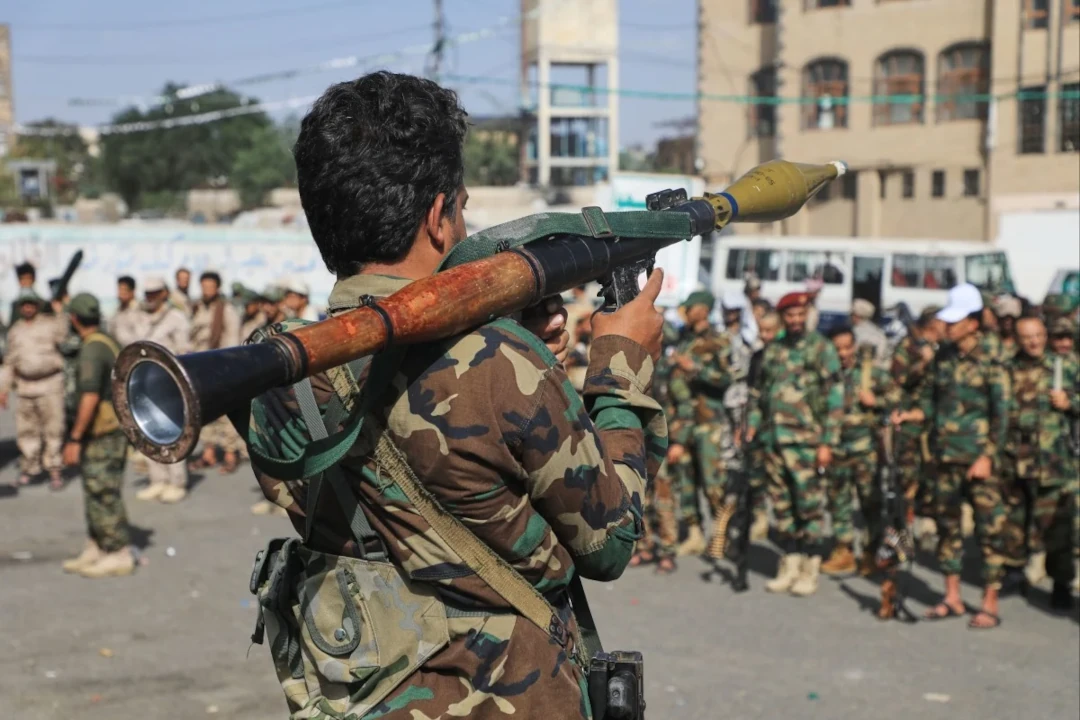
Six months and thirteen days after the president of the United States began an undeclared war of choice against the Islamic Republic of Iran, the geography of that war has redrawn itself in a way no White House briefing can spin away. On Thursday morning, Yemen time, Iran-aligned Houthi forces overran the historic Red Sea port of Mocha. By Friday, according to four Yemeni government sources speaking to CNN and The Jerusalem Post, Houthi fighters had reached Perim Island — the rocky pivot that splits the eighteen-mile-wide Bab el-Mandeb Strait into two channels and, with it, splits the global economy’s access to nearly a fifth of its seaborne oil.
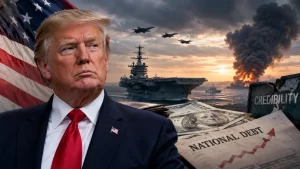
Hours before the fall of Mocha, President Donald J. Trump told reporters in the Oval Office that the war he began on February 28 is “small potatoes” and “very intermittent.” He predicted the fighting would wind down after the November midterm elections. The bombs he was speaking about would continue falling all week. The pipeline of American M-1 caskets flowing through Dover Air Force Base — including the three servicemembers whose deaths the Pentagon quietly reclassified under a newly invented “Overseas Operations” category — would keep flowing too.
This is not a small war. It has become, in a matter of months, the organizing catastrophe of the Middle East. It has scrambled America’s regional alliances beyond recognition, driven our closest partners into strategic embraces we spent forty years preventing, sent Brent crude past $105 a barrel and U.S. diesel past $6 a gallon for the first time on record, and cost more than 750 American service members killed or wounded. It has also become the mechanism through which the People’s Republic of China is quietly completing its inheritance of the region we assumed we owned.
The president, when he is not calling it “small potatoes,” calls it “a little glitch.” He has demanded that the Pentagon obscure its casualty counts, blocked Congress from meaningful oversight, and threatened — on Easter Sunday, in an all-caps social media post — to erase “a whole civilization.” Fifty-two Democratic lawmakers and, briefly, Marjorie Taylor Greene, responded by calling for his removal under the 25th Amendment. The Cabinet did not move. Six months later, the price of that non-decision is being counted in tankers, dollars, and lives.
I. Mocha Falls
The specific military event that reshaped this war took place between Wednesday night and Friday morning of this week. Iran-aligned Ansar Allah forces — the Houthis — punched south along the Yemeni Red Sea coast, seizing Al-Hudaydah’s southern approaches, then Hays, then Al-Khawkhah, then, on Thursday, the storied coffee port of Mocha itself. By Friday morning, Yemeni government sources were confirming to NPR and Reuters that Houthi fighters had reached Perim Island in the strait itself, and had also taken Greater and Lesser Hanish.
The military math is straightforward and devastating. As Hisham Al-Omeisy, senior Yemen adviser at the European Institute of Peace, put it to reporters: “Now you have Iran on one side of the Arabian Peninsula controlling Hormuz, and now the Houthis controlling Bab el-Mandeb on the other side of the peninsula.” Perim Island is eighteen miles from Djibouti. Whoever holds it holds the world’s second-most-important oil chokepoint. The U.S. Energy Information Administration reported this week that Bab el-Mandeb was already carrying 8.1 million barrels a day of crude and petroleum liquids as of the second quarter of 2026 — up from 5.4 million barrels a day in late 2025 — because the closure of Hormuz had made it the region’s escape valve. Now the escape valve is being shut.
Saudi Crown Prince Mohammed bin Salman was, according to MS NOW’s reporting, on the phone to Trump twice on Thursday, begging for U.S. military intervention. The Houthis’ humanitarian coordination center said Thursday that Red Sea navigation “remain[s] safe and uninterrupted” for all shipping — except Saudi vessels. Riyadh, the world’s largest oil exporter, has depended on the Red Sea route since Hormuz effectively closed in March. Riyadh’s ability to move its own product is now conditional on a militia’s mood.
18 miles wide, now under Houthi shadow
Perim Island splits the strait into two navigation channels. Yemeni government sources confirmed Houthi fighters reached it Friday. Control of Perim gives an Iran-backed militia veto power over shipping between Asia, Africa and Europe.
CNN · Sept 10, 20268.1M barrels/day now transit Bab el-Mandeb
Up from 5.4 million barrels a day in Q4 2025, per the U.S. Energy Information Administration. Trump’s Iran war closed one chokepoint. The redirected flow made the second chokepoint a strategic prize — and a Houthi target.
EIA data via Fox News · Sept 10U.S. average tops $6/gallon
According to GasBuddy tracking cited by Reuters, the U.S. national average price of diesel surpassed $6 a gallon for the first time in recorded history this week. Diesel powers the trucks that move virtually every good sold in America.
GasBuddy via Reuters · Sept 11“A new and more dangerous phase”
U.N. Special Envoy for Yemen Hans Grundberg told the Security Council on Thursday that the international community must act to address a new and more dangerous phase of the Yemen war. Bahrain and the U.K. called the emergency session.
Al Jazeera · Sept 10, 2026II. How a “Two-Week Operation” Became Everyone’s War
To understand how Mocha ended up in Houthi hands, one has to understand how, exactly, Donald Trump chose to start the Iran war in the first place — and how relentlessly he has misjudged every stage of it since.
The formal opening act was Operation Epic Fury: the coordinated U.S.–Israeli strikes of February 28, 2026, which killed Supreme Leader Ali Khamenei and targeted Iran’s nuclear and missile infrastructure. The White House claimed the war would be “short, decisive, and contained.” The Council on Foreign Relations now describes it as a six-month war spanning “West Asia, North Africa, [and] the Indian Ocean.” A Pakistan-mediated ceasefire and June memorandum of understanding briefly quieted the largest strikes; they did not resolve the core disputes. On July 7, after Iran attacked three ships in the Strait of Hormuz, Trump declared the truce over. Within seventy-two hours, an Iranian ballistic missile killed 1st Lt. Tyler Feehan and Pvt. Isabella Gonzales at Muwaffaq Salti Air Base in Jordan.
Three trends have defined the war since. First, Iran, wounded but not destroyed, has proven far more resilient than the president’s briefings promised: its proxies — Hezbollah, the Popular Mobilization Forces in Iraq, and, most consequentially now, the Houthis — have all resumed offensive operations. Second, the U.S. and Israeli assumption that the Sunni Arab monarchies would quietly finance and applaud a war on Iran has curdled into open resentment. Third, Trump’s own conduct — the war-crimes threats, the erratic ceasefires, the personal grievance-tweeting — has convinced regional capitals that the American security umbrella is now a personal instrument of a single unstable man. They are looking, urgently, for another umbrella.
“No President in control of his senses would publicly promise to eradicate an entire civilization.”
— Sen. Chris Murphy (D-Conn.), April 7, 2026, calling for the 25th Amendment after Trump’s Easter Sunday threat to Iran
III. The Mecca Compact — America’s Allies Move On
On August 7, in Mecca — one of Islam’s holiest cities and a deliberate choice — the crown princes and prime ministers of Saudi Arabia, Turkey, and Pakistan signed a formal defense pact whose central clause is, in the South China Morning Post’s paraphrase, “a NATO-style clause that an attack on one member would be treated as an attack on them all.” Pakistan is a nuclear power. Turkey is a NATO member with the second-largest army in the alliance. Saudi Arabia is our nominal partner of eight decades. They did not consult Washington.
The Christian Science Monitor’s analysis of the agreement is worth reading in full. As correspondent Taylor Luck wrote from Amman, “The Saudi-Turkish-Pakistani compact is a response to the prolonged Iran war, an Israel perceived as seeking hegemony, and the failure of other diplomatic initiatives. It also anticipates a reduced U.S. regional posture.” Read that last sentence twice. Our closest Arab partners are building a security architecture that presumes we will not be here.
The UAE, meanwhile, announced in May that it was quitting OPEC. The European Council on Foreign Relations described the move as an “expression of a strategic shift accelerated by the Iran war” — Abu Dhabi is now “increasingly unbound by Arab and Muslim consensus politics or inherited institutions.” Riyadh has separately floated a Helsinki-style non-aggression pact with Iran itself, according to Foreign Policy. The country that funded Iran’s isolation for a decade is now writing a peace treaty with it — behind our back.
The Brookings Institution’s Philip Gordon summarized the trajectory in June: “The Iran war has followed a recurring pattern exhibited in past U.S. attempts at regime change — of sowing regional chaos, undermining U.S. soft power and alliances, and unexpectedly empowering adversaries.” That is not the assessment of a partisan hack. It is the assessment of a career Middle East scholar who served as National Security Council coordinator under two Democratic presidents, describing the strategic ruin of a project the current president continues to call a triumph.
Get Involved Today
Contribute to our mission and turn your concerns into action.
IV. China Watches, and Wins
The other capital that has not called Donald Trump this week is Beijing. It has not needed to. Xi Jinping’s Middle East strategy for the past decade has been the quiet accumulation of economic leverage — Chinese-Arab trade has grown from $36 billion in 2004 to nearly $400 billion in 2024 — combined with a pointed refusal to fight anyone’s wars. It brokered the Saudi-Iran rapprochement of 2023. It has vetoed U.N. Security Council resolutions that would have required member states to reopen the Strait of Hormuz by force. It has, as the East Asia Forum observed this summer, presented itself as “an alternative to US interventionism, reinforcing a soft power narrative of trade and mediation without policing.”
Every American strike on Iranian oil infrastructure makes the Chinese pitch more compelling. Every American casualty at a Jordanian air base makes the case for a security partner that does not drag you into wars. Every threat by Trump to reduce a civilization to rubble makes Beijing’s non-interference doctrine sound, to Riyadh and Abu Dhabi, less like weakness and more like maturity. Xi personally telephoned Mohammed bin Salman in April — long before this week’s crisis — to offer Chinese support for “resolving disputes through political and diplomatic means.” He is playing a game we have forgotten how to play.
For Americans, this matters concretely. The Gulf has been the underwriter of the dollar-denominated global oil market since Bretton Woods. If Saudi Arabia begins pricing significant volumes of oil in yuan — an option that becomes materially more attractive every time a U.S. president threatens a Muslim capital with annihilation — the exorbitant privilege of the American reserve currency begins to erode. This is the sort of long-tail strategic damage that does not show up in a news cycle. It will show up, eventually, in every interest rate you pay.
V. Blood and Treasure — the Cover-Up
The war’s costs are being borne, at this hour, by four constituencies: American service members, American drivers, American taxpayers, and Americans on fixed incomes trying to buy groceries as diesel-shipped goods climb.
The Pentagon’s own confirmed toll stands at 19 U.S. servicemembers killed, 757 wounded, sixty-three American aircraft lost or damaged, and 228 U.S. facilities damaged or destroyed. Those are the numbers the Department of Defense concedes. They are almost certainly low. In late July, The Intercept’s Nick Turse reported that a U.S. government official described the department’s new casualty methodology as “designed to obscure the count.” Days earlier, four American soldiers killed after Trump’s declared ceasefire had briefly vanished from the official Defense Casualty Analysis System before being reclassified into a newly invented category called “Overseas Operations” — a category whose start date, as House Oversight Democrats noted, is the same July 7 the administration used to claim a fresh 60-day War Powers Resolution clock had begun.
Rep. Adam Smith of Washington, ranking member on House Armed Services, told CNN he cannot get straight casualty numbers even in his committee capacity. “We have never had a situation where we’ve been at war and the president has treated it as his own war,” Smith said, calling Trump “a dictator running this country.” Jason Dempsey, a retired Army officer who served as special assistant to the chair of the Joint Chiefs, told The Hill the pattern reflects “deep professional and moral cowardice” at the Pentagon.
The treasure ledger is only marginally less obscured. The White House’s supplemental funding request in June came to $87.6 billion — of which, according to the Center for Strategic and International Studies, roughly a third was direct war costs; the rest was, in CSIS’s polite phrase, “Christmas ornaments.” Rep. Rosa DeLauro, ranking Democrat on House Appropriations, called it a war “with no clear objective, no apparent strategy, and no end in sight.” Sen. Patty Murray, the top Democrat on Senate Appropriations, called it “reckless and costly.”
“It’s a little glitch. We had to take this detour.”
— President Donald Trump, on ABC News, describing the collapse of the American middle class’s fuel budget as U.S. gas prices surged past $3.47 a gallon
For the American household, the numbers are less abstract. The Institute on Taxation and Economic Policy’s war-cost tracker, updated Friday, calculates the average American family has now paid $675 in additional motor-fuel costs since the war began — a figure ITEP projects will hit $1,012 by the end of fall. Mark Zandi, chief economist at Moody’s Analytics, puts the household energy cost still higher, at $860, and total aggregate U.S. household energy spending attributable to the war at $115 billion. Airline fares are up 25.5 percent year-over-year. Grocery bills, which move on trucks that burn diesel, are up across the board. And this is before this week’s Bab el-Mandeb shock has fully passed through into the pump.
Every one of these dollars is, in effect, a transfer from working-class Americans to a war their representatives never voted to authorize. That is the deal Donald Trump is offering them heading into the November midterms and the holiday season: pay more to fuel your car so I can prosecute a war I told you would be over in weeks. And, please, don’t ask how many Americans have died fighting it.
VI. The Timeline of a War That Would Not End
VII. What Congress Is Doing — and What It Won’t
Congress has done more than the caricature of the post-2020 legislature suggests, and less than the Constitution requires.
Both chambers have passed war powers resolutions demanding the president remove U.S. armed forces from hostilities with Iran absent an explicit authorization for the use of military force. The House passed the Meeks resolution on June 3 by 215-208, then again on July 23 by 214-208. The Senate passed a companion measure on June 23 by 50-48, with Republicans Bill Cassidy, Susan Collins, Rand Paul and Lisa Murkowski joining the Democratic caucus. Sen. Tim Kaine of Virginia, the principal Senate author, was blunt on the floor: “The most solemn power for Congress is Congress has the power to declare war, not the president.” Minority Leader Chuck Schumer called Trump’s Iran campaign a “historic blunder.”
None of these resolutions is legally binding. All of them would require a two-thirds supermajority to override the veto Trump would inevitably deliver. House Speaker Mike Johnson has refused to send binding measures to the floor. Senate Majority Leader John Thune has been, in Sen. Schumer’s phrase, “an enabler.” The result is a legislature that is on record opposing the war and simultaneously unable to end it.
Meanwhile, House Oversight ranking member Robert Garcia and Rep. Suhas Subramanyam have opened a formal probe into the Pentagon’s casualty-database manipulation. Rep. Jamie Raskin, House Judiciary’s ranking Democrat, briefed the Democratic caucus in April on the mechanics of Section 4 of the 25th Amendment — a briefing that Minority Leader Hakeem Jeffries scheduled personally, opening a door his leadership had kept closed for two prior years. Rep. Rashida Tlaib put the position of the caucus rank-and-file plainly: “It’s time to invoke the 25th Amendment. This maniac should be removed from office.” Sen. Andy Kim of New Jersey, one of the few senators to join the call, told reporters simply: “He’s unfit for office.”
An unfit commander does not become fit by remaining in the chair.
The mechanism. Section 4 of the 25th Amendment, ratified in 1967, provides that the Vice President and a majority of the Cabinet (or of “such other body as Congress may by law provide”) may transmit to the President pro tempore of the Senate and the Speaker of the House a written declaration that the President “is unable to discharge the powers and duties of his office.” Upon such transmission, the Vice President immediately becomes Acting President. The mechanism was designed for exactly the circumstance the country now faces: a sitting president whose judgment can no longer be trusted with the nuclear codes, but who will not resign.
Who has called for it. More than seventy congressional Democrats formally called for Section 4 to be invoked after President Trump’s Easter Sunday threat to destroy “a whole civilization.” The list includes Sens. Ed Markey, Chris Murphy, and Andy Kim, and Reps. Jamie Raskin, Ro Khanna, Rashida Tlaib, Robert Garcia, Jasmine Crockett, Shri Thanedar, and Mark Pocan. Illinois Gov. J.B. Pritzker has joined the call from outside Congress. Even Marjorie Taylor Greene — a MAGA loyalist not previously known for constitutional restraint — publicly urged invocation, calling the president’s rhetoric “evil and madness.”
The constitutional argument. The president has, on the public record, threatened to commit war crimes against civilian infrastructure; ordered the deliberate obscuring of casualty data owed to Congress and the families of the fallen; conducted a war of choice past every congressional check imposed by the War Powers Resolution of 1973; called the resulting deaths of American service members “small potatoes”; and, in the week Iranian proxies seized a second global chokepoint, insisted the war is “very intermittent.” Framers of both the original Constitution and the 25th Amendment understood that the republic cannot survive a commander-in-chief who is either unwilling or unable to grasp the gravity of the power he holds. The record, at this point, does not permit a charitable reading.
VIII. What the Coming Months Hold
The near-term picture is not obscure. Between now and Thanksgiving, absent a diplomatic breakthrough no one currently expects, Americans will pay more for heating oil, more for gasoline, more for Thanksgiving turkeys shipped by diesel truck, more for Christmas gifts that cross the Red Sea in the holds of container vessels now paying war-risk insurance premiums. Airline holiday fares will be higher; the Stanford Institute for Economic Policy Research notes jet fuel prices are up 68 percent since January. Grocery bills, already elevated, will climb further as fertilizer and freight costs propagate through the supply chain.
The political consequences of that squeeze are what the president fears — and precisely why he told reporters last week that the war would “end after the election.” The Brookings Institution notes that many at-risk Republican House members represent districts whose average driver clocks 26 percent more miles than the average Democratic constituent. The pain of this war, on the pump price of every gallon, falls hardest on the voters Republican incumbents most need. The president has essentially conceded he intends to prolong the war past the moment those voters can punish him for it.
Beyond the midterms, the medium-term picture is worse. The Saudi-Turkish-Pakistani defense pact, the UAE’s exit from OPEC, the Saudi-Iranian non-aggression feelers, and Beijing’s patient consolidation of its position as the region’s honest broker will not be undone by a change of American president in January 2029. Alliances, once eroded, are re-forged slowly and expensively. Reserve-currency privileges, once eroded, are re-gained rarely. Every week the current administration remains in office, the strategic hole America must dig itself out of gets deeper.
Editorial Conclusion
Donald Trump began a war of choice against Iran believing it would be brief, cheap, and politically useful. It has proved to be none of those things. It is instead a war that has closed the world’s most important oil chokepoint, driven our closest Arab partners into a defense pact that presumes American withdrawal, handed Beijing the strategic prize of a lifetime, and killed at least nineteen American service members whose deaths the president has ordered obscured from the public record.
The republic does not entrust the war power to one man because it does not trust one man to wield it. It entrusts that power to Congress — which has voted three times, in both chambers, to end this war, and been ignored — and, in the final extremity, to the Cabinet and Vice President who took an oath to the Constitution rather than to the man. Section 4 of the 25th Amendment exists for this hour. The question is no longer whether the case for its invocation has been made. The question is whether anyone in the president’s own party still remembers the oath they swore.
Sources & References
- Reuters via Cyprus Mail — Houthis seize Yemen’s Mocha, tighten grip on key Red Sea route (Sept 11, 2026)
- CNN — Iran-backed rebels capture Red Sea port, tightening grip on a key global chokepoint (Sept 10, 2026)
- NPR — Iran-backed Houthi rebels seize strategic Red Sea port (Sept 11, 2026)
- Al Jazeera — Yemen’s Houthis seize strategic Red Sea city of Mocha (Sept 10, 2026)
- CNBC — Houthis reportedly advance to key Red Sea island, threatening crucial oil chokepoint (Sept 11, 2026)
- Fox News — Houthis seize Mocha and advance on Bab el-Mandeb as oil tops $100 (Sept 10, 2026)
- PBS NewsHour — Trump calls Iran war ‘small potatoes’ and ‘very intermittent’ (Sept 4, 2026)
- Council on Foreign Relations — Global Conflict Tracker: U.S.–Iran Confrontation
- Britannica — 2026 Iran War: overview, Strait of Hormuz, MOU
- Christian Science Monitor — A new regional alliance signed in Mecca (Aug 11, 2026)
- South China Morning Post — China’s Middle East policy at a crossroads (Aug 2026)
- Brookings — Philip Gordon: How the Iran war will change the Middle East
- Foreign Policy — Middle East diverging between U.S. and Chinese interests
- East Asia Forum — China gains by standing aside in the Iran War (July 1, 2026)
- Al Jazeera — How China is gaining by showing it is different from the US
- European Council on Foreign Relations — The postwar UAE and the remaking of Gulf politics
- The Intercept — The Pentagon found a new way to undercount U.S. casualties (Aug 4, 2026)
- House Oversight Democrats — Garcia, Subramanyam demand Pentagon explain casualty count changes
- The Hill — Adam Smith on Iran war transparency; ‘a dictator running this country’
- The Hill — Pentagon under Hegseth draws curtain tighter around Iran war
- NPR — Senate passes Iran war powers resolution 50-48 (June 23, 2026)
- NPR — House approves resolution to end the war in Iran (July 23, 2026)
- The Hill — Dems intensify calls to invoke 25th Amendment (April 8, 2026)
- NBC News — Dozens of Democrats call for Trump’s removal after Iran threats
- CNN Politics — 25th Amendment: Democrats and right-wing voices call for removing Trump
- CNBC — White House requests $87.6B supplemental for Iran war
- CSIS — War costs make up a third of the $87.6B supplemental (July 14, 2026)
- ITEP — Iran War Fuel Cost tracker: $675 per household (Sept 11, 2026)
- Fox Business — Zandi/Moody’s: Iran war costs U.S. households $860
- CBS News — Iran war has dented the U.S. economy — damage could linger
- Stanford SIEPR — Pain at the pump: what spiking gas prices mean
- Brookings — Another oil crisis is here — political headaches for 2026 midterms
Related News