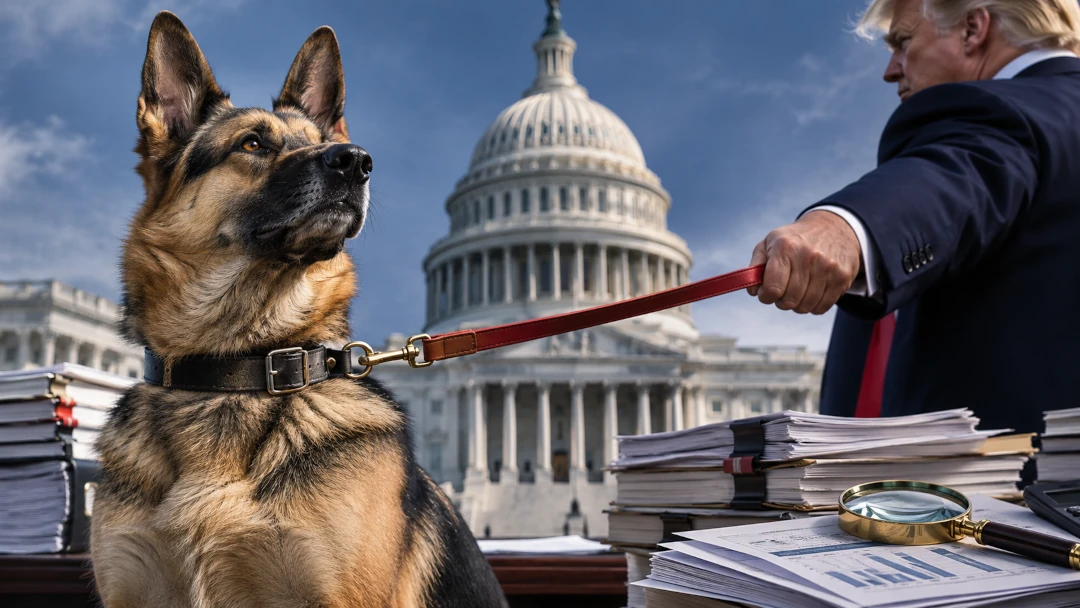
Leashing the Watchdog: Trump’s Fifteen-Year Grab for Congress’s Auditor
The comptroller general is the one federal official built to outlast presidents and tell Congress the truth about where the money goes. Now, in the dying weeks of a Republican Senate, the White House wants to install the deputy of the very budget office GAO keeps catching breaking the law — and lock him in place until 2041.
Most Americans have never heard of the comptroller general of the United States. That is by design. The job is supposed to be boring, technical, and above politics: run the Government Accountability Office, audit federal spending, expose waste and mismanagement, and hand Congress independent analysis it can trust no matter which party holds the White House. To protect that independence, Congress gave the post a single 15-year term — long enough to span multiple administrations — and in 1980 built a deliberate, bipartisan selection process around it. This week, President Trump and an outgoing Republican Senate majority are trying to run straight through that process.
On Monday, November 16, the president formally nominated Eric Ueland, deputy director of the Office of Management and Budget, to be the ninth comptroller general. His confirmation hearing before the Senate Homeland Security and Governmental Affairs Committee (HSGAC) is set for Thursday morning — three days later — bundled alongside nine other nominees. The last time Congress filled this job, the bipartisan search took more than a year. This time, according to Government Executive, commission members were given 24 hours.
I. The Job Built to Outlast Presidents
GAO is not an executive agency. It is Congress’s own investigative arm, and its reach is enormous. As legal scholar Jack Goldsmith has summarized, as quoted by John Haskell, GAO audits and investigates executive programs for Congress, issues legal decisions on whether agencies obey appropriations law, polices presidential impoundments and can sue over them, and advises Congress on agency rules subject to the Congressional Review Act. The comptroller general personally controls those decisions and sets the agency’s priorities.
The payoff for taxpayers is concrete. GAO reported $62.7 billion in financial benefits in fiscal year 2025 alone, and its FY2027 performance plan puts that at roughly $68 returned for every dollar spent running the agency. Since 2002, the agency’s work has produced about $1.51 trillion in financial benefits. There are few better deals anywhere in Washington.
Because the comptroller general can only be removed by impeachment or a joint resolution of Congress, whoever gets the job is effectively untouchable for a decade and a half. That insulation is a gift when the officeholder is independent. It is a disaster when the officeholder is not.
II. Who Is Eric Ueland?
Ueland is no stranger to Washington. He spent years as a Senate staffer, including as chief of staff to Majority Leader Bill Frist and as Republican staff director of the Senate Budget Committee, and managed the State Department and USAID foreign assistance budget in Trump’s first term, according to the Executive Functions newsletter. He was confirmed to OMB on a party-line 52–45 vote in 2025, and performed the duties of USAID administrator for about a year as that agency was dismantled.
The problem is not his résumé. It is where he sits and whom he serves. Ueland is OMB Director Russell Vought’s deputy and close ally. Before becoming deputy director for management, he was Vought’s acting chief of staff during an early stretch of executive defiance of appropriations law, and in written answers after his 2025 confirmation hearing he backed Trump’s position on “restoring impoundment authority,” Executive Functions reports. Rep. Rosa DeLauro, top Democrat on House Appropriations, noted that while Ueland chaired the inspectors general council, OMB repeatedly froze that council’s appropriated funds — asking how someone who could not shield one watchdog from OMB would shield another.
And Vought has never hidden what he thinks of GAO.
“They are a quasi-legislative independent entity and something that shouldn’t exist.”
— OMB Director Russell Vought on GAO, September 2025, via Axios
The man who said the watchdog should not exist now wants his deputy to run it. Matthew Biggs of the IFPTE union, which represents federal professionals, put it plainly to Government Executive: it is sending the fox in to guard the henhouse.
III. The Referee and the Rule-Breaker
The conflict of interest is not hypothetical. GAO has spent two years documenting how this administration ignores the spending choices Congress writes into law. It has opened at least 46 impoundment investigations, and in multiple decisions it found the administration’s withholdings and rescissions violated the Impoundment Control Act. Those rulings target OMB — Ueland’s own office.
Impoundment probes
Impoundment investigations GAO opened by mid-2025, finding violations of the Impoundment Control Act in some cases. Government Executive
September 2026 ruling
GAO ruled the administration must spend the $810 million it tried to cancel via a late-year “pocket rescission.” States Newsroom
Prior pocket rescission
Canceled without congressional action after the administration’s first pocket-rescission request in August 2025. Missouri Independent
Return to taxpayers
Financial benefits from GAO’s work in FY2025 — about $68 for every dollar invested in the agency. GAO
Savings still on the table
GAO’s estimate of future savings if its open recommendations are implemented — work a hobbled GAO would stop pushing. GAO
The only plaintiff
The Impoundment Control Act authorizes only the comptroller general to sue to enforce it. Executive Functions
Get Involved Today
Contribute to our mission and turn your concerns into action.
That last card is the heart of it. Lawmakers from both parties have pressed GAO to go to court over illegal impoundments, but Executive Functions doubts Ueland would ever do so. Installing him would not just change who audits OMB; it would remove the one official Congress empowered to sue over illegal impoundments, for fifteen years.
IV. A Process Congress Built — and Is Now Ignoring
The 1980 law that governs this appointment created a 10-member commission of senior House and Senate members from both parties to recommend candidates to the president, as Government Executive explains. Henry Wray, the retired GAO attorney who helped draft that law, wrote to HSGAC leaders that its goals included broad bipartisan support essential to GAO’s credibility. He called the current effort “partisan, ad hoc, and extremely rushed” and warned that the president appears to be picking the nominee for the commission to rubber-stamp — reversing the order the statute requires.
The paper trail backs him up. According to a committee aide quoted by Government Executive, GAO was told around noon on Veterans Day that Ueland would be the nominee, and he had filed his ethics paperwork before the commission submitted any names. Roughly 90 minutes later, Chairman Rand Paul’s staff asked Democrats for candidates by 8 a.m. the next day. No candidates were interviewed. Paul later told Politico the White House had asked him to put Ueland forward. Democratic leaders say Paul had ignored repeated requests over two years to convene the commission at all.
Compare that to history. Former comptroller general David Walker has noted that the last three comptrollers general were confirmed by unanimous consent. In 1998, Walker himself was nominated after his name appeared on separate lists from both Republican and Democratic commission members, R Street reports. That is what a consensus watchdog looks like.
V. Racing the Calendar
Why the hurry? GAO has functioned under an acting chief for nearly a year. What changed is the election. Democrats won control of the Senate with a net gain of four seats, and Paul will hand over HSGAC’s gavel in January. The same AP VoteCast survey found 70% of voters want Congress to check the Trump administration. Confirming Ueland now would let a defeated majority overrule that verdict for the next fifteen years.
The term math is the whole game. If confirmed, Ueland could serve until 2041 — through the remainder of this presidency and potentially the next three. A future Democratic or Republican Congress that wanted honest numbers about tariffs, defense contracts, Medicare fraud, or disaster aid would be asking an appointee chosen by OMB.
“would be lunacy for the Senate”
— Sen. Patty Murray (D-Wash.), Vice Chair, Senate Appropriations, on confirming Ueland, via Senate Appropriations Committee
VI. What Congress Is Saying
Democrats are united in opposition. HSGAC Ranking Member Gary Peters (D-Mich.), who sits on the selection commission, said the post serves “Congress, and Congress alone” and pledged to oppose the nomination. Murray called Ueland a Vought acolyte and urged Republicans who care about their own power to help reject him — and to modernize the process so Congress picks its own officers. DeLauro argued Ueland lacks nonpartisan credentials and auditing expertise.
More telling are the Republicans. Sen. Thom Tillis (R-N.C.) said he is not a fan of the pick, while saying it deserves individual consideration. Sen. Susan Collins (R-Maine) said she doesn’t know whether it is a bipartisan choice. Sen. John Curtis (R-Utah) has concerns that it is too partisan, his office said, and Sen. John Cornyn (R-Texas) called Ueland an honorable person but acknowledged controversy and is undecided, per Government Executive. Even Paul, who scheduled the hearing, has not publicly endorsed the nominee. None of Collins, Tillis, or Curtis sits on HSGAC, but their votes would matter on the floor.
A White House official, speaking on background to Federal News Network, argued that Ueland's decades in the Senate, White House, and OMB give him deep budget and oversight expertise and make him exceptionally qualified. Vought and allies contend GAO itself has become partisan: Vought has said GAO reversed its own 1970s view on pocket rescissions, and some Republicans regard the Impoundment Control Act as unconstitutional, as Executive Functions notes. Defenders also point out the vacancy has dragged on for nearly a year.
Those arguments deserve an answer, and the answer is the process. If GAO is biased, the remedy is a bipartisan commission and a vetted consensus nominee — not a 72-hour sprint to install the deputy of the agency under investigation. And the delay they cite was caused by the same majority that never convened the commission.
Who Holds the Power of the Purse?
Article I, Section 9
31 U.S.C. § 703 (P.L. 96-226, 1980)
Impoundment Control Act of 1974
Separation of powers
VII. What It Means for You
For the average American, GAO is the reason someone notices when Medicare dollars leak to fraudsters, when a weapons program runs billions over budget, or when disaster aid never reaches the town that flooded. In 2024, GAO estimated the federal government loses between $233 billion and $521 billion a year to fraud. A watchdog led by a political ally doesn’t have to fake an audit to do damage; it just has to choose not to look, or to look slowly.
For the programs families rely on — veterans’ health care, Social Security administration, food safety, public broadcasting, foreign aid Congress funded — impoundment rulings are often the only early warning that money Congress approved is being quietly withheld. For the economy, independent data on federal finances underpins the confidence of markets and creditors. And for Congress itself, losing a trustworthy auditor means making trillion-dollar decisions with information filtered through the White House budget office. As AFGE’s Daniel Horowitz warned, a hasty confirmation would leave GAO with a lasting credibility problem — and a watchdog nobody trusts is no watchdog at all.
VIII. The Watchdogs Who Watch the Watchdog
Opposition outside government spans the spectrum. Both living former comptrollers general, Gene Dodaro and David Walker, joined economist Steve Hanke in a Fortune op-ed saying Paul and Trump have not followed the statute and the hearing should be canceled, per Government Executive. Twenty former inspectors general wrote that the nomination fails both the independence and process tests. Former Interior IG Mark Greenblatt, the Partnership for Public Service’s Max Stier, and the Project On Government Oversight all raised alarms, as Federal News Network reported. Taxpayers for Common Sense urged the Senate to keep the nomination out of any lame-duck package and give it a separate debate and vote. GAO’s own employee union said its concern was the skipped steps, not Ueland personally.
Even before Ueland’s name surfaced, a bipartisan coalition of think tanks argued that Congress — not the president — should appoint GAO’s head. This week has made their case for them.
IX. Trump’s Silence Is the Strategy
Notably, the president has said almost nothing publicly. Federal News Network found no direct Trump statements about the pick; the nomination simply appeared on a list sent to the Senate. The pressure has been applied quietly: the White House chose Ueland before Congress could weigh in and asked Paul to move him. That low profile is itself revealing. A nominee the administration was proud of would be announced with fanfare; this one is being slipped through before the new Senate arrives.
The context is a president who, as Nextgov reports, has said he wants to challenge the impoundment law as unconstitutional, while his budget director has declined to commit to obeying it. Taken together with the purge of inspectors general and the gutting of USAID that Ueland oversaw, the pattern is consistent: the priority is not efficiency, which GAO measurably delivers, but freedom from scrutiny. A leader confident in his record welcomes an honest auditor. One who fears the next Congress tries to capture the auditor on the way out the door.
X. What Happens Next
Thursday’s hearing is only the first gate. The committee must vote, then leadership must find floor time before the session ends. The likeliest danger is a year-end deal that sweeps Ueland into a bundle of nominees, which is exactly what Taxpayers for Common Sense warned against. Whether that works depends on a handful of Republican institutionalists; Executive Functions names Collins, McConnell, Tillis, Cassidy, and Cornyn as possible no votes. If the nomination stalls until January, a Democratic Senate can restart the statutory commission — and Wray urges that any new majority follow the same process scrupulously, rather than repeating the shortcut in reverse.
XI. What You Can Do
Democrats cannot block this nomination alone before January. Only Republican defections in committee or on the floor, or simply running out the clock, can stop it. That makes public pressure on a few GOP senators — and on the calendar — the decisive factor.
Call your senators
Use the Capitol switchboard (202-224-3121). Ask them to oppose Ueland and to demand that the next comptroller general come through the bipartisan commission process.
Target the swing votes
If you live in Maine, North Carolina, Utah, Texas, Kentucky, or Louisiana, your Republican senators are the ones whose doubts could decide this. Tell them you share their concerns.
Insist on a separate vote
Ask senators to keep the comptroller general out of any year-end nominations package, as Taxpayers for Common Sense requested, so each senator has to vote on the record.
Back appointment reform
Support proposals, including Rep. Ed Case’s bill noted by R Street, to let Congress appoint its own legislative-branch officers so this never happens again.
Amplify the watchdogs
Share the letters from former comptrollers general and inspectors general, and follow POGO, the Partnership for Public Service, and Taxpayers for Common Sense for updates on floor timing.
Editorial Conclusion
A government that cannot be audited cannot be held accountable, and a Congress that cannot verify how its laws are carried out has given up the power of the purse the Constitution placed in its hands.
The Senate must refuse to confirm Eric Ueland in this lame-duck session. It should convene the bipartisan commission the law requires and choose a comptroller general both parties can trust. Fifteen years of honest oversight is not a parting gift for a defeated majority to hand the White House. It belongs to the American people, and the Senate has no right to give it away.
Sources & References
- Federal News Network — OMB deputy nominated to lead GAO
- Federal News Network — Senate GOP set up lame duck effort to appoint new Comptroller General
- Federal News Network — Concerns rising over Trump’s pick to lead GAO
- Government Executive — Trump’s GAO pick was a done deal before Congress got a say
- Government Executive — Lame-duck Congress expedites search for next GAO leader
- Roll Call — White House budget aide Ueland slated to head GAO
- Senate Appropriations Committee (Minority) — Murray: Trump Nominating Vought Acolyte to Lead Congress’ Watchdog
- House Appropriations Democrats — DeLauro Statement on Nomination of Eric Ueland
- Henry R. Wray — Letter to HSGAC on the Comptroller General process (Nov. 16, 2026)
- Former Inspectors General — Letter opposing the Ueland nomination (Nov. 17, 2026)
- Taxpayers for Common Sense — TCS Urges Senate Committee to Follow Statute
- Executive Functions — Is the Eric Ueland Nomination a Threat to Congress?
- John Haskell (Substack) — The inside baseball take on why the Ueland nomination matters
- ExecutiveGov — OMB’s Eric Ueland Nominated to Lead GAO
- Axios — OMB director says GAO “shouldn’t exist”
- Nextgov — Vought takes aim at GAO in new guidance
- States Newsroom / Michigan Advance — Watchdog says administration can’t revoke $810M
- Wisconsin Examiner — Congressional watchdog rules on pocket rescission
- Missouri Independent — Background on the 2025 pocket rescission
- GAO — GAO Reports $62.7 Billion in Financial Benefits in FY2025
- GAO — Fiscal Year 2027 Performance Plan
- GAO — FY2026 Budget Request (fraud loss estimates)
- GAO — Performance: $1.51 trillion in benefits since 2002
- The Hill (via Yahoo) — David Walker: Choosing the next comptroller general is too important
- R Street Institute — Coalition Calls for Congressional Appointment of the Comptroller General
- Nextgov — Congress, not the president, should appoint the next GAO head
- Scripps / TMJ4 — Democrats win control of U.S. Senate
- The Volokh Conspiracy — The Coming Storm Over the Comptroller General
Related News