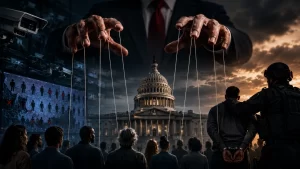
Save Everything: The Shredders, the Signal Chats, and the Reckoning They Fear
With a Democratic Congress eight weeks from taking power, whistleblowers say the paper trail behind Donald Trump’s Washington building spree is going into the shredder. House Democrats have answered with a wave of legally pointed preservation demands aimed at agencies and the corporations that bankrolled the president’s projects. The White House has answered by calling oversight a crime.
Governments that intend to be judged kindly by history keep their records. Governments that expect to be judged harshly by Congress shred them. On Tuesday, CNN reported that whistleblowers had warned House Democrats that key paperwork tied to President Trump’s construction projects around Washington has already been destroyed, before Democrats take over the House in January. The Interior Department, the agency that has fast-tracked much of that construction, called the claims “100% false.” The pattern around those denials tells a different story.
What follows is a story about a ballroom, a golf course, and an arch near the gates of Arlington National Cemetery. It is also a story about the oldest test of any government that claims to answer to the people: whether it will leave behind an honest account of what it did.
I. The Whistleblowers and the Projects
According to reporting compiled by MS NOW’s Steve Benen, the projects under the Natural Resources Committee’s oversight include the White House ballroom, an overhaul of the Lincoln Memorial Reflecting Pool, and a planned “triumphal” arch. Truthout reports the administration is also racing to finish work on the East Potomac golf course, Lafayette Square and the Tidal Basin before the new Congress is sworn in on January 3. Democrats believe they may be able to halt some of that work, especially on the arch and the golf course.
The arch shows how much is at stake. Military.com reports that the National Capital Planning Commission approved its final site and building plans on November 5, after a hearing that ran more than nine hours. More than 90 percent of the 130 people who testified opposed it, and opponents’ modeling showed its shadows falling across thousands of graves, including President Kennedy’s. Three Vietnam veterans have sued, arguing the arch lacks congressional authorization. White House spokesperson Davis Ingle defended the pace by saying the president is moving at “lightning speed.”
The whistleblower claims didn’t come out of nowhere. In August, Politico reported, as summarized by The New Republic, that three Interior staffers had watched officials routinely shred documents and use disappearing Signal messages, even for routine scheduling, so that their communications would not be preserved. Truthout adds that the department has blocked more than 100 national park projects while helping to fast-track Trump’s projects in the capital, sometimes against court orders.
The Shredding
Three Interior staffers told Politico they witnessed officials routinely destroying official documents. The New Republic
The Vanishing Messages
The same staffers described disappearing Signal messages used even for scheduling, which keeps communications off the official record. Raw Story
The Legal Opinion
On April 1, 2026, the Justice Department’s Office of Legal Counsel declared the Presidential Records Act unconstitutional in its entirety. American Historical Association
The Narrowed Rules
A White House Counsel memo told staff to keep work texts on personal devices only when they were the sole record or otherwise “unique.” CREW
The Rush
The arch, golf course, Lafayette Square and Tidal Basin projects are all being pushed forward ahead of the January 3 swearing-in. Truthout
The Denial
Interior told CNN that it follows all federal records management obligations as directed by its ethics officials. AlterNet
II. The Democratic Preservation Offensive
The center of the response is Rep. Jared Huffman of California, the ranking Democrat on the House Natural Resources Committee and its expected chairman in January. On November 9 he sent letters to 36 federal agencies and private companies ordering them to preserve documents, communications and other records tied to the committee’s investigations. According to Military.com, the letters went to nine agencies and 27 companies and organizations, including Lockheed Martin, Boeing, Northrop Grumman, RTX, Palantir and the Trust for the National Mall. Truthout’s list adds Oracle, ExxonMobil, the UFC and UnitedHealth Group, and Law360 reports that Chevron and TikTok also received letters. CNN reported that the whistleblowers did not accuse these companies of destroying anything. The companies are on notice because of their relationship to Trump’s projects, not because of any accusation against them.
The letters are written for the age of Signal. As Sullivan & Cromwell’s client alert explains, they cover messages on personal accounts and devices, ask recipients to turn off disappearing-message settings and recover deleted material where possible, and require written certification of compliance by November 23. Huffman’s message to recipients fit in two words: “save everything.” He told reporters that “those days of obstruction are over.”
“Destruction of federal records implies there is something to hide.”
— House Natural Resources Democrats, in an August letter to Trump’s Interior inspector general nominee
Huffman’s letters are part of a broader campaign. On the House Judiciary Committee, Ranking Member Jamie Raskin has built his own record of preservation demands. He asked Donald Trump Jr.’s venture firm to keep its conversations with administration officials, including messages sent via encrypted apps. Together with Oversight’s Robert Garcia, he demanded that the president preserve his conversations with AI chatbots during an inquiry into whether Elon Musk’s Grok has influenced White House policy. Raskin has also been blunt about the deals that tie corporate America to this White House. At a January hearing on merger reviews, he called the administration’s approach a “political and financial shakedown.”
In August, Garcia wrote to 40 agencies and the National Archives reminding them that the Federal Records Act covers apps like Signal. Last week, Rep. Bobby Scott, the incoming Education and Workforce chairman, warned ten departments and agencies that willful destruction of records carries fines and up to three years in prison. In the Senate, Martin Heinrich and Ron Wyden pressed Interior Secretary Doug Burgum on the shredding reports as early as August 19.
The goal is simple. Washington lawyers call it the “paper trail starts now” strategy: a preservation letter makes future destruction much harder to defend as innocent. Once an agency or company has been notified that an investigation is coming, any deletion afterward looks a great deal more like obstruction.
III. A Year-Long War on the Record
The construction-project allegations are the latest chapter in a campaign against the public record that has been running all year.
The administration’s handling of the PRA is especially telling. In April, the White House told a federal court that staff were still following the law’s preservation mandates, even though the administration no longer considered itself bound by it. Yet according to CREW, the counsel’s memo told staff to skip preserving texts about “ministerial” matters and to summarize text messages in emails or memos instead of keeping them as the law requires. When Judge Bates enjoined that approach, he warned that adopting the government’s position would disable Congress and future presidents “from reflecting on experience.” Axios described the effort as an assault on the two laws, the PRA and FOIA, that treat presidential documents as public property and guarantee public access to government records.
IV. What They Appear to Be Hiding
To be fair, no one has publicly shown which specific documents are gone, and IBTimes notes that its reporting doesn’t establish that records for any particular project are missing. But you don’t need to know the contents of a shredded file to understand why someone might want it shredded. The paper trail Democrats are after would answer three questions.
First: who paid, and what did they get? The corporate letter recipients are companies that donated to Trump’s projects. Many of them also depend on federal contracts, mergers, permits or tariff exemptions that the administration controls. Axios reports that Trump has made the federal government a major corporate investor, with roughly $30 billion in equity and warrant arrangements across more than 40 companies, and that firms which funded the ballroom are now hiring Democratic lobbyists. Raskin has also demanded records on tariff “sweetheart” exemptions. Records of who donated, who asked, and who was approved are the ingredients of any pay-to-play case.
Second: were courts and the law sidestepped? Judge Reyes appointed former D.C. U.S. Attorney Jessie Liu as a special master to look into whether Justice and Interior Department lawyers committed ethical violations. IBTimes reports that the appointment followed conflicting accounts of the golf course redevelopment plans and of what government representatives had told the court. No misconduct has been found. But a court that suspects it may have been misled has every reason to want the underlying records intact.
Third: who gave the orders? The arch case challenges whether any of this was ever authorized by Congress. Internal emails and messages are how investigators work out whether the push to build at “lightning speed” was a legitimate exercise of authority or a personal vanity project driven from the Oval Office.
Get Involved Today
Contribute to our mission and turn your concerns into action.
V. The White House Response: Call Oversight a Crime
Faced with preservation letters, the president did not promise to comply. He threatened prosecution. In a November 7 Truth Social post, Trump called the Democrats’ plans “Weaponization and Lawfare at another level,” reported The Washington Post, and he ordered the Justice Department to investigate.
“This is extortion at the highest level, and they should be held accountable for this.”
— President Donald Trump, Truth Social, November 7, 2026, via Newsweek
Newsweek noted that Trump cited no federal statute and offered no evidence of extortion. Sen. Elissa Slotkin, the only Democrat he named, answered that anyone who breaks the law or uses taxpayer dollars to enrich themselves should be held accountable.
The rest of the administration followed his lead. On November 8, Attorney General Todd Blanche criticized the planned investigations and said the Justice Department would represent administration officials before Congress. The next day, White House Counsel William Scharf wrote to Rep. Garcia that Democrats’ investigative plans aim to “harass and aggrandize” and that some steps “may cross the line into blatant criminality,” according to Sullivan & Cromwell.
And the congressional GOP? Republicans still control the House and Senate until January 3. No reporting reviewed for this piece shows any Republican committee chair joining the preservation demands, asking Interior about the whistleblower claims, or pushing back on the president’s order to investigate his overseers. The party that spent 2024 sending its own preservation letters to Special Counsel Jack Smith has gone quiet now that the records in question are Trump’s. Sen. Ted Cruz called this month’s election a “Watergate-level repudiation,” but so far no Republican has followed that comparison to its obvious point: Watergate is the reason the Presidential Records Act exists.
VI. The Courts Step In
While Congress waits for January, the courts are acting now. Three fronts matter most.
The East Potomac case. On November 10, Judge Ana Reyes ordered the National Park Service, the Justice Department, Interior and all of their components to retain all documents. She also required advance notice before any major work on the golf course. According to IBTimes, she refused to suspend her tree-cutting injunction during the appeal and appointed Jessie Liu as special master.
The arch case. Military.com reports that Judge Tanya Chutkan’s order in the veterans’ lawsuit lapses around November 19 unless she extends it. Chutkan has already questioned Trump’s claim that the arch would house snipers and store drones.
The PRA appeal. The highest-stakes fight is at the D.C. Circuit. There, the administration’s only argument is that the Watergate-era law is unconstitutional in its entirety. Defending the Bates injunction are the American Historical Association, American Oversight, the Freedom of the Press Foundation and CREW. American Oversight’s executive director, Chioma Chukwu, has put the question plainly: is the president above the law?
The Law Does Not Have a Delete Key
- Presidential Records Act (44 U.S.C. §§ 2201–2209)
- Enacted after Watergate, the PRA makes presidential records the property of the United States, not the president, and requires the White House to preserve them. The law also says that when official business is conducted on a non-official messaging account, the message must be copied to an official account. The OLC’s April opinion is the administration’s claim that it can opt out. Judge Bates rejected that claim, and his injunction remains in force pending appeal.
- Federal Records Act (44 U.S.C. chs. 31 & 33)
- This is the law that governs Interior, the Park Service and other agencies. It requires agencies to preserve records of the “transaction of public business,” and it requires agency heads to report unlawful destruction to the Archivist and seek recovery through the Attorney General. It has applied to Signal and other ephemeral apps since Congress modernized it in 2014. Disappearing messages used for official business are a violation of the act.
- Criminal Provisions (18 U.S.C. §§ 2071, 1519, 1505)
- Section 2071 makes it a crime to willfully conceal, remove or destroy federal records. Section 1519 punishes destroying records with intent to obstruct any federal matter, including one that is merely contemplated, by up to 20 years in prison. Section 1505 covers obstruction of congressional inquiries. Preservation letters matter because they eliminate the defense that an investigation wasn’t foreseeable.
- Article I Oversight Power
- The Supreme Court has recognized since McGrain v. Daugherty (1927) that the power to investigate is essential to the power to legislate. The White House relies on Watkins (1957) and Trump v. Mazars (2020), which require a legitimate legislative purpose. But federal construction on public land, the use of appropriated funds, and compliance with records laws are core legislative subjects. As the AHA’s brief argues, the Property Clause gives Congress authority over federal property, and that includes the government’s own records.
VII. What This Means for Oversight
Congressional oversight runs on documents. Witnesses forget, spin and stonewall. Records do not. A government that deletes its records before the overseers arrive is trying to make the new Congress start from zero. That is why Huffman’s letters require recipients to recover deleted material, and why the corporate letters matter so much. When an agency destroys its copy of an email, the company on the other end of it may still have one.
There is a second safeguard: people. Former DHS official Miles Taylor argued on his podcast that destroying documents won’t stop investigators from subpoenaing and deposing the people involved, and he predicted that “those people will end up flipping on each other.” His co-host, Maritsa Georgiou, added that presidential immunity won’t protect the employees who handle the records. The January 6 investigation showed how this works: when the paper trail disappeared, witnesses filled in the gaps.
VIII. What This Says About Trump’s Priorities
Consider the record. With a mandate for change delivered by voters, the White House has spent its first week after the election speeding up construction of a ballroom, a golf course and a monumental arch. It has told the courts that a Watergate-era transparency law is unconstitutional. It has watched officials at the agency carrying out these projects stand accused of feeding records into shredders. And it has responded to oversight by ordering the Justice Department to investigate the lawmakers doing it.
These are the priorities of a man who sees Washington as a construction site in his own honor, and who sees the people’s representatives as trespassers on it. A president confident in his own conduct would welcome a documentary record. This president is spending his final pre-oversight weeks making sure the record is as thin as possible, and calling anyone who objects a criminal.
IX. What You Can Do
An honest assessment: Until January 3, Democrats in Congress can send letters but cannot compel anyone to comply. The courts can act faster but only on the cases in front of them. Citizens can still make a difference in five ways.
Demand that Republicans act now
The GOP majority holds subpoena power until January 3. Call your representative and senators at (202) 224-3121 and ask a plain question: will you insist that Interior preserve every record related to these projects, and will you publicly reject the president’s order to investigate congressional oversight?
Back the watchdogs in court
The PRA injunction exists because American Oversight, CREW, the Freedom of the Press Foundation and the American Historical Association filed suit. Their FOIA requests and lawsuits are often the first place destroyed or missing records come to light.
Know the whistleblower channels
If you work in the federal government and see records being destroyed, federal law protects disclosures to Congress, to an inspector general and to the Office of Special Counsel. Talk to a whistleblower attorney before you act, and use those protected channels rather than going around them.
Show up for public lands
More than 90 percent of the people who testified on the arch opposed it. Planning-commission proceedings, Park Service comment periods and hearings on the National Mall are public, and a public record of opposition supports the litigation that follows.
Hold the new majority to its word
Democrats have promised hearings early in the new Congress on the golf course and the arch. Write to Huffman, Raskin and Garcia and ask them to make records destruction a centerpiece of those hearings, and to pass legislation that makes the PRA’s protections impossible to opt out of.
Editorial Conclusion
The records of the American government belong to the American people, not to the officials who happen to hold the pens, the phones or the shredder. A president who builds monuments to himself on public land, financed by corporations that need his favor, has no right to erase how it happened.
Every agency and every company that received a preservation letter now has a simple choice: save everything, or answer for what was lost. Congress must enforce that choice from its first day in January, the courts must hold the line until then, and the law must be rebuilt so that no future president can again declare the public record optional. A republic that cannot see what its government did cannot govern itself.
Sources & References
- CNN — Whistleblowers tell Democrats documents linked to Trump’s construction projects are being destroyed
- House Natural Resources Democrats — Huffman Puts Trump Admin, Corporate Donors on Notice to Preserve Records
- Military.com — Whistleblowers Allege Records Destruction as Trump Rushes Arlington Cemetery Arch
- Truthout — Democrats Demand Admin Stop Shredding Records Related to Trump’s DC Projects
- Sullivan & Cromwell — White House Warns of Criminal Exposure as Democrats Prepare Investigations
- IBTimes UK — Trump’s Document Destruction Scandal Explodes as Federal Judge Takes Swift Action
- AlterNet — Judge issues swift order in response to reports Trump is destroying docs
- MS NOW via Yahoo News — Democrats respond to whistleblowers’ allegations of document destruction
- The New Republic — Interior Dept. Officials Shred Documents to Avoid Written Records
- House Natural Resources Democrats — Democrats Order Interior Watchdog Pick to Preserve Records Amid Shredding Reports
- E&E News — Democrats warn Interior not to shred official documents
- House Oversight Democrats — Ranking Member Garcia Demands Agencies Not Destroy Records
- CREW — Judge rules Trump White House must comply with Presidential Records Act
- American Historical Association — Historians, Watchdog Head to Appeals Court to Defend PRA Order
- CNN — White House tells court it’s preserving records even though DOJ said law is unconstitutional
- Axios — Inside Trump’s assault on public records
- CBS News — Donald Trump Jr.’s venture firm rejects Raskin’s accusations
- TIME — House Democrats Demand Trump Preserve Grok AI Chats
- The Washington Post — Trump calls for Justice Department to investigate Democrats
- Newsweek — Trump Orders DOJ to Investigate Democrats Over ‘Lawfare’ Threats
Related News