Hunger by Design: How Trump’s SNAP Cuts Are Starving the Red States That Elected Him
More than four million Americans have lost food assistance in a single year. Food pantries in West Virginia, Kentucky, and Georgia are running out of cans. The president is building a $600 million ballroom. This is not policy drift. This is the plan.
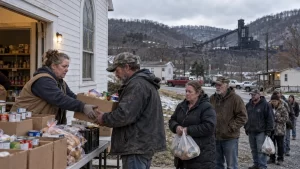
Helen Swire Comer of Lincoln County, West Virginia, quit a bank management job to care for her aging parents at home. She spent more than two years on interrupted sleep and midnight hospital runs. Her mother and father died five months apart. Then, as she was trying to rebuild her life, the federal government took away most of her food stamps. Her story, told to Mountain State Spotlight and syndicated by Raw Story this week, is not the exception. In every red state, in every rural county, this is now the rule.
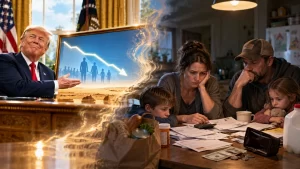
The mechanism is a law signed in the Rose Garden on July 4, 2025 — the misleadingly branded “One Big Beautiful Bill Act.” Its architects sold it as a crackdown on able-bodied loafers who refused to work. What it has produced, thirteen months in, is something the country has not seen at this scale in living memory: a self-inflicted hunger emergency, concentrated overwhelmingly in the counties that voted for the president who signed it.
The numbers are no longer projections. They are receipts. Between February 2025 and February 2026, more than four million Americans lost their SNAP benefits, according to Stateline’s analysis of the most recent federal data. Roughly 1.5 million of them are children. The Congressional Budget Office estimates that $187 billion will be stripped from the program over the next decade — the largest cut in the fifty-year history of American food aid. And the deepest damage, by design, is falling on the states that put Donald Trump back in the White House.
I. The Statistics of Starvation
The scale is easier to grasp when you stop reading it as a spreadsheet and start reading it as a map. Arizona has lost roughly half of its SNAP beneficiaries in a year, CNBC reported in May, citing Center on Budget and Policy Priorities data. California food banks are now feeding six million people a month — more than they served at the height of the pandemic. In West Virginia alone, state data show more than 14,000 residents have already lost food assistance as a direct result of the new rules.
The Federal Reserve Bank of New York flagged what it called a “remarkable” jump in food insecurity in a May study — worse now than during the darkest months of COVID. The nonpartisan Urban Institute puts nearly one in four American adults in a household that cannot reliably afford enough to eat. In a country producing more food per capita than almost any other on earth, that is not a supply problem. That is a decision.
II. Red America Feels It First
There is a particular cruelty in the geography of this crisis. The states losing the most federal SNAP funding, according to Commonwealth Fund analysis, are West Virginia, Georgia, New Mexico, Delaware, and New Jersey — with West Virginia and Georgia each losing roughly 43% of their food-stamp funding. West Virginia went for Donald Trump by nearly 42 points. Georgia is a swing state Trump narrowly carried. The president’s own base is the target audience of his own policy.
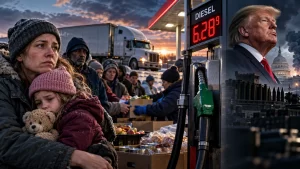
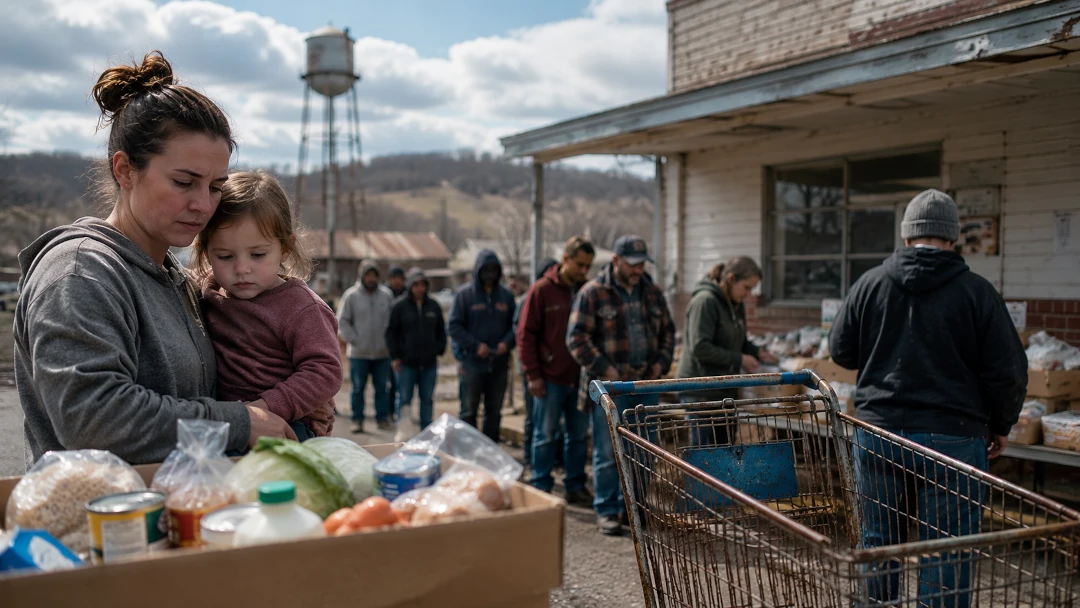
Cyndi Kirkhart runs the Facing Hunger Foodbank in Huntington, West Virginia, which supplies more than 130 pantries across Appalachia. Since late last year, she told Mountain State Spotlight, her pantries have been serving more families while getting less food from the federal government, at the same time inflation has driven the price of ground beef from $2 to $7 a pound. Food banks were never designed to replace a federal program. SNAP benefits provide 9 meals for every one meal a food-bank delivers. When Washington cuts SNAP, no charity in America can close the gap.
In Mingo County — one of the poorest counties in one of the poorest states — KFF Health News found Perry Hall, a multiple-myeloma patient, and his 59-year-old wife Lilly living on his $1,500-a-month Social Security check. She recently took an unpaid waitressing job at a Delbarton restaurant simply to log the hours the new work requirements demand. That is what “welfare reform” looks like in coal country: a woman in her sixties working unpaid so her sick husband can keep eating.
“There is no way that we can offset the absence of SNAP benefits.”
— Cyndi Kirkhart · CEO, Facing Hunger Foodbank / to Mountain State Spotlight, August 2026
What is happening in Mingo County is happening in Kenton, in Rockcastle, in Muskogee, in Pike. The Kentucky Center for Economic Policy estimates that up to 114,000 Kentuckians could lose SNAP under the expanded work requirements. Analyst Jessica Klein told CBS News her worry is not just that people will go hungry — it’s that some states may simply stop administering SNAP altogether rather than absorb the new cost share. A hungry country is one policy choice. A country in which entire red states have no federal food program at all is another. The One Big Beautiful Bill Act makes the second one imaginable for the first time in fifty years.
The premise of the whole exercise — that work requirements will push idle adults into jobs — is empirically false. A federal research project examining data from nine states found work requirements “have no impact” on labor-force participation or hours worked. In Mingo County, the number of people employed each month actually declined after the work requirement was reimposed. The requirements do not create workers. They create paperwork traps that push the sick, the elderly, and the rural poor off the rolls. That is not a bug of the policy. That is the policy.
III. The Democratic Response
The Democratic response has been comprehensive, coordinated, and — under current congressional math — mathematically doomed. That does not make it less important. In November 2025, every Senate Democrat and more than 190 House Democrats co-sponsored the Restoring Food Security for American Families and Farmers Act, led in the Senate by Ben Ray Luján (D-N.M.), Chuck Schumer (D-N.Y.), Amy Klobuchar (D-Minn.), and Jeff Merkley (D-Ore.), and in the House by Ranking Member Angie Craig (D-Minn.) and Nutrition Subcommittee Ranking Member Jahana Hayes (D-Conn.). The bill would repeal the SNAP provisions of the One Big Beautiful Bill in their entirety, restoring the nearly $200 billion in food aid Republicans stripped to fund tax cuts for the wealthiest Americans.
The bill has not moved. It will not move in this Congress. Senate Republicans have shown no interest in reversing cuts they voted for, and House Republicans have advanced a Farm Bill — H.R. 7567, passed 384-35 in April — that locks in the $187 billion in SNAP cuts as standing agricultural law. Senator Schumer has since launched a fallback effort seeking a two-year delay in the cost-shift onto states, appearing in Troy, Albany, and Binghamton with local officials whose county budgets face millions in new SNAP-related costs beginning October 2027.
Outside Washington, Democrats running in 2026 are making SNAP central to their pitch. In Iowa, both Democrats challenging Rep. Zach Nunn — Jennifer Konfrst and Sarah Trone Garriott, the latter of whom works in a food-pantry network — are hammering Nunn’s vote for the bill and the projected $1 billion loss to Iowa’s economy. In Pennsylvania, the DCCC has zeroed in on Rep. Ryan Mackenzie. The party’s calculation is that hunger, unlike almost any other political issue, is not abstract. It is a line at 6 a.m. outside a mobile pantry, in a district the incumbent still calls home.
Get Involved Today
Contribute to our mission and turn your concerns into action.
IV. Why the Administration Looks Away
The Trump administration has responded to the crisis it manufactured in three ways: denial, obstruction, and a construction project. In September 2025, USDA quietly announced it would no longer fund the Current Population Survey’s Food Security Supplement — the thirty-year federal measure of hunger, whose data have anchored bipartisan policy for decades. A USDA spokesperson said the reports had become “overly politicized.” Matthew Rabbitt, a Cornell scholar who led the survey’s last three years at USDA, put it bluntly to reporters: without the survey, the country will not be able to make informed policy decisions about hunger. Child food insecurity, he said, can no longer be measured nationally at all.
During the October–November 2025 federal shutdown, the administration initially refused to spend legally available SNAP contingency funds, exposing 42 million Americans to the first program-wide funding lapse in SNAP history. The Impact Fund and the Western Center on Law & Poverty filed a nationwide class action to force the funds to flow. The administration was, in the plainest legal sense, ordered to feed the country.
At the same moment, on the East Wing of the White House, cranes were disassembling a historic building to make way for the president’s personal ballroom. Trump originally quoted the price at $200 million, then $250 million, then $300 million, then $400 million. In June, The Washington Post revealed, via internal Clark Construction documents, that the true projected cost had reached $600 million, with more than $300 million coming from taxpayers via the Secret Service, the White House Military Office, and the Executive Residence. Trump had repeatedly assured the country the project was “tax-free.”
“This is all my money and donors’ money. This is tax free.”
— President Donald J. Trump / on the ballroom, before the $600M internal budget leaked
A $600 million ballroom for a president who cannot appear to name a single American who has lost food assistance under his own signature law. That is the moral geography of this administration in a single frame. And it is why the administration’s data-suppression campaign matters: if the numbers are never collected, they cannot be entered into evidence.
V. The Midterm Reckoning
Republican strategists are, at least publicly, unconcerned. Rep. David Valadao of California, whose Central Valley district has SNAP participation of more than 27% — well above the 17% national average — told HuffPost he does not expect the SNAP declines to hurt him in November. His argument: hardworking Central Valley voters resent the idea of neighbors receiving benefits without working. His challenger, Randy Villegas, is running on the price of housing, gas, and groceries. Bloomberg columnist Jonathan Bernstein wrote in July that the president’s own affordability messaging in 2024 is now the weapon most likely to be used against his party.
The Democratic Congressional Campaign Committee has calculated the same way. Katie Smith, a DCCC spokesperson, has told reporters vulnerable House Republicans will be forced to defend a “cruel agenda” and that the majority is now in play. A digital-ad program is already running in GOP-held districts with the highest SNAP participation. Democratic strategist Mark Longabaugh told NOTUS that hunger has become one of the party’s most resonant “kitchen table” issues heading into November.
Whether that political calculation is correct is not the point. What is the point is that hungry children in Mingo County, hungry veterans in Georgia, hungry seniors in New Mexico are not electoral abstractions. They are the evidence of a governing choice, made by a president and a Congress and defended even as pantries run out. The question the midterms will answer is not whether Republicans pay a price. It is whether the country still has the political capacity to notice.
The 25th Amendment Question: When Does Cruelty Become Incapacity?
The 25th Amendment’s Section 4, ratified after the Kennedy assassination in a burst of bipartisan sober-mindedness, provides a mechanism for the removal of a president who is “unable to discharge the powers and duties of his office.” On April 14, 2026, Rep. Jamie Raskin (D-Md.) — a constitutional-law professor before he was a congressman — introduced legislation with 50 co-sponsors to create the Commission on Presidential Capacity: a 17-member body of physicians, psychiatrists, and former executive-branch officials empowered by the amendment’s own text to render a formal judgment on that question.
Raskin’s immediate trigger was the president’s April 6 Truth Social post threatening Iran’s civilian power grid (“Praise be to Allah”), followed by the “whole civilization will die tonight” post two weeks later. But the constitutional case does not rest on a single outburst. It rests on a pattern.
The Argument This Editorial Board Would Make
A president who signs a bill projected to strip food from millions of his own voters, who then cancels the federal survey that measures the resulting hunger, who withholds legally available emergency food funds during a shutdown, and who diverts hundreds of millions of taxpayer dollars into a personal ballroom while the country lines up for donated groceries — that is not merely bad policy. It is a pattern of conduct suggesting a president who is disengaged from the actual consequences of his own decisions. The 25th Amendment’s framers used capacious language on purpose. “Unable to discharge” is not a purely medical standard.
An Honest Assessment of the Barriers
The path is nearly impossible under current conditions. Section 4 requires the vice president plus a majority of the Cabinet (or a “such other body as Congress may by law provide”) to make the initial declaration. Vice President JD Vance has shown no sign of considering it. The Cabinet is composed of Trump loyalists. Raskin’s commission bill requires Republican-controlled majorities to enact it. And if the president contests the finding, a two-thirds supermajority of both chambers is needed to sustain the removal — a bar Congress has not cleared since Andrew Johnson.
The moral case does not depend on the political path. The 25th Amendment exists as a formal record that even the framers of the modern presidency understood the office could be exercised in ways that damaged the country. The fact that Section 4 is unlikely to be invoked today does not neutralize the constitutional argument. It documents the failure of a Congress that will not act, and it commits to the historical record that lawmakers saw what was happening and named it. When the survivors of this administration look back at the pantry lines of 2026, they will need to know that someone on the constitutional side of the aisle said, plainly: this president is not discharging the duties of his office.
VI. What This Says About His Leadership
Every presidency reveals its priorities through what it will not tolerate. This administration has tolerated 42 million Americans facing a lapse in food benefits. It has tolerated the collapse of a fifty-year bipartisan promise. It has tolerated the destruction of the federal instrument used to measure hunger. What it has not tolerated is any threat to a $600 million construction project on the East Wing of the White House.
The people paying the price are not the coastal elites of the president’s rhetorical imagination. They are the residents of Mingo County. They are the seniors in Delbarton and Yawkey. They are the veterans stripped of their exemption. They are the 800,000 adults between the ages of 55 and 64 — a cohort the CBO warns has high rates of work-limiting illness and age-related employment discrimination — who will be pushed off the rolls by a law sold as an incentive to work. These are the people the American right claims, in every campaign cycle, to speak for. This is what being spoken for looks like when the checks come due.
Editorial Conclusion
A government that will not feed its own citizens while it gilds its own residences has forfeited the moral authority to govern. A president who cannot see the food-pantry lines in his own base, or refuses to, is not discharging the duties of his office in any sense the country’s founders would have recognized.
The remedy is not private charity, which cannot possibly close a $187 billion hole. The remedy is not the goodwill of a Republican Congress that has already voted, twice, to make this crisis permanent. The remedy is a democratic verdict in November, and a Congress after it willing to restore the promise that no American child, senior, or veteran will go hungry in the wealthiest country on Earth.
Everything else — the ballroom, the tax cuts, the canceled surveys, the theatrical crackdowns on “fraud” — is what a government does when it has stopped caring what its own people eat.
Sources & References
- Raw Story — “Red state food pantries buckling as thousands lose food stamps under new GOP-led rules.” rawstory.com
- Mountain State Spotlight — “‘I’ve never been so low in my life’: As thousands lose food stamps, West Virginia food pantries struggle to keep up,” Tre Spencer, August 3, 2026. mountainstatespotlight.org
- CNBC — “At least 3.5 million people have lost food stamp access as Trump’s ‘big beautiful bill’ cuts take effect,” May 30, 2026. cnbc.com
- Stateline — “More Americans are hungry in the face of federal cuts, rising grocery prices,” June 17, 2026. stateline.org
- KFF Health News — “Food Stamp Work Rules Don’t Increase Employment, Researchers Say.” kffhealthnews.org
- CBS News — “Food stamp work rules don’t increase employment, researchers say,” April 20, 2026. cbsnews.com
- West Virginia Watch — “14K West Virginians have lost food assistance because of Big Beautiful Bill changes,” July 6, 2026. westvirginiawatch.com
- U.S. Senate (Luján) — “Restoring Food Security for American Families and Farmers Act of 2025,” bicameral introduction, November 20, 2025. lujan.senate.gov
- NAACP Legal Defense Fund — “President Trump’s ‘One Big Beautiful Bill Act,’ Explained.” naacpldf.org
- HuffPost — “Republicans Don’t Think Steep Food Stamp Cuts Will Hurt Them In The Midterms.” huffpost.com
- Bloomberg Opinion — “SNAP Cuts Could Cost GOP Ahead of the Affordability Midterms,” July 26, 2026. bloomberg.com
- NOTUS — “SNAP Is Now a Key Part of Democrats’ Campaign Messaging.” notus.org
- Center for American Progress — “5 Ways the Trump Administration Is Forcing Families To Go Hungry,” November 3, 2025. americanprogress.org
- Center for American Progress — “The Trump Administration Cancels Food Insecurity Report, Masking Harms of Historic SNAP Cuts,” September 25, 2025. americanprogress.org
- Mediaite — “House Democrats File Bill to Form 25th Amendment Commission to Assess Trump’s Mental Fitness,” April 14, 2026. mediaite.com
- Deseret News — “Democrats want a medical check on Trump’s fitness for office,” April 14, 2026. deseret.com
- Euronews / Washington Post — “Trump ballroom cost soars to €516m with half coming from taxpayers, US media say,” June 16, 2026. euronews.com
- Sen. Chuck Schumer — “Push to delay SNAP cost shifts and save Capital Region county budgets,” July 2026. schumer.senate.gov
- Stateline — “Red states target SNAP fraud, errors under threat of costly federal penalties,” February 25, 2026. stateline.org
- The Week — “Cutting the food safety net.” theweek.com
Related News