The Plan on the Orange Line: Trump’s Blueprint to Seize America’s Memory
A commuter’s photos of a White House laptop expose what the administration has spent twenty months denying it intends: firing the leadership of the National Museum of American History, rewriting its exhibits, and remaking what millions of schoolchildren learn about their country. The Smithsonian was built to be independent of any president. This White House is treating that independence as an obstacle to be removed.
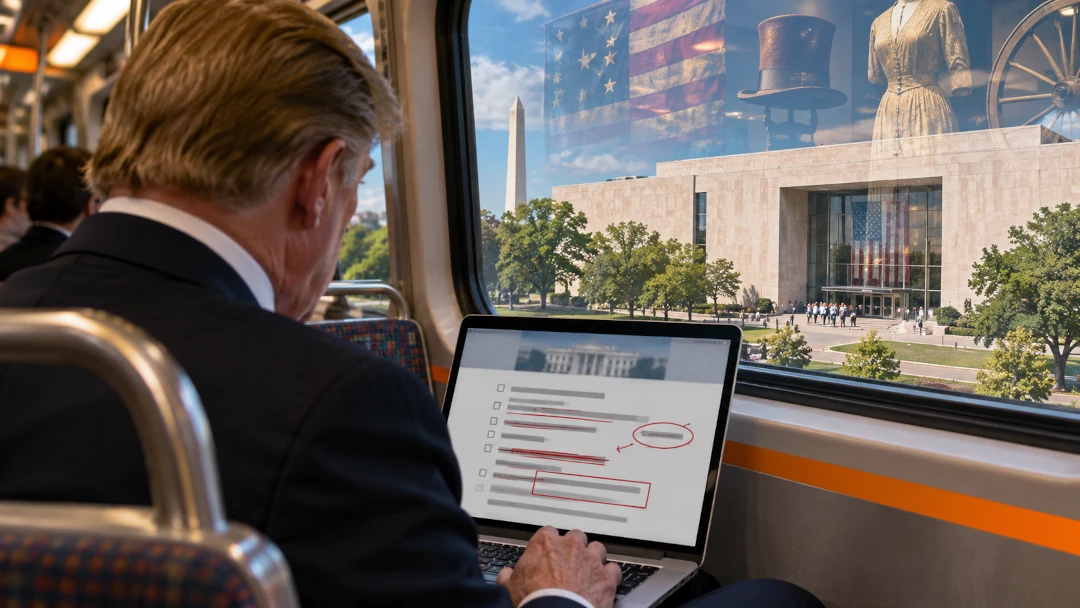
It was the last week of October, and political Washington was fixated on the midterms. On an Orange Line train rolling in from the Virginia suburbs, a commuter glanced at the laptop of the man in the next seat and saw a document titled “Smithsonian Institution Renewal Plan.” The commuter took several photos and sent them to ProPublica. What they captured, according to the reporting published this morning by Alec MacGillis and Andy Kroll, was a 25-item checklist for the most aggressive assertion of presidential control over the nation’s museums in the Smithsonian’s 180-year history.
ProPublica identified the likeliest author as Sam Bock, a 27-year-old associate policy adviser at the White House Domestic Policy Council, the same office that produced the administration’s July broadside against the National Museum of American History. Bock, who previously worked for Rep. Jim Jordan, did not respond to messages. Neither did the White House. The Smithsonian declined to comment.
The silence is telling. For more than a year, the administration has insisted it merely wants “balance” and “accuracy” at the Smithsonian. The document on the Orange Line describes something else entirely: a purge, a rewrite, and a takeover.
I. What the Commuter Saw
ProPublica’s reporters did not simply publish the photos. They worked backward from the initials visible on the laptop, searched White House staffing records, and rode the Orange Line themselves until they identified a man matching the description who exited near a White House employee checkpoint. The plan itself appears to be a work in progress, with no timelines attached. But its contents are specific, and they map almost precisely onto the grievances the White House has aired since the summer.
Personnel: The Purge
Fire museum director Anthea Hartig and about a dozen other top administrators and curators. Hartig is the first woman to lead the museum. ProPublica
Exhibits: The Rewrite
Announce a permanent exhibit called “The Riches of Our Western Civilization Inheritance,” a “Great Families of American History” exhibit, and a “Colossus Statue” of George Washington at the entrance. ProPublica
Traveling Shows: Halted
Stop the traveling exhibition “The Bias Inside Us,” already underway, as part of a review of the museum’s traveling-exhibit strategy. ProPublica
Scholarship: New Rules
Issue new interpretive guidelines ending reliance on the museum’s diversity style guide, and review grants to what the plan calls “woke third parties,” including the American Alliance of Museums. ProPublica
Classrooms: Remade
Overhaul the museum’s online K-12 curriculum to “realign educational materials with patriotism, not ideology,” remove the “Becoming US” immigration module, and launch Founders-focused lessons with working titles like “Architects of Liberty.” ProPublica
The Handwritten Notes
A separate sheet proposed an “exciting cool exhibit on D-Day” and a “no X rated exhibitions policy,” which ProPublica says likely targets a gay history exhibit attacked in the July report and in congressional hearings. ProPublica
A D-Day exhibit, on its own, is unobjectionable. So is a statue of Washington. That is precisely what makes the list so revealing. The crowd-pleasing items are the announcements; the substance is in the firings, the deleted immigration module, the ban framed around “X rated” content, and the attack on the professional standards that govern how curators do their jobs. Strip away the patriotic packaging and what remains is a plan to decide, from the West Wing, who is allowed to tell America’s story and which Americans get to be in it.
II. Twenty Months of Pressure
The Metro leak is not the beginning of this story. It is the logical next chapter of a campaign that started two months into Trump’s second term and has escalated at every stage.
Get Involved Today
Contribute to our mission and turn your concerns into action.
Two items on that timeline deserve particular attention. The first is the July report. CNN summarized its central charge: that the Smithsonian had moved “away from straightforward historical education and scholarship toward an extreme political activism that seeks to transform our country.” The Washington Post’s critic, reading the same 160-odd pages and more than 500 footnotes, reached the opposite conclusion: the evidence assembled reveals a large and vibrant institution doing its job, and the only bias the report uncovers is its own. Bunch, in a memo to staff, called the report “not a fair characterization of the work and totality” of the museum.
The second is Bunch’s departure. He has insisted the decision was personal. But it came eleven days after the Burgum letter, two months after the White House declared the museum’s leadership untrustworthy, and amid what ABC News described plainly as attacks from the administration. In his statement, Bunch said: “I love this country and I love the Smithsonian and I will always work to defend our more perfect Union.” The leaked plan, drafted weeks later, reads like an agenda for the vacuum he leaves behind.
“The Smithsonian is OUT OF CONTROL, where everything discussed is how horrible our Country is, how bad Slavery was, and how unaccomplished the downtrodden have been — Nothing about Success, nothing about Brightness, nothing about the Future.”
— President Donald Trump, Truth Social, August 19, 2025 · via PolitiFact
III. The Warning Signs That Haven’t Gone Up
Executive Order 14416 is the strangest artifact of this whole campaign. Because the president cannot directly order the Smithsonian to change its exhibits, the order targets the ground outside the building. It directs the Interior Department to install temporary exhibits or signage around the museum, warning visitors about what the White House calls its “ideological capture.” It also orders agencies to identify every available lever to force changes the White House wants.
Picture what this means in practice: a family walks up the steps of the nation’s history museum and is greeted by a federal sign instructing them not to trust what they are about to see. It is the governmental equivalent of a disclaimer on a cigarette pack, applied to the Star-Spangled Banner and the Greensboro lunch counter. As of ProPublica’s reporting, the signs had not yet gone up. The leaked plan suggests the White House may have concluded that signs are a half-measure, and that the real prize is control of what’s inside.
IV. What It Means for the Museum, and for You
The National Museum of American History employs several hundred people, holds millions of artifacts, and draws close to two million visitors a year, according to ProPublica. Most of those visitors are not activists or academics. They are families on spring break, eighth-graders on class trips, veterans looking for their war, immigrants looking for their story. The leaked plan would change what all of them encounter.
Consider the “Becoming US” module the plan would delete. It is an online teaching resource on immigration, used by teachers far beyond Washington. Removing it doesn’t just affect visitors to the Mall; it affects every classroom that relies on the Smithsonian’s free educational materials. Replacing broad social history with “Great Families” and a “Western Civilization Inheritance” exhibit signals a narrower definition of whose history counts. The Art Newspaper, analyzing the July report that the plan echoes, summarized the administration’s vision in its headline as “White, patriarchal and Christian.”
Then there is the chilling effect. Firing a director and a dozen curators sends an unmistakable message to every museum professional in the country: get on the wrong side of the White House and you will lose your job. The plan’s review of grants to the American Alliance of Museums, the field’s main accrediting body, extends that message well beyond the Smithsonian’s walls. A curator in Ohio or Oregon deciding whether to mount an exhibit on labor, civil rights, or LGBTQ history will now weigh not only the scholarship, but the politics.
And there is money. The Smithsonian receives about 60 percent of its $1.25 billion operating budget from federal appropriations, according to the Boston Globe. That is taxpayer money, spent on behalf of all Americans. The question is not whether the public should have a say in its national museum. It is whether that say runs through Congress, scholars, and an independent board, as the law intends, or through a 27-year-old’s laptop in the West Wing.
V. The Courts: A Mixed and Unfinished Record
Here honesty requires precision: no lawsuit has yet been filed to stop the Smithsonian overhaul itself. ProPublica’s report cites no pending case, and the Smithsonian has preferred quiet resistance to open litigation. But the courts have already ruled on closely related efforts to scrub history from federal sites, and those rulings tell us where future battles will be fought.
The National Parks case. In June, U.S. District Judge Angel Kelley in Massachusetts ordered the administration to restore signs and exhibits it had removed from national parks under the same March 2025 executive order. In a 63-page ruling, she wrote that the administration was “telling half-truths” by removing displays that did not fit its preferred narrative.
The President’s House in Philadelphia. In January, the Park Service stripped panels about the nine people George Washington enslaved at his Philadelphia executive mansion. In February, Judge Cynthia Rufe, a George W. Bush appointee, ordered them restored, comparing the administration’s rationale to Orwell’s Ministry of Truth. But in June, a unanimous Third Circuit panel reversed her, holding that the city lacked “statutory, property, or contractual rights” to curate the site. The administration has since installed its own panels, which critics say soften the history of slavery.
The right’s own lawsuit. Ironically, the only case aimed squarely at Smithsonian curatorial decisions came from a pro-Trump artist, Julian Raven, who sued after the institution declined his giant Trump portrait. A federal court dismissed his case in January 2026 for lack of standing; he has appealed.
The lesson from Philadelphia is sobering. Courts may agree that history is being distorted and still find that the plaintiff in front of them lacks the right to stop it. Any challenge to a Smithsonian purge will need the right plaintiff: fired employees, the Board of Regents itself, or members of Congress defending their appropriations power.
The Smithsonian Does Not Belong to the President
The legal case against the Renewal Plan begins with the institution’s design. The Smithsonian was created by an act of Congress in 1846 and placed under a governing board, not a cabinet secretary. Every piece of the leaked plan runs into that structure.
Governance: The Board of Regents
The Smithsonian is governed by a 17-member Board of Regents chaired by the chief justice of the United States, with seats for the vice president, members of Congress, and private citizens. Hiring and firing the secretary and setting policy belong to that board. ProPublica notes the board currently has several vacancies, a vulnerability the White House may try to exploit.
Personnel: No Presidential Firing Power
When Trump claimed to fire Kim Sajet in 2025, the Smithsonian publicly reasserted that personnel decisions are its own. A White House plan to fire Anthea Hartig and a dozen curators has no lawful mechanism except pressure on the Regents or on a newly installed secretary. Any direct executive firing would be ultra vires: beyond the president’s legal authority.
Funding: Article I, Not Article II
Congress appropriates the Smithsonian’s federal money. Executive Order 14416 tacitly concedes this by aiming at sidewalks, agency loans, and grants rather than the budget itself. The August 28 Burgum–Haley letter’s threat to withdraw agency support is an attempt to accomplish through leverage what the president cannot do by command, and it invites scrutiny as coercion of a congressionally chartered body.
Speech: The Government-as-Curator Problem
Courts generally give the government wide latitude over its own speech, which is why litigation over park signage has been difficult. But the Smithsonian’s speech belongs to an independent trust instrumentality, not to the White House. That distinction, untested in court, is where a serious legal challenge would live.
VI. Congress Changes Hands
The political ground shifted beneath the White House on November 3. NBC News projects that Democrats will take control of both the House and the Senate in January, with a House majority of roughly 258 seats, the party’s largest since 1992. That matters enormously for the Smithsonian, because the institution answers to Congress.
The key figure is Rep. Joe Morelle of New York, the top Democrat on the House Administration Committee, which oversees the Smithsonian. In July, as Republicans grilled Hartig, Morelle’s committee Democrats released their own report, “The White House Campaign to Seize Control of the Smithsonian and Rewrite American History,” and he issued a blunt statement:
“President Trump is abusing the power of the White House to pressure one of America’s most respected cultural institutions into political obedience… Committee Democrats will continue defending that independence because no president gets to edit the American story.”
— Rep. Joe Morelle (D-NY), Ranking Member, Committee on House Administration · Press Release, July 21, 2026
Morelle has been on this beat since April 2025, when he led committee Democrats in writing to Vance to defend the Smithsonian’s curatorial independence. On election night, he said that if he won the chairmanship he would prioritize ending stock trading by members of Congress, administration officials, and the Supreme Court, part of an anti-corruption package Democrats may bring first. Meanwhile Rep. Robert Garcia, the top Democrat on the Oversight Committee, has laid out four investigations he plans to open once Democrats take power.
To be clear about what is and isn’t known: Democratic leaders have not yet announced a specific Smithsonian agenda for January. But the tools they inherit are formidable. A Democratic House Administration Committee can subpoena the Domestic Policy Council’s drafts, including whatever final version of the Renewal Plan exists. Democratic appropriators can write language barring funds for warning signs or for any reorganization not approved by the Regents. A Democratic Senate will have a say in filling congressional seats on the Board of Regents. And the Republican hearings of July, in which GOP lawmakers questioned Hartig on gender and sexuality exhibits and Democrats called the proceedings an attempt to control the country’s historical narrative, will be replaced by hearings on who wrote the plan on the Orange Line and why.
VII. What the President Says, and What It Reveals
Trump has never been subtle about his objective. His March 2025 order complained of “divisive, race-centered ideology.” His August 2025 post lamented that museums dwell on “how bad Slavery was.” His Domestic Policy Council’s report said the American History museum’s leadership could not be trusted. And when he tried to fire Kim Sajet, he gave as his reason that she was “highly partisan” and a supporter of DEI.
What he has not done, since ProPublica’s story broke this morning, is explain the plan. The White House did not respond to questions. That silence fits a pattern: the administration makes sweeping public claims about “truth” and “sanity,” and drafts its actual intentions out of view.
It is worth asking what this says about the priorities of a president presiding over a country with real problems. Voters just delivered his party one of the worst midterm defeats in a generation. Yet inside his policy shop, staff time is being spent drafting colossal statues, scrubbing an immigration lesson plan, and listing which curators to fire. The pattern extends beyond the Smithsonian: from the Kennedy Center, where a board of his supporters named him chairman, to the National Park Service, this administration treats the nation’s cultural institutions as territory to be conquered.
There is a word for leaders who decide which history citizens may see. It is not “patriot.” Patriotism that cannot survive an honest account of slavery, of immigration, of the struggles of ordinary people, is not love of country. It is love of a flattering portrait. The Smithsonian has never been beyond criticism, and reasonable people can argue about any given exhibit. But that argument belongs to historians, the public, and an independent board, not to a president who has made his own impeachments a point of contention in the very building he now wants to control.
VIII. What Comes Next
Expect the next six weeks to be the most dangerous. Bunch leaves at the end of the year; Democrats don’t take the gavels until January. The Renewal Plan’s firings, exhibit announcements, and curriculum changes all become easier with a sympathetic secretary in place and a Republican Congress still in session. Watch three things closely:
The secretary search. The Regents choose Bunch’s successor. Heritage Foundation’s membership director has already said Bunch’s exit is “just the first stop.” A secretary aligned with the White House would make most of the leaked plan achievable without a single new executive order.
The Regent vacancies. Several board seats are empty. Who fills them, and how fast, may decide whether the board can resist.
The signs. If the warning signs finally appear outside the museum during the holiday tourist season, it will mark the moment the administration chose open confrontation over quiet pressure, and it may finally produce the plaintiff a court case needs.
IX. What You Can Do
This fight will be decided by a small number of people: seventeen Regents, a handful of committee chairs, and whoever the board picks as secretary. That makes public pressure unusually effective, because each of those people can be reached.
There is no single lawsuit you can join or petition that will stop this outright. The most powerful checks are congressional subpoenas and appropriations, which arrive in January, and the Board of Regents, which can act now but has been cautious. Your leverage lies in making silence costly for the people who hold those powers.
Call your members of Congress, especially the Regents
Three senators and three House members sit on the Board of Regents. Ask your representatives to demand that the White House release the full Renewal Plan, and to commit to hearings and funding restrictions in January. Ask your senators to oppose any Regent nominee who supports the plan.
Write to the Board of Regents and Chief Justice Roberts
The Regents, chaired by Chief Justice John Roberts, choose the next secretary. Urge them publicly to select a historian with a record of independence, and to reject any personnel action dictated by the White House.
Teachers: save the materials now
If you use the Smithsonian’s free K-12 resources, including “Becoming US,” download and archive them. Then tell your school board and state education officials why they matter.
Visit, document, and share
Go to the National Museum of American History, in person or online. Photograph exhibits and labels. Public documentation of what exists today makes quiet changes tomorrow far harder to hide.
Support the institutions under attack
Become a Smithsonian member, and support the American Alliance of Museums and local history museums that face the same pressure. Organizations that brought the parks and President’s House lawsuits also need resources for the next round.
Editorial Conclusion
A nation’s museum is its memory, held in trust for every citizen. The Smithsonian was deliberately placed beyond the reach of any single president because the founders of the institution understood that whoever controls the past will try to control the future. The plan glimpsed on the Orange Line is an attempt to erase that safeguard: to fire the historians, rewrite the exhibits, and teach a new generation a history approved by the White House.
This is not a culture-war skirmish. It is a test of whether independent institutions can survive a president who refuses to recognize any limit on his power. Congress must subpoena the plan, write its prohibitions into law, and defend the Board of Regents. The Regents must choose a secretary loyal to scholarship, not to a president. And every American who values an honest account of this country, with its triumphs and its sins, must make clear that our history is not his to edit.
Sources & References
- ProPublica — Spotted on the D.C. Metro: Trump Staffer Accidentally Reveals Plan for Smithsonian Overhaul
- CNN — White House report accuses Smithsonian leadership of radical ideology
- The Washington Post — The only bias uncovered in the White House’s Smithsonian report is its own
- The White House — Saving America’s Story (Domestic Policy Council report, PDF)
- The White House — Executive Order: Restoring Trust in the Smithsonian Institution
- 7News / Local 12 — Trump orders ‘warning’ signage around Smithsonian’s National Museum of American History
- The Art Newspaper — White, patriarchal and Christian: White House’s vision for the NMAH
- Quartz — Trump administration threatens to cut agency support for Smithsonian
- ABC News — Smithsonian Secretary Lonnie Bunch resigns amid attacks from Trump administration
- NPR — Smithsonian chief emphasizes ‘accuracy and integrity’ after White House report
- The Boston Globe — The Smithsonian has withstood Trump’s attacks so far. But the political pressure is mounting.
- House Administration Democrats — Morelle Releases Committee Report Correcting the Record
- WXXI News — Morelle re-elected. Here’s what could await in the next Congress
- NBC News — Election results 2026: Democrats take House and Senate
- CNN — Judge orders Trump administration to restore signs changed at national parks
- WHYY — Trump administration must restore slavery exhibit at President’s House, judge rules
- WHYY — Court ruling clears way to replace slavery exhibit at President’s House
- Urgent Matter — Julian Raven appeals dismissal of Smithsonian lawsuit
- PolitiFact — Trump’s claim Smithsonian has “nothing about success”
- NPR — White House calls for ‘comprehensive internal review’ of 8 Smithsonian museums
- NPR — Trump’s impeachments removed from a Smithsonian exhibit, for now
- The Hill (via AOL) — National Portrait Gallery director resigns after Trump tried firing her
- Associated Press (via KSAT) — Lonnie Bunch to retire following clash with Trump administration
Related News