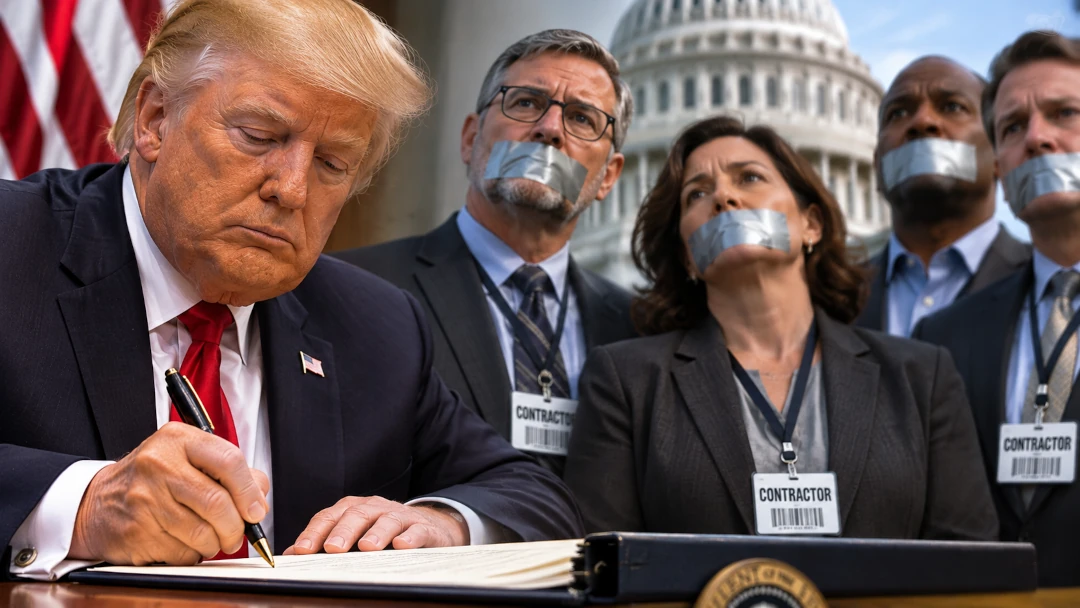
Six weeks before Democrats take the gavels, the president has told every company that does business with the federal government to report congressional inquiries to the White House, coordinate their answers with his staff, and withhold whatever his lawyers call privileged — or risk losing their contracts. The firms that built his ballroom and repainted his Reflecting Pool now answer to him first. The Constitution says they answer to the people’s representatives too.
Late on a Friday night, when Washington had gone home and the news cycle had gone dark, President Donald Trump signed an executive order that turns tens of thousands of private companies into an early-warning system for the White House. Under the order, federal contractors and subcontractors must immediately notify the White House and their contracting agencies of any pending or future congressional request touching their communications or work with the executive branch, and must follow the administration’s instructions on withholding anything it deems protected by executive privilege. The companies must also coordinate with the White House and U.S. agencies on “appropriate responses” to any such request.
The timing is not subtle. Democrats won both chambers of Congress in the November 3 midterms and will be sworn in on January 3. Their incoming oversight leaders have spent more than a year sending letters to the contractors behind Trump’s Washington building spree — and getting stonewalled. Now, just as those letters are about to become subpoenas, the president has moved to put himself between those companies and the people’s representatives.
I. What the Order Actually Says
Stripped of its procurement jargon, the order does four things. First, it creates a notification duty: any contractor that hears from Congress must tell the White House. Second, it creates a coordination duty: the contractor’s response is to be worked out with the administration. Third, it creates a withholding duty: if the White House or an agency says a communication is privileged, the contractor must hold it back. Fourth, it attaches a penalty. According to ABC News, contractors that fail to notify the White House or refuse its instructions face possible contract termination, suspension, or debarment — the corporate death penalty in federal contracting, barring a firm from future government work. The White House Office of Management and Budget is to write the compliance guidelines.
The reach is enormous. The order names no company; it covers “all federal contractors” and their subcontractors. ABC cites a Bloomberg Government estimate that roughly 100,000 companies hold federal contracts, before counting the subcontractors beneath them. That is a defense prime building missiles, a software firm running a benefits website, a small business repaving a federal parking lot — and the handful of hand-picked firms building Donald Trump’s monuments to himself.
The order also carries a constitutional argument in its preamble. It asserts that Congress’s ability to seek executive-branch information “is limited” and that lawmakers cannot demand such information without a valid legislative purpose that steers clear of core executive functions. It frames the whole scheme as a matter of efficiency, warning that uncoordinated contractor responses could be “duplicative and wasteful.” The accompanying White House fact sheet is titled, with no apparent irony, “President Donald J. Trump Protects the Executive’s Privileges and Enhances Efficiencies in Federal Contracting.”
The order did not arrive alone. Days earlier, White House Counsel Will Scharf told agencies to get approval from his office and the Office of Legislative Affairs before agreeing to appear before Congress. Put the two together and the design is clear: government employees need permission to testify, and the private companies that do the government’s work now need permission to answer. Every door to the evidence runs through the West Wing.
II. Who It Silences: The Vanity-Project Contractors
The order is written for 100,000 companies, but it is aimed at a much smaller group. Engineering News-Record, the construction industry’s trade journal, illustrated its coverage with a collage of the projects it said show the order’s potential reach: the White House ballroom, the Lincoln Memorial Reflecting Pool, the proposed 250-foot triumphal arch, and the Kennedy Center, where the board has approved a $257 million rehabilitation involving a two-year shutdown.
These are exactly the projects Democrats have been trying to investigate. Sen. Richard Blumenthal of Connecticut, who will chair a key Senate investigative panel next year, sent letters this month to a slew of companies asking them to cooperate with a planned inquiry into the ballroom, and has previously pressed the construction firm about the project’s cost and how it came to be chosen. And Rep. Robert Garcia, the incoming House Oversight chairman, has told reporters that his committee plans to subpoena private entities directly precisely because Democrats expect the administration to slow-walk document requests and invoke executive privilege, as it did in Trump’s first term.
That is the heart of the matter. Democrats announced their workaround — go to the contractors, who have the invoices, the bids, the emails — and the president has now tried to close it. The order does not merely protect presidential confidences. It tells the companies holding the paper trail that their livelihoods depend on keeping the White House informed and following its lead.
The record of how those projects unfolded explains why the paper trail matters.
III. The Paper Trail They Want Buried
An administration with nothing to hide does not need to pre-clear what its contractors tell Congress. And this administration’s own record — documented by journalists, federal analysts, and lawmakers of both parties — gives the public every reason to want those contractors heard.
The “Taxpayer-Free” Ballroom
Trump said no taxpayer would put up “10 cents.” But the Post, citing Clark Construction project summaries, invoice logs and emails, found tens of millions in public money had gone to the project, tapped from the beginning. Rep. Rosa DeLauro said the administration spent the money “and then lied about it.”
The $385.8 Million Transfer
Money from the 2025 tax law routed to the Secret Service for “White House security” is set to eventually total $385.8 million, according to a senior administration official. Even Republican Senate Appropriations Chair Susan Collins directed her staff to look into it, as Democrats objected to public money for a ballroom Congress never authorized.
No-Bid Pool, Donor Ties
The National Park Service awarded non-competitive Reflecting Pool contracts to two firms with ties to Trump entities, bypassing competitive bidding. Garcia says one firm’s owner gave $250,000 to the Trump Victory committee; the other had serviced pools at a Trump golf club and never held a federal contract.
The “Inflated” Profit Margin
A National Park Service analysis found the Reflecting Pool repair contractor was paid an excessive profit margin: Atlantic Industrial Coatings charged 20%, adding at least $850,000 to what a typical contract would have cost. The agency accepted it anyway, citing the tight deadline.
A Reward for the Ballroom Builder?
Clark Construction, the ballroom’s builder, then received a no-bid contract to repair the Lafayette Square fountains. Blumenthal has demanded to know whether the unilateral selection was a reward for building the ballroom.
Contractors Who Donated
Rep. Jim Himes, the top Democrat on House Intelligence, warned that intelligence contractors who donated to the ballroom could face scrutiny, writing that if they are being pressured in ways that corrupt contracting, Congress has “a vital oversight interest.”
Get Involved Today
Contribute to our mission and turn your concerns into action.
Beyond the monuments sits the money. Oversight Democrats say companies that brought Eric Trump or Donald Trump Jr. into their ownership or onto their payrolls have collected more than $725 million in loans, grants and awards since Trump took office, and Garcia has asked the Pentagon’s inspector general to examine whether those firms won defense contracts. Every one of those companies is a federal contractor. Every one of them is now covered by an order requiring it to tell the White House when Congress calls.
The pattern is not hard to read. A project is announced as free to taxpayers. Donors with business before the government line up. Contracts go out without competition to firms tied to the president. Costs climb. When lawmakers ask how any of this happened, the answers do not come. Now, on the eve of subpoena power, the companies that could supply those answers have been told that the White House wants to hear about any request first — and that their contracts are on the line.
“This is taxpayer-free. We have no taxpayer putting up 10 cents.”
— President Donald Trump on the ballroom, March 31, 2026, via USA Today
IV. The President’s Defense
The administration’s case deserves to be stated in its own terms. The White House fact sheet frames the order as “protecting executive privileges from congressional overreach,” and argues that some lawmakers have intruded on executive prerogatives by “harassing private companies that contract with the federal government.” It says the executive branch “must be able to work closely with its employees and contractors on sensitive matters,” and warns that if contractor communications cannot be kept confidential, agencies will stop sharing sensitive information — which, it says, would “deadlock critical government programs.”
There is a kernel of a real argument here. Contractors do handle sensitive government information, and presidents of both parties have invoked executive privilege against Congress. President Biden, as HNGN notes, asserted privilege over audio recordings of his special counsel interview.
But the administration has not stopped at legal argument. Its rhetoric has been an escalating campaign to paint oversight itself as a crime. In a Truth Social post, Trump accused Democrats of “extortion at the highest level” and said they should be held accountable. Scharf’s letter to Garcia accused Democrats of seeking to “exercise powers of criminal prosecution” and to “intimidate and to interfere with the lawful functioning of government.” White House spokeswoman Lauren Bis dismissed the coming investigations as a decade-long “witch hunt.” And Scharf brushed off Garcia’s document-preservation requests by noting that Democrats are not yet in the majority and cannot compel compliance.
That last point gives the game away. The White House knows the window in which it can ignore Congress is closing. The order is not a privilege claim over a specific document. It is a standing, government-wide system to learn what Congress is asking for, shape what it receives, and punish those who do not play along — built in the last weeks before Congress regains the power to compel.
Privilege is supposed to protect the presidency’s ability to receive candid advice. It was never meant to protect a no-bid paint job, a donor’s quid pro quo, or a construction firm’s invoice log from the people who paid for it. When a president who swore his ballroom cost taxpayers nothing now demands control over what the ballroom’s builders can tell Congress, the defense collapses under the weight of his own words.
V. The Constitution Says Otherwise
Congress’s power to investigate is a century of settled law — and contractors’ duty to speak is written in statute
Article I & the power of inquiry. The Constitution does not use the word “investigate,” but the Supreme Court settled the question almost a century ago. In McGrain v. Daugherty (1927), arising from the Teapot Dome bribery scandal, the Court held that each house of Congress has power to compel a private individual to appear and give testimony needed for its legislative work. A corruption scandal involving the leasing of public resources to favored private interests is exactly where this doctrine was born.
Third parties and the president: Trump v. Mazars. In 2020, in a case brought by Trump himself to block House subpoenas served on his accounting firm and banks, the Court rejected both sides’ absolutist positions and set out a balancing framework for subpoenas seeking a president’s information from third parties — weighing legislative need, scope, evidence, and burden. Crucially, Mazars concerned the president’s personal papers. As HNGN observes, it is not a direct precedent for records of contractor work. Records of how public money was spent on public property sit at the core of Congress’s spending and oversight powers, not at the edge.
Privilege is qualified, not absolute. In United States v. Nixon (1974), the Court recognized a presidential privilege for confidential communications but held that it must yield in some circumstances. A contractor’s bids, invoices, cost estimates and donation records are not presidential deliberations. The order’s own text concedes it creates no enforceable rights and must be carried out consistent with applicable law — meaning it cannot override a statute or a valid subpoena.
The whistleblower statute. Congress has already decided that contractor employees must be free to talk to it. Under 41 U.S.C. § 4712, employees of contractors and subcontractors are protected when they blow the whistle to a Member of Congress or a committee representative; for Defense Department and NASA contracts, the parallel statute is 10 U.S.C. § 4701. An order that makes a company’s contract depend on routing congressional contact through the White House sits in direct tension with a law that forbids reprisal against the workers who make that contact.
No shield from contempt. Even the contracting bar is warning clients. The law firm Crowell & Moring cautioned that the order has little precedent in federal contracting and offers no blanket protection against congressional contempt, noting that an agency’s privilege determination may not shield a contractor from congressional enforcement. In plain terms: a company that obeys the White House and defies a lawful subpoena may still answer for it.
Rep. Jamie Raskin of Maryland, who leads Democratic investigations on the House Judiciary Committee and is expected to chair it, put it bluntly, calling the order “totally unprecedented and blatantly unlawful” and saying contractors have both a duty and a right to speak truthfully when Congress calls.
VI. How This Ends in Court
Prediction is a fool’s game with this Supreme Court, which has handed Trump significant wins — including letting ballroom construction continue after the D.C. Circuit upheld a ruling that the work probably required congressional approval. But on the core question here — whether Congress may obtain information from private parties about how public money was spent — the precedents run in one direction. McGrain affirmed Congress’s power to compel private testimony. Mazars, written by Chief Justice John Roberts, refused to let either branch “win” outright, and its balancing test is far more favorable to Congress when the records concern government contracts rather than a president’s personal finances. Nixon held that even the most powerful privilege claim can yield.
The honest assessment is this: the order is unlikely to survive as a legal shield. It is far more likely to succeed as a delay machine. HNGN identifies the questions courts will eventually have to answer — whether a company’s communications with an agency can be privileged, who decides, and what a contractor does when a subpoena collides with a White House withholding instruction. Each of those questions can be litigated for months. House Democrats’ subpoenas for Trump’s financial records in his first term led to litigation that went all the way to the Supreme Court. Delay is the strategy — and the 120th Congress is two years long.
The deeper danger is not what a court rules but what a contractor does before any court rules. Faced with a choice between a congressional letter and the threat of debarment, many firms will simply call the White House, wait, and stall. That chilling effect is the order’s real purpose, and it operates whether or not the order is ever upheld.
“What is the White House trying to hide? … We’re just getting started.”
— Rep. Robert Garcia, incoming House Oversight Chairman, via CNN
VII. Democrats Take the Gavel
Democratic reaction was immediate. Garcia called the order a “blatant attack on Congress’ constitutional right to conduct oversight,” designed to keep lawmakers from exposing waste, fraud and corruption. Responding earlier to Scharf’s threats, he reminded the White House that Congress has “wide latitude to conduct investigations and oversight” and would not be deterred by threats from a weaponized Justice Department or the president’s lawyers.
The agenda for January is already public. According to Fortune, Garcia’s committee will focus on Trump family corruption, including the family’s crypto company World Liberty Financial and the $500 million stake bought by an Emirati royal while the company seeks a national bank charter Treasury must approve. Corporate donors to the ballroom are expected to be among the first targets, with inquiries possibly beginning in February. Administration officials, including acting Attorney General Todd Blanche, could receive subpoenas on the first day of the new majority. Democrats have also said they will scrutinize the influx of Department of Homeland Security contracts in Trump’s second term, and Defense Secretary Pete Hegseth is likely to be subpoenaed over military actions that bypassed congressional authorization.
In the Senate, Blumenthal’s investigative panel will carry its long-running ballroom inquiry from the minority into the majority, where his requests become enforceable. Senators Patty Murray and Chris Murphy have already asked the Government Accountability Office for a legal ruling on whether the ballroom funding transfers violated federal law. With both chambers in Democratic hands, Congress also holds the most powerful oversight tool of all: the power of the purse. An executive order lives inside contracts that Congress funds — and Congress can write conditions into the appropriations that pay for them.
VIII. What This Means for You
It is tempting to treat this as a Beltway turf war. It is not. Every dollar in these contracts is a taxpayer dollar. Every no-bid award is money that, under competitive bidding, might have bought more for less. When the Reflecting Pool’s repair costs climb to roughly $14 million, when a ballroom promised as free soaks up public funds, when companies employing the president’s sons collect hundreds of millions in federal money, the people who pay are the families now struggling with rent, groceries and health care.
Congressional oversight is how those families find out. It is how Teapot Dome was exposed, how Watergate unraveled, how wartime contracting fraud has been uncovered in every generation. An order that lets the White House screen what contractors tell Congress means the public learns only what the president wants it to learn.
And the precedent will not stay with this president. If the White House can require 100,000 private companies to report and coordinate every congressional inquiry under threat of debarment, any future president can do the same — to hide a botched weapons program, a failed disaster response, or a contract steered to a donor. The question is not whether you trust Donald Trump with that power. It is whether you trust every president who comes after him.
IX. What You Can Do
Executive orders are fought in Congress and in the courts, but public pressure determines how hard lawmakers fight and how quickly companies fold. Here are five realistic options, with an honest sense of what each can achieve.
Press Congress to Legislate a Firewall
Call your representative and senators and ask them to support legislation, or appropriations riders, barring agencies from penalizing contractors for responding to lawful congressional requests.
Honest assessment: Democrats control both chambers, but any standalone bill faces a veto. Riders on must-pass spending bills are the most realistic route.
Know Your Rights If You Work for a Contractor
If you work for a federal contractor or subcontractor and witness waste or misconduct, federal law protects your disclosures to Congress. The House Office of the Whistleblower Ombuds publishes a plain-language guide. Consult a whistleblower attorney before acting.
Honest assessment: The statute protects individual employees from reprisal, but retaliation cases are slow and the order may chill companies anyway. Protection is real but not effortless.
Hold Ballroom Donors Accountable as Customers and Shareholders
Many ballroom donors are household-name public companies. Ask them, publicly and through shareholder channels, whether they will commit to cooperating fully with congressional inquiries regardless of White House instructions.
Honest assessment: Corporations respond to reputational risk more than to politics. A public commitment from even one major donor would undercut the order’s chilling effect.
Support Independent Watchdogs
Organizations like Public Citizen have tracked the corporations identified as ballroom donors. Investigative journalism uncovered the taxpayer spending and no-bid contracts before Congress could. Subscribe to and support that work.
Honest assessment: Watchdogs cannot compel testimony, but nearly every revelation in this story began with reporting or advocacy, not subpoenas.
Show Up and Stay Informed
Attend town halls, follow committee hearings when the new Congress convenes on January 3, and make clear to your representatives that oversight of how public money is spent is not a “witch hunt” — it is their job.
Honest assessment: Visible constituent support gives committee chairs political cover to enforce subpoenas aggressively, including through contempt proceedings.
Editorial Conclusion
A president who swore his ballroom would cost taxpayers nothing, whose administration handed no-bid contracts to donors and loyalists, and whose lawyers call congressional questions “extortion,” has now ordered the companies holding the receipts to check with him before they answer. That is not the protection of executive privilege. It is the construction of a cover-up, enforced by the threat of financial ruin.
The Constitution does not let a president decide what the people’s representatives are allowed to learn about the people’s money. Congress must treat this order as the challenge it is: subpoena the contractors, enforce those subpoenas, protect every worker who tells the truth, and write into law that no company will lose its livelihood for answering Congress honestly. Separation of powers is not a courtesy one branch extends to another. It is the guarantee that no one in America — not even the president — gets to audit himself.
Sources & References
- CBS News / AP — Trump’s new executive order tells federal contractors to check with White House before responding to Congress
- ABC News — Trump orders federal contractors to coordinate with White House on congressional inquiries
- CNN — Trump directs federal contractors to coordinate with White House on congressional requests for information
- Engineering News-Record — Trump Order Puts Federal Contractors at Risk Over Congressional Inquiries
- HNGN — Trump Orders Contractors to Clear Congress Requests With White House
- Al Jazeera — Trump’s White House calls Democratic plans for congressional probes ‘abuse’
- Fortune — ‘Lawyer up’: Democrats take the House, and warn Trump’s family businesses are first in line for subpoenas
- Government Executive — Lawmaker warns intelligence contractors’ Trump ballroom donations may be scrutinized
- Nextgov — Himes letter to intelligence contractors on ballroom donations
- USA Today via Rep. Katherine Clark — Trump ballroom soars to $600M, with taxpayers on hook for half
- House Appropriations Democrats — Trump Administration Spent Tens of Millions in Taxpayer Funds on Ballroom and then Lied About It
- Bloomberg Government — White House Security Money Transfer Probed by Key Senators
- House Oversight Democrats — Ranking Member Garcia Demands Answers on Trump’s Reflecting Pool Failure
- Philadelphia Inquirer — Reflecting pool contract has ‘inflated’ profit margin, government analysis finds
- Sen. Richard Blumenthal — Blumenthal questions no-bid contract awarded to Trump’s ballroom construction firm
- ABA Journal — Supreme Court clears way for White House ballroom construction to continue
- Bloomberg Law — US Judge Blocks Trump’s Plan to Construct Triumphal Arch
- Justia — McGrain v. Daugherty, 273 U.S. 135 (1927)
- Cornell Legal Information Institute — Trump v. Mazars USA, LLP (2020)
- House Office of the Whistleblower Ombuds — Federal Contractor and Grantee Whistleblowing (41 U.S.C. § 4712)
Related News