Three days after voters handed Democrats both chambers of Congress, the prosecutor behind Trump’s retribution probe is gone, two more senior Justice officials are out the door, and the president has answered the country’s rebuke by handing the White House keys to Stephen Miller. This is not a course correction. It is a bunker being built.
Tuesday night, the American people delivered a verdict. By Friday, the Trump administration had delivered its reply. In the space of seventy-two hours, the official who ran the Justice Department’s so-called “grand conspiracy” investigation into the president’s perceived enemies resigned, the head of the department’s National Security Division walked out with him, the chief of its Civil Rights Division was already gone, and the president replaced his chief of staff, Susie Wiles, with the single most polarizing figure in his orbit. As The Washington Post observed, the move stands in sharp contrast to an electorate that just made its largest leftward swing in half a century.
Read together, these events tell a single story. The people who carried out the administration’s most aggressive and legally dubious projects are leaving before Democrats take their gavels in January, and the president, rather than reckoning with why voters turned on him, is doubling down on the man most responsible for the policies they rejected.
I. The Grand Conspiracy That Never Was
Jason Reding Quiñones, the U.S. attorney for the Southern District of Florida, resigned Friday, and Attorney General Todd Blanche announced the departure himself. According to CNN, Blanche’s statement said the department was “grateful for Jason’s leadership” — while CNN noted that Quiñones was effectively pushed out, a blow that may finally end the department’s campaign to prosecute a broad swath of Trump’s political foes. It was Quiñones who drove the use of a grand jury in Fort Pierce, Florida, to pursue former officials who had worked on investigations of Trump and his campaign between 2016 and 2024.
ABC News describes the probe’s theory plainly: that intelligence officials and other government actors organized a criminal effort to violate Trump’s civil rights stretching back to his 2016 campaign. More than a year on, it has produced no charges. The Associated Press reported that the investigation had been faltering amid staff turnover and delays, with investigators postponing scheduled grand jury testimony from several witnesses in recent weeks. ABC’s sources said department leadership had privately admonished Quiñones over his lack of progress and his frequent trips to Washington.
Consider what that means. Quiñones was not ousted for weaponizing a federal grand jury against the president’s critics. By these accounts, he was ousted for failing to weaponize it fast enough. And he is hardly the first casualty. As The Hill reported, Maria Medetis Long, a career official with a leading role in the case, resigned in April, reportedly over doubts about the strength of the evidence. Then Joe diGenova — a Trump loyalist installed to lead the effort — resigned in September without bringing a single charge, and gave an interview to the New York Post that remains the most revealing statement anyone has made about this enterprise.
“If you want indictments where there’s no evidence, you have an ethical problem.”
— Joe diGenova, former lead prosecutor on the “grand conspiracy” probe, as reported by The Hill
That is a Trump ally, speaking about a Trump investigation, run by Trump appointees. Stacey Young, a former Justice Department lawyer who now leads the watchdog group Justice Connection, captured the absurdity in a statement to NBC News, calling Quiñones “this president’s Don Quixote for tilting at the windmill of the so-called grand conspiracy.”
II. The Exits Begin
Quiñones did not leave alone. CNN reported that, with Democrats now poised to control oversight and launch investigations, some top department officials have concluded that the firebrands inside the building are more liability than asset. The pattern of departures since Tuesday supports that read.
Harmeet Dhillon · Civil Rights Division
Dhillon resigned Thursday, the first senior official out after the election. She told Fox News she had decided to leave three weeks earlier but was asked by Susie Wiles to hold off until after the midterms, per The Washington Sun.
Dhillon’s Legacy · The Voting Section
Under her leadership, all but two of the roughly three dozen attorneys in the division’s Voting Section left, and she oversaw dozens of lawsuits demanding sensitive state voter data, The Washington Sun reported.
John Eisenberg · National Security Division
The department’s top national security official also resigned Friday, Blanche announced, according to ABC News — three senior Justice exits in barely three days.
Susie Wiles · White House Chief of Staff
Wiles submitted her resignation Thursday evening, and CNN reported Trump has grown angrier as he watched coverage of the losses, with the West Wing becoming increasingly factionalized, per CNN.
The Running Tally · A Revolving Door
Wiles follows former Attorney General Pam Bondi, former DHS Secretary Kristi Noem, former Labor Secretary Lori Chavez-DeRemer, former DNI Tulsi Gabbard and former press secretary Karoline Leavitt out the door, as The Daily Beast catalogued.
The Investigators · Already Hiring
Democrats have spent months laying groundwork, and a source told MS NOW to expect a flurry of letters in the coming weeks — including calls for Attorney General Blanche to testify, which a majority can now compel.
We should be precise. Each of these officials has offered, or been given, a reason for leaving, and not every reason is the same. But the Dhillon detail is the tell. If her account is accurate, the White House’s own chief of staff asked a senior official to delay her exit until the votes were counted. That is not an administration managing personnel. That is an administration managing optics, and now that the optics are ruined, the people who would sit at the witness table are finding the exits.
III. Miller Time: Trump’s Answer to the Voters
Then came the main event. In a Truth Social post Friday, the president announced that Stephen Miller — his deputy chief of staff, homeland security adviser, and the architect of the mass-deportation campaign — would become White House chief of staff starting Monday, November 9, while Wiles moves to his political operation, as NPR reported. NPR also noted that voter data from this week show the electorate’s swing to Democrats was driven in part by Trump’s aggressive immigration enforcement.
In other words, the president looked at an election that repudiated his immigration crackdown and promoted the man who designed it. Fox News reported that Miller and budget director Russ Vought have spent months identifying policies on immigration, tariffs and spending that Trump can impose by executive order — a blueprint for governing around a Congress the voters just handed to the opposition. Miller himself, according to CNN, framed his new job on X as a fight on the president’s behalf, not a mandate to serve the public.
IV. What Trump Is Saying
The president’s explanation for the shake-up has been notable mostly for what it omits. He has offered no account of what went wrong on Tuesday and no acknowledgment that voters asked for anything different. He praised Wiles in his announcement and told reporters outside the White House that Miller was the right man because of loyalty. “Stephen’s been with me since the beginning. He gets it,” Trump said, according to NPR.
Asked about the change on his way to Florida, he was even more casual: “sometimes in life, you gotta make moves,” he told reporters, per CNN. As for the resignations at Justice, the department’s only public comment came through Blanche’s brief statements of thanks. Not a word about the stalled investigation. Not a word about why three senior officials are leaving at once. On the Democratic investigations to come, the White House line has been dismissal: an administration official told Newsweek that Democrats pursuing what it called sham probes would be working against the American people, and reminded them that the administration still controls the federal government.
That last point deserves to be read slowly. It is not a defense of the record. It is a reminder of power — and a preview of the stonewalling to come.
Get Involved Today
Contribute to our mission and turn your concerns into action.
V. A Government Hollowing Out
The chaos did not begin Tuesday. It has been building for more than a year, and the midterms simply accelerated it.
Maria Medetis Long resigns from the grand conspiracy probe, reportedly over concerns about the strength of the case (The Hill).
Tulsi Gabbard and Karoline Leavitt depart, joining Bondi, Noem and Chavez-DeRemer on the list of high-profile exits (The Daily Beast).
Joe diGenova resigns as lead prosecutor without bringing any charges (AP).
Democrats win both chambers, flipping seven Senate seats in a broad rebuke of the administration (Northeastern Global News).
Harmeet Dhillon resigns from the Civil Rights Division; Susie Wiles submits her resignation that evening (CNN).
Quiñones and Eisenberg resign; Trump names Stephen Miller chief of staff (ABC News).
Miller takes over as White House chief of staff (Time).
The new Congress convenes and Democrats take committee gavels — and subpoena power (NBC News).
Every one of these empty chairs has consequences. A Civil Rights Division stripped of its voting lawyers, a National Security Division without its Senate-confirmed leader, a flagship U.S. attorney’s office in Miami whose real law-enforcement work was reportedly neglected in favor of a political vendetta — this is what it looks like when loyalty is the only qualification and the government is treated as the president’s personal instrument.
VI. The Democratic Response
Democrats did not mince words. House Democratic Leader Hakeem Jeffries, likely the next Speaker, demanded on X that Trump fire Miller immediately, according to The Hill. Senate Democratic Leader Chuck Schumer said Trump had learned nothing from the midterm results.
“Stephen Miller is a dangerous xenophobe and reckless extremist who has American blood on his hands.”
— Rep. Hakeem Jeffries (D-N.Y.), House Democratic Leader, via The Hill
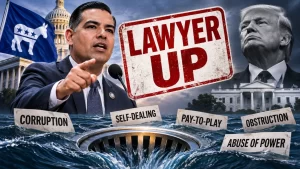
Rep. Robert Garcia of California, the likely incoming chair of the House Oversight Committee, told Miller to lawyer up and promised that “Oversight Democrats will continue to investigate Miller for his misconduct,” according to Time. The Daily Beast reported that Democrats have signaled Miller is among their top targets, and that investigating ICE’s conduct — including the killings of two American citizens, Alex Pretti and Renee Good, by immigration agents earlier this year — will be a leading priority.
The agenda extends well beyond Miller. NBC News reported that Garcia’s committee will focus on Trump family corruption, including cryptocurrency ventures that have earned the president more than $1 billion. Rep. Jamie Raskin, the presumptive Judiciary Committee chair, plans to examine the Trump family businesses and the politicization of the Justice Department and FBI, per ABC7 New York. And Rep. Analilia Mejia of New Jersey promised that Democrats will “toss out subpoenas like Mardi Gras beads,” as Newsweek reported.
Jeffries has framed the work as principled rather than vindictive. Before the election, he told reporters Democrats would “follow the facts, apply the law, be guided by the Constitution,” according to NBC News. That standard matters. The administration spent two years demonstrating what investigations look like when the verdict comes first. Democrats must demonstrate the opposite.
VII. What This Means for You
It would be easy to dismiss all of this as Washington palace intrigue. It is not. Analysts attributed Tuesday’s results to frustration over the Trump-initiated war with Iran, rising gas prices and broad economic anxiety, according to Northeastern Global News. Voters asked for relief. They received a chief of staff whose specialty is immigration enforcement and whose reported plan, per Fox News, is to govern by executive order around Congress — including on tariffs that land directly on family grocery and hardware bills.
Meanwhile, the incoming majority has its own kitchen-table agenda. Jeffries has said House Democrats will focus on reversing Trump’s Medicaid cuts, extending Affordable Care Act credits, restoring congressional authority over tariffs and ending the war with Iran, per NBC News. A White House built for confrontation rather than compromise makes every one of those fights harder — and every family waiting on health coverage, lower prices or a son or daughter’s safe return from the Middle East will feel the cost of that choice.
There is a quieter cost, too. When the Civil Rights Division loses nearly its entire voting staff, Americans’ ballots are less protected. When the National Security Division loses its leader in wartime, the country is less safe. When a U.S. attorney’s office is consumed by a political crusade, ordinary criminal cases suffer. A government emptied of competence and filled with loyalists is a government that fails the people it serves.
You Can Resign. You Cannot Hide.
Article I · The Power to Investigate.
The Supreme Court has recognized for nearly a century — since McGrain v. Daugherty (1927) — that Congress’s power to investigate is an essential auxiliary to its power to legislate. In Trump v. Mazars (2020), the Court reaffirmed that power even as applied to a sitting president’s records, while requiring that subpoenas serve a valid legislative purpose. Investigations into the weaponization of the Justice Department, ICE’s use of force, and presidential self-enrichment fit squarely within that purpose.
Leaving Office Is Not Immunity.
A congressional subpoena reaches private citizens as readily as officials. Former executive-branch officials have been subpoenaed and compelled before; the D.C. Circuit’s litigation over former White House Counsel Don McGahn’s testimony is the best-known modern example. Officials who resign this month to dodge the witness table will discover that a resignation letter is not a shield.
2 U.S.C. § 192 & 18 U.S.C. § 1505.
Defying a lawful congressional subpoena is a federal misdemeanor, and obstructing a congressional inquiry — including by destroying documents — is a felony. That is why demands that agencies preserve records now, before January, matter so much.
The Enforcement Problem.
The hard truth: criminal contempt referrals go to the Justice Department, which this administration controls. Democrats will likely need civil enforcement in federal court and Congress’s own inherent contempt power — slow tools against a White House that has signaled, through its own spokespeople, that it intends to resist.
VIII. What You Can Do
The election was the first step, not the last. Accountability over the next two years will depend on whether the public stays engaged after the gavels change hands. Here is what that looks like in practice.
- Demand document preservation nowCall your senators and representative — Democrat or Republican — and ask them to press agencies to preserve all records tied to the grand conspiracy probe, ICE operations and the Civil Rights Division before the new Congress is seated. Evidence destroyed in December cannot be subpoenaed in January.
- Push for public hearings, not closed doorsAsk the incoming Oversight and Judiciary chairs to hold investigations in public, with live testimony. Sunlight is what turns an investigation into accountability the country can see.
- Back whistleblowers and career staffSupport the organizations, such as Justice Connection, that defend civil servants who refuse unlawful orders. The officials who resigned in protest are often the best witnesses Congress will have.
- Watch the vacanciesTrack who fills the empty Justice Department posts and whether nominees face Senate confirmation or are slipped in as “acting” officials. With a Democratic Senate, confirmation hearings become another venue for oversight.
- Keep showing up locallyAttend town halls, support local reporting on immigration enforcement in your community, and hold your state officials to their commitments on voting rights. The midterm wave was built locally; so is accountability.
Subpoena fights take months, and the administration still controls the agency that prosecutes contempt. Some departing officials will run out the clock. But public pressure shapes how aggressively committees act, how quickly courts move, and whether wavering Republicans cooperate. None of these steps is guaranteed to work. All of them make stonewalling more expensive.
Editorial Conclusion
On Tuesday, the American people revoked the blank check. By Friday, the president had answered by promoting the architect of the policies they rejected, while the enforcers of his retribution campaign headed for the doors. This is not leadership. It is an administration that understands accountability is coming and has chosen confrontation over correction.
The stakes are not partisan. They are whether the Justice Department belongs to the public or to one man, and whether officials who abused federal power can escape scrutiny simply by walking away. Congress must use every lawful tool it now holds — subpoenas, public hearings, and the confirmation power — to make the answer clear. No one who wielded the power of this government against the people’s rights should be allowed to resign their way out of answering for it.
Sources & References
- NBC News
Trump DOJ appointee who led ‘grand conspiracy’ probe of Trump foes resigns - NBC News
Trump names Stephen Miller his new chief of staff, replacing Susie Wiles - CNN
Three Justice Department officials, including man behind Trump’s ‘grand conspiracy’ probe, resign since brutal midterm losses - Associated Press (via Yahoo News)
2 Justice Department officials resign, including US attorney who oversaw ‘grand conspiracy’ probe - ABC News
US attorney tasked with leading ‘grand conspiracy’ probe into Trump’s foes resigns from DOJ - The Hill (via FOX 5 San Diego)
Top prosecutor in office that housed Trump’s ‘grand conspiracy’ probe resigns from DOJ - The Washington Sun
Trump Administration Gets Its First Major Post-Midterms Departure - NPR
Stephen Miller will replace Susie Wiles as Trump’s chief of staff - CNN
Stephen Miller replacing Susie Wiles as chief of staff as Trump grows furious with midterm results - The Washington Post
Stephen Miller is named new White House chief of staff as Susie Wiles departs - Time
Stephen Miller to Be Trump’s New Chief of Staff, Replacing Susie Wiles - The Hill
Jeffries calls Miller a ‘dangerous xenophobe’ after promotion: ‘Fire him today’ - Fox News
Trump’s move from Wiles to Miller signals major tactical shift for governing without Congress - NBC News
Democrats win control of the House of Representatives with a vow to combat Trump - Newsweek
Democrats Plan Avalanche of Subpoenas for Trump Admin: ‘Lawyer Up’ - ABC7 New York
Democrats take the House. Here’s what they plan to investigate and their legislative agenda - MS NOW
‘Lawyer up’: A new Democratic majority prepares for a slate of Trump investigations - The Daily Beast
Trump Fires Susie Wiles and Promotes Reviled Aide in White House Purge - The Daily Beast
Top Dems Vow to Make Newly Promoted Stephen Miller Face Justice - Northeastern Global News
2026 midterm election results: Who won the key House and Senate races?
Related News