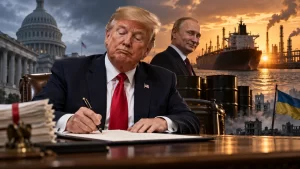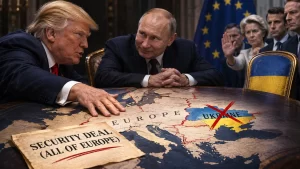
Hours after calling Vladimir Putin “my friend” in Shenzhen, the President of the United States dialed into a summit of Ukraine’s allies in Berlin and told them to rethink paying for Kyiv’s defense. Europe said no. Republicans broke ranks. Even one of Trump’s oldest friends in the media has called it appeasement. And the bill for America’s falling credibility is already coming due.
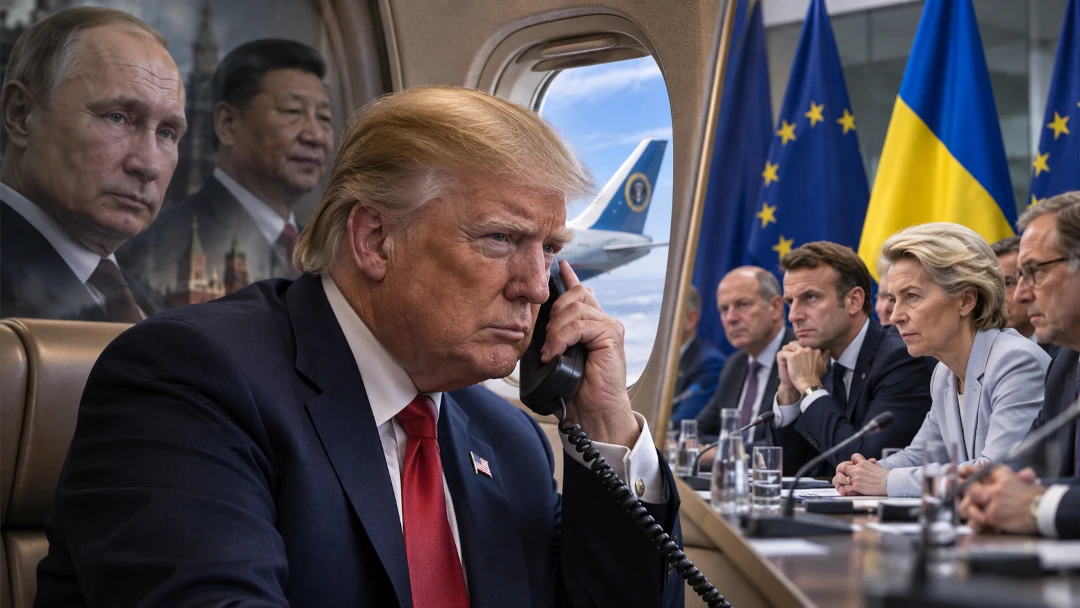
It was the phone call nobody in Berlin had planned for. On Thursday, November 19, leaders from some thirty to forty nations gathered in the German capital for the largest meeting yet of the “Coalition of the Willing,” the European-led bloc backing Ukraine’s defense against Russia. Their host, Chancellor Friedrich Merz, wanted to send one message: Europe would not let a peace be imposed over its head. Then the President of the United States came on the line from Air Force One, fresh from a trilateral summit with Vladimir Putin and Xi Jinping in Shenzhen, China. By the accounts of the people in the room, he did not come to strengthen that message. He came to argue against it.
According to reporting compiled by Proto Thema from officials briefed on the call, four European officials said Trump strongly questioned whether military and financial aid to Ukraine should continue, said he was confident Putin was serious about a peace deal, and asked why the coalition kept spending billions on Kyiv. Two participants described it as an angry outburst. A third said it was more measured, focused on the lives lost and the money spent over nearly five years of war. The timing was not incidental: Europe is trying to close a roughly €70 billion hole in Ukraine’s 2027 budget, and the European Commission had proposed an extra €45 billion loan the day before.
I. The Call from Air Force One
The White House’s own envoys confirmed the outline. Jared Kushner, who attended in Berlin, confirmed to Euronews that Trump phoned in from the plane and addressed the closed-door session. Kushner told Reuters that the president had left Shenzhen convinced that peace was achievable. Special envoy Steve Witkoff defended the call, saying Trump had told his team to work with the coalition to end the war.
British Prime Minister Andy Burnham would not confirm the “outburst” description. He said Trump had spoken forcefully about the loss of life and the pointlessness of the war continuing. Poland’s Donald Tusk said Trump had sounded quite optimistic, but that he doubted Russia was ready for real concessions and did not expect serious talks before the end of winter. The summit closed with no new agreement on security guarantees and no specific new funding package. In practice, the American president had used Europe’s own summit to pull money away from the country under attack.
Trump’s public statements followed the same line. Speaking to Fox News after the trip, he rated the trilateral a 12 on a scale of zero to ten and said Putin now wants to make a deal. The Kremlin has offered no concession to back that up.
II. A “Friend” in Shenzhen, a Declaration Without Ukraine
The Berlin call can only be understood in light of what came just before it. Walking up to shake Putin’s hand at the Kylin Villa, Trump joked “Who is that?” and then called him his friend, CBS News reported. The three leaders met for about ninety minutes and produced a four-point joint declaration on “peace.” ABC News reported that one point criticized the International Criminal Court, the same court that issued an arrest warrant for Putin over the abduction of Ukrainian children. Jonathan Eyal of the Royal United Services Institute told ABC that “just about the only substantial outcome of the Shenzhen summit was the rejection of international law and institutions.”
Ukraine was left out. The White House readout mentioned neither Ukraine nor any peace proposal. The agreed points instead covered more energy production, which critics in both parties say will put more oil money in the Kremlin’s hands. According to the Associated Press, Trump left the villa and boarded Air Force One without a word to reporters. Daryl Kimball of the Arms Control Association said the world needs “more than diplomatic theater and photo opportunities.”
The next day, CNN’s Kaitlan Collins asked whether Putin is a friend to America. The president’s answer should stay with every American who believes the job of the office is to put the country first:
“I can’t speak to America.”
— President Donald Trump, asked whether Putin is a friend to the United States · via The New Republic
Evidence · The Call
Four European officials briefed on the Berlin call said Trump strongly questioned continuing military and financial aid to Kyiv. Proto Thema
Evidence · The Money
Ukraine faces a funding shortfall of about €70 billion in 2027, and Brussels proposed a further €45 billion loan the day before the summit. Proto Thema
Evidence · The Declaration
The U.S.–China–Russia statement criticized the International Criminal Court. The White House readout did not mention Ukraine. ABC News
Evidence · The Energy Deal
Sen. John Cornyn (R-TX) warned that Russia uses export revenue to fund the killing of Ukrainian civilians, and called the deal a big mistake. Yahoo News
Evidence · The Delay
A bipartisan group says the administration obligated Congress’s $400 million for Ukraine only in the final days of the fiscal year, with deliveries stretched out to FY2029. Sen. Gallego
Evidence · The Answer
Asked if Putin is a friend to the U.S., Trump said he could not speak for America. In his own telling, his personal ties come before the national interest. The New Republic
III. When Trump’s Own Friends Say “Appeasement”
For years, calling Trump soft on Putin was treated as a partisan habit. That is getting harder to maintain. Piers Morgan, the British broadcaster who has called Trump a friend for nearly twenty years and has often defended him, has accused the president of appeasing Putin. He called the Russian leader a modern-day Hitler and compared Trump’s approach to the appeasement of the 1930s, telling him directly: “Don’t be that guy.” Morgan has since said he “vehemently disagrees” with Trump on Ukraine. He also posted a vomiting emoji in response to Witkoff calling Putin a “humanitarian.”
The historical comparison is Morgan’s, and it fits. In 1938 Neville Chamberlain came home from Munich promising “peace for our time” after agreeing to the dismemberment of a democracy that had no seat at the table. Chancellor Merz made the same point with an even more familiar reference. He handed every delegation a piece of the Berlin Wall, the physical symbol of what he said Yalta had done to Europe.
The criticism now reaches into the Republican caucus. Sen. Thom Tillis of North Carolina responded to the summit with the line “With friends like these, who needs enemies?” and said world peace was not on Putin’s or Xi’s agenda. Tillis also urged the incoming Democratic majority to rescind the administration’s sanctions waivers on Russian energy. Sen. Cynthia Lummis of Wyoming warned that a flood of Russian fuel could undercut American refining. Sen. Rick Scott of Florida told NBC News he thinks Putin is a thug, though he said Trump has to deal with him to end the war.
The MAGA establishment has held the line. Vice President JD Vance argued that the president will talk to anyone, anywhere, for American interests. White House spokesperson Olivia Wales insisted Trump is committed to a lasting, just peace and is only pushing more oil onto the market to lower gas prices. NATO Secretary General Mark Rutte, never eager to provoke Washington, praised Trump’s “Herculean efforts.” Former NSC official John Erath gave the less flattering reading: a summit aimed at short-term movement in oil prices, paid for with Ukraine’s leverage.
Get Involved Today
Contribute to our mission and turn your concerns into action.
IV. Democrats: “Putin’s Puppet”
Democrats did not soften their language. Senate Minority Leader Chuck Schumer called the Shenzhen meeting a historic embarrassment and, on the Senate floor, said Xi and Putin had Trump eating out of their hands. Sen. Jeanne Shaheen, the top Democrat on Foreign Relations, called the president’s “friend” a murderous war criminal. Sen. Tim Kaine of Virginia told CBS News that Trump was “either being insincere or he is deeply deluded.” Kaine added that he was troubled to see the American president standing with autocrats rather than with the world’s democracies. Vermont Rep. Becca Balint put it most bluntly:
“If there’s anything Trump is consistent on, it’s that he’s Putin’s puppet.”
— Rep. Becca Balint (D-VT) · via Spectrum News
The 2547NOW Editorial Board does not claim to know what Putin holds over Donald Trump, or whether he holds anything. We do not need to. A president’s loyalty shows in what he does, and the record is clear. He welcomes the invader as a friend, signs a declaration attacking the court that indicted that invader, and then phones Ukraine’s allies to discourage them from paying for Ukraine’s survival. A paid foreign agent could hardly serve the Kremlin better.
V. Kyiv Responds: “Pressure Is Needed”
Volodymyr Zelensky has learned to choose his words carefully about Washington. Asked about Trump greeting Putin as “my friend,” he simply shrugged and walked on. His substance was not subtle. He called Trump’s one-on-one with Putin a mistake and insisted that decisions about Ukraine be made with Ukraine in the room. He told ABC News that the U.S. and Europe must stop Russia from dragging talks into the winter, that Europe stood ready with new sanctions, and that Washington should use its influence on Moscow. He cast the Berlin summit itself as proof that the Kremlin had failed to split Europe.
Ukrainian lawmaker Oleksandr Merezhko gave the sharpest assessment, quoted by Yahoo News: Putin won a propaganda victory and nothing else of substance came out of Shenzhen.
VI. Europe Refuses a “Yalta 2.0”
Europe answered with unusual unity. Merz delivered the line of the week: “A Yalta format will not bring peace.” He said Europe would support Kyiv as long as necessary, and that any settlement must include Ukraine and Europe. French President Emmanuel Macron rejected the idea that the Shenzhen statement had reordered the world, and said Europe would not be an item on someone else’s menu. Burnham said there could be no decision about Ukraine without Ukraine, and none on European security without Europe.
The Nordic and Central European frontline was blunter still. Danish Prime Minister Mette Frederiksen told Reuters she found it “very incomprehensible” that an American president would want to sit down with Putin. Tusk’s reply to “my friend,” noted by NBC’s Andrea Mitchell, was a single line on X: “God protect us from such friends.” Mitchell observed that European leaders had been assured beforehand that Ukraine would not be dealt with in Shenzhen.
Read together, these statements show a continent planning for an America it can no longer count on. Germany’s defense minister, Boris Pistorius, called a Pentagon official’s dismissal of Ukraine’s strikes on Russian oil sites “quite a stupid thing.” A NATO ally’s defense chief now publicly mocks America’s defense leadership. That is the clearest measure of how much standing Washington has lost.
VII. How We Got Here: A Timeline
VIII. What It Costs You: Tourism, Debt, and the Dollar
Foreign policy can feel distant. Its costs are not. A country that tells its allies their security is negotiable should not be surprised when those allies stop visiting, investing, and lending.
Tourism is collapsing in a year built for a boom. The U.S. Travel Association projects that inflation-adjusted spending by international visitors will fall about $11 billion in 2026, a 6.3% drop to $163 billion and 25% below 2019. Arrivals are not expected to recover until 2030. This happened in the year America hosted the World Cup and marked its 250th anniversary. Semafor noted that the steepest drops came from allies such as Canada and Europe, the same countries targeted by Washington’s trade war, and called the slide partly “self-inflicted.” Every missing visitor means a hotel shift, a restaurant cover, or a tax dollar a local government no longer collects.
The allies who used to fund our debt are stepping back. Bloomberg data reported by The Edge show that Japan, the largest foreign holder of U.S. Treasuries, bought just $389 million in the first eight months of 2026, down 99% from a year earlier. South Korea sold $23.8 billion, the most for that period in records going back to 1977. This is not a debt crisis. But when steady allied buyers leave, the government has to pay higher yields to attract more price-sensitive private investors, and those costs show up in mortgages, car loans, and credit cards.
The dollar is losing ground. The Atlantic Council recorded a decline of about 10% against major currencies over the year to early 2026 and a falling share of foreign Treasury holdings, while cautioning that both remain within historical ranges. Its analysts warned that a sharper, disorderly fall would pose serious risks to U.S. markets. Reserve-currency status rests on trust. A president who says he cannot speak for America whittles that trust away.
National security is the deepest cost. Alliances are America’s cheapest deterrent. Every European capital now asking whether Washington will keep its word is doing the math on its own forces and its own deals with Beijing. The adversaries watching Shenzhen learned that the United States can be flattered off its commitments.
Whose Power Is the Purse, and Whose Duty Is the Law?
Article I, §9 — The Appropriations Clause
“No Money shall be drawn from the Treasury, but in Consequence of Appropriations made by Law.”
The Constitution gives Congress, not the President, the power of the purse. When bipartisan majorities appropriated $400 million for the Ukraine Security Assistance Initiative, they made national policy. A president can lobby foreign governments to stop funding Ukraine. He cannot quietly undo a U.S. appropriation by slow-walking it.
The Impoundment Control Act of 1974
Congress passed this law after the Nixon years so presidents could not defeat spending decisions by sitting on funds. It requires a formal request to Congress before money is deferred or rescinded. In 2020 the Government Accountability Office concluded that Trump’s first-term hold on Ukraine aid violated this law. The delays now documented by a bipartisan group of lawmakers, with money obligated at the last minute and stretched over three years, call for the same scrutiny. Lawmakers have rightly demanded a written account of any holds placed by the Office of Management and Budget.
Article II, §3 — The Take Care Clause
The President “shall take Care that the Laws be faithfully executed.” That duty covers Russia sanctions laws he signed. When the administration waives those sanctions weeks after enacting them, as senators including Tillis have complained, Congress has both the right and the obligation to ask whether the law is being carried out or quietly worked around.
Article I, §7 — The Veto Override
From January, a Democratic Congress can pass Ukraine aid on its own, and a two-thirds vote in each chamber can override a veto. Republicans like Tillis, Cornyn, and Scott have now said publicly what they think of Putin. Their votes on an override will show whether they mean it.
IX. What Congress Is Planning
The midterms changed the board. According to the Financial Times, as summarized by the Kyiv Post, Democrats who take control of both chambers in January are preparing a security package of about $15 billion. It would focus on air defense interceptors, emergency support for Ukraine’s power grid through the defense authorization bill, intelligence and satellite communications, tighter enforcement of Russia sanctions, and new oversight of the president’s foreign-policy decisions. Senate Democrats also expect to chair Foreign Relations, giving them subpoena power and control of hearings.
In the lame-duck weeks, the pressure is bipartisan. Shaheen and Tillis have pressed Secretary of State Marco Rubio to release security assistance already approved and to prevent it being diverted elsewhere. The Gallego–Costa letter demands that any FY2027 funds be apportioned and executed on time. Tillis’s call for Democrats to rescind the Russian energy waivers gives the new majority a ready-made bipartisan first bill.
X. What This Says About Trump’s Priorities
Look at the president’s week as a whole. He flew halfway around the world to stand between the leaders of China and Russia. He called the man whose army has killed tens of thousands of Ukrainian civilians a friend. He signed onto an attack on the court trying to hold that man to account. He then phoned America’s allies, who have carried most of the cost of this war while Washington stalled, and told them to stop paying. Asked if his friend was also America’s friend, he would not say.
A president chooses between his relationships and his country many times a day, often in small ways. This week the choice was made in public. Trump chose Putin’s approval over America’s allies, an energy talking point over a democracy’s survival, and a photo op over the hard work of deterrence. The world saw it. Our allies are adjusting to it. Americans will pay for it.
XI. What You Can Do
- Call your senators about the Russian energy waivers. Ask them to back legislation that rescinds the sanctions waivers. Senator Tillis has already invited Democrats to lead on this. A bipartisan bill is the fastest route to a veto-proof vote.
- Press Republican members by name. If your senator or representative is a Republican who has criticized Putin, thank them, then ask directly whether they will vote to override a veto of Ukraine aid in 2027. Statements on X cost nothing. Votes count.
- Demand oversight of the Berlin call. Ask your members of Congress to support hearings in the new Congress on what the president told allied leaders, and on why appropriated Ukraine funds were held until the end of the fiscal year.
- Support the people of Ukraine directly. Give to established, vetted humanitarian and medical relief organizations working in Ukraine, especially those repairing power and heat before the hardest months of winter.
- Tell the truth in your own circles. Share primary reporting, like the sources below, rather than slogans. The case against appeasement rests on facts. Make sure the people around you know them.
Editorial Conclusion
A president who cannot say whether Vladimir Putin is a friend to the United States has told the world whom he serves. Neville Chamberlain at least believed he was buying peace for his own country. Donald Trump is offering a democracy’s survival in exchange for a handshake, and calling it peace.
Europe has refused to accept a new Yalta. The Constitution gives Congress the purse, the power to override a veto, and the duty of oversight. Starting in January, Congress has to use all three. What is at stake is more than Ukraine’s borders. It is whether America’s word, and its laws, still mean what they say.
Sources & References
- Proto Thema — Trump called the Berlin summit from Air Force One to question further funding for Ukraine
- Euronews — European leaders reject ‘Yalta 2.0’ for Ukraine after Trump meets Putin and Xi
- Reuters via TimesLIVE — Ukraine’s allies warn against Yalta-style carve-up
- CBS News — Trump, Xi and Putin sit down for a rare 3-way meeting, but appear to achieve little
- ABC News — At China summit, Trump calls Putin ‘my friend’ amid Ukraine war
- AP via ITV News — Trump, Xi and Putin hold rare 3-way talks but deliver no breakthroughs
- NBC News — Trump’s symbolic summit (analysis by Andrea Mitchell)
- Yahoo News — Trump’s trilateral draws backlash from Republicans and Ukraine allies
- Spectrum News — ‘Putin’s puppet’: Lawmakers recoil after Trump calls Russian leader a ‘friend’
- Fox News — Trump gives Putin-Xi summit ’12 out of 10′; Tillis, Vance react
- The New Republic — Trump admits he only cares if Putin is his friend, not America’s
- HuffPost UK via Yahoo — ‘Don’t be that guy’: Piers Morgan accuses Trump of appeasing Putin
- AOL — Piers Morgan issues telling update on 20-year friendship with Donald Trump
- HNGN — Trump, Xi, Putin issue peace declaration that omits Ukraine
- Kyiv Post — US Democrats weigh $15B aid package and grid support for Ukraine
- Office of Sen. Ruben Gallego — Colleagues press administration to expedite Ukraine aid
- The Washington Sun — Shaheen and Tillis press Rubio on Ukraine security funding
- Hotel Dive — International visitor spending projected to fall nearly $11B in 2026
- Semafor — Decline in tourism hits US economy
- The Edge (Bloomberg) — US allies no longer reliably funding the deficit
- Atlantic Council — What the data shows, and doesn’t show, about the future of the dollar
Related News