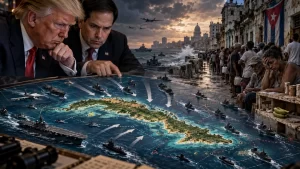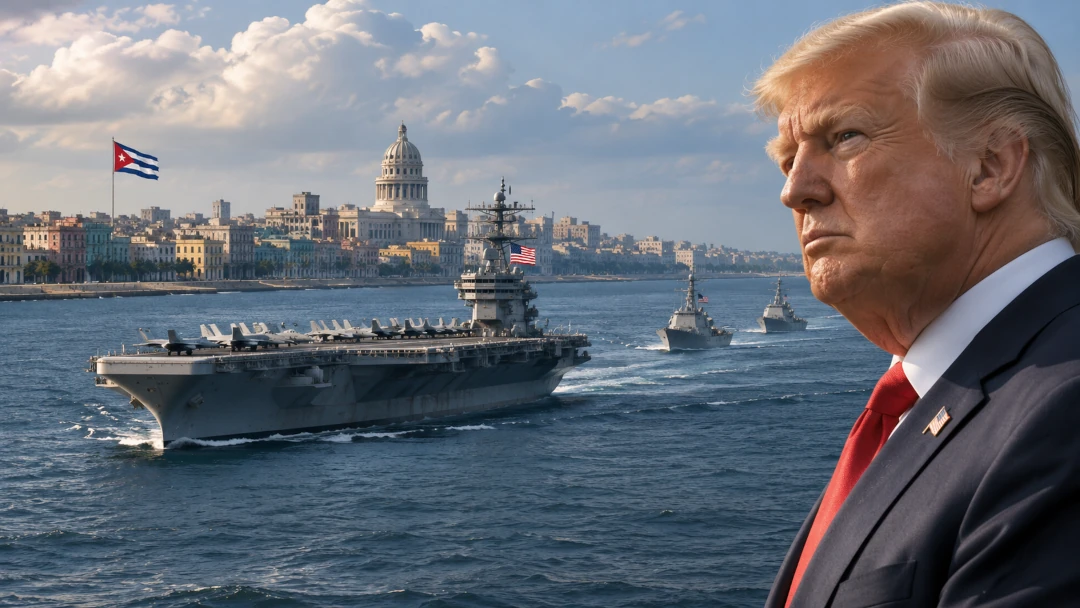
One week after voters handed Democrats both chambers of Congress, the president told a friendly radio host he wants to finish off Cuba’s government before his term ends, and said he would “certainly consider” a week-long military campaign. Marco Rubio has spent his career preparing for this moment. The American people, the Constitution, and the law of nations have not signed off on it.
There was no national address, no briefing to Congress, no request for authorization. On Thursday, November 12, President Donald Trump disclosed his intentions toward a sovereign nation 90 miles from Florida the way he discloses most things: in conversation with a sympathetic broadcaster. Asked by Hugh Hewitt whether he would consider military intervention to “free” Cuba, the president answered, according to reporting carried by Yahoo News: “I want to get Cuba done before I leave.” He called the island “essentially a failed place, nation, whatever you want to call it.”
Hewitt pressed further. Would the president accept “a week campaign”? According to an account of the interview published by South Shore Press, Trump replied: “I would certainly consider that, yes.” He also praised Secretary of State Marco Rubio as “a very good, talented guy for Cuba.”
The reaction in Havana was immediate. The next day, Cuban President Miguel Díaz-Canel, speaking at a civil-defense drill in Boyeros, said the island was preparing for a possible U.S. attack. “We are determined to repel any attempt at foreign military aggression against our country,” he said. One need not hold any sympathy for Cuba’s one-party state to grasp what has happened. The president of the United States has publicly put a deadline on the overthrow of a foreign government, and has floated the use of force to get there.
I. What Trump Actually Wants
The Hewitt interview did not come out of nowhere. It caps a year in which Trump has spoken about Cuba less as a diplomatic problem than as a prize. In March he said he believed he would have “the honor of taking Cuba,” a remark that United Nations human rights experts later singled out, as reported by Common Dreams, as evidence of “a deeply concerning strategy of coercion against a sovereign state.” At an October 23 rally in Fort Myers he promised “we’ll take care of Cuba on our way back from Iran.” At CPAC on November 6, speaking of Rubio, he joked: “We’re gonna drop him by parachute into Cuba.” And at a White House press conference on November 9 he predicted Cuba “will fall fairly soon,” all according to South Shore Press’s compilation of his recent remarks.
What is missing from all of this is a definition of success. Is the goal a new government in Havana, or simply a set of concessions Trump can call a victory? Is it a democratic transition, or the “regime change-lite” model the administration applied in Venezuela after U.S. forces seized Nicolás Maduro in January? The administration has not said. What it has said, repeatedly, is that the Cuban government must go, and that the president is prepared to entertain force to hurry the process along.
“I want to get Cuba done before I leave.”
— President Donald Trump, on The Hugh Hewitt Show, November 12, 2026 · via Yahoo News
II. The Architect: Why Marco Rubio Wants This So Badly
If Trump supplies the bravado, Marco Rubio supplies the blueprint. Rubio, who serves as both secretary of state and national security adviser, has made no secret of his aim. Asked by Sen. Brian Schatz at a January 28 Senate Foreign Relations Committee hearing to rule out U.S.-backed regime change in Cuba, Rubio reacted with open incredulity. “Regime change? Oh no, I think we would love to see the regime there change,” he told the committee, adding that this “doesn’t mean we are going to make a change.”
Nine months later, that caveat looks threadbare. On October 23, Rubio posted a public appeal urging Cubans to pursue change through a “discreet partnership” with the CIA, an extraordinary act for a sitting secretary of state, noted by Lee Schlenker in a Quincy Institute analysis for Responsible Statecraft. Schlenker describes Cuba regime change as a “singular point of obsession” across Rubio’s 25-year political career, and argues that this personal commitment is a major reason Rubio is likely to stay in an increasingly unpopular administration rather than leave to pursue his own presidential ambitions.
The roots run deep, and they are entangled with Rubio’s own political mythology. For years Rubio told audiences his parents had fled Fidel Castro. As a recent profile in UnHerd recounts, the record shows they left in 1956, under the Batista dictatorship, in search of economic opportunity, a discrepancy first reported by The Washington Post in 2011. The profile argues that the embellished story says much about how Rubio sees his own mission: as the heir to the exile community’s unfinished cause. In South Florida, that cause has been politically profitable for decades. In the State Department, backed by an aircraft carrier, it is something far more dangerous.
Rubio’s public case rests on national security. He has argued that Cuba’s ties to Russia, China, and Iran make it a threat, and on November 5 he framed the latest sanctions as targeting an elite rather than a people. “Cuba’s ruling elite is hoarding the island’s energy, shipping, and technology resources for its own enrichment,” he said in announcing the measures. Yet the blackouts and shortages he describes have been dramatically worsened by the very fuel blockade his department designed. A policy that starves a population of electricity and then cites its suffering as proof the government must fall is not a humanitarian policy. It is a siege.
III. The Machinery Is Already Moving
Those who dismiss the Hewitt remarks as talk should look at what the administration has already done. The scaffolding for a military operation, and the legal pretexts that could accompany it, have been under construction for most of the year.
The Fuel Blockade
Since January, a naval-enforced fuel blockade has choked off Cuba’s energy supply. Responsible Statecraft reports that Rubio’s department believes this pressure campaign is already working.
A Carrier Off the Coast
The USS Nimitz Carrier Strike Group has operated in the Caribbean since May, and U.S. drones and surveillance aircraft logged more than 150 hours of flights around Cuba, according to NOTUS.
The Castro Indictment
The administration unsealed an indictment of former President Raúl Castro over the 1996 Brothers to the Rescue shootdown, a move analysts told NOTUS could serve as one rationale for military action, echoing the indictment that preceded the Maduro raid.
A Public CIA Recruitment Call
On October 23, Rubio publicly urged Cubans to form a “discreet partnership” with the CIA, a step Responsible Statecraft links to expanded covert planning against Havana.
Sanctions, Round After Round
On November 5, the State Department designated ten new targets and blocked five tankers, while Treasury opened key sectors of Cuba’s economy to sanctions, the Associated Press reported.
The President’s Own Timeline
Trump has now attached a deadline, the end of his term, and endorsed a “week campaign” as an option worth considering, per accounts of the Hewitt interview.
The trajectory of the past eleven months makes the pattern unmistakable:
IV. What a New War Means for the Average American
Americans already know what a war of choice costs, because they are paying for one now. Almost immediately after the U.S. and Israel attacked Iran on February 28, Tehran began disrupting energy shipments through the Strait of Hormuz, and the resulting spike in energy and transportation costs fed inflation throughout the economy, Al Jazeera reported on the eve of the midterms. That war is not over. The strait remains contested, and talks remain fragile.
The direct bill is staggering. The Pentagon’s inspector general told Congress in September that the Iran war had cost the department an estimated $33.4 billion through June 29 alone, according to an analysis by the Arab Center Washington DC, which also cited polling showing 63 percent of Americans opposed the war. Trump himself acknowledged in September that oil prices were likely to stay high through the midterms. Every dollar spent opening a second front in the Caribbean is a dollar not spent on child care, health care, or the cost-of-living relief Americans just voted for.
Then there is the human cost. Cuba is not Venezuela’s presidential compound. It has a population of roughly ten million people, a military trained for decades around a doctrine of popular resistance, and a president who has already warned of mass mobilization. A “week campaign” is the kind of promise that has preceded nearly every American quagmire. Sen. Tim Kaine warned in May that such a war would “generate a man-made migration crisis,” and the logic is simple: a collapsing state 90 miles from Key West sends its people to sea. Florida’s communities, the Coast Guard, and American taxpayers would bear the consequences of a humanitarian emergency Washington itself manufactured.
Get Involved Today
Contribute to our mission and turn your concerns into action.
V. A Military Already Running on Empty
The case against a Cuba operation is not only moral and legal. It is practical. America’s armed forces have been drawn down hard by the Iran campaign. By the time full-scale fighting with Iran paused in April, the Pentagon had fired at least half of its THAAD ballistic-missile interceptors, nearly half of its Patriot interceptors, and around 30 percent of its Tomahawk cruise missiles, CNN reported. Elaine McCusker, a former acting Pentagon comptroller now at the American Enterprise Institute, told CNN that replenishment would largely be measured in years.
The Center for Strategic and International Studies reached the same conclusion. Its analysis found that while U.S. stocks could cover plausible scenarios in Iran, “the depleted inventories have created a window of vulnerability for a potential Western Pacific conflict,” the Associated Press reported. Even some Republicans see the danger. Rep. Don Bacon of Nebraska, a retired Air Force brigadier general, told NOTUS: “I would be worried about overextending, and I think it’s not the right time.”
Every carrier group parked off Havana is a carrier group not deterring Beijing in the Taiwan Strait or Moscow on NATO’s eastern flank. Every interceptor fired in the Caribbean is one unavailable to defend American troops in the Gulf. A president serious about national security would be husbanding these resources, not hunting for a third theater.
VI. Markets, Shipping, and the Global Economy
The global economy entered this moment already strained. The Iran war turned the Strait of Hormuz, once the route for roughly a fifth of the world’s oil and gas, into a pressure point, and the energy shock has filtered into prices from diesel to groceries. Markets can absorb a single shock. What they price poorly is a pattern: a United States that opens new conflicts without warning, without allies, and without Congress.
A strike on Cuba would add a Caribbean risk premium on top of a Gulf risk premium. Shipping and insurance costs through the Florida Straits and the Windward Passage, both vital corridors for Gulf Coast energy exports and Caribbean trade, would rise. Tourism economies across the region would take the hit. And the deeper damage would be to the dollar’s standing as the anchor of a rules-based financial order. Investors and central banks around the world are already watching middle powers hedge away from Washington; another unilateral war would only accelerate that shift. Stability is America’s most valuable export, and this president keeps spending it.
VII. Congress: A Lame-Duck GOP and the Reckoning Coming in January
For most of this year, the Republican majority treated its constitutional duty as optional. When Democratic Sens. Tim Kaine of Virginia, Adam Schiff of California, and Ruben Gallego of Arizona forced a vote on a Cuba war powers resolution in April, Senate Republicans killed it 51–47. Only Sens. Rand Paul and Susan Collins broke ranks, after Sen. Rick Scott of Florida raised the objection that blocked it, CiberCuba reported.
Yet the GOP is hardly united behind a war. Sen. James Lankford of Oklahoma, the vice chairman of the Senate Republican Conference, was asked whether he would support a military operation against Cuba. “No, I wouldn’t,” he replied. Sen. Steve Daines of Montana said he preferred “less conflict than more, given what is happening in the world.” Meanwhile, the South Florida hardliners egg the president on. Rep. María Elvira Salazar addressed him directly: “We are waiting for you to give the order. And it will happen.” Those cheerleaders paid a price at the ballot box: Salazar and Rep. Mario Díaz-Balart each lost double-digit support compared with 2024, Responsible Statecraft notes, even if affordability and immigration, not Cuba, drove most of the swing.
“The last thing that our country needs right now is a regime change war in Cuba based on imaginary threats to the homeland that would devastate the Cuban people and generate a man-made migration crisis.”
— Sen. Tim Kaine (D-Va.) · via Roll Call
Democrats have not waited for January. Kaine, Schiff, and Gallego reintroduced their resolution in May, directing the president to remove U.S. forces from hostilities “within or against Cuba, unless explicitly authorized by a declaration of war or a specific authorization for use of military force,” Roll Call reported. In the House, Reps. Gregory Meeks and Nydia Velázquez of New York are pushing a parallel measure, according to NOTUS.
When the new Congress convenes on January 3, the balance of power shifts. Democrats are expected to try to end the national emergency that underpins the oil blockade, restrict funding for any unauthorized military action, and potentially move to lift the embargo, Responsible Statecraft reports. Committee gavels bring subpoena power and the ability to drag Rubio and Pentagon leaders into public testimony. The limits are real. Democrats lack the two-thirds majorities needed to override a veto, Al Jazeera notes. But the power of the purse is the oldest check in the Constitution, and a president planning a war has to pay for it.
That is precisely why the next seven weeks matter. A president who knows his congressional cover expires on January 3 has every incentive to act before then, and the “before I leave” framing suggests he understands the calendar perfectly well.
VIII. The Law: An Unprovoked Attack Would Be Illegal Several Times Over
Strip away the rhetoric and the legal question is not close. Cuba has not attacked the United States. No U.S. ally has requested collective defense. The Security Council has authorized nothing. Congress has declared nothing. An American strike on Cuba under these conditions would be a war of aggression under international law and an unconstitutional war under American law.
Four Layers of Law, Each One Broken
1. The Constitution, Article I, Section 8
The power “to declare War” belongs to Congress alone. The president’s role as commander in chief allows him to repel sudden attacks, not to launch planned campaigns of regime change against nations that have not attacked us. That is why the Kaine-Schiff-Gallego resolution would require U.S. forces to leave hostilities against Cuba “unless explicitly authorized by a declaration of war or a specific authorization for use of military force,” according to draft text reported by Roll Call. No such declaration or authorization exists.
2. The War Powers Resolution of 1973
The statute permits presidential action to repel an imminent attack, but requires that military operations end within 60 days absent congressional authorization, Al Jazeera explains. A pre-announced “week campaign” is designed to slip under that clock. That would mock the law’s purpose: to keep the decision to go to war in the hands of the people’s representatives.
3. The U.N. Charter, Articles 2(4) and 51
Article 2(4) prohibits “the threat or use of force” against another state’s territorial integrity or political independence; Article 51 permits force only in self-defense against an armed attack. U.N. experts have already concluded that the Nimitz deployment contravenes Articles 2(4) and 2(7), and described Washington’s posture as “part of a disturbing trend of lawlessness and contempt of multilateralism and the UN Charter,” Common Dreams reported. Under the Constitution’s Supremacy Clause (Article VI), ratified treaties like the Charter are “the supreme Law of the Land.” The president is bound by them.
4. The OAS Charter and the 1962 Settlement
The United States is a founding party to the Charter of the Organization of American States, whose Article 19 declares that no state “has the right to intervene, directly or indirectly, for any reason whatever, in the internal or external affairs of any other State,” and whose Article 20 bars coercive economic measures meant to force another state’s sovereign will. There is also history: as a Third Way memo notes, the United States committed not to attack Cuba as part of the negotiations that ended the 1962 Cuban Missile Crisis. Rubio’s favorite statute, the Helms-Burton Act, governs the embargo; nothing in it authorizes the use of force.
The administration’s likely justifications, from the Castro indictment to Cuba’s state-sponsor-of-terrorism designation to a humanitarian crisis of Washington’s own making, were catalogued months ago by analysts speaking to NOTUS. None of them creates a legal right to invade. An indictment in a Miami courtroom is not a declaration of war. A blockade that causes suffering does not license bombing to relieve it.
IX. A Gift to Our Adversaries and a Recruiting Poster for Our Enemies
Rubio insists that Cuba is a beachhead for Russia and China. An American attack would hand both powers exactly the narrative they crave. Beijing has already demanded that Washington “stop threatening force at every turn,” in the words of Chinese foreign ministry spokesman Guo Jiakun, while Moscow called the Castro indictment unacceptable and pledged “active support” for Havana, Dawn reported. A U.S. strike would let both governments pose as defenders of sovereignty and the U.N. Charter, the very norms they trample in Ukraine and the South China Sea, while pointing at Washington as the aggressor.
Across Latin America, the costs would compound. Responsible Statecraft warns that another U.S. attack on a Latin American nation would embolden anti-American sentiment on the region’s left, make cooperation with Washington politically toxic for allied governments, and accelerate efforts in Brazil, Mexico, and Colombia to hedge toward China. History is instructive. The failed Bay of Pigs invasion of 1961 did not topple Fidel Castro; it made him a national hero and cemented his alliance with Moscow for a generation. Bombing Havana in 2026 would give a sclerotic regime what it has lacked for years: a foreign enemy to rally against and a new generation of recruits willing to die resisting the yanquis.
X. What Comes Next, and What It Says About His Priorities
For now, the most likely near-term path is more of the same: new sanctions designations, covert planning, and an ever-tighter fuel blockade, while the administration seeks to avoid outright collapse, Responsible Statecraft’s Schlenker assesses. He argues the midterm results have sharpened the case against a military operation, and notes that the administration has not identified a Cuban equivalent of Venezuela’s Delcy Rodríguez who could be pressed into service after a strike. On November 9, Trump told reporters the U.S. would help Cuba “on a humanitarian basis.” Days later, he was entertaining a week of military action. Both things can be true of a president who governs by impulse.
But consider the sequence. On November 3, Americans rendered a verdict on Trump’s foreign adventurism and the prices it has driven up. One week later, the president’s answer was not a plan to bring down gas prices, end the Iran war, or reckon with the election. It was a promise to an audience of loyal listeners that he would finish off a small, impoverished Caribbean nation before his term ends. That is the behavior of a leader seeking a legacy rather than serving a public. It treats the U.S. military as an instrument of personal ambition, and Cuba policy as a political debt owed to his secretary of state.
A serious president facing a hostile regime 90 miles away would use the leverage he has, the threat of sanctions and the promise of relief, to win verifiable concessions on political prisoners and economic opening. He would consult allies and Congress. He would worry about refugees, shipping lanes, and depleted missile stocks. Trump is doing none of these things. He is counting down to a deadline only he has set.
XI. What You Can Do
The window between now and January 3 is when the risk is highest and when public pressure on the outgoing Congress matters most. Here is where citizens can apply it.
Call your senators and representative this week
Ask them, by name, to support the Kaine-Schiff-Gallego Cuba war powers resolution in the Senate and the Meeks-Velázquez measure in the House before the lame-duck session ends. The Capitol switchboard is (202) 224-3121. A recorded vote matters even if it fails.
Press Republicans who have already wavered
Sens. Lankford, Daines, Collins, and Paul and Rep. Bacon have all signaled discomfort. If they represent you, thank them, then ask them to put that discomfort on the record with a vote.
Demand that the new majority use the purse on Day One
Tell incoming Democratic leaders you expect a funding prohibition on unauthorized military action against Cuba in the first spending bills of 2027, and public hearings with Rubio and Pentagon leaders under oath.
Support humanitarian relief channels
Religious and humanitarian groups, including the U.S. Conference of Catholic Bishops delegation that Díaz-Canel thanked this weekend, are moving aid to Cubans hit hardest by blackouts and shortages. Supporting them undercuts the argument that only force can help the Cuban people.
Make war powers a 2028 litmus test
Ask every presidential hopeful, at every town hall, whether they will commit to seeking congressional authorization before any use of force not required to repel an attack. Make their answer public.
No resolution passed this year is likely to survive a veto, and the lame-duck Senate remains in Republican hands until January 3. The realistic goals are to raise the political cost of acting before then, build a recorded bipartisan coalition, and prepare the new majority to wield its funding and oversight powers quickly. Those goals are achievable, and they have worked before: in September the House passed an Iran war powers resolution 220–204 with seven Republicans joining Democrats, the Arab Center notes.
Editorial Conclusion
No president has the right to “get a country done.” Cuba’s government is repressive and its economy is broken, and the United States is free to say so, to sanction its rulers, and to support its people. It is not free to bomb a nation that has not attacked us because a president wants a trophy before he leaves office and his secretary of state wants to close a family chapter.
An unprovoked attack on Cuba would violate Article I of the Constitution, the War Powers Resolution, the U.N. Charter, and the OAS Charter. It would drain a military already stretched thin, deepen an energy shock American families are still paying for, and hand Moscow, Beijing, and every anti-American movement in the hemisphere the propaganda victory of a generation. The Congress that ends on January 3 must go on the record now. The Congress that begins that day must close the purse. The question before the country is not whether Havana falls. It is whether the decision to go to war still belongs to the American people.
Sources & References
- Yahoo News / dpa — Cuba preparing for possible US military attack, president says
- South Shore Press — Cuba’s President Says the Island Is Preparing for a Possible U.S. Military Attack
- Responsible Statecraft — After midterm disaster, can Rubio still get Cuba regime change?
- Washington Examiner — Rubio says Trump administration would ‘love’ to see regime change in Cuba
- The Star / Reuters — US Democrats push to rein in Trump on Cuba as White House steps up pressure
- Associated Press via ClickOnDetroit — US escalates economic campaign against Cuba and targets China-based suppliers
- UnHerd — Marco Rubio’s Havana Syndrome
- NOTUS — Democrats Are Trying to Stop a War in Cuba Before It Starts
- Roll Call — Democrats renew effort to prevent US military action against Cuba
- CiberCuba — Which Republicans did Trump refer to when he talked about Cuba?
- CNN via KRDO — Iran war heats up while US weapon stocks remain depleted
- Associated Press via WSLS — US will need years to replenish stockpiles of advanced weapons used in the Iran war
- Al Jazeera — ‘Foreign policy is the economy’: How Iran war is shaping US midterm vote
- Arab Center Washington DC — America’s Affordability Crisis: Will Trump’s Iran War Cost Him the 2026 Midterms?
- Common Dreams via The Real News — UN experts demand US “cease all threats” against Cuba
- University of Minnesota Human Rights Library — Charter of the Organization of American States (full text)
- Third Way — Trump Is Laying the Groundwork to Attack Cuba. Democrats Should Push Back.
- Responsible Statecraft — Analysis: the regional costs of a U.S. war on Cuba
- Dawn — Russia, China excoriate US move to indict Raul Castro
- Al Jazeera — Democrats win Congress: How they did it, and what it means
Related News