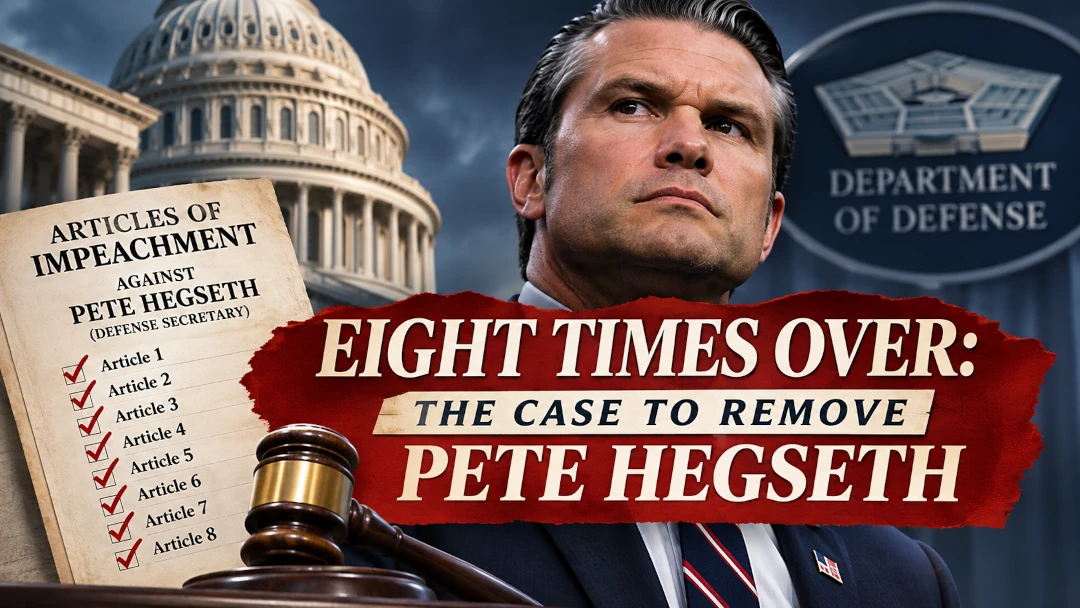
Eight Times Over: The Case to Remove Pete Hegseth Arrives on the House Floor
A Republican congressman has done what his party’s leadership would not: forced the House to vote on whether the Secretary of Defense waged an unauthorized war, ordered unlawful killings, and punished a senator for speaking. The vote comes by Wednesday. The question it poses — whether Congress still controls the power to make war — will outlast this week.
On Monday afternoon, Rep. Thomas Massie of Kentucky stood on the floor of the House of Representatives and read, line by line, a 34-page resolution accusing Defense Secretary Pete Hegseth of high crimes and misdemeanors. It was not a Democrat who did it. It was a Republican — one who lost his own primary this year and has nothing left to protect but his oath. According to CBS News, Massie’s eight articles charge Hegseth with waging war on Iran without congressional authorization, ignoring laws meant to limit civilian deaths, and abusing the powers of his office.
Because Massie filed the measure as a privileged resolution, House leaders no longer get to decide whether it sees daylight. As CNBC reported, the House must now act on it, table it, or refer it to committee within two legislative days — and it is far from clear that Republican leadership still has the votes to bury it. Republicans hold a razor-thin 218-214 majority in a lame-duck chamber they will surrender in January.
The articles close with language the founders would recognize. Hegseth, Massie read aloud, has shown he will remain “a threat to the Constitution if allowed to remain in office.” That is the charge. This week, every member of the House will have to answer it on the record.
I. What the Eight Articles Allege
The full resolution is not a vague indictment of competence. It is a specific catalog of alleged lawbreaking, most of it tied to the war with Iran that voters punished Republicans for last Tuesday. Reporting from Task & Purpose lays out each count:
Article I · Unauthorized War
Entering hostilities with Iran with no declaration of war, no statutory authorization, no attack on the United States, and no imminent threat, as NBC News summarized Massie’s announcement.
Article II · Defying Congress
Ignoring a congressional resolution directing the removal of U.S. forces from hostilities with Iran, per Task & Purpose.
Article III · The War Powers Clock
Continuing the war past the statutory time limit without congressional approval — the core of the 1973 War Powers Resolution charges.
Article IV · Civilian Harm
Flouting civilian-harm laws, citing the strike on an elementary school in Minab, Iran, and the gutting of the Pentagon’s civilian harm mitigation staff, as detailed by Task & Purpose.
Article V · The Boat Strikes
Directing what the articles call extrajudicial killings of more than 240 people aboard alleged drug boats in the Caribbean and eastern Pacific, under legal authorities the resolution calls false.
Article VI · Retaliating Against Speech
Targeting Sen. Mark Kelly (D-Ariz.) after he joined lawmakers urging troops to refuse unlawful orders, according to Fox News.
Article VII · The Maduro Seizure
Unlawfully seizing Venezuela’s head of state — an operation the articles describe as aimed at “regime change and the acquisition of foreign oil,” per Task & Purpose.
Article VIII · Yemen
Waging a campaign of more than 1,100 strikes in Yemen without authorization, citing the leaked Signal chat in which officials discussed pausing operations — evidence, Massie argues, that no imminent threat existed.
The civilian toll matters here, and it should not be abstracted away. The Intercept reports that the Minab school strike killed more than 150 civilians, most of them children, while Massie’s articles put the dead and injured above 200. Those are not statistics in a policy dispute. They are the human cost of a war the people’s representatives never voted to begin.
“The question is whether he committed impeachable acts. And the answer is yes, eight times.”
— Rep. Thomas Massie (R-Ky.), via CBS News
II. How Massie Forced the Vote
Massie’s weapon is an old rule of the House. Any member can introduce an impeachment resolution as “privileged,” which strips the majority of its usual power to let a bill die quietly in committee. Fox News described the mechanism plainly: the resolution must be considered within two legislative days, putting the deadline at Wednesday.
This is Massie’s second attempt. He first filed articles in September, but GOP leaders recessed the House early and ran out the clock, CBS News reported. Monday’s updated filing restarts that clock — and this time there is no recess to hide behind. Massie had also offered Hegseth an exit: in the days after the election, he said publicly that the only way he would not refile was if the secretary resigned, as The Hill documented.
- April 2026Rep. Yassamin Ansari (D-Ariz.) files six articles of impeachment against Hegseth over the Iran war and civilian targeting, per The Intercept.
- September 2026Massie introduces his first articles. House GOP leaders adjourn early, pushing any vote past the midterms.
- Tuesday, Nov. 3Democrats win both chambers in a midterm rout widely blamed on the Iran war and its effect on gas prices.
- Late last weekHegseth posts a defiant video on X calling the effort a sham. Trump takes to Truth Social to attack impeachment efforts against his officials.
- Sunday, Nov. 8Hakeem Jeffries declares himself a “hard yes.” Trump’s 60 Minutes interview airs.
- Monday, Nov. 9Massie reads all eight articles on the House floor, triggering the two-day clock.
- Tuesday, Nov. 10Hegseth holds his first press briefing in more than 180 days, according to FOX 5 Atlanta.
- By Wednesday, Nov. 11The House must act — vote, table, or refer.
III. What Happens Next — and the Leadership Trap
Republican leaders have two escape hatches before the House ever votes on impeachment itself. As ABC News explained, they can move to “table” the resolution, or they can move to refer it to committee. Either kills it — but either also requires a simple majority. That is the trap: in a chamber this narrow, Speaker Mike Johnson cannot table the resolution without the same votes he would need to defeat it outright.
And Johnson is not saying what he will do. The Intercept reported that he did not answer when asked whether leadership would whip the vote. Meanwhile, the House returns for a five-week lame-duck session with a government funding deadline of December 11, as CNN’s analysis notes — meaning Hegseth’s presence now threatens to complicate must-pass spending legislation.
IV. The House Math: Three Republicans
Impeachment in the House requires only a simple majority. ABC7 reports that just three Republicans need to join a unified Democratic caucus for the resolution to pass. Massie is one. Democrats appear unified: House Minority Leader Hakeem Jeffries, poised to become Speaker in January, said on ABC’s This Week that he is a “hard yes” — a reversal from his reluctance before the election, as The Hill observed.
Where do the other two or more come from? Several House Republicans told Fox News Digital they believe the resolution could pass, pointing to a combination of resentment over Hegseth’s conduct and absences among defeated members who may simply not show up. Retiring Rep. Don Bacon (R-Neb.) has said he is undecided, according to Axios. Rep. French Hill (R-Ark.) said on Face the Nation he wants to hear the debate before deciding. Oversight Chair James Comer (R-Ky.) declined to back the effort but conceded on NewsNation that Republicans have no idea what the strategy in Iran is, per CBS News.
Even Sen. Ted Cruz (R-Texas) saw it coming. “I expect in the lame duck we will see an impeachment of Pete Hegseth,” he said, as quoted by Newsweek.
V. The Senate: Sixty-Seven Votes
If the House impeaches, the articles go to the Senate for trial — and here the arithmetic turns brutal. Conviction requires two-thirds of senators present. CNN estimates that in the current Senate, removal would require roughly 20 Republicans to join Democrats. Even after Democrats take the majority in January, Axios notes, two-thirds remains a difficult threshold. History is not encouraging: neither Secretary of War William Belknap in 1876 nor Homeland Security Secretary Alejandro Mayorkas in 2024 was convicted.
There is also the question of whether a trial happens at all. A GOP aide told CNN there is a strong argument for referring the matter to committee instead of going straight to trial. Senate Majority Leader John Thune (R-S.D.), whose own leadership position is now in question, told reporters Monday that his party must “internalize” the voters’ message, per CNN’s live coverage. An Armed Services Committee staffer told The Intercept they doubted Thune would bring the measure to a vote — though Rep. Ansari argued Thune privately shares doubts about Hegseth’s fitness.
But “unlikely” is not “impossible,” and Hegseth has few friends in the upper chamber. Sen. Thom Tillis (R-N.C.) said months ago that the secretary had “lost my confidence,” and has called his confirmation vote a regret. Hegseth was confirmed only because Vice President JD Vance broke a 50-50 tie. A man who entered office by the narrowest possible margin cannot count on a wide one to save him.
Get Involved Today
Contribute to our mission and turn your concerns into action.
VI. A Bipartisan Path to Removal
Removing Hegseth does not require Democrats and Republicans to agree on everything. It requires them to agree on one thing: that the Constitution gives Congress, not the Pentagon, the power to take the nation to war. Several realistic routes exist.
First, the House vote itself. A bipartisan impeachment — even one that dies in the Senate — would be a formal, historic rebuke from a Republican-controlled chamber. CNN observes that a strong vote against Hegseth could undermine his viability regardless of the trial outcome.
Second, the resignation path. Massie has urged the president to replace Hegseth “now while he can still get a replacement confirmed in the Senate,” as reported by Yahoo News. Republican senators who will not vote to convict can still deliver that message privately — and should.
Third, the January oversight wall. When Democrats take the gavels, they gain subpoena power, hearings, and the ability to compel testimony. Massie himself warned that his resolution is “a much gentler version of what’s coming” under Democratic control. A Senate trial built on a full evidentiary record is a different proposition from a lame-duck rush — and a few Republican senators facing that record may find conviction easier to defend than acquittal.
Who Holds the War Power — and Who Answers for Its Abuse
Art. I, § 8, cl. 11 — The Power to Declare War
- The Constitution assigns the power to declare war to Congress, not the executive. Articles I through III rest on this foundation: that a Secretary of Defense who prosecutes a war Congress never authorized, and continues it after Congress has directed withdrawal, has usurped a legislative power.
War Powers Resolution of 1973 (50 U.S.C. §§ 1541–1548)
- Enacted over a presidential veto after Vietnam, the law limits how long U.S. forces may remain in hostilities without congressional authorization and allows Congress to direct their removal. Massie’s articles allege violations of both the time limit and an express withdrawal directive.
Art. II, § 4 — Who May Be Impeached
- “All civil Officers of the United States” — which includes Cabinet secretaries — may be removed on impeachment for and conviction of “Treason, Bribery, or other high Crimes and Misdemeanors.” That phrase has never been limited to statutory crimes; it reaches serious abuses of public trust.
Art. I, §§ 2–3 — The Process
- The House holds “the sole Power of Impeachment” by simple majority. The Senate tries the case, and conviction requires two-thirds of members present. Judgment may extend to removal and disqualification from future office — exactly the remedy Massie’s resolution seeks.
First Amendment & the Speech or Debate Clause
- Article VI alleges retaliation against a sitting senator for urging service members to refuse unlawful orders — a statement of existing military law. Using the Pentagon’s power against a legislator for such speech strikes at both free expression and the separation of powers.
VII. What Trump Is Saying — and Doing
The president’s response has been a study in mixed signals that resolve, in the end, into one message: loyalty first. Asked on 60 Minutes whether he still had confidence in Hegseth, Trump replied “I do” — yet when asked whether Hegseth deserved credit for the Venezuela operation, he said no. In the same interview he teased coming Cabinet changes, adding, “I don’t want to mention who.” Earlier in the week he told reporters he intended to “keep him” in the post.
What Trump has done is more alarming than what he has said. On Saturday, according to The Intercept, he wrote on Truth Social that calls to impeach administration officials amounted to “extortion at the highest level” and directed the Justice Department to investigate those pushing them. Attorney General Todd Blanche then said the department would represent Hegseth in any impeachment proceedings and suggested that some threats from Democrats could be criminal. CNN reported last week that Trump personally likes Hegseth and has told aides the secretary should fight back against impeachment and investigations.
Meanwhile, Hegseth’s standing inside the White House may have strengthened. The president replaced Chief of Staff Susie Wiles — who had reportedly soured on Hegseth — with Stephen Miller, whom a senior administration official described as extremely close to the defense secretary.
“Didn’t work against President Trump, and it won’t work with me.”
— Defense Secretary Pete Hegseth, in a video posted to X, via The Hill
VIII. What Hegseth’s Defenders Argue
Fairness requires stating the other side plainly. Hegseth argues that confronting Iran was a necessity: he told an audience at the Naval War College that “someone had to confront the Iranian regime’s pursuit of a nuclear weapon.” He has also framed criticism of the Iran, Yemen, and Venezuela operations as criticism of the troops who carried them out. His allies dismiss Massie personally; Rep. Derrick Van Orden (R-Wis.) called the effort “pathetic.” And Rep. French Hill raised a genuine constitutional point: poor performance is not, by itself, an impeachable offense.
That last argument deserves an answer, and the answer is in the articles. Massie is not impeaching Hegseth for losing a war or for being unpopular. He is charging him with acting outside the law — waging war without authorization, defying a congressional withdrawal directive, and turning the Pentagon’s power against a member of Congress. Those are not policy disagreements. They are precisely the abuses of public trust the impeachment clause was written to address.
IX. What This Says About Trump’s Priorities
The country delivered a verdict last Tuesday. Voters, squeezed by a war that drove up gas prices and cost American and Iranian lives, handed both chambers to the opposition. A president who heard that message would have taken the off-ramp Massie offered: accept a resignation, nominate a replacement while his own party still controls the Senate, and begin repairing the damage.
Instead, Trump has chosen to defend his secretary, deny him credit in the same breath, and point federal law enforcement at the lawmakers seeking accountability. That pattern — personal loyalty over institutional duty, and retaliation over reckoning — is the through-line of this presidency. Massie put it bluntly to CNN: the election losses were avoidable if Republicans had broken from what he called the “cultish following” of the president. When a sitting Republican congressman says that on the record, the problem is no longer partisan. It is constitutional.
X. What You Can Do
Impeachment is decided by 435 representatives and 100 senators, not by voters directly. But this vote is close enough that public pressure on a handful of members could decide it. An honest assessment: House passage is genuinely possible this week; Senate removal remains a long shot in the current Congress. Both outcomes still matter, because the record built now shapes what happens in January.
- Call your representative before Wednesday. Use the U.S. Capitol switchboard at (202) 224-3121. Ask a simple question: will they vote against tabling the resolution and for the articles? A vote to table is a vote to protect Hegseth.
- Focus on persuadable Republicans. If you live in the district of an undecided or retiring Republican — including those publicly weighing the vote, such as Reps. Don Bacon and French Hill — your call carries outsized weight.
- Contact both of your senators now. Tell them you expect a full trial on the merits, not a quiet referral to committee, if the House impeaches.
- Watch the roll call and keep the receipts. The House Clerk publishes every recorded vote. Note how your member votes on the motion to table as well as on the articles themselves — and remember it in 2028.
- Support independent reporting on the war. Much of what we know about civilian harm and the boat strikes comes from journalists and whistleblowers. Share their work, and push for public oversight hearings when the new Congress convenes.
Editorial Conclusion
The Constitution does not give the Secretary of Defense the power to start wars, to ignore Congress when it orders troops home, or to punish senators for reminding soldiers of the law. Pete Hegseth stands accused of all three, and the charges are grounded in public record.
The House must impeach him this week. The Senate must try him honestly. And every member of Congress, of either party, must understand what is truly on the ballot: not Pete Hegseth’s career, but whether the people’s representatives still decide when America goes to war. If Congress will not defend that power now, it will not have it to defend later.
Sources & References
- CBS News — Hegseth could face impeachment vote in coming days as House returns
- Office of Rep. Thomas Massie — Articles of Impeachment Against Secretary Peter B. Hegseth (PDF)
- CNBC — Hegseth impeachment articles introduced by Rep. Massie
- Task & Purpose — Hegseth faces possible impeachment over Iran war, boat strikes and Maduro raid
- NBC News — GOP Rep. Thomas Massie unveils impeachment articles against Hegseth
- NBC News — Trump administration live updates: Congress returns
- Fox News — Hegseth impeachment vote looms as House Republicans privately warn it could pass
- ABC News — Massie introduces impeachment articles against Hegseth
- ABC7 San Francisco — Massie introduces impeachment articles against Defense Secretary Pete Hegseth
- KVIA / ABC News — Massie introduces impeachment articles against Hegseth
- CNN — Live updates: GOP congressman introduces articles of impeachment against Hegseth
- CNN — Why lawmakers are pushing to impeach Pete Hegseth
- CNN — Analysis: Hegseth impeachment drama is first test of Trump’s eroded post-midterms power
- CNN — Republicans quickly turn against Pete Hegseth after midterms rout
- The Intercept — Impeachment Vote Looms for Hegseth
- Axios — House poised to impeach Pete Hegseth after GOP midterm defeat
- The Hill — Pete Hegseth faces House impeachment vote amid controversy over Iran war
- The Hill — Hegseth amid impeachment threats: ‘Didn’t work against’ Trump
- The Hill — Massie says his Hegseth impeachment resolution ‘much gentler’ than what Democrats plan
- Newsweek — Pete Hegseth faces mounting pressure ahead of impeachment push over Iran
- Newsweek — Thom Tillis on Hegseth confirmation vote
- IBTimes UK — ‘No’: Trump refuses to credit Hegseth for Venezuela
- The Daily Beast — Trump teases mystery firings after midterm losses
- FOX 5 Atlanta — Rep. Thomas Massie introduces resolution to impeach Pete Hegseth
- Yahoo News — Republican lawmaker launches bid to impeach Hegseth over Iran war
- FOX 25 Oklahoma City / The National Desk — GOP Rep. Thomas Massie moves to impeach Pete Hegseth over Iran war
Related News