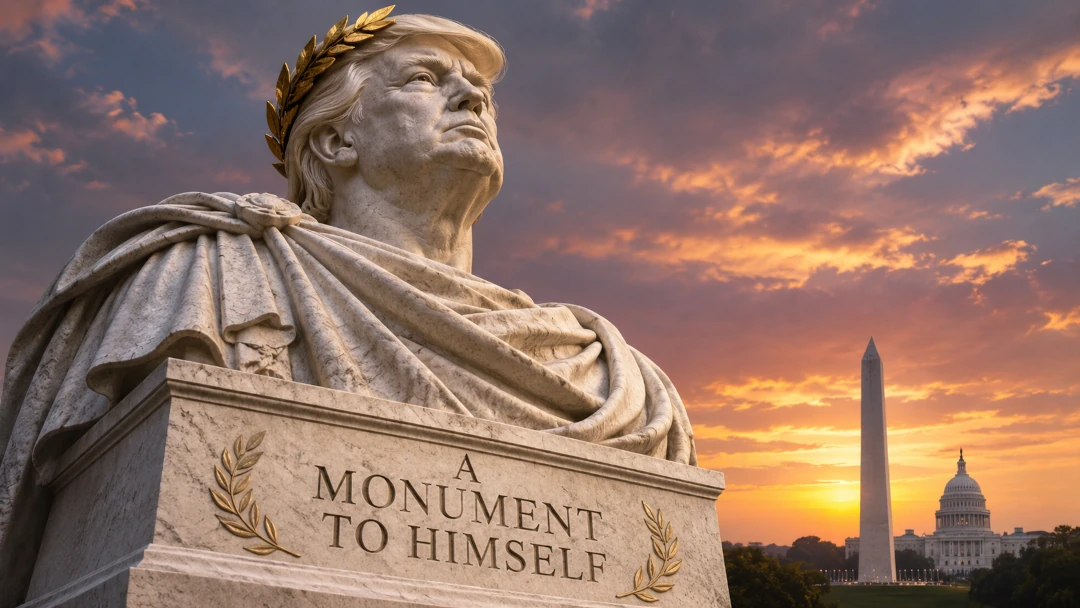
The Gilded Oval: A Monument to Himself
Two days after voters handed Democrats both chambers of Congress, Donald Trump’s first official act was not about prices, war, or wages. He signed a proclamation turning his own redecorated office into a “national monument.” The order is legally hollow, contradicted by his own Justice Department, and revealing about what this president thinks the job is for.
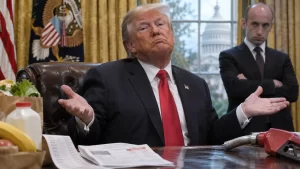
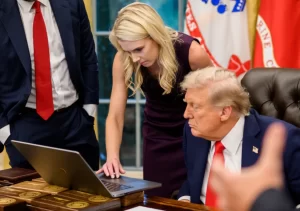
On Thursday, November 5, 2026, in a room now trimmed in gold leaf, gilt ornaments, and trophies, the President of the United States picked up a pen to protect the room he was sitting in. According to CBS News, the proclamation designating the Oval Office and Cabinet Room a national monument was his first official action after his party was swept aside in Tuesday’s midterm elections. The official proclamation invokes the Antiquities Act of 1906 and covers the Oval Office, the Outer Oval Office, and the Cabinet Room.
Trump left no doubt about what he wanted. Asked a month earlier in a Time interview whether a federal designation could preserve the changes he has made, he pitched it exactly that way, and Raw Story reported that when asked whether a successor could alter his gilded décor under such a designation, he answered simply: “No.”
A country facing a war, high gas prices, and a fresh electoral rebuke deserves a president who spends his first post-election morning on them. Instead, Americans got a ceremony about curtains.
I. What the Proclamation Actually Says
Strip away the Oval Office theatrics and the document is far weaker than the man who signed it. The White House fact sheet says the order directs the Interior secretary to write a management plan and to document and weigh alternatives before the rooms are substantially altered or demolished. That is a paperwork requirement, not a lock.
Most tellingly, the proclamation itself preserves the very thing Trump claimed to be blocking. As NBC News reported, the text lets future presidents redecorate, choose furnishings, and make ordinary operational and security changes, so long as they do not substantially impair the room’s historic structure. The gold can come down on January 20, 2029.
“It will not be allowed to be touched by anybody, destroyed, ripped down by stupid people…”
— President Donald Trump, Oval Office, Nov. 5, 2026, via ABC News
Trump also told reporters that any major change would need to go back to Congress for approval. The document says nothing of the kind. The National News Desk noted plainly that the proclamation does not require congressional review, whatever the president said at the signing.
Redecorating stays legal
The order explicitly preserves a future president’s power to redecorate and refurnish. Newsweek confirmed a successor could still change furniture, artwork and décor.
No congressional veto
Trump claimed Congress would have to approve major changes. The text requires no such approval; it mandates internal review only.
Already a landmark
The White House has long held National Historic Landmark status, which raises the question of what this order adds beyond a press event.
His own DOJ says it’s revocable
Trump’s Office of Legal Counsel concluded in 2025 that presidents can abolish monuments created by predecessors. By his own lawyers’ logic, the next president can erase this one.
Rules for thee
Under the same landmark status, Trump demolished the East Wing, paved the Rose Garden, and built a South Lawn helipad without congressional approval.
Voters noticed
About two-thirds of midterm voters said Trump lacks the right priorities, per The AP Voter Poll, and most of them backed Democrats.
II. The Preservationist Who Demolished the East Wing
The hypocrisy here is structural, not incidental. The White House is a National Historic Landmark, but, as the Philadelphia Inquirer explained, Congress exempted the building from the National Historic Preservation Act. That exemption is what allowed Trump to reshape the property so quickly. He used it to tear down the East Wing in October 2025 for his ballroom, with little notice or oversight, as ABC News recalled.
Preservation lawyer Greg Werkheiser, founding partner of Cultural Heritage Partners, saw the contradiction coming. He told reporters that a separate landmark designation for the Oval Office would be legally meaningless, and noted the irony of a president reaching for historic protection after ignoring it everywhere else on the grounds. The National Trust for Historic Preservation, which sued to halt the ballroom because it proceeded without congressional authorization and federal review, publicly questioned the timing and rationale of this latest order.
The pattern is simple. When preservation law stands in Trump’s way, he bulldozes past it. When preservation law can be turned into a shield for his own taste, he suddenly becomes its champion.
III. How We Got Here
- January 2025Trump returns to office and redecorates the Oval Office, filling it with his signature gold, as NBC News recounted.
- April 2025Critics take note. The Washington Post’s Robin Givhan, speaking to NPR, described the gold-heavy clutter as a break from the room’s traditional restraint.
- June 2025Trump’s Justice Department rules presidents may abolish national monuments, reversing a 1938 opinion, according to High Country News.
- October 2025The East Wing is demolished to make way for the ballroom (ABC News).
- October 1, 2026Trump tells Time he rejected a Secret Service idea to rebuild the Oval and had pressed chief of staff Susie Wiles for six months to make it a federal landmark (The National News Desk).
- November 2, 2026Trump’s closing midterm message comes from the Lincoln Memorial Reflecting Pool, a renovation marred by algae, leaks and delays (AP).
- November 3, 2026Democrats win control of the House and Senate, including seats in deep-red states (Reuters).
- November 4, 2026Trump’s first public event after the loss is a ballroom construction tour, where he talked limestone columns and Corinthian design (Reuters).
- November 5, 2026Trump signs the Oval Office monument proclamation. The same day, Sen. Blumenthal sends letters to ballroom donors, and Judge Tanya Chutkan blocks groundbreaking on Trump’s arch for 14 days (PBS NewsHour/AP).
IV. What Congress Is Doing About It
For two years, Democratic oversight of Trump’s building spree amounted to letters into a void. CBS News documented at least eight Democratic letters seeking information about the ballroom. Rep. Robert Garcia of California got no response to his request for plans, budgets and a donor list. Sen. Adam Schiff’s letter to Susie Wiles went unanswered. Sen. Elizabeth Warren’s questions to the National Park Service drew silence.
That era is ending. In January the minority becomes the majority, with subpoena power, committee staff, and control of appropriations. Here is what is already in motion:
The Senate investigates the money. Sen. Richard Blumenthal of Connecticut, the top Democrat on the Permanent Subcommittee on Investigations, sent letters on the very day of the proclamation to known ballroom donors, warning that noncompliance could bring “alternative measures to obtain compliance,” according to CBS News. The Associated Press reports he expects to chair that panel and wants to examine Trump’s real estate projects around the capital.
The House goes after the projects. Rep. Jared Huffman of California, the ranking Democrat on the Natural Resources Committee, which oversees the Interior Department that will now manage the “monument,” has spent a year probing these projects and is seeking the gavel.
“…vanity projects that seek to transform treasured public spaces into gaudy tributes to Trump.”
— Rep. Jared Huffman (D-Calif.), letter to colleagues, via PBS NewsHour/AP
The purse strings tighten. Rep. Don Beyer of Virginia, who testified against the arch planned across from the Lincoln Memorial, will use the Democrat-controlled appropriations process beginning January 3, his spokesman Aaron Fritschner told the AP. A Democratic House speaker will also appoint a House general counsel able to put the institutional weight of Congress behind lawsuits.
Leadership ties it to corruption. Presumptive Speaker Hakeem Jeffries has tasked Rep. Garcia and Rep. Jamie Raskin with a broad oversight agenda, and Jeffries has argued that corruption explains why so little gets done for ordinary Americans, per the Associated Press. Sen. Peter Welch of Vermont has cautioned colleagues against turning the agenda into a vengeance tour, a fair warning that oversight must stay tied to the cost of living.
A monument that its own author has already argued can be undone
Antiquities Act, 54 U.S.C. § 320301.
The 1906 law lets a president proclaim “historic landmarks, historic and prehistoric structures” on federal land as national monuments. Trump cited exactly this section. Using a statute written to stop the looting of Southwestern ruins to freeze one man’s interior design choices stretches its purpose, though the White House is undeniably historic.
The revocation problem.
For nearly 90 years, the Justice Department followed Attorney General Homer Cummings’ 1938 opinion that only Congress could abolish a monument. In 2025, Trump’s own Office of Legal Counsel, in an opinion by Lanora Pettit, declared that opinion wrong and concluded that the power to declare a monument includes the power to revoke it, as E&E News reported. Trump cannot have it both ways. If his lawyers are right, his successor can dissolve the Oval Office National Monument with a stroke of the pen. If his lawyers are wrong, his own campaign against earlier monuments rests on sand.
Article IV, § 3, cl. 2 (Property Clause).
The Constitution gives Congress, not the president, power to make rules for federal property. That is the real check here. Congress can legislate the Oval Office’s status, condition any appropriation for White House construction, or require public disclosure of the donors financing it. The incoming majority should use that authority deliberately rather than leave the question to dueling proclamations.
NHPA exemption.
Congress exempted the White House from the National Historic Preservation Act, which is why the East Wing could fall with little review. A serious preservation reform would narrow that exemption for structural demolition while leaving every president free to decorate as presidents always have.
V. What This Says About His Priorities
Every president leaves a mark. The question is what kind. Franklin Roosevelt, who built this Oval Office, left Social Security. The current occupant is leaving a ballroom, a 250-foot arch, a granite helipad, a golf course remake, and now a legal decree meant to keep his gold where he put it. Reuters reported that Trump acknowledged taking flak for his prestige projects but insisted the ballroom was needed for the glory of the country.
Voters disagreed. Some Republican strategists, per Reuters, urged the administration to end the Iran war and focus on bringing down consumer prices instead of opulent structures. Trump himself conceded at the ballroom site that the war had pushed gasoline prices up. The AP observed that the event displayed the same detached behavior voters had cited as a reason for their verdict. States Newsroom summed it up in a headline: still focused on D.C. projects.
This is the deeper problem. A presidency is a temporary trust, held on behalf of people who will never set foot in the Oval Office. Trump treats it as a property to brand and then to lock. A leader confident in his legacy would let his policies speak for him. A leader who knows they will not tries to make the furniture permanent instead.
Get Involved Today
Contribute to our mission and turn your concerns into action.
VI. What You Can Do
This proclamation will not stop a future president from taking down the gold. The real fights are over money, transparency, and the ongoing construction across Washington. Here is where ordinary citizens have leverage:
- Call your new representatives. Ask your House member and senators to back full investigations of the ballroom’s private donors and to demand public release of the Interior Department’s monument management plan. The Capitol switchboard is (202) 224-3121.
- Push for appropriations conditions. Ask appropriators to require disclosure of every donor and cost estimate before any further federal money supports White House or National Mall construction. Congress appropriated $257 million for the Kennedy Center; taxpayers deserve the same accounting everywhere else.
- Support a narrower NHPA exemption. Urge lawmakers to keep presidents free to decorate while requiring real review before structural demolition of historic White House spaces, so no future East Wing falls overnight.
- Show up for public review. Federal planning bodies such as the National Capital Planning Commission take public comment. More than 120 witnesses testified against the arch at a hearing that ran 9½ hours. Public records like that matter in court.
- Back the litigants. Preservation and legal groups, including the National Trust for Historic Preservation and Democracy Forward, are challenging these projects. Its president, Skye Perryman, told the AP that Congress is now a second line of defense beside the courts.
Congress cannot simply veto a proclamation, and courts move slowly. But subpoenas, spending conditions, and public pressure have stopped presidential projects before. The leverage changed hands on November 3. It only matters if people use it.
Editorial Conclusion
The Oval Office does not belong to Donald Trump. It belongs to the American people, who lend it to each president for a few years and expect it back in working order. A president who spends his first act after a national rebuke declaring his own decorating choices untouchable has confused the office with himself.
The new Congress must restore the principle that public property answers to the public. Follow the money, open the books, and write into law that no president may demolish the people’s house on a whim or embalm it in his image.
Sources & References
- The White House — Establishment of the Oval Office National Monument (Proclamation)
- The White House — Fact Sheet: Trump Establishes the Oval Office as a National Monument
- CBS News — Trump signs proclamation declaring Oval Office a national monument
- ABC News — Trump moves to make Oval Office a national monument
- NBC News — Trump focuses on White House decor for second straight day
- Newsweek — Trump Declares Oval Office National Monument to Limit Future Changes
- CBC News — Trump declares his redesigned Oval Office a national monument
- The National News Desk / WPDE — Oval Office designated a national monument under Trump proclamation
- PBS NewsHour / AP — Trump’s Washington projects are a likely casualty as Democrats claim Congress
- Associated Press / WBTV — Democrats vow major probes into Trump’s ‘tentacles of corruption’
- Associated Press / WDBO — Trump brags about his ballroom and seeks to deflect blame for midterm drubbing
- Reuters — After Republicans routed, Trump devotes first post-midterm event to ballroom
- Reuters / TimesLIVE — Trump says ballroom needed for the glory of the country
- Philadelphia Inquirer — Trump says Secret Service wants him to ‘take down’ Oval Office
- The National News Desk / KUTV — Trump says he rejected Secret Service’s suggestion to rebuild Oval Office
- Raw Story — Trump eyes move that would lock in his gilded Oval Office makeover
- E&E News — DOJ tells Trump he can wipe out national monuments
- High Country News — DOJ opinion puts national monuments at risk
- CBS News Colorado — Congressional Democrats hit wall in requests for ballroom information
- NPR — Style expert breaks down Trump’s Oval Office gold decor
- States Newsroom — Still focused on D.C. projects, Trump signs order preserving Oval Office
Related News