The Planner Purge: Firing Generals on the Eve of a War Without Permission
Days before the United States may resume bombing Iran, Pete Hegseth has removed the officer who ran strategy and plans for the Joint Chiefs. It is the latest in more than two dozen ousters of senior military leaders — and it comes in a war whose legal clock, by any honest reading of the law, ran out long ago. Congress has the power to stop this. The question is whether it will use it.
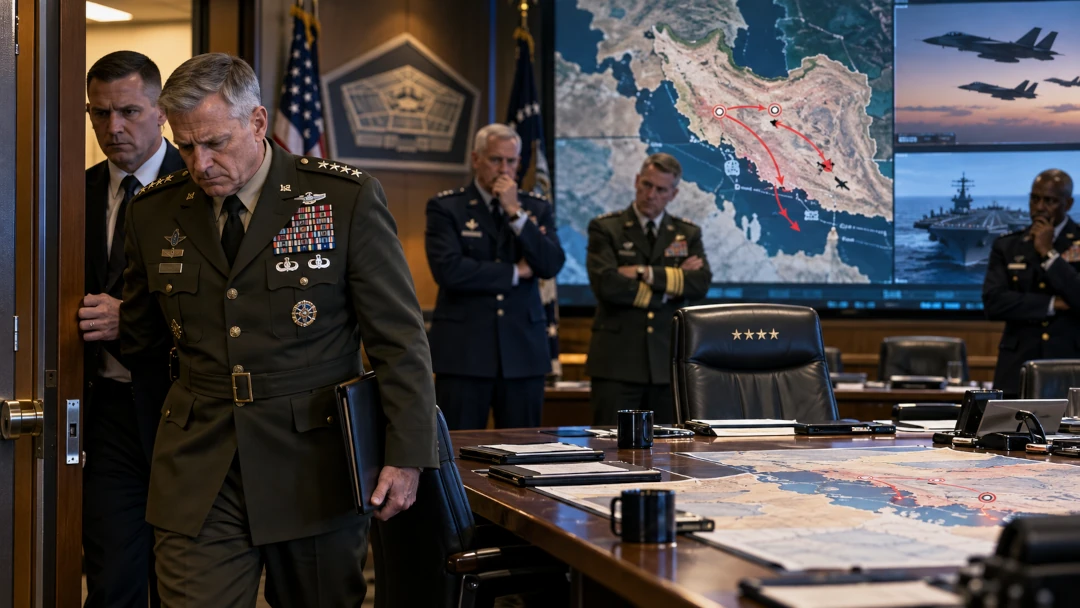
On the night before America’s allies in the Persian Gulf were told to brace for impact, the Pentagon’s chief military planner was shown the door. According to the Associated Press, Defense Secretary Pete Hegseth fired Army Lt. Gen. Brett Sylvia, the director of strategy, plans and policy on the Joint Chiefs of Staff — the post known in uniform as the “J5” — as President Trump weighs renewed strikes in a war now in its ninth month. Sylvia is the second J5 to be ousted under Hegseth; his predecessor, Lt. Gen. Joseph McGee, was forced into retirement last October.
The J5 is not a ceremonial job. As Reuters reported, the directorate helps advise Gen. Dan Caine, the chairman of the Joint Chiefs, the nation’s highest-ranking military officer. Sylvia, a 32-year veteran who once commanded the 101st Airborne Division, was removed while the military plans for what Trump has called “another little Epic Fury.” As of this writing, the Pentagon has named no replacement.
I. What the Pentagon Says — and What It Hasn’t Shown
The administration’s explanation arrived a day after the firing, not with it. A Defense Department official told Military.com that Sylvia is under investigation for leaking classified information about the Iran war and the Russia-Ukraine war, that he allegedly met reporters outside the building to get around the Pentagon’s escort rules for journalists, and that he failed three polygraph examinations. According to Al Jazeera, the matter has been referred to the Department of Justice, and the same official insisted Sylvia “was not a central planner for the Iran war.”
These are serious allegations, and if they are proven, they will warrant serious consequences. But they are, for now, allegations — anonymous, unproven, and issued by a department that has made leak hunts and polygraphs a signature of Hegseth’s tenure. Sylvia has not publicly responded. And the president’s own contribution did not inspire confidence: asked about the firing Thursday, Trump said “She’s gonna have big problems,” referring to the male three-star general as a woman.
II. Did He Oppose the Plan? The Honest Answer
Many Americans are asking whether Sylvia was removed because he resisted plans to resume bombing Iran. We will not pretend to know what we do not. There is no public reporting — as of today — that Sylvia opposed the administration’s Iran plans. The Pentagon says the issue is leaks; it also says he was not a central Iran planner. Neither claim has been tested by any independent body.
What we can say is that the pattern invites the question. The nation’s top uniformed officer has himself been reported to be wary of this war. Before the first strikes in February, multiple outlets reported that Gen. Caine had warned of the risks of a prolonged conflict, casualties, and depleted air defenses — reporting Trump called “100% inaccurate,” as The Financial News summarized. Later, CNN reported that Caine was privately seeking an “off ramp” from the war. When the chairman’s own planning shop loses its second chief in a year — on the eve of a new offensive, with no successor and no public evidence — the burden is on the Pentagon to show this was about misconduct and not about message discipline. Congress should demand exactly that.
A campaign to “purge talented officers for politically charged reasons.”
— Sen. Jack Reed (D-R.I.), Ranking Member, Senate Armed Services Committee, via Arkansas Advocate
III. The Drumbeat Toward “Another Little Epic Fury”
The firing did not happen in a vacuum. Every signal from Washington and the region this month points toward renewed war — timed, conspicuously, for the days after Americans vote.
Allies Told to Brace
U.S. officials told several Middle East partners to prepare for renewed military action after the Nov. 3 midterms — and for Iranian retaliation against energy facilities and infrastructure, two diplomats told the AP.
96 Hours From an Order
U.S. forces in the region are ready to launch potentially major new operations within 96 hours of a presidential order, two U.S. officials told CNN.
Joint Plans With Israel
Israeli and U.S. militaries have drawn up plans for joint strikes, discussed during Hegseth’s unannounced trip to Israel, with petrochemical facilities among potential targets, according to ABC News.
Another Carrier Heads East
The U.S. is sending another aircraft carrier to the Middle East, a sign more attacks may be coming, WBUR’s Here & Now reported.
“Deal” or “Finish It Off”
Trump said he is deciding whether to make a deal with Iran or “finish it off,” while denying that peace talks are under way, CNBC reported.
$47.1 Billion and Counting
U.S. Central Command now puts the war’s cost at no less than $47.1 billion as of mid-October, up from the $37.5 billion Hegseth gave lawmakers three months ago, per CBS News.
IV. Anatomy of a Purge
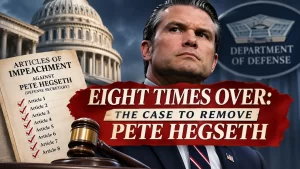
Sylvia’s ouster is not an anomaly; it is a method. The Hill reports Hegseth has now fired or pushed out more than two dozen senior military officers, drawing objections from members of both parties. Some were fired outright. Others were “retired” early or nudged to resign. Rarely has the public been told why. The pattern that emerges is not one of accountability for failure — it is one of removing those who dissent, who deliver inconvenient assessments, or who simply do not “fit”.
Note who is on that list: a Joint Chiefs chairman, a Navy chief, an Army chief, the nation’s top cyber warrior, the intelligence chief whose analysts contradicted the president, the military’s senior lawyers, and now two consecutive war planners. These are not the people a government removes when it wants candid advice. They are the people it removes when it wants compliance.
V. Congress: Oversight on Paper, Paralysis in Practice
Has Congress ensured the military is ready, lawful, and accountable? The record is mixed — and the blame is not evenly shared.
Democrats have used every tool available to a minority. In March, House Armed Services Ranking Member Adam Smith and every committee Democrat demanded a dedicated public hearing on the war, its costs, and its objectives. Senate Armed Services Democrats have pressed the Pentagon to disclose the cost of damage to U.S. bases — a figure left out of official estimates. When Hegseth and Caine came to the Senate to request emergency funding, Sen. Jeanne Shaheen asked why taxpayers should absorb the cost of an unpopular war when the Pentagon had reportedly spent barely half of its reconciliation money, according to The Hill.
And Democrats forced vote after vote. In June, for the first time in this war, both chambers passed a war powers resolution directing the president to remove U.S. forces from hostilities with Iran — the House 215–208, the Senate 50–48, with four Republicans joining in each chamber, as CBS News reported. Sen. Tim Kaine said the measure was binding under the War Powers Resolution. A White House official dismissed it as having “no significance.” Weeks later, the bombing resumed.
The failure, in short, belongs to the Republican majorities that control the committees, the hearing schedules, and the floor. They have held hearings to process the administration’s funding requests; they have not held one to ask why the Joint Staff’s planners keep disappearing. That should change before a single new bomb falls.
VI. What Democrats Are Planning
With the midterms days away, Democrats have been explicit about what they would do with power. Sen. Chris Murphy told the Washington Times that a Democratic majority would fund the Defense Department but not this war, and Rep. Adam Smith said ending the Iran war would be his committee’s top task. Because Trump would veto any standalone cutoff, the strategy is to write restrictions into must-pass defense and spending bills.
Brookings analysts make the same point: even a new majority likely lacks the two-thirds needed to override a veto, but funding limits in must-pass legislation and subpoena-backed oversight can put real pressure on the administration. The near-term danger, CNN notes, is the lame-duck session, when Republicans will be pressed to pass a massive war-funding bill before new members are sworn in.
VII. The Clock Has Run Out
No pause button: why continued war on Iran is unlawful without Congress
The Constitution
Article I, Section 8 gives Congress — not the president — the power to declare war. The president commands the forces Congress authorizes; he does not get to start and sustain a war on his own say-so. Congress has passed no declaration of war and no authorization for the use of military force against Iran.
The War Powers Resolution (50 U.S.C. §§ 1541–1548)
The 1973 law, enacted over Richard Nixon’s veto, requires the president to report to Congress within 48 hours of introducing forces into hostilities, and then to terminate that use of force within 60 days unless Congress authorizes it, with at most 30 more days to withdraw safely. Trump reported on March 2, which put the deadline at May 1, as The Conversation explained. Section 8 of the same law states that authority to wage war is not to be inferred from appropriations unless the funding law specifically says so — which means a war-funding supplemental should never be treated as a backdoor authorization.
The “Pause” Theory — and Why It Fails
On April 30, Hegseth told senators that because of the ceasefire, the 60-day clock “pauses or stops,” according to AP; the next day, Trump wrote that hostilities “have terminated.” Then, when bombing resumed in July, the White House sent a new notice claiming a fresh 60 days, per The Dallas Express — a notice that itself appears to have arrived outside the 48-hour window.
Nothing in the statute’s text supports a pause or reset. John Bellinger, a former top legal adviser at the State Department and National Security Council under George W. Bush, told Fox News that “a ceasefire does not automatically suspend the War Powers 60-day clock.” Duke law professor Curtis Bradley told the Daily Caller he knew of no precedent for the claim that a temporary ceasefire pauses the clock. Even the libertarian Cato Institute’s Katherine Thompson called the administration’s theory “legally dubious,” noting the blockade never stopped.
Do the arithmetic the administration won’t. Count only days of active U.S. bombing — roughly late February to early April, and again from early July into September — and the total runs to about three months, beyond the 60-day limit and the 30-day withdrawal window combined. Count the blockade, an act of war in its own right, and the war has never paused at all. If a president may reset the clock every time he stops firing, the 60-day limit means nothing, and any war can be made permanent in 59-day increments.
The Administration’s Defense
To be fair to the opposing argument: the White House contends the ceasefire genuinely ended one set of hostilities, that July’s strikes were a new conflict triggered by Iranian attacks on shipping, and that the president has inherent Article II authority to protect U.S. forces. Presidents of both parties, including Barack Obama in Libya, have stretched the definition of “hostilities.” Courts have generally declined to referee these disputes, and the June concurrent resolution’s binding force is contested in light of the Supreme Court’s 1983 Chadha decision. But past abuse is not a license, and judicial silence is not legal permission. The law’s text — and Congress’s recorded votes — point one way.
“There’s no pause button in the Constitution, or the War Powers Act.”
— Sen. Richard Blumenthal (D-Conn.), via PBS NewsHour / AP
VIII. For Those in Uniform: Lawful Orders and Your Oath
Service members swear an oath to the Constitution, not to a person. Under the Uniform Code of Military Justice, Article 92 (10 U.S.C. § 892) makes it a crime to disobey a lawful order, and Article 90 covers willful disobedience of a superior officer. But military law has long held that an order which is clearly — “manifestly” — unlawful must not be obeyed, and that following one is no defense. As military defense attorneys at the Law Offices of David P. Sheldon stress, orders are presumed lawful, and the burden falls on the service member to show otherwise.
That is why the six Democratic lawmakers — all veterans or former intelligence officers, including Sens. Mark Kelly and Elissa Slotkin — released a video reminding troops that they can and must refuse illegal orders. The administration’s answer was to call them seditious and open a Pentagon inquiry into Kelly, as NBC News reported. Restating the law is not sedition. Punishing people for restating it is a warning sign.
- Know the standardObey lawful orders. Refuse orders that clearly require a crime — under the UCMJ, the law of armed conflict, or the Constitution. "I was following orders" is not a defense to a manifestly illegal act.
- Ask, clarify, documentIf an order seems wrong, ask for clarification and, where possible, for the order in writing. Write down what you were told, by whom, and when.
- Use the system's safety valvesConsult your unit's judge advocate (JAG) or legal assistance office, your chaplain, or the Inspector General. Communications with members of Congress and IGs are protected by the Military Whistleblower Protection Act (10 U.S.C. § 1034).
- Get independent, confidential counselThe Orders Project, now part of the National Institute of Military Justice, connects service members with experienced military-law attorneys for confidential consultations. It does not encourage disobeying lawful orders.
- Know your other rightsThe GI Rights Hotline provides free, confidential information on discharges, conscientious objection, and service members' rights.
IX. What This Means for the Average American
Most Americans will never meet a J5. But they are already paying for what happens when the people who plan wars are replaced by people who follow them. They are paying at the pump: the war and Iran’s closure of the Strait of Hormuz have driven up fuel prices. They are paying in taxes: $47.1 billion so far, with the Congressional Budget Office estimating $2–3 billion more every month the war continues, according to CBS News. And military families are paying most of all — in deployments, in casualties, and in the knowledge that the officers best positioned to say “this plan is unsound” have been taught what happens to those who do.
A military led by loyalists rather than professionals is not stronger. It is more dangerous — to the troops, to the country’s security, and to a democracy that depends on the armed forces staying out of politics and inside the law.
Get Involved Today
Contribute to our mission and turn your concerns into action.
X. What You Can Do
Voting next week matters enormously. But citizens have more power than a single day at the ballot box, especially in the lame-duck weeks when a war-funding bill may move. Here are the main options — and an honest assessment of each.
- Call about the lame-duck funding billTell your representative and both senators: no supplemental war funding without a specific vote to authorize — or end — the Iran war, and an express statement that funding is not authorization. This is the single most powerful lever right now; funding is where Congress has real leverage.
- Demand a hearing on the Sylvia firingAsk the Armed Services Committees to call Hegseth and Gen. Caine to explain, under oath, why the J5 was removed, who is planning the next phase of the war, and what evidence supports the leak allegations. The GOP majority controls the schedule, but public pressure has moved Republicans before — four in each chamber voted to end this war in June.
- Ask your members where they stand on war powersGet them on the record: Do they believe a ceasefire resets the 60-day clock? Will they vote for funding limits in the defense bill?
- Support service members and their familiesShare the GI Rights Hotline and The Orders Project resources with anyone you know in uniform. Knowing where to get confidential legal advice protects troops from both bad orders and bad decisions.
- Stay informed and spread facts, not rumorsFollow credible reporting and share it. Be precise — the Sylvia firing raises legitimate questions, but claims about motives should rest on evidence. Accuracy is what makes pressure credible.
XI. What This Says About Leadership
Strip away the rhetoric and the record is plain. This administration started a war without asking Congress. When the law’s deadline arrived, it declared the war over without ending it. When Congress — both chambers, with bipartisan votes — directed it to stop, it called the vote meaningless and resumed bombing. Now, as it prepares to escalate again, it is removing the senior officers responsible for planning, and it has timed the next round for after Americans vote.
A president who trusted his case would bring it to Congress and to the public. A defense secretary confident in his generals would let them give candid advice without fear. Instead, we are watching an administration that treats law as an obstacle, oversight as an insult, and professional military judgment as disloyalty. Rep. Brian Fitzpatrick, a Republican, put the principle simply when he crossed party lines in June: “we have to follow the law.” That this has become a controversial position tells you everything about where this government’s priorities lie.
Editorial Conclusion
The war against Iran has outlived every legal deadline Congress wrote to restrain it, and the officers best placed to warn against its next phase are being removed one by one. That is not strength. It is the dismantling of the guardrails that keep American power accountable.
The Constitution gives the power of war to the people’s representatives, not to one man and his loyalists. Congress must refuse to fund another round of bombing without a vote to authorize it, must demand sworn answers on why the Pentagon’s planners keep vanishing, and must defend every service member’s duty to obey the law above any individual. Anything less is a surrender of the most solemn power a republic holds.
Sources & References
- PBS NewsHour / AP — Hegseth fires the Pentagon’s top military planner even as Trump considers new Iran strikes
- Military.com — Hegseth fires Pentagon’s top military planner over alleged classified leaks
- Al Jazeera — Pentagon fires general it says leaked classified information to media
- Daily Sabah / Reuters — US defense chief fires senior general over alleged classified leaks
- WSLS / AP — Pentagon accuses newly fired general of leaking sensitive information
- Mediaite / CNN — “Caine is looking for an off ramp”: Joint Chiefs chairman reportedly wants U.S. out of Iran
- OPB / AP — US warns allies to prepare for possible Iran strikes, retaliation after elections
- CNN — US has plans for major Iran strikes if Trump chooses
- ABC News — US and Israel drawing up plans to resume attacks on Iran post-election
- CBS News — Iran war has cost $47 billion, U.S. military says
- Newsweek — Hegseth fires top military planner — list of high-profile Pentagon departures
- Axios — Trump and Hegseth keep pushing out military leaders: Here’s the list
- Christian Science Monitor — With U.S. at war, Hegseth’s Army leadership purge raises questions
- CBS News — Senate adopts House-passed Iran resolution in symbolic rebuke of Trump
- PBS NewsHour / AP — Trump says deadline for Congress to approve Iran war doesn’t apply
- Fox News — Trump aims to reset war powers clock with controversial bid to bypass Congress
- Cato Institute — Cato scholar: Iran ceasefire doesn’t stop War Powers clock
- Washington Times — Democrats want to end the war in Iran. Can congressional majorities give them that power?
- Brookings Institution — The midterm effect: What the 2026 election could mean for public policy
- NBC News — Sen. Mark Kelly says Trump and Hegseth are “not serious people” amid video investigation
Related News