Twenty-Five Minutes, Zero Answers: Hegseth Meets the Press to Defend a War the Country Has Already Rejected
After six months without a Pentagon briefing, the war secretary resurfaced hours before a House impeachment vote, not to answer the eight articles against him but to brand them “policy disagreements.” He offered no plan to end a war voters just punished at the ballot box. And the president, asked what Hegseth had done wrong, answered with a question of his own.
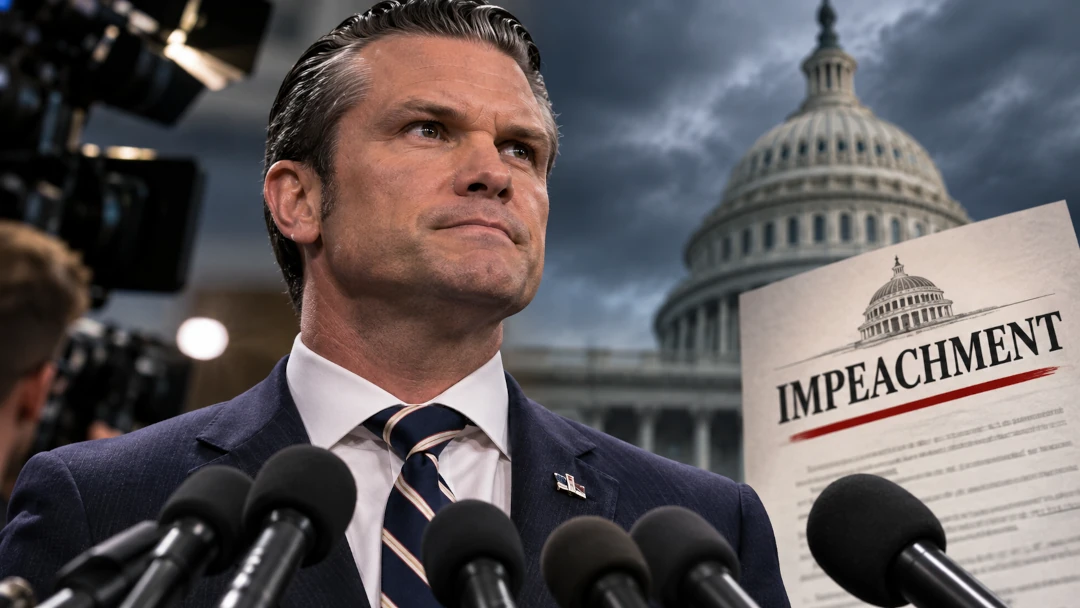
Pete Hegseth has not spent much time at a Pentagon podium this year. According to The Hill, the department’s last press conference before Tuesday took place on May 5, and the briefing room stayed dark through a summer of escalation, a congressional order to withdraw from Iran, and a midterm election that Republicans themselves now describe as a referendum on his war. On Tuesday morning, with his parents and brother seated in the audience, as Breitbart reported, the man the administration now calls the “Secretary of War” finally returned. He stayed for roughly 25 minutes, according to NBC News.
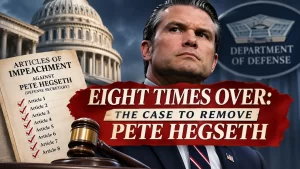
The timing was not a coincidence. A day earlier, Rep. Thomas Massie of Kentucky, a Republican, read eight articles of impeachment onto the House floor in a 34-page resolution, CBS News reported, accusing Hegseth of waging war on Iran without congressional authorization and abusing the powers of his office. Because Massie filed it as a privileged resolution, Just the News noted, House leaders must bring it to the floor within two legislative days. The Hill reported that a procedural vote was set for 5:30 p.m. Eastern on Tuesday, the same day as the press conference.
What the country got from Hegseth was not an accounting. It was a counteroffensive, and its central claim is worth examining closely, because it is the same claim every official facing accountability makes: that the charges are just politics.
I. The Briefing: “A Farce,” “A Stunt,” and a Disgruntled Congressman
Hegseth spent his opening statement on the messenger rather than the message. He called Massie a “disgruntled and defeated congressman” and described the resolution as “a political spectacle, a personal manifesto driven by ego and resentment,” according to Breitbart’s account. Massie did lose his May primary to a Trump-endorsed challenger, as CNBC notes. That fact says something about the president’s grip on his party. It says nothing about whether the War Powers Resolution was violated.
“It’s a farce, and it’s a stunt, and everybody knows it.”
— Secretary Pete Hegseth, Pentagon briefing, Nov. 10, via NBC News
His legal argument came down to one line. The articles, Hegseth said, describe “policy disagreements” rather than high crimes, and CBC News reported that he told reporters the proper remedy is legislation, debate and “the next presidential election.” He warned that any proceedings would be a “show trial against the president and the secretary of war.” PBS NewsHour reported that he went further, arguing that no defense secretary has ever been impeached for carrying out lawful military operations, and casting the whole effort as an attack on service members that undermines American forces “in real time.”
That framing does a lot of work. TIME reported that Hegseth called the effort “sabotage” that “puts a target on the backs of American warriors.” But as Military.com pointed out in its own coverage, the resolution targets Hegseth as a civilian official and charges no service member with anything. Hiding behind the troops is not a defense of what the secretary ordered. It is a way to avoid defending it.
The setting matched the message. Meidas+, citing Washington Post Pentagon reporter Tara Copp, reported that a Hegseth security agent warned reporters they could be “physically removed” from the room if they did not keep “decorum,” and that questions went largely to friendly outlets including OANN, Real America’s Voice, the Daily Wire and Fox News. For a man accused in Article IV of undermining journalistic oversight, it was a strange way to rebut the charge.
II. The Charges: What Massie Actually Alleged
Because Hegseth refused to engage with the articles one by one, it is worth setting out what they say. The full text, posted on Massie’s House website, is not a list of complaints about tone. It lays out dates, statutes and body counts. Axios reported that three of the eight articles concern congressional war powers in Iran alone.
Article I · War Without Authorization
Hostilities against Iran began Feb. 28, 2026, with no declaration of war, specific statutory authorization, or attack on the U.S., in violation of War Powers Resolution §2(c). Resolution text
Article II · Defying Congress’s Withdrawal Order
H.Con.Res. 86, directing removal of forces, passed the House June 3 and the Senate June 23. Operations continued anyway on June 26, and the department was allegedly told to disregard the resolution. Resolution text
Article III · Blowing the 60-Day Clock
The president’s March 2 report started the War Powers 60-day clock, which expired May 1. No extension was enacted and no certification sent for the extra 30 days, which ended June 1. Hostilities continued. Resolution text
Article IV · Gutting Civilian Protections
Cites the Feb. 28 Tomahawk strike on an elementary school in Minab, Iran, and alleges that more than 90% of civilian-harm staff were removed and a casualty-tracking database defunded. Resolution text
Article V · Extrajudicial Killings
Boat strikes since Sept. 2, 2025: at least 221 deaths, including two survivors killed clinging to wreckage in a follow-up strike, and eight shipwrecked survivors who died with no rescue assets nearby. Resolution text
Article VI · Suppressing Free Speech
Retaliation against Sen. Mark Kelly for a video telling troops they may refuse illegal orders, including a threatened recall to active duty and a censure letter raising criminal prosecution. CNBC
Article VII · Seizing a Foreign Leader
The Jan. 3, 2026 raid that captured Nicolás Maduro in Caracas, alleged to have killed at least 83 people without congressional authorization. Resolution text
Article VIII · Unlawful War in Yemen
More than 1,100 strikes over roughly 52 days in 2025, an estimated 224 civilians killed, and a War Powers report filed after the 48-hour deadline. Resolution text
III. The Answer Key: How Hegseth Addressed Each Charge
Read against the articles, the press conference falls apart. Hegseth defended the outcomes of the operations. He did not engage with the legal process those operations were supposed to follow. Fox News reported his core legal defense: the operations were ordered by the commander in chief and Congress was notified. Notifying Congress is not the same as getting its approval, and the War Powers Resolution requires approval.
| Charge | What Hegseth Said |
|---|---|
| War powers (I–III) | Said the operations were lawful, ordered by the president and "notified" to Congress, and that "I stand behind every one of these operations" (CBC). He did not mention the 60-day clock or H.Con.Res. 86. Not addressed |
| Civilian harm (IV) | Rejected claims that U.S. forces unlawfully targeted civilians, calling them slander against troops (Military.com). No mention of the gutted civilian-harm office or the Minab investigation. Deflected |
| Boat strikes (V) | "We sank the boats carrying poison into our communities" (Fox News). Nothing on the survivors or the legal basis for lethal force over arrest. Justified, not answered |
| Sen. Kelly (VI) | Neither Breitbart's nor Fox's detailed accounts of the briefing report any remarks on Kelly. Silent |
| Maduro raid (VII) | "We put a narco dictator in handcuffs" (Fox News). Nothing on the constitutional captures clause or the deaths. Justified, not answered |
| Yemen (VIII) | Grouped with the other operations as lawful and successful (TIME). Not addressed |
His summary line, per Fox News, was “I would do it again tomorrow.” Coming from an official accused of ignoring a binding withdrawal resolution passed by both chambers, that is not a defense. It is close to a confession of intent.
IV. “Not Necessarily Popular”: The War Voters Rejected
The most revealing moment came during questions. Asked about Vice President JD Vance’s statement that the Iran war cost Republicans the midterms, Hegseth said he respected Vance and would not engage in finger-pointing, according to the Department’s official transcript. He then borrowed a line from Secretary of State Marco Rubio, reported by Breitbart: the war “is not necessarily popular, but it may have been necessary.”
That was the whole plan. No exit strategy, no timeline, no outreach to the voters who turned on the war. Instead Hegseth predicted that “history will judge the Iran war quite differently than conventional wisdom right now,” according to an IANS report. In the same answer he conceded that “they’re gonna attempt to reconstitute” in response to a question about Iran’s Revolutionary Guard rearming behind the U.S. blockade, and warned that the U.S. could strike again if Iran resumed work at its nuclear sites. As Military.com noted, that admission sits uneasily with his claim that Iran’s industrial base had been destroyed. The outlet also reported that U.S. forces struck Iranian defenses near the Strait of Hormuz as recently as Nov. 6, with no active negotiations to end a conflict now more than nine months old.
He framed the Feb. 28 decision to attack as an act of courage: “He did not kick the can. He kicked their teeth in” (Military.com). He told the press that critics’ “disagreements are with success” (USA Today via Yahoo). But the people disagreeing are no longer only Democrats and a Kentucky libertarian. They are most of the country.
69% · Not Worth Fighting
An AP-NORC poll in October found 69% of adults said the war was not worth fighting and 71% disapproved of Trump’s handling of Iran. Al Jazeera
74% · A Factor at the Ballot Box
A midterm exit poll found 74% of voters called the war a crucial or major factor in their vote. TIME estimates the war has cost taxpayers about $47.1 billion. TIME
23 Dead, 860+ Wounded
At least 23 Americans have died across the broader conflict and more than 860 service members have been wounded. Hegseth acknowledged 18 killed in Operation Epic Fury. Military.com
“The Reason We Lost Is the War”
Vice President Vance wrote on Nov. 4 that the war caused the GOP’s losses, and said winning voters back starts with ending it. Axios
Get Involved Today
Contribute to our mission and turn your concerns into action.
Voters delivered their verdict on Nov. 3. Democrats took control of both chambers, with Senate Democrats holding at least 54 seats, the Associated Press reported, as voters cited high prices, the war and unease about the country’s direction. Gas averaged $3.98 back in March, up from just under $3 before the war began, the AP reported then, because the fighting choked traffic through the Strait of Hormuz. A defense secretary with any political sense would have come to the podium with a plan to end the war. Hegseth came with a highlight reel.
V. The Boats: “Poison,” Survivors, and Missing Evidence
On the Caribbean and Pacific boat strikes, the subject of Article V, Hegseth gave numbers. Military.com reported his claim that Operation Southern Spear destroyed more than 70 vessels, killed 218 alleged traffickers and cut maritime smuggling by at least 65%, saving “thousands” of American lives. The same report pointed out that the Pentagon has never publicly shown how many overdose deaths, if any, were prevented; that the targeted boats mainly carry cocaine while fentanyl enters mostly by land from Mexico; and that U.S. overdose deaths were already falling before the strikes began.
Nothing in Hegseth’s remarks explained the legal theory that turns suspected smugglers, who would normally be arrested and prosecuted, into military targets who can be killed. He did not mention the two survivors killed in a follow-up strike, the incident that led Rep. Shri Thanedar to file the first impeachment articles against Hegseth in December 2025. He did not mention the eight shipwrecked survivors Massie’s resolution says died after the Dec. 30 strike. His answer to questions about due process and the laws of war was a slogan.
Is Defying Congress on War a “Policy Disagreement”?
Hegseth’s defense depends on one claim: that the articles concern policy, not law. The Constitution’s text says otherwise. Article I, Section 8 gives Congress, not the executive, the power to declare war and to “make Rules concerning Captures on Land and Water.” Article II, Section 4 provides that civil officers “shall be removed from Office on Impeachment for, and Conviction of, Treason, Bribery, or other high Crimes and Misdemeanors.”
A policy disagreement is a dispute over which lawful option to choose. Continuing hostilities after both chambers have ordered a withdrawal is a dispute over whether the law applies.
The War Powers Resolution of 1973 is binding federal law, not advice. Section 5(b) requires forces to be withdrawn within 60 days, plus a possible 30-day extension, unless Congress authorizes the hostilities. Section 5(c) allows Congress to direct removal by concurrent resolution. Massie’s Articles II and III say the department did the opposite on both counts: hostilities went past the May 1 and June 1 deadlines, and operations continued after H.Con.Res. 86 passed both chambers in June (resolution text). Whether every one of the eight articles would survive a Senate trial is a fair question. But calling these “policy disagreements” means treating a statute as optional, and that is exactly the kind of abuse of power the framers had in mind.
Hegseth’s line that “the proper remedy” is “the next presidential election” also gets the Constitution backward. The framers made impeachment available precisely because waiting four years for voters is not enough when an officer is accused of abusing power. If he is impeached, Hegseth would be only the third Cabinet secretary in history to suffer that fate, CBS News noted. The first was War Secretary William Belknap in 1876.
VI. The President’s Reply: “What Has Hegseth Done?”
If Hegseth’s press conference was defensive, Donald Trump’s response was something worse: indifference. On Sunday, he said Hegseth was “guilty of two things: basically winning two wars,” CNN reported. On Monday, at an impromptu White House briefing, he told reporters he would “stand by” Hegseth even if the House impeached him (ABC News), and called Massie “a stone cold loser” who “has a lot of hatred in his heart” (CNN).
“Really, what has Hegseth done?”
— President Donald Trump, White House, Nov. 9, via TIME
That night on Truth Social, Trump called Hegseth “perhaps the most popular and successful military official in the Country,” pointed to “TWO VICTORIES, Venezuela and Iran,” and declared that Hegseth “should be praised, not Impeached” (The Hill). After Tuesday’s briefing, Fox News reported, Trump gave Hegseth’s performance an “A PLUS, PLUS, PLUS.” When CNN’s Kaitlan Collins pressed him on the specific allegations, Military.com reported, Trump called her a “loser” too and went back to claiming victory.
The “most popular” claim does not survive contact with the polling. And the president’s own words show he knows it. The day after the election, Trump told the Wall Street Journal that “Iran was a piece of it” (Axios), but added: “I did the right thing. I would have done it again” (Reuters via Al-Monitor). Last week, he acknowledged getting calls from people unhappy with Hegseth and said, “I don’t understand why” (ABC News).
He has been told why. Sen. Thom Tillis, a Republican who voted to confirm Hegseth, wrote that he had “never witnessed more inept management” of the people who serve (Newsweek). Rep. Don Bacon, a retired Air Force general, said Hegseth was “trouble from the beginning” (Newsweek). Axios reported that House GOP leaders are bracing for enough Republican defections to pass impeachment, and that Hegseth has become the face of the war on Capitol Hill. House Minority Leader Hakeem Jeffries calls himself a “hard yes” (ABC News). Speaker Mike Johnson’s answer has been to warn that impeachment during hostilities would be “a terrible, terrible look” (CBS News). He made the same calculation in September, when he recessed the House early rather than allow a vote.
VII. Timeline: From the First Strike to the Floor Vote
VIII. What This Says About Trump’s Priorities
Put the pieces side by side. The country has turned decisively against a war that has killed Americans, cost tens of billions and raised the price of gas. The president’s own vice president says the war cost the party Congress. A Republican senator and a Republican general-turned-congressman have called the Pentagon’s leadership a failure. A third Republican has filed articles of impeachment. In response, the president gives his war secretary an “A plus, plus, plus,” attacks the congressman as a “loser,” insults the reporter who asks the question, and insists that the only thing Hegseth is guilty of is winning.
This is not leadership under pressure. It is loyalty treated as the top qualification for office. Trump’s measure of Hegseth is not whether he obeyed the law, protected civilians, or kept faith with Congress, but whether he defended the president. Hegseth understood that test perfectly. When he compared himself to Trump’s own impeachments, he said, “If standing with President Trump puts me in that company, I’ll take that company every day of the week” (Breitbart).
The deeper failure is democratic, not political. Voters were asked, in effect, whether they consented to this war. They said no. Congress was asked, in June, whether the war should continue. It said no. The White House’s answer to both, delivered through Hegseth from a podium he had avoided for half a year, is that their opinion does not matter, because history will vindicate the men in charge.
IX. What You Can Do
Even if the House impeaches Hegseth this week, removal requires a two-thirds vote in the Senate. Republicans hold 53 seats until January, so conviction is unlikely in this session, as TIME notes. Still, impeachment creates a permanent constitutional record, and the new Democratic majorities can investigate and legislate starting in January. Pressure now shapes what happens next.
- Call your representative todayBefore the House votes, use the Capitol switchboard (202-224-3121) to tell your member to oppose any motion to table or refer Massie’s resolution, and to vote on the merits. A motion to table is a vote to avoid the question.
- Target persuadable RepublicansIf you live in a district with a retiring or defeated Republican, or one who has backed war powers measures before, call that office in particular. Axios reports that members with “little left to lose” may decide the outcome.
- Press your senators to commit to a real trialAsk both senators to publicly commit to hearing evidence, including witnesses on the Minab strike and the boat-strike survivors, rather than dismissing the articles without a trial.
- Demand War Powers enforcement in the new CongressUrge the incoming majorities to make a binding Iran war powers resolution, funding limits on unauthorized operations, and restoration of the civilian-harm office their first national-security priorities in January.
- Defend the press that covers the PentagonSupport outlets that keep asking questions despite restricted access, and share original reporting rather than spin. Accountability depends on a press corps that cannot be “physically removed” for asking the wrong question.
Editorial Conclusion
Pete Hegseth came to the podium to call his impeachment a policy dispute. It is not. The Constitution gives Congress the power to decide when this nation goes to war, and the War Powers Resolution puts a clock on any war Congress has not approved. Both chambers ordered this war to stop. It did not stop. A secretary who treats that order as optional, and a president who answers the charge with insults and “A plus, plus, plus,” are claiming that the law ends where their certainty begins. The House must vote on the merits, the Senate must hold a real trial, and the incoming Congress must take back the war power it was never supposed to give up. The question before the country is not whether one man won or lost a war. It is whether Americans still decide, through their representatives, when their sons and daughters are sent to fight. That answer has to be yes.
Sources & References
- Massie.house.gov — Articles of Impeachment: Peter Brian Hegseth (full resolution text)
- U.S. Department of War — Transcript: Secretary of War Pete Hegseth Holds a Press Briefing
- PBS NewsHour — Hegseth says House impeachment push is about “policy disagreements” not high crimes
- CBC News — Defiant Hegseth calls Republican’s impeachment resolution a “farce”
- NBC News — Live updates: Hegseth calls impeachment push a “farce” and “stunt”
- Military.com — Hegseth Claims Iran Victory in Press Conference as War and Impeachment Fight Continue
- Fox News — Hegseth rips impeachment push from outgoing Republican as “farce,” “stunt”
- Breitbart — Hegseth: Massie’s Impeachment Effort Is a “Political Spectacle,” “Farce”
- TIME — “This Is Sabotage”: Pete Hegseth Rails Against Looming Impeachment Vote
- CBS News — Massie introduces impeachment articles against Hegseth, teeing up vote this week
- CNBC — Pete Hegseth impeachment articles introduced by Rep. Massie
- Axios — Hegseth faces impeachment resolution from GOP member with little to lose
- Axios — House poised to impeach Pete Hegseth after GOP midterm defeat
- The Hill — Trump says Hegseth should be praised, not impeached
- CNN — Trump vows to stand with Hegseth if he’s impeached
- ABC News — Trump says he’d “stand by” Hegseth even if he’s impeached
- Axios — Trump’s VP says the Iran war cost them the midterms
- Al Jazeera — Most Americans say US-Israel war on Iran not worth fighting: AP-NORC poll
- Newsweek — Tillis urges Trump to replace Hegseth; Bacon agrees
- Anchorage Daily News / AP — Democrats usher in new era with sweep of House and Senate
Related News