Trump Faced the Cameras After a Historic Rout. He Offered Grudges, Not a Plan.
On 60 Minutes, a conservative interviewer pressed the president on prices, war, corruption and cruelty. Trump blamed his candidates, his “messaging,” and his enemies, then promoted the architect of the very policy he called “too tough.” As families brace for a winter of high fuel bills, tariffs and rising interest rates, the question is no longer what voters want. It is whether this White House is listening.
Six days after voters handed Democrats one of the most lopsided midterm victories in modern memory, Donald Trump sat down in the Oval Office with 60 Minutes correspondent Ross Douthat. By the count of the Associated Press, as reported by Yahoo News, Democrats now hold 54 Senate seats and at least 254 House seats, with a national House vote margin approaching 13 points. Early exit polls cited by CBS News put the president’s approval on Election Day at 38 percent, on track to be the lowest for any president in a midterm.
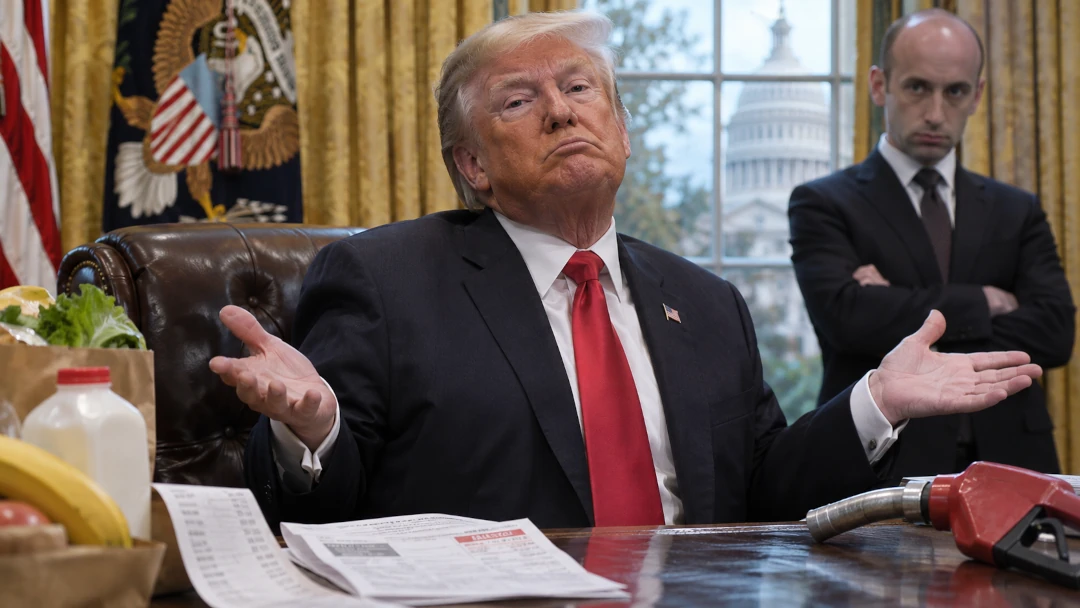
The interview, taped Friday and broadcast Sunday night, was billed as a moment of reflection. In places it was. In the full CBS transcript, the president conceded that voters disliked the Iran war and the rise in gasoline prices, and he said he did not disagree with Vice President JD Vance’s post-election claim that the war cost Republicans the election. But on the issue that decided the midterms, the cost of living, Trump offered an explanation that should alarm every family now opening a heating bill: I think it was bad messaging.
“
I. The Pushback in the Room
It matters who asked the questions. Douthat, a former New York Times columnist and a conservative, joined 60 Minutes under the network’s new editor-in-chief Bari Weiss. He is no partisan foe of the president. That made his persistence more revealing, not less.
When Trump argued that candidates simply failed to absorb his personal popularity, Douthat reminded him that he had picked many of those candidates himself, including Ken Paxton in Texas. When Trump insisted the economic numbers were “phenomenal,” Douthat asked why Americans, poll after poll, said they felt worse off than in his first term. When Trump said he could work with Democrats, Douthat noted that he had mocked the incoming Texas senator James Talarico by name during the campaign, and asked whether Trump could go six months without insulting the people whose votes he now needs. Trump said he could do it “very easily,” then added that he also calls them “Dumocrats.”
The sharpest exchange came on money. Douthat cited a Forbes estimate that the president’s net worth had climbed by about $3 billion since his return to office, and pressed him on World Liberty Financial, the family cryptocurrency venture that, Douthat noted, is partly owned by investors connected to the government of the United Arab Emirates. He asked the obvious question: if this were the Biden family, would Trump call it corrupt? Why not simply divest? Trump’s answer, per the transcript, was that he knows nothing about the company and that his sons run the business. CNN described this as the most combative stretch of the interview, and concluded that, outside of immigration, Trump showed little appetite for conciliation.
On Ukraine, when Trump attributed the war to mutual hatred between Vladimir Putin and Volodymyr Zelenskyy, Douthat asked whether the anger was more understandable from the leader whose country had been invaded. Trump allowed that it was, then pivoted to Russia’s feelings of disrespect and predicted Ukraine would end up “a little bit different shape.” On Iran, he said he saw no reason to escalate, and claimed the Gulf nations the U.S. protected would eventually repay the costs of the war.
The interview closed on faith. Douthat recalled the president’s remarks at Charlie Kirk’s memorial and asked whether, standing before the judgment of God, he could forgive James Comey or Nancy Pelosi. Trump said no.
“I do hate some of my enemies, and I always will.”
— President Donald Trump to 60 Minutes, as published by CBS News
That is the sentence that will define this interview, and it should. A president entering two years of divided government, who says he wants to make deals with the opposition, told a national audience that his hatred of his opponents is permanent.
II. One Hour Later: The Miller Promotion
The most consequential thing Trump said on immigration was that his deportation policy “both helped and hurt.” Asked whether it went too far, he said, as CBS News reported, I think it was too tough.
He described hotel workers and landscapers, people here 10 or 15 years, being swept up, and floated a deal with Democrats on some form of legal status. CBS noted that 58 percent of midterm voters in exit polling said the administration’s immigration actions had gone too far.
Then, roughly an hour after the cameras stopped, the president announced that Stephen Miller, the architect of that deportation crackdown, would replace Susie Wiles as White House chief of staff. Miller begins today. Axios reported that Wiles had been a critical internal voice against the Iran war and had repeatedly questioned Miller’s hardline immigration tactics. CBS News called the move a doubling-down on the president’s governing approach despite voters’ widespread rejection of it.
- Tuesday, Nov. 3Democrats win the House and, by the next day, the Senate, flipping more than 40 House seats including districts once considered safely Republican.
- Thursday, Nov. 5Susie Wiles submits her resignation as chief of staff, according to Axios, after offering to quit for two days.
- Friday, Nov. 6 — MorningTrump tapes the 60 Minutes interview, calling his immigration crackdown “too tough” and signaling openness to a deal with Democrats.
- Friday, Nov. 6 — AfternoonTrump names Stephen Miller chief of staff, elevating the official most associated with mass deportation.
- Sunday, Nov. 8The interview airs. Prominent figures on the right accuse Trump of betrayal; the White House insists nothing has changed.
- Monday, Nov. 9Miller takes office as the lame-duck Congress returns to Washington.
- Dec. 8–9The Federal Reserve meets, with a rate hike widely expected.
Read together, the interview and the personnel move send two messages at once. One is aimed at swing voters and Democratic leaders: the president has heard you. The other is aimed at his own staff and base: nothing fundamental will change. It is difficult to negotiate in good faith with a White House that says both things in the same afternoon.
III. What Democrats Are Saying
Democratic leaders have answered with a two-track message: costs first, accountability alongside. Hakeem Jeffries, the likely next Speaker, wrote to his caucus that the era of the House functioning like a wholly owned subsidiary of the Trump administration is over, and he has tasked Rep. Jamie Raskin with leading oversight, explicitly linking corruption to affordability. According to CNBC, House Democrats plan to use their first 100 hours to restore the expired enhanced Affordable Care Act subsidies, reverse the Medicaid cuts Trump signed into law last year, and advance a bill to undo his tariffs and reassert Congress’s authority over import taxes.
“Whenever Trump defies the will of the American people or the law, we will launch investigations, take him to court and entangle him in legislative razor wire.”
— Senate Democratic Leader Chuck Schumer, via Virginia Independent News
The Miller appointment drew immediate fire, and not only from Democrats. ABC News reported that several congressional Democrats said the choice showed how little the president had learned, while retiring Republican Sen. Thom Tillis called Miller the worst of all possible choices
and questioned how so divisive a figure could serve as an olive branch to the new Democratic majorities.
IV. What Republicans Are Saying
On the right, the reaction split. Trump’s immigration remarks set off an angry response from the movement’s hardliners. Rolling Stone reported that the Daily Wire’s Matt Walsh wrote that the policy was not too tough,
calling the president’s concession a betrayal. The White House pushed back on its own allies: its Rapid Response account, as The Daily Beast documented, noted that the word ‘amnesty’ was never even said
and insisted no president has been tougher on enforcement.
The fairest summary of the Republican position is this: the president’s defenders argue that he has stopped Iran from obtaining a nuclear weapon, that his border record remains popular, that the stock market sits at record highs, and that Democrats intend to bog the country down in investigations. White House spokeswoman Lauren Bis, quoted by PBS NewsHour, said that if Democrats pursue what she called sham investigations, they will be working against the American people. Those arguments deserve a hearing. They do not answer why a family in Ohio is paying more for diesel, groceries and heating oil than it was a year ago.
Get Involved Today
Contribute to our mission and turn your concerns into action.
V. The Kitchen Table: A Winter of Bills
Here is the reality the president called a messaging problem. Every figure below comes from economists, the Federal Reserve system, or nonpartisan energy analysts, not from campaign talking points.
Cost of the Iran War
~$2,000
Moody’s Analytics chief economist Mark Zandi estimates the war has cost the typical household about this much, including roughly $1,100 in higher energy costs, while real wages have fallen almost every month since it began. CNN
Home Heating
+31.3%
Households heating with oil face the sharpest increase this winter, driven by war-inflated oil prices. The average household will spend $1,030 to heat its home, up 8.7 percent. NEADA
Tariffs on Everyday Goods
+2.9 pts
New York Fed researchers found tariffs added this much to inflation across 67 categories of consumer goods, and that prices for many would have fallen without them. Elevated prices are expected into 2027. CNBC
Interest Rates
3.75–4.00%
The Fed raised rates in September for the first time in three years and held in October, warning inflation remains elevated. Investors widely expect another hike in December. NPR
Tariffs Outlast the Court
60 countries
After the Supreme Court struck down the IEEPA tariffs in February, the administration imposed a temporary global tariff, then replaced it with 10 to 12.5 percent duties on 60 countries. Chase / NY Fed
Who Voters Blame
65%
An October AP-NORC poll found nearly two-thirds of adults blame Trump and his policies for persistently high costs, more than factors outside his control. Forbes
Put those numbers together and the coming winter looks like a squeeze from three directions. Energy costs, pushed up by a war the president chose, hit first and hardest in the Northeast and in rural homes that heat with oil and propane. Tariffs, which Trump long insisted foreign countries would pay, continue to raise the price of imported goods at the checkout. And because inflation has not come down, the Federal Reserve under Chair Kevin Warsh is preparing to make borrowing more expensive, which means higher rates on credit cards, car loans and adjustable mortgages for the very families already leaning on credit to get through the month.
None of this was addressed with a concrete proposal in a 50-minute interview. The president talked at length about artificial intelligence, the race with China and UFO sightings by Air Force pilots. He did not name a single measure to bring down the price of heating oil, groceries or a car payment before spring.
VI. The Plan That Wasn’t There
To be precise about what Trump did articulate: he proposed working with Democrats on immigration, possibly including legal status for long-resident workers without criminal records. He said he would welcome “guardrails” on AI as long as the U.S. stays ahead of China. He said he does not intend to escalate in Iran and expects allied nations to reimburse America’s war costs. He said he expects to fire “a little bit” of his team, and has so far removed the one senior aide reported to have argued against the war.
He did not propose rolling back a single tariff. He did not propose emergency heating assistance. He did not propose ending the war that has kept fuel prices elevated for eight months. Before the election, the White House did pursue narrower moves, such as drug-pricing agreements and an oil arrangement with Venezuela. But in his first extended remarks after the voters’ verdict, the president’s diagnosis was that Americans had not heard enough about his good numbers. That is not a policy. It is a refusal to accept the premise of the question.
That leaves the next two years balanced on a knife’s edge. One path is real bargaining: an immigration deal that protects workers who have built lives here, tariff relief passed by Congress, and restored health subsidies that a president facing his own legacy might choose to sign. The other path is the one the Miller promotion points toward: a White House that governs by executive order, treats congressional subpoenas as hostile acts, and answers oversight with grievance. The president’s own words on Sunday suggest he is temperamentally inclined toward the second path. Democrats should keep offering the first while preparing for the second.
What the new Congress can lawfully do
Article I, Section 8 — The Taxing Power
Article I, Section 9 — The Power of the Purse
The Oversight Power
The Foreign Emoluments Clause
VII. What You Can Do
Voting changed the balance of power. It does not pay this winter’s bills or force the next Congress to keep its promises. Here are five practical steps, with an honest word on what each can and cannot do.
- Apply for heating help now
The Low Income Home Energy Assistance Program (LIHEAP) and the federal Weatherization Assistance Program are run through your state and local agencies. Applications open in the fall and funds can run out, so apply early, even if you are unsure you qualify. - Call your utility before you fall behind
Ask about budget billing, payment plans, and your state’s winter shutoff protections. Most states limit disconnections in cold months, but the rules vary and usually require you to ask. - Prepare for higher rates
If a December rate hike comes, variable-rate debt gets more expensive first. Where you can, pay down credit cards, avoid new adjustable-rate loans, and consider whether locking a fixed rate makes sense for you. - Hold the new majority to its word
Democrats promised tariff relief, restored health subsidies, and lower costs in their first 100 hours. Call your representative and senators (Capitol switchboard: 202-224-3121) and ask specifically when those bills will get a vote and whether LIHEAP will be fully funded. - Show up where oversight happens
Committee hearings on corruption, tariffs and the war will be public. Follow them, attend town halls, and submit questions. Investigations that are tied to household costs are the ones most likely to produce change.
Democrats will need the president’s signature for nearly every law, and a Senate filibuster still applies. Tariff relief and health subsidies may stall on his desk. Assistance programs are underfunded relative to need. The steps above protect your household now and raise the political cost of inaction later. They are not a guarantee.
Editorial Conclusion
Voters delivered a clear verdict on November 3: on the war, on prices, on cruelty, and on corruption. Given the largest platform in American television to respond, the president blamed his candidates and his messaging, told the nation his hatreds are permanent, and within the hour handed the keys of the West Wing to the man who built the policy he had just disowned.
That is not leadership. It is a refusal to be accountable to the people who hired him. The Constitution anticipated exactly this moment. It placed the power to tax, to spend, to declare war and to investigate in the hands of the people’s representatives, not the president’s. The new Congress has a duty to use every one of those powers, first to bring down the cost of living, and then to make certain that no president, of any party, governs as if an election were an inconvenience. The voters have done their part. Now the institutions must do theirs.
Sources & References
- CBS News
60 Minutes Transcript: Donald Trump, the 2026 post-midterm elections interview - CBS News
Trump talks to 60 Minutes’ Ross Douthat in first sit-down since Democrats’ midterm victories - CBS News
Trump says his deportation policy might have been “too tough” - CBS News
Trump installs Stephen Miller as White House chief of staff, replacing Susie Wiles - CBS News
2026 House midterm election results as Democrats capture majority - CNN
Trump’s regrets on immigration enforcement, and other takeaways from his 60 Minutes interview - CNN
The Iran war is costing American households $2,000 each, Moody’s estimates - ABC News
Trump says chief of staff Susie Wiles out, Stephen Miller will replace her - Axios
Trump replaces chief of staff Susie Wiles with Stephen Miller - Rolling Stone
Trump, who just promoted Stephen Miller, says immigration crackdown may have been “too tough” - The Daily Beast
MAGA melts down at Trump “betrayal” on 60 Minutes - Yahoo News
Midterms 2026 latest updates: seat counts and lame-duck session - CNBC
Democrats map out an agenda to address affordability and corruption after midterm sweep - PBS NewsHour
After taking control of Congress, Democrats vow major probes into Trump’s “tentacles of corruption” - Virginia Independent News
Democratic leaders say affordability and accountability will be focus of new Congress - NEADA
Winter heating costs projected to jump 8.7 percent (press release, Sept. 2026) - NPR
Fed holds interest rates steady even as inflation remains stubborn - CNBC
Inflation on many everyday items was entirely due to tariffs, NY Fed says - Chase
Would prices have fallen without tariffs? New York Fed research says yes - Forbes
Democrats have an ambitious affordability plan, but filibuster and Fed risks loom
Related News