The Wrecking Ball Presidency: Trump’s Kennedy Center Tantrum
A photograph through the window of Air Force One. A forklift ramming into support pillars. A federal judge forced to bar demolition of a national memorial because the sitting president is holding a monument to a slain predecessor hostage over his own name. This is no longer policy — it is the visible unraveling of executive judgment. And the courts, Congress, and the Constitution now stand between one man’s grievance and the sanctity of an American shrine.
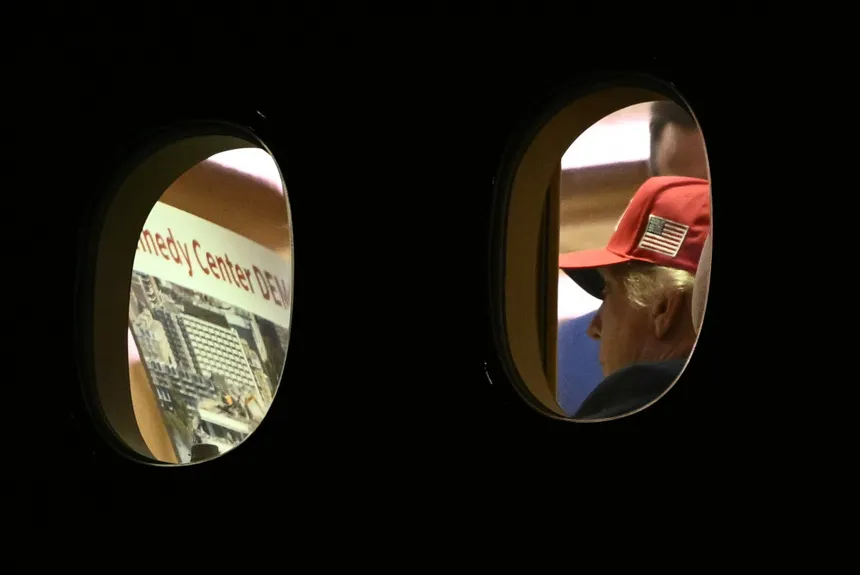
The photograph tells a story no one is disputing. On the evening of Wednesday, September 16, AFP photojournalist Brendan Smialowski aimed his lens through a window of Air Force One after the aircraft touched down at Joint Base Andrews. Framed in the interior light was the sitting President of the United States, Donald J. Trump, studying a large printed placard. The lettering across the top was unambiguous: KENNEDY CENTER DEMOLISH. Beneath it, per reporting by The New Republic, was imagery consistent with a demolition rendering. He was not scrolling on a phone. He was not glancing at a briefing binder. He was reviewing a plan to level the John F. Kennedy Center for the Performing Arts — the only living national memorial to an American president murdered in office.
Hours earlier, workers had erected black metal fencing around the Center. A staff member from the legal team of Rep. Joyce Beatty (D-Ohio), the Kennedy Center’s ex officio trustee and the plaintiff in the ongoing lawsuit challenging Trump’s takeover, had been turned away at locked doors. And a sworn declaration filed that same night in federal court alleged that a forklift, moving construction fencing near the north side of the building, had “run into and hit the pillars on the building” — repeatedly. As Snopes verified from the court filing, the account did not describe an accident. It described a pattern.
Twenty-four hours before, federal district judge Christopher “Casey” Cooper had issued a written order finding that the Trump-appointed Kennedy Center Board of Trustees was engaged in “linguistic gymnastics” to inscribe Trump’s name onto a federal memorial without congressional authorization. In direct and public response, the president threatened that if his name did not go on the building, the building would be closed indefinitely — and, in his own word on the tarmac that night, potentially “ripped down.”
What Americans are watching is not a real estate dispute. It is the unmistakable spectacle of a president treating a congressionally created national memorial as personal property, punishing a federal judge with a demolition threat, and — if the sworn declaration in Beatty v. Trump is accurate — permitting heavy equipment to damage the structure while the court was still in session. The stakes have moved from vanity to vandalism, and from vandalism to the raw constitutional question that has hung over this administration for months: is the man in the Oval Office still capable of discharging its powers?
I. The Photograph and the Placard
The Smialowski photograph, distributed by AFP and reproduced by outlets including CBS News, ABC News, and CNBC, is now a central piece of documentary evidence in a federal case. It depicts Trump aboard Air Force One after returning from North Carolina, where he had campaigned for Republican U.S. Senate candidate Michael Whatley. Earlier that same evening, speaking to reporters on the tarmac before takeoff, Trump made his intentions plain, according to a C-SPAN clip reviewed by The Hill: “For the Trump administration, for me, to get involved and to take that on… I think that the Trump administration should certainly have recognition. Because frankly, if we don’t do that, it’s going to close. It’ll end up being ripped down.”
The phrasing is not incidental. This is not a president describing structural risk. It is a president describing consequence — an outcome he controls, or believes he controls, if he is not given personal credit on a wall. Recognition, or ruin. And the placard photographed inside the plane suggests that “ruin” is not rhetorical decoration but a plan being actively contemplated. It is worth remembering that in February 2026, the same president told the White House press pool, per PBS NewsHour’s transcription, “I’m not ripping it down. I’ll be using the steel. So we’re using the structure.” The distance between that promise and the placard on Air Force One is measured not in policy shifts but in one adverse court ruling.
“Simply put, Defendants cannot install memorials for President Trump or anyone or anything else at the Kennedy Center without Congress’s blessing. The board resolution bucks a federal court order and a statute Congress enacted.”
— U.S. District Judge Christopher R. Cooper, Sept. 15, 2026
II. The Forklift, the Fencing, and the Filing
The court record filed by Rep. Beatty’s counsel — the veteran government-ethics attorney Norman Eisen and co-counsel Nathaniel Zelinsky — argues plainly that the sudden closure and construction activity are designed to circumvent the court itself. “Given the unexplained and unlawful closure,” the motion states, “it is possible Defendants intend to undertake immediate steps in order to make public access practically impossible for the foreseeable future, including by demolishing public avenues of access to the building, and thereby evade the Court’s order by fait accompli.” That is the legal Latin for what any reader can see with their own eyes: run the wrecking equipment before the judge can rule.
According to the sworn declaration reviewed by CBS News and independently verified by Snopes, the observer — identified in court filings as Bridget Kennedy-Bailey of Beatty’s legal team — arrived at the Center on the morning of September 16 to find the main doors locked and security personnel citing orders from unspecified “higher-ups.” Then came the fencing. Then came the forklift. Kennedy-Bailey watched, she attested under oath, as it “carried fencing” toward the north side of the building and repeatedly ran into and hit the pillars.
Snopes, which does not deal in speculation, was careful in its conclusion. Its fact-check found the underlying claim true — a legal observer did indeed swear that she saw it happen — while noting the fact-checker cannot yet determine the driver’s intent. Fair enough. But intent is not the only question the American public gets to ask. The question the public gets to ask is: why, after a federal judge ordered the president’s name off the building and blocked closure for cosmetic renovation, was a piece of heavy equipment repeatedly striking the pillars of a national memorial? And why did no one, apparently, tell the driver to stop?
The Placard
AFP photographer Brendan Smialowski captured Trump aboard Air Force One reviewing a large printout emblazoned “KENNEDY CENTER DEMOLISH.” The New Republic, Sept. 17.
The Sworn Declaration
A legal observer for Rep. Beatty filed a court affidavit reporting a forklift “run into and hit the pillars” of the Center repeatedly. Verified by Snopes, Sept. 17.
The Court Order
Judge Cooper’s Sept. 17 order requires 30 days’ written notice before “any ‘demolition’ of the Center’s main building.” ABC News.
The Tantrum
Rep. Joyce Beatty told MS NOW that Trump called her “dumb” and “incompetent” during the board meeting and threatened to hold her personally responsible “if something fell out of the ceiling and killed someone.” HuffPost.
III. Contempt in Everything But Name
Judge Cooper, an Obama appointee whose May 2026 ruling first ordered Trump’s name removed from the Kennedy Center facade, has now been forced to act three times to protect one federal building from one federal officer. On September 15, he ruled that the board’s proposal to affix “Restored and Renovated by President Donald J. Trump” to the facade — and to rename the campus “President Donald J. Trump Plaza” — constituted “linguistic gymnastics” and violated both his permanent injunction and the 1964 congressional statute that created the Center. On September 17, per ABC News, he issued a further order requiring the administration to give Rep. Beatty at least 30 days’ written notice before “any changes to the scope of the project plans… including but not limited to any ‘demolition’ of the Center’s main building.” No federal judge writes the word demolition into an order about a national memorial unless he has reason to believe demolition is being planned.
Beatty’s counsel, in a statement carried by CNBC, framed the events with precision: “Closing the Kennedy Center without Judge Cooper’s approval appears to directly violate his order. This is an assault on the rule of law.” That the president’s response to a court ruling stripping his name from a wall has been to threaten to knock the wall over is not an act of governance. It is, at minimum, contempt in everything but name. And the courts have taken notice.
Get Involved Today
Contribute to our mission and turn your concerns into action.
IV. The Board Call and the “Tantrum”
What happened inside the closed session of the Kennedy Center board on September 15 — the meeting at which Trump’s handpicked trustees voted to close the venue immediately — is now a matter of public testimony, courtesy of Rep. Beatty herself. Speaking to MS NOW’s “The Weeknight”, and separately to NewsNation and HuffPost, Beatty described the president’s conduct on the call in language that a member of Congress does not deploy lightly.
“It was the most unprofessional thing that I have ever witnessed or been a part of,” Beatty said. “He went into name-calling — everything from trying to say that I was an obstructionist, I was dumb. He said, ‘I think you’re incompetent.’ And I said, ‘I know you’re incompetent.'” She continued, describing the threat that has now been reported across three separate outlets: “He said he was going to hold me responsible if something fell out of the ceiling and killed someone. And I told him, I said, ‘You’re already killing people. We’re at war. We also have people who are starving. You’re doing this.'” A source familiar with the interaction, quoted by CNN and cited by The Daily Beast, characterized the exchange in blunter terms still.
“He doesn’t care about the jobs, the people who have worked there for years. He didn’t care about any of that. This is strictly because he lost in court. His name did come down, and he’s upset about it. So now he’ll tear it down.”
— Rep. Joyce Beatty (D-Ohio), Kennedy Center Trustee
Set aside for a moment the partisan valence and read that sequence as a citizen. A president loses a case. A president learns his name will come off a building. A president then, according to a sworn public account by a member of Congress, calls the plaintiff names, threatens to blame her for any physical injury inside the building he controls, and, hours later, is photographed reviewing a demolition graphic on his official aircraft. If this were a corporate executive threatening to burn down a headquarters he was ordered to hand over, we would call it what it looks like. There is no reason to grant a president a lower standard of behavior than a landlord.
V. The Kennedy the Center Was Built to Honor
It is worth pausing on what, exactly, this president is threatening to knock down. The John F. Kennedy Center for the Performing Arts was established by an Act of Congress in 1964 — the year after President Kennedy was assassinated in Dallas — as a “living memorial” to a president who died in the service of his country. It is not a Trump property. It is not a Kennedy family property. It is a memorial designated by the elected representatives of the American people to honor a man who took his oath at forty-three, called on a generation to ask what it could do for its country, and had his life ended by a rifle at forty-six. The bust of John F. Kennedy on the facade of the building is, per the congressional record and public documentation, one of the few authorized federal memorials to a martyred president in the capital.
The Kennedy Center is not neutral to Americans. It is where the National Symphony Orchestra plays, where the Kennedy Center Honors have inducted the artists who shaped the American century — Aretha Franklin and Ella Fitzgerald, Frank Sinatra and Bruce Springsteen. It is where First Ladies of both parties have hosted state artistic events. It is a shared inheritance. To threaten it because a court would not let one man’s name be nailed to its front is not merely small. It is an act of desecration against a man who is not here to defend himself, and against the tradition of civic memory that made his memorial possible.
That is the ground on which this fight is being waged. Not the maintenance schedule. Not the HVAC system. A national memorial to a slain president, being used as leverage in a personal grievance. That the sitting president would even conceive of the trade tells the American people something about his priorities that no press briefing can walk back.
VI. What Congress and the Courts Are Doing
The line of defense between the wrecking equipment and the building is holding, for now, by three separate threads. The first is Judge Cooper’s expanded order, requiring 30 days’ written notice of any project changes “including but not limited to any ‘demolition’ of the Center’s main building” — an unusual and revealing formulation, per The New Republic. The second is Beatty’s underlying lawsuit, Beatty v. Trump, which won its most recent ruling on September 15 and has now compelled the administration to file an executive-director sworn statement that the closure is “temporary,” lasting seven days and re-evaluated weekly. The third — and most far-reaching — is the pending appellate posture. The D.C. Circuit rejected Trump’s stay request in July; the administration has signaled a further appeal.
In Congress, the response has moved beyond litigation. Rep. Beatty testified before a joint Democratic oversight shadow hearing titled “Monumental Waste” in July, telling members that the Kennedy Center litigation is fundamentally about “protecting the rule of law and standing up for the only living memorial to John F. Kennedy,” according to her official statement. Rep. Jamie Raskin (D-Md.), the ranking member of the House Judiciary Committee, has taken the more consequential step of moving the conversation onto its constitutional terrain — a step that a growing chorus of medical and legal observers argues is no longer optional.
The 25th Amendment Case: When a President Threatens a Memorial
The mechanism. Section 4 of the Twenty-Fifth Amendment, ratified in 1967 in the wake of President Kennedy’s own assassination, was written precisely for a president who has not died or resigned but who cannot, or will not, discharge the duties of the office. It permits the Vice President and a majority of the Cabinet — or the Vice President and a body Congress may designate — to transmit a written declaration to Congress that the president is unable to serve. The president resumes power upon his own written declaration, unless the Vice President and the same body dispute it, at which point Congress decides.
The legislators moving now. On April 14, 2026, Rep. Jamie Raskin introduced legislation to establish a Commission on Presidential Capacity to Discharge the Powers and Duties of Office — precisely the “other body” the Amendment contemplates. Four days earlier, Raskin had written to White House Physician Capt. Sean P. Barbabella demanding an immediate cognitive and neurological evaluation of the president, citing the president’s “volatile, incoherent, and alarming public statements.” Sen. Ed Markey of Massachusetts and Reps. Yassamin Ansari and others have joined in public calls for evaluation of the president’s fitness, per The Independent.
The medical record, cited by name. As reported in The Hill, a public letter signed by 36 neurologists, psychiatrists, and mental health professionals concluded that the president shows “objectively observable” signs of decline, including “deterioration of cognitive function, grandiose and delusional beliefs, and severely impaired judgment and impulse control.” These are not anonymous social media diagnoses. They are credentialed clinicians putting their licenses to the letter. A February 2026 Reuters-Ipsos poll found that a majority of Americans — including 30 percent of Republicans — believe the president has become erratic with age.
The Kennedy Center as evidence. The pattern this week fits the concern the doctors raised on paper. Fixation on a personal slight. Retaliatory threats disproportionate to any provocation. Public conduct — a name-calling board meeting, a tarmac ultimatum, a demolition placard on Air Force One — that would end a private executive’s career overnight. This is not a policy dispute over which the reasonable minds of a functioning executive branch differ. It is the response of a man who cannot separate a court ruling from a personal wound, and who is willing to inflict damage on a national memorial to salve the wound.
The Practical Barriers — Named Honestly
Section 4 requires the Vice President and a majority of the president’s own Cabinet. Vice President JD Vance, a Trump loyalist, will not sign the letter. Neither will a Cabinet composed almost entirely of individuals whose appointments are owed to Trump personally. Congress can build the alternative body Raskin has proposed, but a two-thirds vote in both chambers is required to override a presidential objection. That is a mathematical impossibility in the current House and Senate. This is the truth, and it does not help anyone to pretend otherwise.
Why the Barriers Do Not Negate the Case
The 25th Amendment is not only a mechanism. It is a public standard — the standard the Constitution itself sets for when a president is unfit to serve. That standard exists whether or not the political will to enforce it exists on any given day. The Kennedy Center episode belongs in the historical record of that assessment, not as a partisan grievance but as documentary evidence: photographic, judicial, and sworn. When the political conditions change — and they do change — the record will be there, contemporaneous and undisputed. The purpose of Section 4 is not merely to remove. It is to warn. This week’s events are that warning, in the plainest possible form.
VII. What This Says About Priorities — and Leadership
The Kennedy Center employs hundreds of Americans. Its stagehands and ushers and musicians are the people who lose paychecks when a president closes a building to spite a judge. Beatty made that point in her MS NOW interview: “He doesn’t care about the jobs, the people who have worked there for years. He didn’t care about any of that.” That is the local cost. The national cost is larger. It is the message this episode sends to every federal court, every federal employee, every civic institution designated by Congress as a public trust: your protections are conditional on the president’s mood.
Set that against the substantive challenges the country actually faces this week — the ongoing military commitments, the domestic economy, the routine business of government — and the ratio is its own indictment. The sitting president has spent a working week fixated on a naming dispute over a building his predecessors, of both parties, treated as untouchable. The White House’s own response, delivered by spokesperson Davis Ingle to The Hill, was to accuse Beatty and other Democrats of putting “America Last” — a phrase that tries to minimize the actions of the president by deflecting blame on to the ones protecting American’s interests.
The question before the country is not whether the Kennedy Center will stand this month. It probably will, because the courts are still functioning and Judge Cooper is still writing orders and Rep. Beatty is still filing motions and the Constitution is still on paper. The question is what it means that we now need all three of those things to protect a memorial to a slain president from the sitting one. The answer is not comfortable, and it is not partisan, and it is not going to become less true if we look away.
Editorial Conclusion
A president who threatens to demolish a national memorial because a federal judge would not let him carve his name into it is not fit to hold the memorial’s key, let alone the office. The Kennedy Center will stand or fall this month on the vigilance of one federal judge, one member of Congress, and the sworn word of a legal observer. That the wall between one man’s grievance and a slain president’s monument is now that thin is the story. The Constitution provides a remedy — Section 4 of the Twenty-Fifth Amendment — for exactly this scenario. The political conditions to invoke it do not yet exist. The moral and constitutional case that it should be on the table does. The American people are entitled to a president who protects the country’s shared inheritance rather than holding it hostage. This week, they do not have one.
Sources & References
- NPR — Trump threatens to tear down the Kennedy Center, as legal battle continues (Sept. 17, 2026).
- CBS News — Kennedy Center says “nothing is being demolished” as Trump says it could be “ripped down” (Sept. 17, 2026).
- ABC News — Judge says Trump has to give 30 days notice before demolishing Kennedy Center (Sept. 17, 2026).
- The New Republic — Photographer Exposes Trump’s Kennedy Center Plan — and It’s a Bombshell (Sept. 17, 2026).
- The New Republic — Judge Ties Trump’s Hands on Changes to Kennedy Center (Sept. 18, 2026).
- Snopes — Legal observer said she saw forklift repeatedly hit Kennedy Center pillars (Sept. 17, 2026).
- CNBC — Trump photo appears to reference Kennedy Center demolition; judge orders advance notice (Sept. 17, 2026).
- CNBC — Trump’s Kennedy Center closure is ‘unlawful,’ Rep. Beatty tells judge (Sept. 16, 2026).
- CNBC — Trump says Kennedy Center will stay closed without renovation unless his name is added back (Sept. 15, 2026).
- CNN — Kennedy Center board votes to close for renovations after chaotic call with Trump (Sept. 15, 2026).
- ABC News — ‘Linguistic gymnastics’: Judge blocks adding Trump tribute to Kennedy Center (Sept. 15, 2026).
- The Hill — Beatty reveals heated discussion with Trump over Kennedy Center (Sept. 16, 2026).
- The Hill — Trump appears to review poster about Kennedy Center demolition on Air Force One (Sept. 17, 2026).
- The Hill (Opinion) — Concerns Grow Over Trump’s Mental Fitness for Presidency (June 10, 2026).
- HuffPost — Democrat Spills On Confronting Trump During Kennedy Center ‘Tantrum’ (Sept. 17, 2026).
- The Daily Beast — Trump’s Kennedy Center Foe Joyce Beatty Spills on His Deranged Threats (Sept. 17, 2026).
- MS NOW — Trump threw a ‘tantrum’ after losing Kennedy Center ruling, Rep. Joyce Beatty says (Sept. 17, 2026).
- House Judiciary Democrats — Raskin Introduces Legislation Establishing Independent Commission on Presidential Capacity (April 14, 2026).
- House Judiciary Democrats — Raskin Demands White House Physician Immediately Evaluate Trump’s Cognitive Fitness (April 10, 2026).
- Rep. Joyce Beatty — Testimony at Joint Oversight Shadow Hearing on Kennedy Center Takeover (July 22, 2026).
- PBS NewsHour — Trump says he’s not ripping down the Kennedy Center: ‘We’re using the structure’ (Feb. 2, 2026).
- Axios — Raskin demands Trump cognitive test in 25th Amendment push (April 10, 2026).
- The Independent (via AOL) — Renewed calls for Trump to be removed under the 25th Amendment (2026).
Related News