October’s consumer prices rose faster than Wall Street expected, core inflation refused to budge, and the government can’t even publish the annual figure Americans rely on most. A strong jobs report masks shrinking paychecks, the Federal Reserve is preparing to raise rates again, and a president who declared inflation “solved” a week ago is doubling down on the very policies driving it.
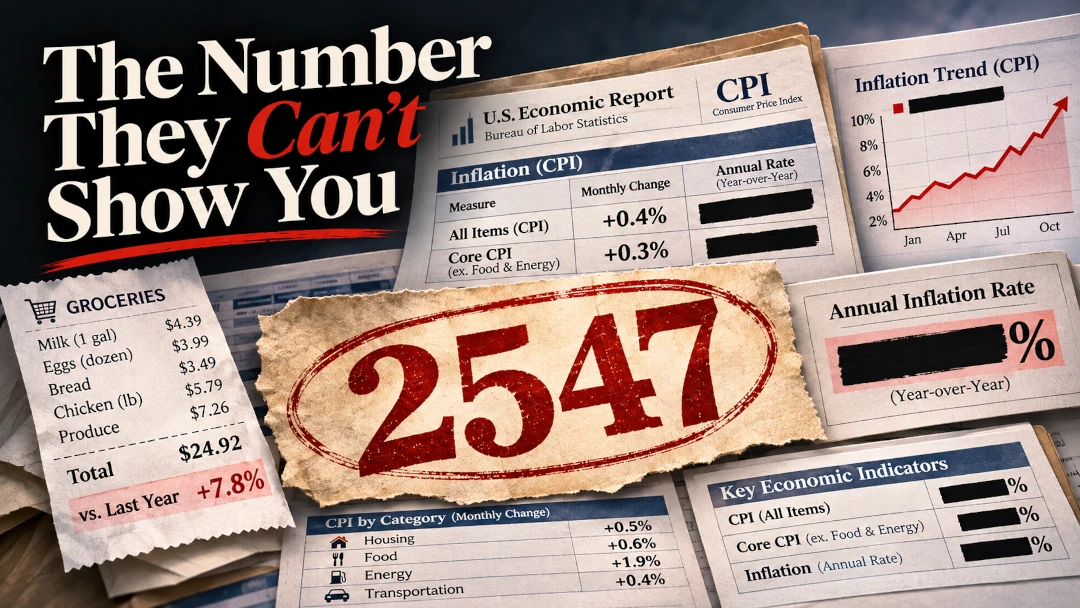
Every month, the Bureau of Labor Statistics hands the country a receipt. On Tuesday, the receipt for October came in: the Consumer Price Index rose 0.4 percent on a seasonally adjusted basis, after a 0.6 percent jump in September. Economists had braced for 0.3. Core prices, the measure that strips out food and energy to show where inflation is really headed, rose 0.3 percent, the same as in August and September and above the 0.2 percent forecasters expected. One week after voters handed both chambers of Congress to Democrats in a revolt over the cost of living, the data confirmed what every family already knew. Prices are not coming down, and the administration that promised to bring them down has no plan to do it.
I. Two Numbers, One Message
The two figures measure different things. Headline CPI covers the whole basket: rent, groceries, gasoline, electricity, doctor visits, car insurance. It’s what life actually costs this month. Core CPI leaves out food and energy because those prices swing with weather, wars, and OPEC, and what’s left shows the slower trend that the Federal Reserve watches most closely.
In October, both told the same story. Moody’s chief economist Mark Zandi told CNBC that core inflation would need to run steadily around 0.2 percent a month to be consistent with the Fed’s 2 percent target. Three straight months at 0.3 percent works out to an annual pace of roughly 3.7 percent. A 0.4 percent headline month, repeated for a year, would be close to 5 percent. Nothing in the report points toward relief.
Headline CPI · October
Above the 0.3% consensus and down only from September’s 0.6% spike. Shelter alone accounted for over thirty percent of the monthly increase.
Core CPI · October
The third straight 0.3% reading. BLS cites recreation, medical care, motor vehicle insurance, household furnishings and education. Economists had expected 0.2%.
Food · October
Grocery prices rose 0.4% and restaurant meals 0.5%, after a flat September, according to the BLS release.
Energy · October
A smaller rise after September’s 5.2% surge, but electricity still climbed 0.9% and gasoline rose 1.0% seasonally adjusted, per NAW’s breakdown.
Economists can name the causes. Josh Hirt, an economist quoted by CNBC, said core inflation reflects “three outsized shocks: tariffs, energy prices, and AI-related demand.” Two of those three come straight from decisions this president made: the tariff wall he has rebuilt again and again, and the war with Iran that sent energy prices soaring. Zandi pointed to toys, furniture and appliances, tariff-exposed goods where businesses are passing import taxes on to customers.
II. The Missing Number
Tuesday’s report left out the figure most Americans think of as “inflation”: the change in prices over the past twelve months. It is worth being precise about why, because accuracy is the point of this editorial.
The BLS didn’t refuse to publish it. It can’t calculate it. During last fall’s government shutdown, the bureau could not collect October 2025 survey data because of the lapse in appropriations. With no October 2025 index, there is nothing to compare October 2026 against. The bureau also said plainly that it cannot give data users specific guidance on handling the missing observations. The career statisticians followed their methodology, and nothing suggests otherwise.
The gap still matters. The last official annual readings, for September, were 3.7 percent headline and 2.6 percent core. Economists surveyed by Reuters, using substitute comparison indexes, estimated October’s unofficial annual rates at about 3.9 percent overall and 2.7 percent core. Navy Federal Credit Union chief economist Heather Long put the implied annual rate at roughly 4 percent. Even White House economic adviser Kevin Hassett acknowledged on Fox Business that energy prices are up about 20 percent over the year and gasoline about 37 percent. So the headline number the administration would least like printed — “inflation hits 4%” — simply never appears this month.
This administration has worked to blur exactly that number, which is why the gap deserves attention. In August 2025, President Trump fired BLS Commissioner Erika McEntarfer hours after a weak jobs report and accused her, without evidence, of manipulating data. The Friends of BLS, a group that includes former commissioners from both parties, warned that the firing “undermines the credibility of federal economic statistics.” When the shutdown later wiped out October 2025’s data, press secretary Karoline Leavitt blamed Democrats, saying they “may have permanently damaged the federal statistical system.” Weeks after that, Hassett argued on television that year-over-year inflation is the wrong measure and that Americans should look at three-month averages instead. That framing put inflation below the Fed’s target, and Hassett said “the president is thinking about it” the same way.
The White House didn’t cause this month’s gap. But an administration that has spent a year trying to steer the public away from annual inflation, and has fired the official responsible for the numbers, now benefits from a month when the annual figure doesn’t exist. Voters shouldn’t let the missing number make the problem look smaller than it is.
III. The Jobs Report Paradox
On paper, last Friday’s jobs report was a blowout. Employers added 165,000 jobs in October, nearly triple the 59,000 economists expected, and unemployment slipped to 4.1 percent. The White House will cite those numbers all winter.
The details are weaker. The number of Americans working part time because they can’t find full-time work jumped by 339,000 in one month to 4.84 million, and CNBC reported that long-term unemployment rose sharply. Average hourly earnings grew 3.1 percent over the past year. Set that against estimated annual inflation of 3.7 to 4 percent, and the typical worker’s paycheck buys less than it did a year ago. University of Michigan economist Justin Wolfers said real wages have been flat throughout Trump’s second term, and the Economic Policy Institute’s Ben Zipperer charted real wage growth declining in the months since the Iran war began.
Together the reports describe an economy that keeps growing while working families fall further behind. There are more jobs, but more of them are part-time, and pay rises are being eaten by prices. The strong jobs number also hurts in a second way. It gives the Fed room to keep raising rates, and the rate increases fall hardest on the borrowers least able to absorb them.
Get Involved Today
Contribute to our mission and turn your concerns into action.
IV. What It Means at the Kitchen Table
For the average household, the October report is a list of bills. Groceries are up again. Rent and housing costs, the biggest item in nearly every family budget, rose another 0.3 percent. The electric bill climbed 0.9 percent in one month. Car insurance and medical care, two costs families can’t easily cut, were among the leading drivers of core inflation.
Borrowing is getting more expensive at the same time. The 30-year fixed mortgage averaged 7.33 percent in October, up nearly half a point from September, after touching 7.40 percent, its highest level since 2023. Every Fed hike feeds into credit card rates, auto loans and home equity lines. For a family already carrying debt to cover higher prices, a rate hike adds to the problem instead of relieving it.
“The inflation is solved.”
— President Donald Trump, Fox News phone interview, Election Day, November 3, 2026 · via Moneywise
V. Wall Street’s Verdict
Markets reacted quickly. Before the release, Fed Governor Christopher Waller said in a London speech that “a stronger policy move may be needed” if core inflation came in at 0.3 percent, meaning a half-point hike in December instead of the usual quarter point. The report then showed core at exactly 0.3 percent. By early afternoon, according to the Associated Press, the S&P 500 was down 0.9 percent and the Dow had lost 319 points. That erased part of Monday’s big rally, as rising Treasury yields hit rate-sensitive stocks.
The market’s view is that the Fed will raise rates again, possibly by more than usual, and that it is acting because the White House has given it no other option. The Fed already raised its benchmark rate in September to a range of 3.75 to 4 percent. That was its first hike in more than three years, and Chairman Kevin Warsh, Trump’s own appointee, made it over the president’s repeated demands for lower rates. The president wanted cheap money. His tariffs and his war have produced a central bank that has to tighten.
VI. The Political Reckoning
The report came one week after Democrats took control of both the House and the Senate in a midterm election that turned on affordability. Democratic leaders tied the numbers directly to the president. Senate Democratic leader Chuck Schumer said, “From his costly tariffs to his reckless war, Trump has only made inflation worse.” Rep. Brendan Boyle of Pennsylvania, the House Budget Committee’s ranking Democrat and its likely next chairman, said, “Unless you’re a billionaire, Donald Trump’s economy is simply too expensive,” and promised a new agenda focused on lowering costs and protecting health care. House Democratic Leader Hakeem Jeffries has begun his campaign for speaker with a pledge to eliminate the Trump tariffs entirely. That position has broad support: an NBC News exit poll found two-thirds of midterm voters believe the tariffs have hurt the economy.
The administration’s response has shifted between partial admission and denial. Hassett called the October numbers disappointing and pointed to energy. Trump declared on Election Day that inflation was solved and credited falling oil prices and a naval blockade of the Strait of Hormuz. Republicans in Congress, who spent the campaign blaming the Biden administration and calling the price spikes temporary, lost both chambers. The White House has taken a different lesson from the defeat than voters intended.
“We are quadrupling down on tariffs.”
— Peter Navarro, White House trade adviser, four days after the midterms · The Washington Times
VII. What Trump Is Actually Doing
The administration has taken some steps on prices. Many are small or mostly for show, and every one of them is outweighed by the tariffs and the war, which the president refuses to reconsider.
Draining the Oil Reserve
In March, Trump ordered 172 million barrels released from the Strategic Petroleum Reserve, the second-largest release ever. Eurasia Group’s Clayton Allen told CBS it was far too small to offset the war’s hit to supply.
Leaning on Retailers
A White House release in August listed voluntary price cuts by grocers and brands as proof of progress. Rotating discounts at a few chains are not economic policy, and October’s 0.5% food increase shows they haven’t worked.
Evading the Supreme Court
After the Court ruled in February that emergency powers don’t authorize his tariffs, Trump reimposed them under a different statute and raised the blanket rate from 10% to 15%.
Planning More Tariffs
Goldman Sachs economists Alec Phillips and Abhay Duggirala told clients they expect Trump to announce new tariff increases after the election, pushing the effective tariff rate up by nearly two percentage points.
Denying the Problem
On Election Day, with gas prices at a record national average for the date, the president told Fox News inflation was “solved.” He made the claim one week before a hotter-than-expected inflation report.
Blaming the Messenger
The administration fired the BLS commissioner over unwelcome data and blamed Democrats for damaging the statistical system. Meanwhile it promoted measures of inflation that make the numbers look better.
The pattern shows the administration’s priorities. Faced with prices it largely caused, the White House has drawn down an emergency oil stockpile, announced voluntary corporate discounts, and promoted more favorable ways of measuring inflation. It has not changed the policies behind the problem. It has expanded the tariffs, kept the war going, and attacked the agencies that report the results. A president focused on families’ finances would treat the October report as a warning. This one has treated similar data as a messaging problem.
VIII. How We Got Here
Who Holds the Power Over Prices — and Who Has Been Using It
Article I, Section 8: The Taxing Power Belongs to Congress
The Constitution gives Congress, not the president, the power “To lay and collect Taxes, Duties, Imposts and Excises.” Tariffs are taxes paid by American importers and, in the end, American consumers. In February the Supreme Court confirmed that the International Emergency Economic Powers Act does not give the president tariff authority. Trump’s response was to find another statute and raise the rate. When a president treats a constitutional ruling as a drafting problem, he is no longer respecting the separation of powers.
Section 122 of the Trade Act of 1974: A Built-In Clock
The replacement blanket tariff relies on authority that caps the surcharge at 15 percent and limits it to 150 days unless Congress votes to extend it. That puts real power back with the legislature. The new Democratic majorities can let temporary tariffs expire by refusing to extend them, and they won’t need to override a veto to do it.
The Federal Reserve Act: Stable Prices Is a Legal Mandate
Congress directs the Fed to pursue maximum employment, stable prices and moderate long-term interest rates. Chairman Warsh’s September hike was the Fed carrying out that law despite pressure from the president who appointed him. Fed independence is what is keeping price stability from becoming a political choice.
Statistical Integrity: The Public’s Right to Know
The BLS exists so that the public, markets and lawmakers can rely on numbers no politician controls. Long-standing federal statistical policy requires agencies like the BLS to produce data that are credible and objective, free of political interference. Firing a commissioner over unwelcome results, without evidence, attacks that principle directly. Congress should write into law protections against removing statistical agency heads for political reasons. It should also fund the BLS fully, so the next missing number isn’t the result of neglect.
IX. The Long Road: Rates and the Economy Ahead
The near-term outlook is clear. The Fed is widely expected to raise rates again next month, and the only open question is whether by a quarter point or a half. The Fed’s own September projections had headline inflation falling to 2.3 percent and core to 2.5 percent in 2027, and they did not expect inflation to reach the 2 percent target until 2029. If that holds, inflation will have run above target for roughly eight years.
Relief is possible, but it depends on decisions in Washington. Zandi said the inflationary effect of the tariffs should fade by year’s end, as long as the White House doesn’t add new import taxes. Goldman Sachs expects it to do exactly that. The longer the Iran war continues, the longer energy keeps pushing prices up. The AI investment boom adds more demand that the Fed can only offset by squeezing the rest of the economy.
The danger is that the Fed keeps raising rates to fight inflation caused by tariffs and war, while the underemployment numbers show the labor market weakening under the surface. In that case, Main Street pays twice: once at the checkout and again in higher borrowing costs and slower hiring. A softer path is possible only if the White House stops adding to the problem.
X. What You Can Do
Voting has already changed Congress. The fight now moves to the new Congress, the courts and public pressure. Here are five realistic options.
Push the new Congress to end the tariffs
When the new Congress meets in January, ask your representative and senators to oppose any extension of the temporary blanket tariffs and to back legislation returning tariff authority to Congress. Find your members here.
Demand protection for the statistical system
Call for full BLS funding and for statutory protections so statistical agency heads can’t be fired for reporting bad news. Accurate data is how the public holds every administration accountable.
Insist on a war-powers vote
Energy is the biggest driver of this year’s inflation. Tell your members that Congress, which the Constitution gives the power to declare war, must vote on whether the conflict with Iran continues.
Protect your own household before December
With another rate hike likely, variable-rate debt such as credit cards and home equity lines will cost more. Car insurance is among the fastest-rising core costs, so compare quotes at renewal.
Report price gouging
If prices on tariff-exempt goods stay high, or a company is clearly using “tariffs” as cover, report it to the Federal Trade Commission and your state attorney general.
Editorial Conclusion
October’s report shows that inflation in this country is now largely self-inflicted. It comes from a tariff wall the Supreme Court said the president had no authority to build, and from a war Congress never declared. The White House answers each bad report by questioning the measurement, firing the statistician or calling the problem solved.
Americans don’t need an annual number to know their paychecks buy less than they did a year ago. What they need, and what the Constitution provides, is a Congress that will use its power over taxes and war, a central bank free to do its job, and statistics no president can intimidate. Voters delivered that Congress last week. Now it has to use its power.
Sources & References
- U.S. Bureau of Labor Statistics — Consumer Price Index – October 2026 (USDL-26-1685)
- U.S. Bureau of Labor Statistics — 2025 Lapse in Appropriations: Revised Release Dates and CPI Note
- CNBC — Here’s the inflation breakdown for October 2026 — in one chart
- National Association of Wholesaler-Distributors — October CPI Decelerates but Still Tops Expectations as Core Inflation Persists
- Common Dreams — ‘Big Jump in Grocery Prices’ Highlights How Trump’s Iran War Kept Hammering Consumers in October
- House Budget Committee Democrats — Boyle Statement on October 2026 CPI Inflation Data
- NBC News — White House says key economic reports may not be released
- Reuters via Yahoo Finance — Hassett says Trump is right where others are wrong about inflation
- PolitiFact — Trump’s baseless ‘manipulated’ data claim in firing BLS chief Erika McEntarfer
- CNBC — U.S. economy added 165,000 jobs in October, way more than expected
- Forbes — The October Jobs Report’s Hidden Warning: 339,000 More Underemployed
- Associated Press via BNN Bloomberg — U.S. stocks fall after a discouraging update on inflation
- CNBC — Fed approves interest rate hike, signals one more to come this year
- National Association of Home Builders — Mortgage Rates Climb in October Amid Accelerating Inflation
- Moneywise — Trump claims ‘inflation is solved’ with gas prices still over $4 per gallon
- The Washington Times — Navarro: ‘We’re quadrupling down on tariffs’
- Fortune — Wall Street is bracing for a fresh wave of tariff hikes after the midterms
- Al Jazeera — Can Democrats stop Iran war, reverse Trump’s tariffs after midterms win?
- CBS News — Here’s what the Trump administration is doing to lower oil and gas prices. Is it working?
- The White House — Private Sector Answers President Trump’s Call to Lower Prices for American Families
Related News