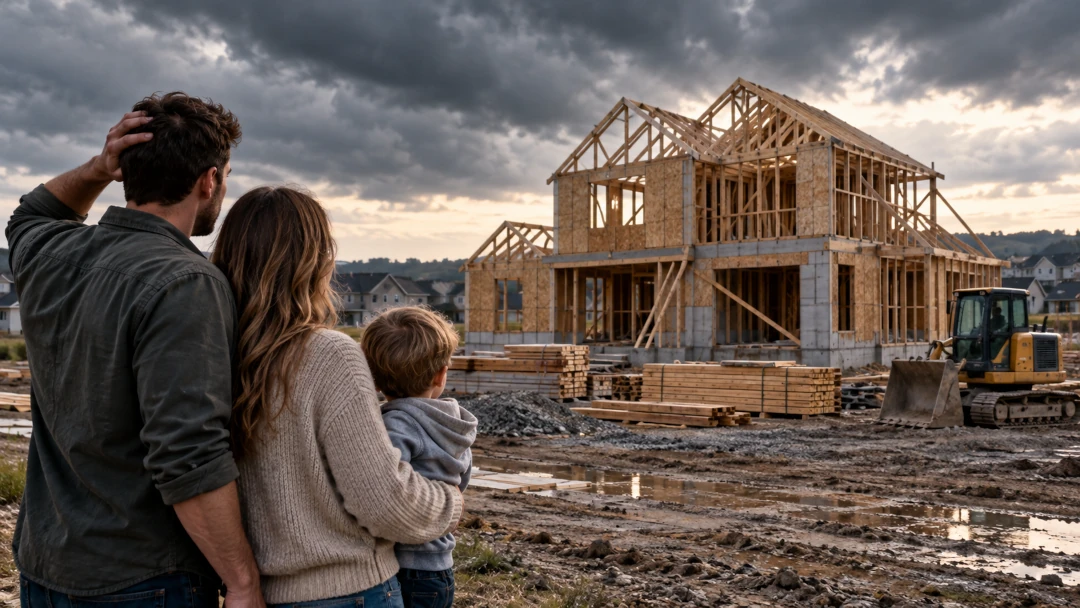
Builders Haven’t Been This Scared Since 2012. Blame the Man With the Tariff Pen.
The nation’s homebuilders just posted their gloomiest reading in more than fourteen years — back to the moment the country was finally crawling out of the 2008 wreckage. Tariffs on the materials that frame a house, a war-driven energy shock pushing diesel and mortgage rates to multi-year highs, and immigration raids emptying job sites have turned the American Dream into a clearance sale nobody can afford to shop.
On Monday, October 19, the National Association of Home Builders released a number that should alarm every family hoping to own a home and every renter hoping their lease won’t climb again. The NAHB/Wells Fargo Housing Market Index fell three points to 29 in October, down from 32 in September. According to Reuters, that is the lowest reading since June 2012 — and economists had expected 31.
Remember what June 2012 was. It was the bottom of the hangover, the moment the housing market was only just beginning its real recovery from the 2008 financial collapse. Briefs Finance noted that the industry was still climbing out of the post-2008 slump at that point. Fourteen years of recovery have now been erased in builders’ own estimation — not by a banking collapse, but by a string of policy choices made in Washington this year.
(50 = neutral)
in October
mortgage rate
I. Inside the Collapse
Every part of the index fell. The NAHB index is built from three gauges, and as The Asia Business Daily laid out, current sales conditions slipped two points to 33, expectations for the next six months fell five points to 32, and prospective buyer traffic fell five points to just 18. NAHB Chief Economist Robert Dietz said buyer traffic is now at its weakest since April 2012, excluding the pandemic shock of April 2020.
The index has been below the 50-point line separating good from poor conditions for 30 straight months, per TheStreet, and below 40 for 18 straight months — the longest such stretch since 2012. This is not a blip. It is a slow-motion seizure in the one industry that most directly determines whether America builds enough homes for its people.
“Housing remains squeezed by supply-side constraints and significant affordability challenges.”
— Robert Dietz, NAHB Chief Economist, via Briefs Finance
Builders are doing what businesses do when customers vanish: they are slashing prices and throwing in sweeteners. The evidence is stark.
Price Cuts at a Record Share
Share of builders cutting prices in October, up from 38% in September — the highest during the 2020–2026 period, according to the NAHB.
Average Discount
The average price reduction held at 6% for a seventh consecutive month, Dow Jones reported via Morningstar.
Incentives Everywhere
Builders using sales incentives such as mortgage rate buydowns — the 19th straight month above 60%, per HousingWire.
Buyers Disappearing
The buyer-traffic gauge — its weakest since April 2012 outside the pandemic’s onset, per Reuters. Unsold inventory is discouraging new groundbreakings.
Raids on the Job Site
More than a third of builders reported immigration enforcement in their markets in the past month, causing delays and keeping even legal workers home, Reuters reported.
Materials Inflation
Year-over-year jump in prices charged by building material and supply dealers in September, per producer price data cited by Briefs Finance.
Economists see no quick turnaround. Capital Economics estimates 2026 is on track to be the weakest year for home sales since 2011, and Oxford Economics’ Sara Godfrey expects housing to stay stagnant through next year, Briefs Finance reported. The NAHB itself forecasts single-family construction will shrink 4% this year and another 3% in 2027, according to ROIC.
II. Three Wounds, One Source
NAHB Chairman Bill Owens, a builder and remodeler from Worthington, Ohio, named the forces at work in plain language. Speaking to Reuters, he pointed to costlier construction loans, building materials and diesel, plus persistent labor shortages. Each of those wounds traces back to a decision made by this administration.
Wound one: rates driven up by a war of choice. The conflict in Iran, ABC News reported, began with a large-scale U.S.-Israeli attack in late February and led Iran to nearly close the Strait of Hormuz, which carries a fifth of the world’s crude. Energy prices surged, inflation followed, and on September 16 the Federal Reserve under Chair Kevin Warsh raised rates for the first time in three years, citing energy prices as the main driver. By October 8, Freddie Mac’s 30-year average hit 7.40% — the highest since November 2023, with the 10-year Treasury at its highest level since 2002.
Wound two: tariffs on the bones of a house. Even after the Supreme Court struck down the president’s emergency tariffs in February, the duties that matter most to builders remain. A tariff tracker compiled by HomeSnacks lists 50% tariffs on steel, aluminum, and copper products; a 10% tariff on softwood lumber with roughly 35% in additional Canadian duties stacked on top; and 25% tariffs on kitchen cabinets and vanities. Federal producer price data cited there show aluminum mill products up more than 52% in a year and copper and brass up 26%. A Center for American Progress analysis cited by Rep. Don Beyer estimates these tariffs could raise the cost of building a home by $17,500 and cut new construction by 450,000 homes through 2030.
Wound three: raids that empty the job site. The NAHB has warned that foreign-born workers make up more than a third of the residential construction workforce, Scotsman Guide reported, as the administration stripped Temporary Protected Status from workers who had legal authorization. HousingWire has documented ICE operations at construction sites leaving crews — including workers here legally — afraid to show up, pushing up labor costs and delaying projects. Research on the Obama-era Secure Communities program found that deportations cut new home construction by nearly 6%, Construction Owners reported. You cannot deport your way to more houses.
III. The Diesel Squeeze
Diesel is the fuel of construction itself — the excavators, the concrete trucks, the flatbeds hauling lumber and drywall. Federal data show the national average hit a record $6.53 a gallon on September 21, well above the 2022 peak. University of Houston energy economist Ed Hirs told The National News Desk that diesel is expensive primarily because of the Iran war and the Hormuz blockade — not, as the White House has claimed, because of Democrat-led states.
The president’s answer was a stage prop. On October 5, at a campaign rally in Grand Island, Nebraska, he signed an executive order letting drivers temporarily use tax-free red-dyed diesel normally reserved for farms and off-road equipment. He promised sweeping relief.
“This order will also drive down the cost of all goods, including grocery prices, very substantially.”
— President Donald Trump, Oct. 5 rally in Nebraska, via KUTV / The National News Desk
The people who actually buy diesel weren’t persuaded. Todd Spencer, president of the Owner-Operator Independent Drivers Association, said wider use of red-dyed diesel would provide “minimal relief.” Hirs warned it could even backfire on farmers if large fleets start competing for their supply. The order, ROIC noted, only asks Treasury to consider deferring certain diesel taxes — not forgiving them. Prices stood at $6.28 days later.
IV. What It Means at the Kitchen Table
For a family trying to buy, the arithmetic is brutal. At last year’s rate of roughly 6.3%, a typical loan’s principal and interest ran about $1,981 a month; at today’s 7.40%, the same loan costs about $2,216, according to SwitchWize’s amortization math. That is roughly $235 more every month — about $2,800 a year — for the identical house. Builder discounts help at the margin, but a 6% price cut is quickly swallowed by a rate that keeps climbing.
For renters, the news is no better. Harvard’s Joint Center for Housing Studies found that a record 22.7 million renter households — nearly half of all renters — spend more than 30% of their income on rent and utilities, and about 12.1 million spend more than half. Rents stood 29% higher in early 2026 than in 2020, and 83% of renters earning under $30,000 are cost-burdened. When builders stop breaking ground, the shortage that keeps rents high only deepens — the NAHB puts the national shortfall at roughly 1.2 million homes.
And the pain travels. Fewer starts mean fewer jobs for carpenters, electricians, and plumbers; fewer furniture and appliance sales; and a frozen market where homeowners can’t sell and young families can’t buy. The housing slump is not a niche industry story. It is a story about whether a generation gets to build wealth at all.
V. How We Got Here
VI. What Congress and the Democrats Are Doing
Credit where it is due: the biggest housing law in decades passed with both parties’ votes. The 21st Century ROAD to Housing Act cleared the Senate 85–5 and the House 358–32. Co-led by Sen. Elizabeth Warren and Republican Sen. Tim Scott, it bars corporate investors already owning 350 or more homes from buying more single-family houses to rent out, and it expands financing, encourages modular “innovative housing,” and adds new renter protections. House Democrats in the New Democrat Coalition, led on housing by Rep. Norma Torres, say 11 of their members’ bills were folded into the House version.
But a supply bill cannot outrun a cost shock. That is why Democrats have gone straight at the tariffs. The Rosen-Coons Housing Tariff Exclusion Act would automatically exempt many building materials from current and future tariffs and create a fast-track exclusion process for others. Rep. Nanette Barragán of California carried the House companion, which the NAHB helped write — a striking alliance between progressive lawmakers and an industry group that rarely leans left. Rep. Beyer’s bill goes further, eliminating the tariffs on key home products and requiring congressional approval before any new ones can be imposed while the housing crisis lasts.
None of these tariff bills has received a vote. All sit in committees controlled by the president’s party. On immigration, the NAHB has prioritized the bipartisan DIGNITY Act to stabilize the construction workforce — another measure going nowhere while the administration treats job-site raids as a campaign talking point.
The administration’s own housing moves have focused on deregulation and mortgage paperwork: two March executive orders on permitting and mortgage credit, and a pre-midterm order on mortgage fees whose draft even proposed appraisal technology built on “Super Intelligence.” Owens has acknowledged that regulatory reform eases some cost pressure. But trimming closing costs while doubling down on metal tariffs and a war-driven energy shock is like mopping the floor while the pipe is still burst.
The Tariff Power Belongs to Congress — and Congress Can Take It Back
“The Congress shall have Power To lay and collect Taxes, Duties, Imposts and Excises…” — U.S. Constitution, Article I, Section 8
The Framers did not hand the taxing power to the executive. Tariffs are taxes, paid by American importers and passed to American buyers. In February, the Supreme Court enforced that principle in Learning Resources, Inc. v. Trump, holding 6–3 that the International Emergency Economic Powers Act does not authorize the president’s sweeping tariffs. Writing for the majority, Chief Justice John Roberts said the president must point to clear congressional authorization for such power, then added two words: “He cannot.”
The administration’s response was to shop for another statute. Its replacement 10% global tariff under Section 122 of the Trade Act of 1974 was itself ruled unauthorized by the Court of International Trade in May, though that order is stayed on appeal. Meanwhile, the duties hitting builders hardest rest on Section 232 “national security” findings — an authority Congress delegated and Congress can narrow.
That is the accountability lever. The Rosen-Coons, Barragán, and Beyer bills are not just economic policy; they are Congress reasserting an Article I power it has let drift to the White House. A president who taxes lumber, steel, and cabinets in the middle of a housing emergency is exercising authority on loan from the people’s representatives. The loan can be recalled.
VII. What This Says About Priorities
Look at the choices in sequence. A war launched with an ally that sent oil, diesel, and inflation soaring. Tariffs on the metals and wood that hold up American homes, defended even after the Supreme Court rebuked the legal theory behind them. An enforcement campaign aimed at the very workforce that frames, roofs, and wires the nation’s houses. And, when the bill came due, an executive order signed as a rally prop and mortgage tweaks timed for the midterms.
Even the Federal Reserve chair this president appointed declined to play along. When Warsh raised rates in September, he defied Trump’s public demands for cheaper borrowing, The Irish Times reported, because the energy inflation unleashed by the war left him little choice. The president wants low rates and high tariffs, cheap diesel and an open-ended war, more houses and fewer workers to build them. Those wishes cannot all come true, and families are absorbing the contradiction in their mortgage payments and rent checks.
Leadership means choosing the American family’s ability to afford a roof over the satisfaction of a trade-war posture or a show of force at a rally. On housing, this White House keeps choosing the posture.
Get Involved Today
Contribute to our mission and turn your concerns into action.
VIII. What You Can Do
Voting on November 3 matters enormously — control of both chambers will decide whether the tariff-relief bills ever reach the floor. But there is more you can do this week, whether you rent, own, or are trying to buy.-
Demand a Vote on Tariff Relief
Call your representative and senators through the Capitol switchboard and ask them to cosponsor and demand floor votes on the Housing Tariff Exclusion Act (Rosen-Coons in the Senate, Barragán’s H.R. 10416 in the House) and Beyer’s Homebuilding Materials Tariff Relief Act (H.R. 9977). Name the bills. Staffers tally calls by bill number.
-
Show Up for Local Housing
Much of what blocks construction is decided at your city or county planning board. Attend hearings, speak in favor of new apartments, accessory dwelling units, and missing-middle housing, and watch for how your local government uses the new planning grants in the ROAD to Housing Act.
-
Push for Workforce Immigration Reform
Tell your members of Congress to back the bipartisan DIGNITY Act and a construction guest-worker pathway. Builders and their trade association are already asking; constituent voices make it politically safer for lawmakers to say yes.
-
If You’re Buying, Use the Leverage
With 43% of builders cutting prices and roughly two-thirds offering incentives, buyers of new homes have bargaining power they haven’t had in years. Ask about rate buydowns, compare at least three lenders, and look into first-time buyer and down-payment programs from your state housing finance agency.
-
If You Rent, Organize
Learn your state and local tenant protections, connect with a tenants’ union or local housing advocacy group, and support rent-stabilization and just-cause eviction measures where they are on the ballot or before your city council.
Honest assessment: None of these steps will lower mortgage rates next month — those are tethered to an energy shock and a Fed fighting inflation. Tariff relief cannot pass while committee leaders keep it bottled up. But pressure works on the margin, local zoning fights are winnable now, and the November elections decide who sets the agenda in January.
Editorial Conclusion
A builder-confidence reading of 29 is not an abstraction. It is a warning that the homes this country needs are not going to be built — because a president taxed the lumber and steel, chased away the workers, and drove up the cost of the fuel and the money it takes to build them.
The Constitution gave the power over tariffs to Congress for exactly this reason: so that no single official could tax the American household on a whim. Congress must take that power back, pass tariff relief for building materials, and fix the workforce crisis it has ignored.
A roof over every family’s head is not a trade-war bargaining chip. It is a basic measure of whether this government serves its people — and right now, it is failing that test.
Sources & References
- NAHB — Builder Sentiment Falls on Rising Rates (Oct. 2026 HMI)
- Reuters / Yahoo Finance — US homebuilder sentiment tumbles to near 14-1/2-year low
- Briefs Finance — Homebuilder sentiment sinks to lowest since 2012
- Dow Jones / Morningstar — U.S. Home-Builder Sentiment Sinks to 14-Year Low
- TheStreet Pro — Homebuilder Sentiment Falls to Lowest Since 2012
- Reuters / BusinessDay — US homebuilder sentiment declines to 14-year low
- HousingWire — Mounting ICE raids leave homebuilding’s frontlines frozen in fear
- ABC News / ABC11 — Federal Reserve expected to raise rates for first time since 2023
- New Jersey Monitor — Fed raises interest rates for first time in 3 years
- SwitchWize — Mortgage rates at 7.40%: payment math and Freddie Mac data
- HomeSnacks — How much do tariffs add to the price of a new house in 2026
- The National News Desk / OKCFox — Truckers and economist question Trump’s diesel order
- Media Bias / Fact Check — Did U.S. diesel prices reach an all-time high in September 2026?
- NAHB Blog — House Bill Seeks Tariff Relief for Building Materials
- Office of Sen. Jacky Rosen — Rosen, Coons Introduce Bill to Exclude Homebuilding Materials from Tariffs
- Capitol Releases (Rep. Don Beyer) — Beyer Introduces Bill to Reduce Homebuilding Costs
- PBS NewsHour / AP — House gives final approval to landmark housing bill
- Congressional Research Service — Housing for the 21st Century Act (R48849)
- Housing Finance — Harvard report: affordability crunch continues
- Manitoba Co-operator / Reuters — Trump declares global tariff after Supreme Court decision
Related News