Billions Flow Back to the Boardroom. Not One Dollar Reaches Your Kitchen Table.
The Supreme Court ruled in February that Donald Trump’s signature tariffs were illegal. Six months later, Washington has refunded $100 billion to the same importers who raised prices on everything from iPhones to groceries — while the money promised directly to the American people has never materialized, and the administration has spent every day since finding a new legal doorway to keep the tariffs coming anyway.
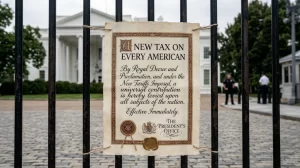
Six months ago, the Supreme Court told Donald Trump something no president has been told quite this bluntly in decades: he had been taxing the American public illegally. In a 6-3 ruling in Learning Resources v. Trump, Chief Justice John Roberts wrote plainly that the 1977 emergency powers law the president invoked to justify his “Liberation Day” tariffs, and the fentanyl-related duties on Canada, Mexico, and China, “does not authorize the President to impose tariffs.” Six justices, including two of Trump’s own appointees, agreed. The ruling should have been the end of an illegal tax that had already cost American households an estimated $1,745 apiece over the previous year, according to Treasury’s own figures cited in recent reporting. Instead, it became the opening chapter of a much stranger story: one where corporations are getting their money back by the billion, ordinary people are getting nothing, and the president has simply gone shopping for new legal authority to keep charging everyone anyway.
The refund math is not in dispute. By early August, Customs and Border Protection had processed roughly $100 billion of the $166 billion collected under the tariffs the Court struck down. That money is not going to shoppers. Under Customs and Border Protection rules, refunds flow only to the “importer of record” — the corporation that wrote the check to the government — with no mechanism to route a dollar of it back to the households who paid the higher shelf prices those tariffs caused. Households, meanwhile, are estimated to have absorbed roughly $231 billion in tariff costs over the same period. The gap between what corporations are getting back and what consumers ever see is, by design, total.
I. The Windfall
Apple’s most recent quarterly results make the pattern plain. The company disclosed an estimated $2.19 billion in tariff refunds, a windfall that single-handedly added two full percentage points to its gross margin and eleven cents to its earnings per share. Strip the refund out and Apple’s “record” quarter was, in truth, an ordinary one. CEO Tim Cook has said the money will go toward domestic manufacturing investment — not toward the customers who paid more for their iPhones during the year the tariffs were in effect. Newsweek found no indication that any portion will reach consumers directly.
Apple is not unusual. It is the norm.
Apple
Refund lifted gross margin two points and EPS by 11¢ this quarter alone. Roughly $1B more is expected in September. Earmarked for U.S. manufacturing investment, not price cuts. Source
Nike
The refund alone added roughly nine percentage points to Nike’s gross margin for the quarter — a bigger swing than most retailers see from an entire year of strategy. Source
Sony
Drove a 37% jump in operating income — after the company raised PlayStation prices twice in a year. Customers have sued, alleging a “double recovery windfall.” Source
Amazon
Has signaled only “limited” customer reimbursements, even as its refund total continues to climb alongside the rest of the CBP disbursement schedule. Source
Walmart
CFO John David Rainey says the company will “invest in the customer and invest in price” — but faces an Ohio class-action lawsuit alleging 20–30% tariff-era markups, and no refund has reached a single customer’s receipt. Source
Target
This projection, provided by Citi in April 2026, positions the retailer as one of the largest beneficiaries among U.S. importers. Target has not publicly committed to passing any portion of these funds back to customers through rebates or price reductions. Source
To be fair to Walmart, Costco, UPS, and FedEx: each has publicly said it intends to direct at least some refund money toward lower prices, and Walmart has pointed to roughly 7,200 items now selling at reduced prices. But “intends to” is doing a great deal of work in that sentence. There is still no dollar amount attached, no timeline, and — because CBP has no consumer-refund mechanism — no way for a shopper to verify that any specific price cut is tariff money and not ordinary retail churn. Target, as one of the largest beneficiaries among U.S. importers, has not publicly committed to passing any portion of these funds back to customers through rebates or price reductions.
Meanwhile, one detail companies rarely volunteer: under IRS “tax benefit rule” guidance, most of these refunds are not tax-free windfalls — they are ordinary taxable income, since the tariffs were originally written off as a deductible cost of doing business. That is a modest silver lining for the Treasury. It is no comfort at all to the family that paid full, tariff-inflated price for a washing machine last year and will never see a cent of it back.
“If there is a payout, it’s just going to be the ultimate corporate welfare.”
— Scott Bessent · U.S. Treasury Secretary
Even Trump’s own Treasury Secretary has said the quiet part out loud. Speaking hours after the February ruling, Bessent predicted flatly that ordinary Americans “won’t see” any benefit from the refunds, and separately challenged corporations to explain publicly how they intended to get money back to the consumers who, by industry’s own prior arguments, had paid every dime. Six months on, according to a Coalition for a Prosperous America review of earnings calls, essentially no major importer has answered that challenge with a number.
II. What’s Still On the Shelf Tag
Here is what the Supreme Court’s ruling did not do: end the tariffs. The February decision applied narrowly to duties imposed under the International Emergency Economic Powers Act. Tariffs imposed under other statutes — Section 232 of the Trade Expansion Act and Section 301 of the Trade Act — were never before the Court and remain fully in effect today. Steel and aluminum are tariffed at 50%. Copper sits at 50%. Automobiles carry a 25% duty, semiconductors 25%, lumber 10%. Section 301 tariffs on Chinese goods run as high as 100% on some categories, with new forced-labor investigations opened against roughly 60 additional countries this year.
The economic effect has been exactly what economists predicted when these policies began. Federal Reserve researchers estimate tariffs pushed core goods prices up roughly 3.1% through early 2026, and Harvard economist Alberto Cavallo’s research attributes a similar share of the past year’s inflation directly to tariff pass-through. The affordability crisis that dominates kitchen-table conversation this election year was not an accident of the broader economy — it was substantially manufactured, one executive order at a time, by a trade policy corporate America is now being reimbursed for.
Get Involved Today
Contribute to our mission and turn your concerns into action.
What the courts have actually gotten, since February, is a president who treats “illegal” as a drafting problem rather than a stop sign. Within hours of the Supreme Court’s ruling, Trump signed a new 10% across-the-board tariff under a different statute, Section 122 of the Trade Act — then raised it to 15%, its statutory maximum, the very next day. Three months later, the Court of International Trade ruled that tariff unlawful too, finding the administration’s stated economic justification didn’t meet the law’s own terms. The government appealed, won an emergency stay, and kept collecting the tariff from every importer in the country anyway while the appeal played out.
Asked directly about the pattern on Fox News, the president was unusually candid about his own strategy.
“I have other ways of doing the same thing.”
— President Donald Trump · Fox News interview
That admission is now central to a federal lawsuit brought by the Liberty Justice Center, the nonprofit that won the original Supreme Court case. Its chairman and CEO, Sara Albrecht, argues that “changing the statute doesn’t change the law” — that swapping the legal citation on an executive order does not make an unlawful tariff lawful, no matter how many times the administration tries a new one. No court has yet ruled that the administration is in contempt of the February decision. But three separate tribunals, including the nation’s highest court, have now told this White House the same thing in three different ways, and each time the response has been to look for the next available doorway rather than the exit.
IV. Congress Had the Votes. Congress Blinked.
It is not as though lawmakers have no tools here. Article I of the Constitution gives the power to tax and set tariffs to Congress, not the presidency — a point Nebraska Republican Don Bacon made explicitly when he crossed party lines in February. On a 219-211 vote, the House passed a resolution terminating the national emergency underlying Trump’s Canada tariffs, with six Republicans — Bacon, Thomas Massie, Kevin Kiley, Dan Newhouse, Brian Fitzpatrick, and Jeff Hurd — breaking from leadership to join nearly every Democrat. Bacon later told reporters he “voted on principle” after the White House tried, and failed, to change his vote with district-specific concessions.
Democratic Rep. Gregory Meeks, who authored the resolution, framed the vote for colleagues as a test of whose interests they served, warning against “loyalty to one person, Donald J. Trump” over the cost of living faced by their own constituents. The Senate had already passed similar bipartisan resolutions on Canada and Brazil tariffs in 2025. None of it has become law. Trump has vowed to veto any tariff-limiting resolution that reaches his desk, and neither chamber has shown anything close to the two-thirds majority needed to override him. He has also threatened, in a Truth Social post issued the same day as the House vote, that any Republican voting against his tariffs would “seriously suffer the consequences” at the ballot box, including in primaries. Weeks later, House GOP leadership quietly attempted to extend a procedural rule blocking any further anti-tariff votes through the end of July — a maneuver that itself collapsed only after a handful of Republicans revolted. This is not a Congress asleep at the wheel; it is a Congress that knows exactly what is happening and, for now, largely lacks the votes or the will to stop it.
V. The People Pay Twice
While corporate refund checks clear, the labor market Americans actually live in has been cooling. July payrolls fell by 23,000 jobs, the labor force participation rate slid to its lowest level in more than five years, and wage growth slowed to 3.2% — the weakest pace since 2021, according to the Bureau of Labor Statistics’ July report. Moody’s chief economist Mark Zandi has warned that tariffs, layered onto a stalling job market, mean “tough financial times” are likely to persist for low- and middle-income households well into next year.
And then there is the money that was supposed to come directly to households, and never did. For the better part of a year, Trump promised a $2,000 “tariff dividend” check to be paid for out of tariff revenue — floating it in cabinet meetings, Truth Social posts, and a State of the Union address. PolitiFact and independent tax analysts concluded the math never worked: a universal $2,000 payment would cost roughly $450 billion, nearly double what tariffs were projected to raise in a full year, and would require congressional authorization the president never sought. As of this writing, no bill funding the checks exists, no legislation has passed, and no Treasury infrastructure has been built to issue them. The IRS has instead had to issue a public warning about scam texts and emails impersonating the very dividend program the president promised. The refund corporations are receiving is real, documented, and arriving on a predictable schedule. The refund the public was promised is a Truth Social post.
Is This What Unfitness Looks Like?
The 25th Amendment’s fourth section allows the vice president and a majority of the Cabinet — or a body Congress creates for the purpose — to declare a president “unable to discharge the powers and duties of his office” and transfer authority to the vice president. It has never been used to remove a sitting president against his will. The bar it sets is deliberately narrow: incapacity, not policy disagreement.
It is nonetheless the provision an unusually broad range of lawmakers has reached for repeatedly this year. Connecticut Democrat Rep. John Larson filed articles of impeachment in April and separately called on the Cabinet to invoke the Amendment, saying Trump had “blown past every requirement to be removed from office.” Illinois Democrat Rep. Raja Krishnamoorthi made a formal, on-the-record request to Vice President Vance and the Cabinet the same week. Massachusetts Sen. Ed Markey, Arizona Rep. Yassamin Ansari, and California Reps. Eric Swalwell and Sydney Kamlager-Dove have each made the same call on separate occasions this year, citing what Ansari called a pattern befitting “a deranged lunatic.” None of those calls arose from tariff policy specifically — they followed threatening posts about Iran, a Greenland ultimatum sent to Norway’s prime minister, and other episodes. But the underlying argument in each case is the same one this investigation surfaces: a pattern of governing by decree, discarding legal guardrails the moment they become inconvenient, and treating court losses as tactical setbacks to route around rather than verdicts to obey.
The constitutional argument proponents make is straightforward: Article I, Section 8 vests the power to tax and set tariffs in Congress alone. Three separate courts, including a Supreme Court with a 6-3 conservative majority, have now told this president he lacks that power. His response, in his own words, has been to find “other ways of doing the same thing” — not to accept the limit the Constitution and the courts have both now identified.
The honest barrier is that none of this makes 25th Amendment removal realistic. Section 4 requires the vice president’s cooperation, and JD Vance has given no indication he would support it. It requires a majority of a Cabinet appointed specifically for loyalty to this president. It was written for incapacitation — a stroke, a coma — not for a president who is, by all evidence, fully capable and simply choosing to test the limits of lawful authority again and again. Invoking it over tariff policy alone would stretch the amendment well past its text.
That barrier doesn’t erase the underlying question. The 25th Amendment exists because the founders understood that unchecked executive power eventually has to run into something. Right now, the something being tested is not the Cabinet — it’s Congress’s willingness to use its veto-override power, the courts’ willingness to enforce their own rulings, and voters’ willingness to hold their representatives accountable this November. Those are the checks actually built for this moment. Whether they hold is the real test of this presidency’s fitness to govern within the law it swore to uphold.
Editorial Conclusion
This was never really a story about tariffs. It is a story about who this government answers to. When the bill came due, corporations got their money back within months, wired directly to the same accounts that raised your prices in the first place. The public was handed a broken promise, a shrinking paycheck, and a president who has made clear — in his own words — that a court telling him “no” simply means finding a different door.
Congress still has the authority to end this, override a veto, and give consumers, not just importers, standing to reclaim what they were charged. The courts still have the authority to enforce their own rulings rather than watch them be routed around in real time. Neither has yet chosen to use it with any urgency. That is the accountability gap this moment actually demands closing — not because the law is unclear, but because, for six months, the people who are supposed to enforce it have let it slide.
Sources & References
- Supreme Court strikes down tariffsSCOTUSblog
- Supreme Court Rules Against IEEPA TariffsCongressional Research Service
- Supreme Court Strikes Down IEEPA Tariffs — What Now?WilmerHale
- Tariff refunds bolster Apple’s record-breaking quarterAppleInsider
- Apple reaps billion-dollar tariff refundNewsweek
- The $166 Billion Tariff Refund Is Corporate America’s Biggest PaydayCoalition for a Prosperous America
- Americans are suing companies over tariff refundsFortune
- Walmart ties tariff refunds to price strategyRetail Dive
- Walmart’s stance on tariff refund spendingTheStreet
- The Federal Income Tax Treatment of Tariff RefundsCBIZ
- Treasury Has Refunded $100 Billion — None of It Is Going to You24/7 Wall St.
- Bessent Says Tariff Refund Would Be “Ultimate Corporate Welfare”Bloomberg
- Tariffs in Flux: Section 232 Duties ExpandMiller Nash LLP
- Section 122 Tariffs Invalidated: Ruling and Next StepsGibson Dunn
- A defiant Trump imposes replacement tariffsNPR
- Trump: New tariffs “doing the same thing”CNBC
- The House Votes to Rein In Trump’s Canada TariffsCouncil on Foreign Relations
- House votes to end Trump tariffs on CanadaNBC News
- Tariff ruling traps GOP leadersAxios
- High Prices, Thin Buffers: America’s Affordability CrisisAllianz Research
- Jobs report: July 2026CNBC
- Fact-checking Trump’s $2,000 tariff dividend promisePolitiFact / PBS
- What to Know About the 25th AmendmentTIME
- Larson Files Articles of Impeachment, Calls for 25th AmendmentOffice of Rep. John Larson
- Krishnamoorthi Calls for Trump’s Removal Under 25th AmendmentOffice of Rep. Raja Krishnamoorthi
Related News