The “Biggest Oil Deal in History” Was Built to Outlast Accountability
ProPublica has obtained the 18-page agreement President Trump sold to Americans as a historic energy win. The text reveals a corporate firewall meant to bind future presidents, investors hidden behind a Caribbean shell company, and a wide gulf between what the White House promised and what the contract actually guarantees.
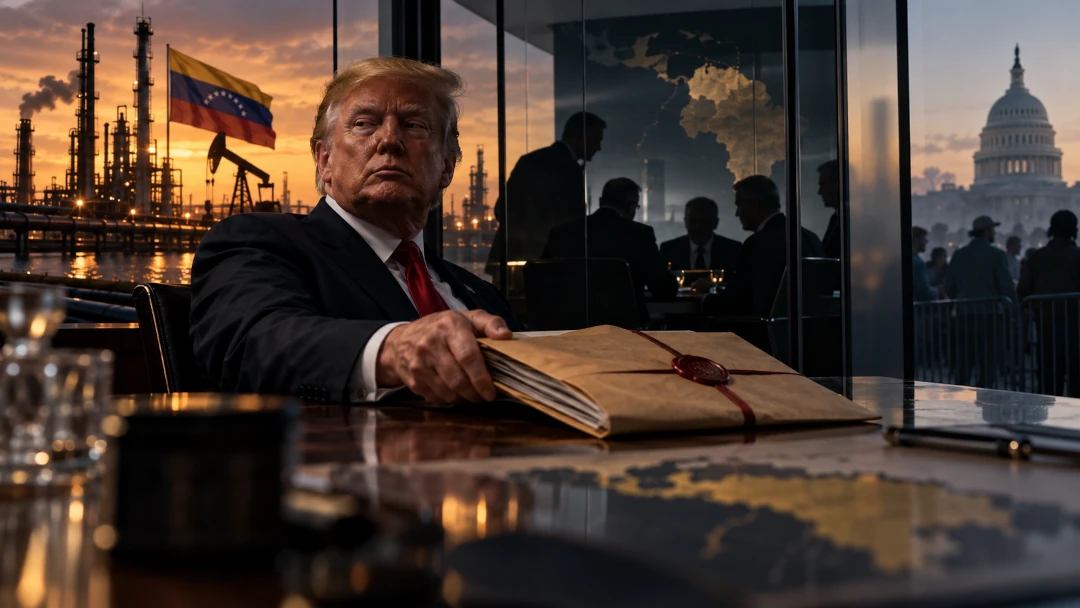
When Donald Trump took to Truth Social on the night of August 28 to announce what he called the biggest oil deal in world history, he promised Americans something concrete: cheaper gasoline, a doubled national oil reserve, and energy security for a hundred years — all, he said, at no cost to the taxpayer. For nearly two months the contract behind those promises stayed locked away, stamped as a “sensitive” government record. Now ProPublica reporters Cate Brown, Aaron C. Davis and Sebastian Rotella have reviewed it, and what they found is not a national energy policy. It is a private enterprise, engineered by a handful of administration insiders, wrapped in the American flag and fortified against the voters’ ability to undo it.
The agreement, signed for the United States by Secretary of State Marco Rubio and Defense Secretary Pete Hegseth, commits the Pentagon to a 35% stake in North American Blue Energy Partners (NABEP), a Venezuelan oil producer run by billionaire Alejandro Betancourt. According to ProPublica, the role of Venezuela’s government and any benefit to its people are almost entirely missing from the document. So, it turns out, are several of the benefits Americans were told to expect.
I. What the Contract Actually Says
Strip away the superlatives and the deal is a set of carefully lawyered terms that concentrate power in a very small circle. ProPublica’s review of the text and three supporting documents shows the following core provisions:
The Price of the Stake
The U.S. pays nothing upfront and acquires its 35% stake at one cent per warrant share, through a Barbados-registered parent company, with the terms running 75 years from closing, per ProPublica.
The Locked Board
A seven-member board governs for an initial 15-year term. Betancourt is the only member named, and a five-vote supermajority is needed to remove him as CEO, Raw Story summarized.
The Discount Oil
Washington can buy 20% of NABEP’s output at $30 a barrel — but the price excludes the costly diluents Venezuela’s heavy crude needs before it can flow through a pipeline, ProPublica found.
The Chosen Courtroom
Venezuela cannot challenge the deal in its own courts. Disputes go to federal court in the Northern District of Texas, a venue the administration has repeatedly sought out for favorable rulings.
The Gag Clause
The signed agreement is marked “sensitive,” and a confidentiality clause bars NABEP from disclosing even the existence of its terms with the U.S. government, ProPublica reported.
The Missing Guarantee
The White House touted an expected $200 billion in royalties and taxes for Venezuela. ProPublica found no clause explicitly obligating NABEP to pay it.
Read together, these terms describe a deal in which the obligations run almost entirely in one direction and the decision-makers are almost entirely insulated. One person who reviewed parts of the contract told ProPublica, in effect, that they could see everything Venezuela was giving up and could not find what it was getting in return.
II. The Corporate Firewall
The single most important finding in ProPublica’s reporting is not a dollar figure. It is an intention. According to people with knowledge of how the agreement came together, the governance provisions — the 15-year board, the protected CEO seat, the supermajority thresholds, the requirement that a majority of directors be U.S. citizens at all times — were designed to prevent future American and Venezuelan leaders from dismantling the enterprise. A person familiar with the negotiations told ProPublica that the structure was meant to maximize the dealmakers’ control and shield them from later administrations seeking to reverse it.
The architect, by ProPublica’s account, was David Lorch, head of the Pentagon’s Office of Strategic Capital, who arrived from Cerberus Capital, the private equity firm of Deputy Defense Secretary Steve Feinberg. Lorch reportedly placed an explicit premium on ensuring the venture could not be undone by Trump’s successor. The initial board, not any elected government, will establish how future board members are chosen. There is no requirement for any Venezuelan government participation at all; the United States gets a single non-voting observer.
Consider what that means. A president acting without a treaty, without an appropriation, and without public disclosure has attempted to commit the United States to a private corporate arrangement that is engineered to survive the next election. In a democracy, policy is supposed to be reversible by the people who pay for it. A firewall against future presidents is a firewall against future voters.
“The only likely short-term result of this agreement is to create a misleading narrative for the American people about lower gas prices.”
— Sens. Jeanne Shaheen, Martin Heinrich, Jack Reed & Elizabeth Warren, letter to Rubio, Hegseth & Wright
III. The Hidden Investors
If the firewall protects the deal from the public, the ownership structure protects the dealmakers from scrutiny. The Pentagon’s stake is not in NABEP directly but in its Barbados-registered parent company — and the agreement says little about who owns or has invested in that parent. As coverage of ProPublica’s findings noted, the structure could allow private backers to remain anonymous indefinitely. Under Barbados corporate law, ProPublica reports, there is almost nothing that can compel those interests to be revealed.
The secrecy goes further. The contract permits transactions with indirect equity holders, directors, affiliates and “immediate family members” without the supermajority vote required for other insider dealings — but never says who those people are. The board will set Betancourt’s compensation, and the deal does not appear to require any public disclosure of executive pay or share distributions. The company must submit audits and quarterly financials to the U.S. government, but nothing indicates the public will ever see them.
Then there are the names that did surface. The agreement was signed on behalf of the parent company by Orlando Alvarado, a longtime Betancourt executive whose role the administration never disclosed. The Miami Herald previously reported that federal prosecutors identified Alvarado as an unindicted co-conspirator in a scheme to embezzle from Venezuela’s state oil company. A NABEP spokesperson told ProPublica that neither man has ever been charged with a crime and called the claims baseless. ProPublica also reports that Betancourt arrived at a key August 5 Pentagon meeting with Jacob Hirshman, chief executive of Erebor Bank — the first bank chartered after Trump’s return to office, backed by Trump supporters Peter Thiel and Palmer Luckey — which has vowed to reconnect Venezuela to the world economy.
One source told ProPublica that people close to the administration were drawn to Betancourt’s privately held company precisely because of the privacy and flexibility it offered — advantages a publicly traded oil major, bound by shareholder reporting rules, could not provide. That is the tell. The administration did not choose opacity as an unfortunate side effect. It chose a partner because of it.
Senate Democrats saw this coming. In their September 30 letter, the ranking members of the Foreign Relations, Energy, Armed Services and Banking committees demanded to know whether any member of the Trump family, any campaign donor, or any current or former administration official stands to profit through an LLC or other corporate vehicle. The contract ProPublica reviewed does nothing to answer that question. It appears built to make sure it cannot be answered.
IV. The Partner
The administration’s chosen partner was, until recently, confined to house arrest at his English estate while fighting a Swiss extradition request tied to an international money-laundering probe. Betancourt has faced money-laundering investigations in three countries; he remains under investigation in Spain, according to El País. He has never been charged anywhere, and his lawyer has maintained his innocence, the BBC reported.
How did a man under that cloud become Washington’s oil czar? The Washington Post reported that senior Trump officials — including Deputy Secretary of State Christopher Landau, former Attorney General Pam Bondi and then-Deputy Attorney General Todd Blanche — pressed foreign counterparts to let Betancourt travel freely and to close their investigations into him. Reuters reported that he had provided information that aided the seizure of Venezuelan tankers and planning before Nicolás Maduro’s capture. Secretary Rubio, in a State Department interview, insisted a review with U.S. law enforcement found “there were no investigations of him in our system.”
Venezuela’s most prominent opposition leader, María Corina Machado, has accused Betancourt of involvement in corruption that caused great suffering for her people, according to The New York Times. Even Elliott Abrams, Trump’s own former special representative for Venezuela, publicly opposed the arrangement in a Washington Post op-ed, and told Newsweek he fears the deal gives the president a new incentive to keep Venezuela’s unelected interim leader in power. And former U.S. Ambassador James Story told ProPublica that the first question for a new Congress will simply be why Betancourt got this deal at all.
“It is know-who, not know-how.”
— Brian Naranjo, former senior U.S. diplomat in Venezuela, to ProPublica
V. The Promises vs. The Paper
The president sold this deal to a country squeezed at the pump. Gas prices have surged during the war with Iran, and AFP reported that cheaper oil was a priority for the administration heading into the midterms. Against that backdrop, Trump declared the agreement would “substantially lower Gas Prices for all Americans, long into the future.” Here is how his central claims hold up against the documents:
Get Involved Today
Contribute to our mission and turn your concerns into action.
A president can be wrong about a forecast. What the documents reveal is something different: a sales pitch whose most specific promises — the century, the price relief, the reserve, the royalties — are contradicted or unsupported by the very contract his own cabinet signed and then hid.
VI. How the Deal Came Together
Who Authorized This — and Under What Law?
- The Appropriations Clause (Art. I, §9, cl. 7). No money may be drawn from the Treasury except by appropriation. The senators asked which funds the State Department will use to buy NABEP’s oil. A long-term federal purchase commitment with no identified appropriation runs headlong into Congress’s power of the purse.
- The Office of Strategic Capital’s mandate. As the senators’ letter explains, the statute creating OSC authorizes loans and loan guarantees to help U.S. companies develop critical technologies for the defense industrial base — not equity stakes in foreign oil producers. Senate Armed Services Democrats told ProPublica they believe OSC lacks authority to contract with a foreign entity in a sanctioned country.
- Evasion of the DFC prohibition. The government’s own development-finance agency is barred by law from operating in Venezuela. Routing the investment through the Pentagon instead looks less like a legal pathway than a workaround of Congress’s express limits.
- The Case-Zablocki Act and transparency. Just Security’s legal analysis warns the deal may be structured to fall outside the law that requires international agreements to be reported to Congress — meaning disclosure may require new legislation.
- Binding future presidents without the Senate. Article II gives the Senate a role in durable international commitments. An executive arrangement designed to bind successors for 15 to 75 years, signed by cabinet officers and hidden from Congress, inverts that design.
VII. What This Says About His Priorities
Every administration makes deals. What distinguishes this one is whom it was built to serve. The Venezuelan people, whose oil it is, are largely absent from the text. The American public, told it would see lower prices, gets a discounted share too small to matter for years. Congress, which holds the power of the purse, was not consulted and has not been shown the agreement. The beneficiaries who are protected — a politically connected oligarch, his longtime executives, a board insulated for 15 years, and investors whose names may never be known — are precisely the people with the least democratic claim on a nation’s natural wealth.
This is a pattern, not an accident. The administration intervened in foreign criminal probes on behalf of its chosen partner. It selected a private firm because a public company’s disclosure duties would have been inconvenient. It designed governance specifically to resist reversal by the next elected president. And it marketed the result to struggling families with promises the contract does not keep. That is the leadership of a president who treats public power as a private asset — who sees the instruments of the American state, from the Pentagon to the State Department, as tools for arranging deals among friends rather than as trusts held for the people.
The defenders’ case deserves to be stated plainly: the White House says the agreement will help stabilize Venezuela’s economy and expand American reserves, and NABEP insists its fields are productive and its barrel economics strong. Some analysts agree that partnering with a company already pumping oil is a faster route than starting from scratch. But none of those arguments explains the secrecy, the shell company, the gag clause, or the deliberate effort to tie the hands of future voters. Good deals do not need firewalls against democracy.
The deal has not yet fully taken effect: according to ProPublica, its closing conditions are still pending and key “Implementation Documents” governing investors’ rights are still being negotiated. That window matters. Here is where citizen pressure can count:
Back the Senate’s demands
Call your senators (Capitol switchboard: 202-224-3121) and ask them to publicly support the Shaheen–Heinrich–Reed–Warren letter demanding the full text, legal authorities and a list of anyone connected to the administration who stands to profit.
Demand oversight hearings
Ask your House member to press for hearings before the deal closes — on Betancourt’s selection, on officials’ intervention in foreign investigations, and on OSC’s legal authority, as former Ambassador James Story has urged.
Push for disclosure legislation
Support legislation requiring executive energy and investment agreements with foreign entities to be reported to Congress, closing the gap identified by Just Security — including beneficial-ownership disclosure for any company receiving a federal stake.
Insist on an appropriations rider
Urge your representatives to block federal funds from being used to purchase NABEP oil or execute the Pentagon’s warrants until the agreement and its investors are fully disclosed. The power of the purse is Congress’s strongest lever.
Support the journalism — and vote on it
This deal came to light only because investigative reporters obtained it. Support independent outlets like ProPublica, share their reporting, and ask every congressional candidate on your ballot this November where they stand on the deal.
Editorial Conclusion
The secret text of Trump’s Venezuelan oil deal answers the question its salesmanship was designed to avoid: who is this really for? Not the American driver, who was promised relief the contract cannot deliver. Not the Venezuelan people, who are written out of their own oil. It is for a protected few — a favored oligarch, his circle, and investors hidden behind a Barbados shell — shielded by a structure built to defy the next election.
A government that hides its contracts from the people it serves, chooses partners for their secrecy, and engineers its deals to outlive accountability is not practicing diplomacy. It is privatizing power. Congress must obtain this agreement in full, name every beneficiary, and refuse a single dollar until it does. In a republic, no deal — however “big” — may be built beyond the reach of the voters.
Sources & References
- ProPublica — The Secret Terms of Trump’s Venezuelan Oil Deal (Oct. 20, 2026)
- The White House — Fact Sheet: Historic Oil Agreement to Secure American Energy Dominance (Aug. 31, 2026)
- U.S. Senate — Letter from Sens. Shaheen, Heinrich, Reed & Warren to Secretaries Rubio, Hegseth & Wright (Sept. 30, 2026)
- Raw Story — 7 Striking Revelations Buried in Secret Text of Trump’s ‘Biggest Oil Deal’
- Just Security — How Will Congress and the Public Learn the Details of Trump’s Venezuela Oil Deal?
- The Washington Post — U.S. Intervened in Criminal Probe of Venezuelan Oilman Alejandro Betancourt (Aug. 27, 2026)
- Reuters — Venezuelan Billionaire the U.S. Investigated for Money Laundering Now Has Pentagon Oil Deal (Sept. 5, 2026)
- El País — United States Stalls Spanish Investigation into Alejandro Betancourt, Its New Oil Czar in Venezuela
- BBC News — Who Is Alejandro Betancourt, Oil Baron Behind U.S.-Venezuela Oil Deal
- The New York Times — María Corina Machado on Trump’s Venezuela Oil Deal (Oct. 15, 2026)
- Newsweek — Elliott Abrams on Trump’s Venezuela Deal: Interview with Trump’s Former Venezuela Envoy
- The Guardian — Trump’s Oil Deal with Venezuela and the 25-Year Concession Limit (Sept. 26, 2026)
- Miami Herald — Reporting on Orlando Alvarado and the PDVSA Embezzlement Case
- U.S. Department of State — Secretary Rubio with Sergio Novelli on “Al Día” (Sept. 2026)
- Fox Business — Trump Announces ‘Biggest Oil Deal in World History,’ Says It Will Substantially Lower Gas Prices
- Newsweek — Trump’s Venezuela Oil Plan May Not Bring Gas Price Relief to Americans
- AFP via Eyewitness News — U.S. Defends Trump Venezuela Oil Deal as Energy Secretary Lands in Caracas (Sept. 2, 2026)
- The New York Times — The Texas Courtroom the Trump Administration Keeps Turning To (Aug. 30, 2026)
- inkl — Trump’s Venezuela Oil Deal Could Allow Investors to Remain Anonymous Behind Barbados Company
- Vanguardia — Acuerdo petrolero entre EE.UU. y Venezuela bajo la lupa (Oct. 21, 2026)
Related News