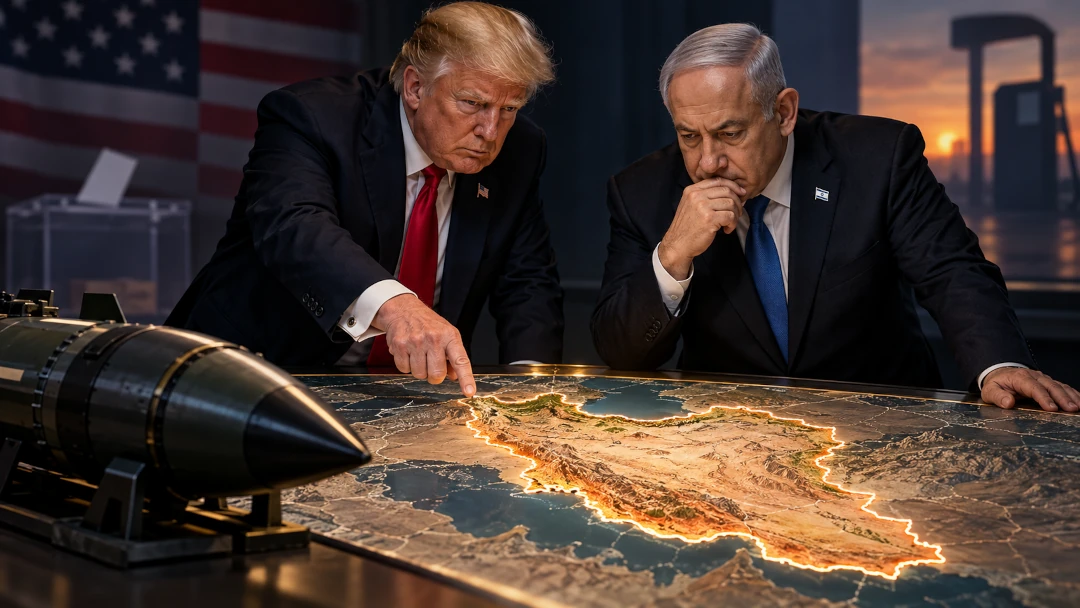
As Tehran trains civilians to repel a ground attack, Donald Trump and Benjamin Netanyahu — both facing voters within a week of each other — are openly weighing a new round of strikes, up to and including the largest non-nuclear bomb in America’s arsenal. Eight months in, the war has cost the nation tens of billions of dollars, at least 21 American lives, a third of our cruise missiles, and roughly $2,000 per household. The question is no longer whether this war serves America. It is whom it serves.
In Tehran’s Haft-e Tir Square this month, the Islamic Republic opened something that should alarm every American who still believes this war is nearly over: a military training center for ordinary citizens. According to Middle East Eye, the facility is meant to prepare civilians to fight U.S. and Israeli forces in the event of a ground assault, and a Basij training official, Ali Kowsari, claimed 1,000 battalions had been readied for instruction. A government does not teach its shopkeepers to fire shoulder-launched missiles because it expects peace. It does so because it has been told, by the words and deployments of its enemies, that another blow is coming.
And that blow may be timed not to any military logic, but to two election calendars. Israelis vote on October 27. Americans vote on November 3. Between those dates sits a war that both Donald Trump and Benjamin Netanyahu launched together on February 28 — and that neither has been able to end.
I. The Warning From Tehran
Iran’s leadership has spent October telling its people, in effect, to brace. Beyond the civilian training sites, Iranian officials have reportedly warned regional governments that a renewed American attack could trigger Iranian ground incursions into neighboring states and strikes on Saudi oil infrastructure, according to Ynet’s summary of Wall Street Journal reporting. The same report describes Tehran billboards advertising civilian courses in anti-aircraft missiles and sniper rifles, and Revolutionary Guard personnel visiting a kindergarten to recount wartime experiences.
It matters what Washington has and hasn’t said. President Trump has ruled out sending U.S. ground troops and ruled out nuclear weapons, according to The Arab Weekly’s account of his Newsmax interview. But in the same breath he said the United States may have to strike Pickaxe Mountain, a fortified site near one of Iran’s main nuclear facilities. Iran’s mobilization is the predictable response of a regime that has already lost its supreme leader in this war’s opening strikes and has every reason to take American threats literally.
II. Two Leaders, Two Ballots, One War
Benjamin Netanyahu is losing. With ten days to go before Israel’s election, The Jerusalem Post reported that four recent polls showed former IDF chief Gadi Eisenkot’s Yashar party ahead of Netanyahu’s Likud, with Channel 13’s latest survey giving the prime minister’s bloc just 51 seats — down from 55 — far short of the 61 needed to govern.
Into that vacuum stepped Donald Trump. On Sunday he gave Netanyahu his full endorsement and, as NPR reported, paired it with a threat to “soon finish the job” against Iran — while adding that if Israelis chose anyone other than Netanyahu, America would have to do that work alone — something he said he was reluctant to do. Read plainly, the President of the United States told a foreign electorate that the course of an American war depends on whether they re-elect his ally.
“Bibi’s got an election before the midterms. He believes his strength is being a wartime prime minister.”
— Unnamed U.S. official, as reported by Axios, Oct. 13, 2026
The endorsement capped weeks of reporting that the two men had discussed resuming the war before their respective elections. Axios reporters Barak Ravid and Marc Caputo reported that Netanyahu held several calls with Trump about returning to major combat operations, and that Trump told him to prepare without making any commitment. According to the same report, IDF Chief of Staff Lt. Gen. Eyal Zamir warned Joint Chiefs Chairman Gen. Dan Caine that restarting the war could force Israel to postpone its own election. The Times of Israel noted that Netanyahu’s office denied he was seeking a pre-election war — a move critics say would be politically motivated. The White House denied the Axios account outright.
Trump’s own political position is hardly stronger than Netanyahu’s. A Reuters/Ipsos poll cited by The Jerusalem Post found some 60 percent of Americans — including one in four Republicans — disapprove of his handling of Iran. CNN’s political analysis wrote that the war’s link to high gas and diesel prices is a prime reason Republicans face uphill or tight races in states like Iowa, Ohio and North Carolina that Trump won easily two years ago.
III. What a “Quick Win” Would Look Like
When leaders are behind in the polls and holding a war they cannot end, the temptation is a dramatic, short, televisable strike — a “win” that can be announced in a news conference and sold on a campaign trail. The reporting suggests that option is being built.
According to CNN reporting summarized by Military.com, the military has drawn up strike packages that could include the 21,600-pound GBU-43/B Massive Ordnance Air Blast — the MOAB, or “Mother of All Bombs” — against Iranian energy infrastructure and nuclear sites, pending presidential approval. One source described plans that would amount to a “fireworks show” giving Trump a way to end the conflict. Another suggested the President had boxed himself into a position where he felt he had to act.
The problem is that the bomb is wrong for the stated target. Sources in the same CNN reporting described the MOAB as essentially a psychological and area-clearance weapon — not for destroying facilities buried deep inside a mountain like Pickaxe. In other words, the leading “quick win” option is chosen for its spectacle, not its military utility. That is precisely what a political strike looks like.
“We will not be attacking Iran at any time prior to the Midterm Elections.”
— President Donald Trump, Truth Social, Oct. 8, 2026, via Al Jazeera
Trump has publicly promised not to strike before November 3. Take him at his word, and the timeline still tells the story: the weapon is chosen, the packages are drafted, a third carrier is steaming toward the Gulf, and the strike is merely scheduled for after Americans cast their ballots — while Israel votes a week earlier, under the shadow of a promised “finish.” CNN’s analysis described the pledge itself as an implicit admission of the damage the war is doing to Republican hopes. A war whose next phase is calibrated to the electoral calendar is a war being run for its managers, not for the country.
IV. The Bill Comes Due
The Pentagon told Congress last month that the war had cost $45.1 billion, according to CNN — a figure that excludes the cost of repairing damaged bases and that keeps climbing by an estimated $2 to $3 billion a month. The nonpartisan Congressional Budget Office, as PBS NewsHour reported, found the war will keep inflation about half a percentage point higher than previously projected into early 2027. The White House has asked Congress for an $87.6 billion supplemental, largely for the war.
Rep. Brendan Boyle, the top Democrat on the House Budget Committee, put the contradiction bluntly in his response to the CBO: an administration that says it cannot afford help for families at home has found tens of billions of dollars for what he called a reckless war. And the household bill is larger still. Moody’s chief economist Mark Zandi calculates the war has left the average American household nearly $2,000 worse off, Newsweek reported — a figure roughly seven times what Defense Secretary Pete Hegseth told Congress the war had cost the nation.
Direct Military Cost
Pentagon’s estimate to Congress, excluding base repairs; CBO projects $2–3B more each month. CNN
Cost Per Household
Economist Mark Zandi’s estimate of what the war has cost the average American household. Newsweek
Americans Killed & Wounded
The Pentagon’s updated toll — revised upward after reporting showed earlier counts were too low. The Hill
Emergency Oil Reserve
Down from about 415 million barrels in February — the lowest since the early 1980s. NPR
Tomahawks Expended
The stockpile fell from roughly 3,000 to about 2,000; some 40% of THAAD interceptors have been fired. Council on Foreign Relations
Aircraft Lost
U.S. military aircraft lost, including 45 Reaper drones, per a Congressional Research Service report. Forbes
V. The Human Toll
The numbers that matter most are the ones the Pentagon has been slowest to share. The Hill reported that the Defense Department raised its public tally of American service members killed to 21, with 865 wounded, after reporting by The Washington Post showed more troops had died than the department had disclosed. Hegseth’s response to that reporting was to attack it as fake. Among the dead are six soldiers killed when an Iranian drone struck their tactical operations center in Kuwait — the youngest just 20 years old. Joey Amor, whose wife Sgt. 1st Class Nicole Amor died in that strike, confronted Vice President JD Vance at a CBS town hall over what he called the war’s fundamental failures, The Hill reported.
The toll on the other side is measured in thousands. Al Jazeera reported that at least 3,468 people were killed in U.S.-Israeli attacks on Iran between the war’s start and the June memorandum of understanding — a count that does not capture the deaths in Lebanon, Israel, Iraq and the Gulf.
VI. Oil, the Reserve, and the Pump
This war was launched at the chokepoint of the world’s energy supply, and Americans have paid at the pump ever since. NPR reported that gasoline has been above $4 a gallon for months and diesel keeps setting records above $6.50 — which means higher costs for every truck, tractor, school bus and grocery delivery in the country.
To blunt the shock, the administration has drained the Strategic Petroleum Reserve by more than 30 percent in six months. The reserve held around 415 million barrels in February; it now holds less than 285 million, its lowest level since the early 1980s. Brookings energy expert Samantha Gross warned NPR that such rapid drawdowns threaten the structural integrity of the salt caverns that store the oil. The cushion meant to protect Americans from the next crisis has been spent on a crisis of the President’s own choosing — and the Strait of Hormuz remains effectively closed.
Get Involved Today
Contribute to our mission and turn your concerns into action.
VII. An Arsenal Running Dry, a Force Stretched Thin
The deepest and least visible cost of this war is to the strength of the American military itself. The Council on Foreign Relations estimates that roughly 40 percent of the 452 THAAD ballistic-missile interceptors on hand at the war’s start have been fired, and that the Tomahawk stockpile has fallen by about a third. Lockheed Martin builds just 96 THAAD interceptors a year. A U.S. official told ABC News that key interceptor stockpiles are “extremely low.” The Center for Strategic and International Studies, as Military Times reported, warned that replenishing some systems could take until 2030 or 2031, opening a “window of vulnerability” in the Western Pacific.
The bases have suffered too. A Congressional Research Service report cited by William Hartung in Forbes counts 81 U.S. military aircraft lost, and The New York Times has reported that some regional bases are so badly damaged they may never be rebuilt — none of which is included in the Pentagon’s official price tag.
And the people are worn down. The USS Abraham Lincoln returned to San Diego after ten months at sea, and NPR reported that the Navy is struggling to staff mental-health care for crews still deployed. The USS Gerald R. Ford spent 11 months at sea, according to Bloomberg via gCaptain, and the Pentagon is now sending a third carrier and 10,000 more sailors and Marines — the first three-carrier presence in the region since the 2003 invasion of Iraq. Former Congressional Research Service naval analyst Ronald O’Rourke warned that sustaining three carriers there for an extended period would be a significantly greater strain on the fleet. The military is being spent like a campaign budget.
VIII. A Region Choosing Sides
Wars of choice rarely stay where they start. The UAE, Saudi Arabia, Kuwait and Bahrain have been absorbing Iranian missiles and drones since the first week. Now the fighting has opened a new front in Yemen, where the Iran-allied Houthis have escalated attacks on Saudi Arabia. On Sunday, Egypt’s National Defense Council, chaired by President Abdel-Fattah el-Sissi, agreed to provide “all possible forms of support” to Riyadh, the Associated Press reported; the same day, the Saudi defense minister met the UAE’s president about strengthening military cooperation. The Arab world’s most populous nation edging toward combat is not a sideshow. It is the regional war that critics warned this campaign would ignite.
Outside the region, support for the war is scarce. Russian President Vladimir Putin told Iran’s president that Moscow would “do everything” to help end what Russian outlets called the U.S.-led war, Al Jazeera reported, while China’s support for Iran has been the subject of a U.S.-China Economic and Security Review Commission timeline, including Beijing’s April veto of a Security Council resolution on reopening the Strait of Hormuz. America’s rivals are watching our interceptor counts fall and our carriers wear out — and they are in no hurry for this war to end.
IX. Congress: Votes Without Teeth
Congress has not been silent. It has been ignored. The House has now passed three war powers resolutions. The most recent, sponsored by Rep. Seth Moulton, passed 220–204 on September 15 with seven Republicans joining every Democrat, The Hill reported. Rep. Gregory Meeks, the top Democrat on the House Foreign Affairs Committee, said on the floor that the administration has kept troops in harm’s way with no declaration, no authorization, and no plan to win or end the war.
In the Senate, the effort failed by a single vote. The Washington Post reported the 49–50 tally on September 24: Republicans Rand Paul, Susan Collins, Lisa Murkowski and Thom Tillis voted with Democrats; Democrat John Fetterman voted with the White House. And when both chambers did pass a war powers resolution in June, The Intercept reported, the administration simply ignored it, arguing the law is unconstitutional.
Who Decides When America Goes to War?
Article I, Section 8: “The Congress shall have Power … To declare War … To raise and support Armies … [and] To make Rules for the Government and Regulation of the land and naval Forces.”
The Framers placed the war power with the people’s representatives precisely to prevent a single executive from launching and sustaining wars for personal or political ends. The War Powers Resolution of 1973 operationalized that principle: absent a declaration or authorization, the President must withdraw forces from hostilities within 60 days (plus a 30-day withdrawal window), and Congress may direct their removal by resolution under Section 5(c).
This war has run for more than 230 days without either a declaration or an authorization for the use of military force. The administration’s position — that Congress’s directives under the War Powers Resolution are themselves unconstitutional and may be disregarded — is not a legal argument so much as a claim that the President’s war power has no outer limit. If that position stands, the War Powers Resolution is a dead letter, and Article I’s war clause is ornamental.
What remains is the one power no President can veto into irrelevance on his own: the power of the purse. Article I, Section 9 provides that “No Money shall be drawn from the Treasury, but in Consequence of Appropriations made by Law.” The Intercept reports that the continuing resolution funding the government expires December 11 — and that a rider barring funds for the Iran war, or binding limits in the annual defense authorization bill, are the levers advocates are urging Democrats to pull.
The honest assessment is that Democratic leaders have not yet committed to pulling them. House Minority Leader Hakeem Jeffries told CNN the party would “deal with the appropriations process when we deal with the appropriations process,” while continuing to force war powers votes. Rep. Adam Smith, the ranking member on House Armed Services, told The Intercept he is open to using the defense bill or spending bills to end the war, but doubts there is enough Republican support to overcome an inevitable veto. Brian Finucane, a former State Department lawyer now at the International Crisis Group, framed the choice simply: if Democrats are serious, they must be willing to use the power of the purse.
X. The Administration's Case — and Why It Falls Short
The administration and its defenders make a serious argument that deserves a fair hearing. They contend that Iran is reconstituting its nuclear program — Israeli intelligence, per Axios, points to concerning steps at sites like Pickaxe Mountain — and that a nuclear-armed Islamic Republic would pose an intolerable threat. Administration officials argue that economic pressure is working and that Tehran is betting on outlasting Trump through the midterms. On munitions, even critical analysts at CSIS and CFR acknowledge the U.S. still has enough to fight Iran under any plausible scenario; the shortage is in high-end interceptors and stand-off weapons, not across the board. And the White House flatly denies that Trump and Netanyahu discussed timing strikes to their elections.
But none of that answers the central questions. If the threat is grave enough to justify an eight-month war, it is grave enough to bring to Congress for a vote. If the aim is to destroy buried enrichment sites, a weapon its own planners call ill-suited to the task is not a strategy. And if the war is succeeding, why is its next phase being scheduled around two election days?
XI. What This Means for You
For the average American, this war is not abstract. It is the extra dollar at the gas pump and the higher grocery bill that follows diesel’s climb. It is inflation that the CBO says will linger into next year. It is a federal debt growing by billions every month for a war Congress never approved. It is a neighbor in the Guard or the 82nd Airborne whose deployment keeps stretching, a sailor home after ten months at sea, a family in Kentucky or Ohio burying a son or daughter. And it is a military that, if a real threat to the homeland or to an ally in the Pacific emerged tomorrow, would face it with fewer interceptors, fewer cruise missiles, damaged bases, and exhausted crews.
That is what this war says about the President’s priorities. A commander in chief who drains the oil reserve, burns through the munitions meant to deter China, keeps carriers at sea for nearly a year, and then reportedly weighs a bomb chosen for its spectacle on a timeline set by the polls — while endorsing a foreign leader on the promise of more fighting — is not stewarding American power. He is spending it.
XII. What You Can Do
Voting on November 3 matters, and if you can vote, you should. But the decisive fights over this war will come before the new Congress is sworn in. Here is where citizen pressure can actually reach — and an honest read on each option.
Demand a funding rider by December 11
Call your House member and both senators (Capitol switchboard: 202-224-3121). Ask one specific question: will they refuse to vote for any continuing resolution that funds offensive operations against Iran without congressional authorization?
Honest assessment: the strongest lever available, but it risks a shutdown, and leadership has not committed to it. Pressure is what moves undecided members.
Press for binding limits in the defense bill
Ask your senators — especially members of the Armed Services Committee — to oppose any National Defense Authorization Act that leaves the administration free to resume or expand the war without a vote.
Honest assessment: the NDAA is must-pass, giving Senate Democrats filibuster leverage — but it also faces a likely veto, as Rep. Adam Smith has acknowledged.
Hold the swing votes accountable
If your senator voted against the September 24 war powers resolution, ask them publicly — at town halls, in letters to the editor — why. If your senator or representative crossed party lines to vote for it, thank them; those votes are politically costly.
Honest assessment: one Senate vote separated passage from failure. Individual members are persuadable.
Demand transparency on casualties, costs and deployments
Urge your members to back public hearings on extended deployments and a full accounting of base damage, aircraft losses and casualties — figures the Pentagon has repeatedly revised upward only after press reporting.
Honest assessment: oversight won’t stop a strike, but it raises the political cost of a war managed in the dark.
Support the people paying the price
Military families are carrying this war. Support organizations serving deployed service members and Gold Star families, and amplify their voices — they are among the most credible witnesses to what this war is costing.
Honest assessment: this doesn’t change policy directly, but families’ testimony has moved public opinion more than any statistic.
Editorial Conclusion
America did not choose this war through its Congress, and it should not let its next chapter be chosen by two politicians’ poll numbers. A war launched without authorization, sustained in defiance of Congress’s votes, and now apparently paced to election calendars is not national defense — it is the conversion of American lives, American treasure and American military strength into political capital.
The Constitution gives the war power to the people’s representatives for exactly this moment. Congress must use the power of the purse to forbid any expansion of this war without a vote, demand a full public accounting of its costs, and restore the principle that no President may wage war on his own say-so. Anything less concedes that the most consequential decision a democracy can make now belongs to one man.
Sources & References
- Middle East Eye — Iran opens military centre for citizens, “training 1,000 battalions”
- Ynet News — Report: Iran threatens ground incursions into neighboring countries if US attacks
- The Arab Weekly — Trump signals possible new strike on Iran’s nuclear programme
- The Jerusalem Post — Eisenkot leads Netanyahu in four polls, but neither bloc secures Knesset majority
- NPR — Trump endorses embattled Israeli Prime Minister Benjamin Netanyahu for reelection
- Axios — Inside Trump, Netanyahu’s dilemma: Strike Iran before elections or wait
- The Times of Israel — Netanyahu reportedly pressed Trump to renew Iran fighting before Israeli and US elections
- The Jerusalem Post — Trump rules out US strikes on Iran before midterms as Treasury hits oil fleet
- CNN — Analysis: Why Trump says he’s not attacking Iran before Election Day
- Military.com — Trump Administration Mulls Using “Mother of All Bombs” Against Iran: Report
- Al Jazeera — Trump says US will not strike Iran before midterm elections
- CNN — Iran war has cost $45.1 billion, Pentagon tells Congress
- PBS NewsHour / AP — Iran war has cost the U.S. more than $38 billion so far, budget office says
- Newsweek — Iran War Has Cost American Families Nearly $2,000, Economist Says
- The Hill — Pentagon updates death toll of troops during Iran war to 21
- Al Jazeera — What we know about US soldiers killed in Iran war, and Iranian casualties
- NPR — The U.S. Strategic Petroleum Reserve is low. Here’s why you should care
- Council on Foreign Relations — The U.S. Munitions Crisis
- ABC News — Crucial US missile stockpiles “extremely low,” official says
- Military Times — US munitions depleted by Iran war will take years to restore, analysis finds
- Forbes — The Full Costs of the Iran War Are Clearer By the Day
- NPR — USS Abraham Lincoln returns home as Navy navigates lengthy deployments
- gCaptain / Bloomberg — US Adds Carrier and 10,000 Troops to Mideast
- The Hill — Husband of soldier killed in Iranian drone strike grills Vance on “fundamental failures”
- Associated Press via Washington Times — Egypt’s top security body agrees to help Saudi Arabia defend itself against Houthi attacks
- U.S.-China Economic & Security Review Commission — Enabling Iran: A Timeline of China’s Role During and After Operation Epic Fury
- The Hill — House passes Iran war powers resolution
- The Washington Post — How every senator voted on the Iran war powers resolution
- The Intercept — Dems Have an Opportunity to Force an End to the Iran War. Will They Take It?
Related News