Ninety Minutes of Silence: When Zuckerberg’s Meta Pulled the Plug on No Kings
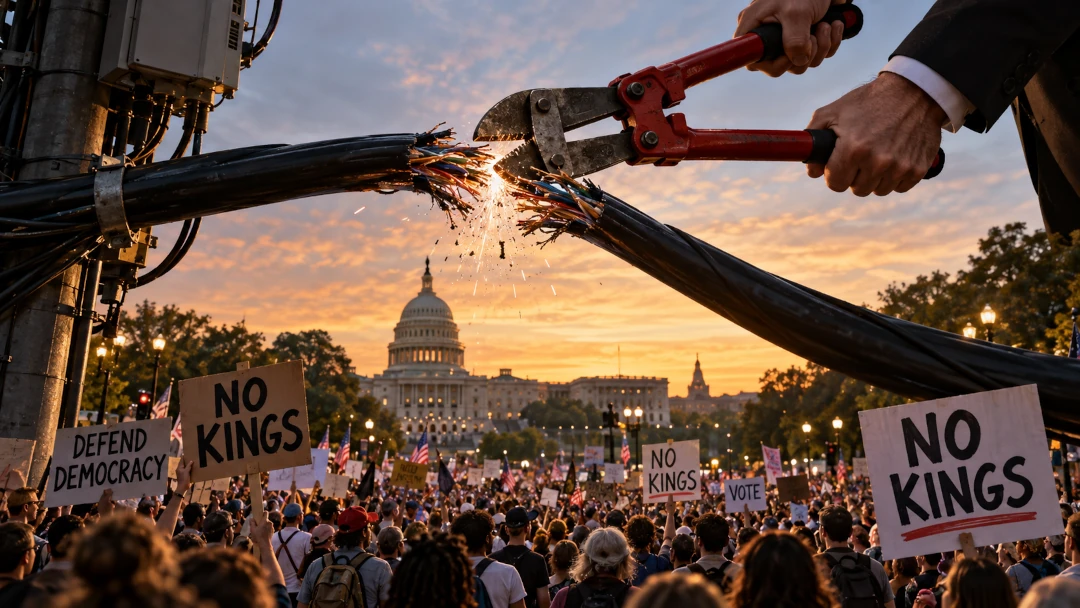
At the height of the largest early-vote mobilization the movement has ever attempted, Meta switched off the No Kings coalition’s Instagram account — then kept organizers locked out for hours. Meta calls it a robot’s mistake. But in an America where a handful of Trump-friendly billionaires now own the microphones, an “error” that silences the opposition weeks before a midterm is not a glitch. It is a warning.
On Saturday afternoon, as crowds gathered from the Lincoln Memorial to Phoenix’s Grant Park under signs reading “VOTE EARLY” and “HANDS OFF MY VOTE,” the official Instagram account of the No Kings coalition simply vanished. According to MeidasTouch, Indivisible co-founder Ezra Levin said Meta suspended the account for about 90 minutes at the peak of the day’s demonstrations — precisely when organizers were using it to coordinate events, push turnout, and urge Americans to cast early ballots. Even after the page reappeared, the people who run it could not get back in.
This was not a small, sleepy page. The No Kings network has staged some of the largest single-day protests in American history; its March 2026 mobilization alone drew an estimated eight million people across more than 3,300 events, according to organizers’ counts. Saturday’s “No Kings: Vote Early” day was its pivot from protest to the ballot box, with nearly 3,000 events across all 50 states and Washington, D.C., ahead of the November 3 midterms. For a movement whose entire strategy that day ran on real-time communication, losing its main channel was not an inconvenience. It was an amputation.
I. Ninety Minutes in the Dark
The sequence matters, because the timing is the story. Here is what the public record shows, drawn from organizers’ statements and Meta’s own account.
“We’re not gonna stop organizing against this regime.”
— Ezra Levin, Co-Founder, Indivisible, to MeidasTouch, Oct. 17, 2026
II. “An Error,” Says Meta. Who Ordered It?
Let us be precise, because precision is what separates accountability from conspiracy. As of this writing, no reporting has identified any person who ordered the suspension, and Meta insists no one did. In a statement on X quoted by Newsweek, Stone said accounts that post, share, or comment at very high frequency can trigger automated systems, that this is what happened to No Kings, and that “that automated action was clearly taken in error.” Meta apologized. Even MeidasTouch, no friend of Zuckerberg, noted there was no evidence yet that the takedown was politically motivated.
Fine. Take Meta at its word. Then ask the questions Meta has not answered. Why did a system supposedly built to stop spam treat the most predictable traffic spike in American civic life — a scheduled, publicly announced national day of action — as abuse? Why did it take roughly 90 minutes for a trillion-dollar company to answer an organization coordinating thousands of events? Why could administrators still not post hours after Meta conceded its “bad call”? An automated error that lands, with perfect timing, on the opposition to the president is still a decision — a decision about whose speech is worth protecting with human review and whose is left to the algorithm.
And Meta does not get the benefit of the doubt in a vacuum. Consider the company’s recent record with this president and with democratic opposition abroad:
$25M to Trump
Meta agreed to pay $25 million to settle Trump’s lawsuit over his post–January 6 suspension, with $22 million designated for his future presidential library, PBS NewsHour reported. Meta admitted no wrongdoing.
A criminal probe, halted
Days before the No Kings takedown, Trump-appointed DOJ leaders halted a criminal investigation into whether Meta’s platforms facilitated illegal drug sales, and Meta executives are no longer being summoned to the grand jury, Bloomberg Law reported.
“What Meta’s money is buying”
That is how Kyle Jacobs-Morse of the Tech Oversight Project characterized the halted probe, Common Dreams reported. Meta’s defense team reportedly included Sullivan & Cromwell, which represents Trump personally.
Brazil’s warning
On October 15, a judge on Brazil’s top electoral court ordered Meta to treat President Lula and challenger Flávio Bolsonaro equally after Lula’s campaign alleged biased algorithms favoring Bolsonaro, NBC News reported. Meta denies any bias, and the court has not ruled on the merits.
Inside the tent
Zuckerberg donated to Trump’s inaugural fund, attended the inauguration, met with Trump in September, and reportedly helped shape a White House AI-industry initiative, Newsweek reported.
Fact-checking, gone
Before Trump’s 2025 inauguration, Meta dropped fact-checking on its platforms — a longtime demand of Trump and his allies, PBS NewsHour noted.
Levin himself drew the Brazil comparison, telling MeidasTouch the episode was strikingly reminiscent of what happened there. We do not need to prove intent to see the structural problem. When a company is simultaneously paying the president, escaping his Justice Department, and sitting at his policy table, its “errors” against his opponents deserve the same scrutiny any newspaper would give a bank that kept “accidentally” freezing the accounts of one political party.
III. The Wider Wall Around No Kings
The Instagram blackout is the only direct, documented disruption of Saturday’s communications reported so far. But it landed on a movement already pushing uphill against an administration that has spent two years trying to delegitimize it and to make voting harder.
The White House response to the day of action was mockery, not respect. Spokeswoman Lauren Bis told Newsweek that the group’s focus on voting proved it should change its name, and recast the election as a choice against “radical socialist” Democrats. That is the official voice of the United States government sneering at citizens for urging their neighbors to vote.
The substance of the rallies was itself a catalog of obstacles. Speaking in Atlanta, Indivisible co-founder Leah Greenberg pointed to Trump’s mid-decade redistricting drive and his attempts to restrict voting by mail, warning that “they want chaos, fear, and confusion at the polls,” Common Dreams reported. Levin raised concerns to NPR that federal immigration officers could be sent to polling places — one reason No Kings groups trained volunteers as poll watchers. Chicago-area organizers cited voter-roll purges and the failed SAVE America Act, which opponents say would have created unnecessary barriers for eligible voters, ABC7 Chicago reported.
The rhetorical groundwork was laid long ago. Before the October 2025 No Kings protests, administration officials smeared participants as members of “antifa,” a label the administration had equated with ISIS-style terrorism, as documented here, and House Speaker Mike Johnson branded that day a “Hate America Rally,” Britannica recounts. When the government spends a year calling peaceful protesters terrorists, a platform silencing them “by accident” does not feel accidental to the people being silenced.
IV. What Lawmakers Are Saying — and Promising
Democratic reaction was swift. Sen. Chris Murphy (D-Conn.) condemned the suspension and vowed to “put this on the January investigation list” if Democrats retake Congress in the midterms, Common Dreams reported — a pointed reminder that subpoena power, not press releases, is what makes trillion-dollar companies explain themselves. Sen. Adam Schiff (D-Calif.) stood with the day of action, writing on X that Americans do not need to be ruled by a despot and urging voters to cast ballots early, per Newsweek.
Outside Congress, Norm Eisen demanded that Meta restore full access immediately, noting administrators remained locked out even after the page returned, Raw Story reported. The coalition itself called the suspension “unjustified” and demanded that Meta take immediate steps to ensure it never happens again to any account — especially those informing voters, Yahoo News reported.
Notice what is missing: any Republican demanding answers. The party that spent years holding hearings on alleged “censorship” of conservatives by Big Tech has, so far, found nothing to say when a platform silenced a pro-voting movement on the busiest organizing day of the cycle. Free speech, it turns out, was never the principle. Whose speech was.
V. The Owners of the Microphone
The deeper scandal is not one 90-minute outage. It is that the outage could happen at all — that a single company could, by mistake or by design, cut off a mass democratic movement from millions of people in an instant. That power exists because America has allowed its information infrastructure to be bought up by a few of the richest men alive, nearly all of whom have spent the last two years courting Donald Trump.
| Owner | Platforms & outlets | Ties to Trump |
|---|---|---|
| Mark Zuckerberg | Facebook, Instagram, WhatsApp, Threads | $25M settlement; inaugural donation; DOJ probe halted |
| Ellison family | CBS News, CNN, HBO, Paramount & Warner Bros. (now "Skydance"); ~15% of TikTok U.S. | Larry Ellison described as a close Trump ally; merger cleared by Trump DOJ |
| Elon Musk | X | Trump surrogate; X paid ~$10M settlement |
| Jeff Bezos | The Washington Post | Sat with fellow tech barons at Trump's inauguration |
On October 6, the Ellisons completed their takeover of Warner Bros. Discovery, folding CBS News and CNN into a single company called Skydance in which the Ellison family holds the largest equity stake and, with RedBird Capital, controls all voting shares, Cord Cutters News reported. Two of America’s three legacy television news brands now answer to one family. Larry Ellison’s Oracle also sits at the center of the new TikTok U.S. venture; Truthout warned the deal places Ellison, Musk, and Zuckerberg in firm control of virtually all major U.S. social platforms. The new Skydance also leans on foreign money: Paramount disclosed to the FCC that roughly 49.5 percent of the combined company’s equity could come from the sovereign wealth funds of Saudi Arabia, Qatar, and the UAE, according to Sen. Schiff’s office.
Meta, meanwhile, made a showy bid for Trump’s favor after the 2024 election, donating $1 million to his inauguration, where Zuckerberg sat beside Musk and Bezos, as Stop the Presses chronicled. This is the landscape in which No Kings tried to organize on Saturday: the newsroom, the broadcast tower, the video feed, and the social graph increasingly owned by men who need this administration’s favor for their next merger, their next tax break, their next closed investigation.
Get Involved Today
Contribute to our mission and turn your concerns into action.
VI. The Case for Breaking It Up
Why would billionaires want to blunt protest? The honest answer is not a cartoon of evil. It is incentive. Mass movements like No Kings threaten the policy bargain these owners have struck: lax antitrust enforcement, friendly regulators, halted prosecutions, approved mergers. An informed, mobilized electorate that votes in a Congress with subpoena power endangers every one of those favors. When your fortune depends on the president’s goodwill, you do not have to be ordered to quiet his critics. You simply stop building safeguards for them.
The argument for structural separation follows directly. First, concentration creates a single point of failure for democracy: when one company’s automated system can mute a national movement, the “error” rate becomes a political weapon whether anyone intends it or not. Second, ownership tied to regulatory favors corrupts editorial judgment; critics have warned for over a year that settlements and merger approvals would chill network newsrooms, as The Conversation argued. Third, breakups restore competition that protects speech better than any content rule could: if No Kings had a dozen equally powerful channels, no single takedown could cripple it. Separating platforms from news outlets, unwinding politically tainted mergers, and capping foreign and single-family control of broadcast licensees are not radical ideas. They are the antitrust tradition that built the modern American press.
“Donald Trump has turned the antitrust review process into a cesspool of corruption.”
— Sen. Elizabeth Warren (D-Mass.), April 29, 2026
VII. The Democratic Playbook — and the Minority Wall
Democrats have not been silent; they have been outvoted. The core of their agenda is already written:
The CLEAN Mergers Act (S. 4434). Introduced April 29 by Sen. Cory Booker (D-N.J.), ranking member of the Senate antitrust subcommittee, with Sens. Elizabeth Warren, Martin Heinrich, Chris Murphy, and Mazie Hirono, the bill would review and unwind anticompetitive mergers approved under the second Trump administration and restore independence to antitrust enforcement, according to Warren’s office. It is endorsed by the American Economic Liberties Project and the Open Markets Institute. The bill text sits in the Judiciary Committee.
The Antitrust Accountability and Transparency Act (S. 4107). Led by Sen. Amy Klobuchar (D-Minn.) with Durbin, Booker, Hirono, Blumenthal, Welch, Warren, Murphy, and Whitehouse, it would force courts to scrutinize the quiet dismissals and sweetheart settlements this DOJ has used to wave deals through, per the bill record.
Oversight of the Ellison merger. Booker, Warren, and Schiff pressed FCC Chairman Brendan Carr to bar the Paramount–Warner Bros. deal from closing until a national-security review of its foreign investment was complete, Variety reported; Warren had earlier called the merger an antitrust disaster, and Booker invited Ellison to testify, NBC News reported. Carr ignored them; the deal closed anyway.
The pattern is the point. In the minority, Democrats can write bills, send letters, and demand testimony. They cannot hold a committee vote, issue a subpoena, or block a nominee. Only state attorneys general extracted real concessions: a 12-state lawsuit forced Paramount to accept a settlement that includes a new board to monitor editorial independence at CBS and CNN, Android Headlines reported. That is the measure of what minority power can do — and of what majority power could.
Why the First Amendment Won’t Save You From Meta — But Can Still Check Trump
Here is the uncomfortable legal truth. The First Amendment restrains government, not private companies. In Moody v. NetChoice (2024), the Supreme Court made clear that platforms’ decisions about what content and accounts to host are themselves editorial choices protected by the Constitution. No Kings has no constitutional claim against Meta, and Republican states that tried to force “neutral” moderation lost. That cuts both ways — and it means the remedy for platform power is structural, not speech-policing:
- Antitrust law. Section 7 of the Clayton Act bars mergers that may substantially lessen competition. The CLEAN Mergers Act would let enforcers revisit deals approved under political pressure.
- Communications Act § 310(b)(4). Foreign ownership of broadcast licensees above 25 percent requires FCC approval in the public interest — the exact review Democrats demanded for Skydance.
- Government action is different. When the White House expels reporters or the DOJ investigates networks for their coverage decisions, the First Amendment applies with full force. Those fights belong in court, and press groups are bringing them.
- Transparency is legislatable. Congress can condition safe harbors or require disclosure and appeal rights for automated enforcement against civic and electoral accounts — a narrower path than content mandates, and the subject Sen. Murphy’s promised investigation could build a record on.
The lesson: you cannot sue a billionaire into respecting your speech. You can elect a Congress that breaks up his power to suppress it.
VIII. Trump’s War on the Press: Lawsuits, Bans, and the Merger Toll Booth
Meta’s behavior makes sense only in the context of a president who has taught every media owner in America that crossing him costs money and complying pays. The lawsuits came first. ABC paid $15 million toward Trump’s presidential library plus $1 million in fees; Paramount paid $16 million; X settled for roughly $10 million, Marketplace reported. YouTube added $24.5 million. Combined with Meta’s $25 million, Trump has collected well over $80 million in such agreements, The Guardian tallied, while suing the New York Times, the BBC, and the Wall Street Journal as an individual, NPR noted.
Then came the toll booth. Paramount settled the widely derided 60 Minutes lawsuit in July 2025 while it needed the administration’s approval for its merger with Skydance. The merger went through. Months later, the Ellisons’ even larger bid for Warner Bros. Discovery was cleared by top DOJ officials before career antitrust lawyers — who had been leaning toward suing to block it — could finish their recommendation, the Wall Street Journal reported, per Variety. Warren demanded to know if the deal was “approved as a political favor.” The DOJ insists its investigation was thorough. We note only that the president had loudly demanded that CNN change hands, and now it has — to a family he counts as friends.
And then came the expulsions. On September 19, reporters from CNN, MS NOW, and Politico were turned away from the White House and stripped of their credentials a day after Trump announced he was “banning” the outlets, ABC News reported. The Justice Department now defends the bans by arguing that White House access is a “privilege,” seeking to extend last year’s ruling against the Associated Press to the entire complex, ABC News reported. Just last week, the DOJ opened an antitrust investigation into ABC, CBS, CNN, NBC, and Fox for suspending pool coverage during that access fight, while the FCC ordered a review of ABC’s station licenses that Disney calls retaliation for The View and Jimmy Kimmel Live, NPR reported.
What does this say about this president’s priorities and leadership? It says he treats the First Amendment as a revenue stream and the antitrust laws as a loyalty program. It says the Justice Department’s merger desk and criminal division have become instruments for rewarding friends and punishing critics. A leader confident in his record welcomes scrutiny. A leader who extracts tribute from networks, evicts reporters from the people’s house, and watches his allies buy up the newsrooms that cover him is building something else: a court, with courtiers — the very thing No Kings was named to oppose.
IX. What This Means for You
For the average American, the Meta blackout is a preview. Your news increasingly comes through a feed you do not control, ranked by systems you cannot see, owned by people who need the government’s favor. Your local station may share a parent company with the network whose owner just closed a deal the president blessed. The question is no longer whether you will be told what to think. It is whether you will be told at all when the people organizing in your town need to reach you — on the day it matters most.
None of this is irreversible. Saturday’s rallies went on. Millions still showed up, and the account came back because people noticed and made noise. That is the lesson: sunlight and numbers still work. But they work best when we stop depending on the goodwill of billionaires to carry our voices.
X. What You Can Do
Plainly: you cannot force Meta to change its algorithms, and the reform bills above will not move until Congress changes hands. But citizens have more leverage than the oligarchs would like you to believe. Here are five concrete steps.
Vote early — and bring three people
The single most effective response to an attempt to disrupt an early-vote mobilization is a record early vote. Election Day is November 3; early voting is already open in many states, including Georgia and Texas. Check your registration, make a plan, and help neighbors do the same.
Get off the single point of failure
Sign up directly for the email and text lists of the organizations you care about, and follow them on more than one platform. A movement you can only reach through Instagram is a movement Meta can switch off. Ask your local organizers to maintain backup channels.
Pay for independent journalism
Reader-funded, independently owned newsrooms are the only outlets with no merger to protect. A modest subscription or donation to an independent or nonprofit outlet is a direct vote against the consolidated model.
Call your senators about S. 4434 and S. 4107
Ask them to cosponsor the CLEAN Mergers Act and the Antitrust Accountability and Transparency Act, and to support Sen. Murphy’s call for an investigation into the No Kings suspension. If your senators are Republicans, ask why they demanded hearings on platform “censorship” for years but are silent now.
Document and report takedowns
If your group’s page is suspended or throttled around an election, screenshot everything, note exact times, file an appeal, and tell reporters and your representatives. Saturday’s account came back faster because the outage became a public story within minutes.
An honest assessment: none of these steps will break up Meta or unwind Skydance by November. What they can do is protect this election from disruption and deliver a Congress with the subpoena power to begin the work in January.
Editorial Conclusion
Whether a machine or a man pulled the switch on Saturday, the result was the same: the largest pro-democracy movement in the country went dark at the moment it was asking Americans to vote. Meta owes a full public accounting — what triggered the suspension, why no human intervened for ninety minutes, and why organizers were locked out for hours after the company admitted its mistake.
But the deeper verdict is about power, not one company’s error. A republic cannot remain free when a few billionaires who depend on a president’s favor own the channels through which citizens speak to one another. The Founders rejected kings precisely because concentrated, unaccountable power always serves itself. The remedy now is the one they gave us: vote, organize, and elect a Congress willing to break up the new crowns — before the next “error” comes on Election Day itself.
Sources & References
- MeidasTouch — Zuckerberg’s Meta Takes Down No Kings Instagram During Massive Protest Day
- Newsweek — ‘No Kings’ Says Meta Cut Off Access to Instagram Account on Key Protest Day
- Common Dreams — Fears of Big Tech Censorship Grow After Meta Suspends No Kings Instagram Account
- TheWrap — No Kings Instagram Account Disappears Amid Nationwide Trump Protests
- Yahoo News — Meta says suspending No Kings account on day of action was done ‘in error’
- Raw Story — Fury as Meta accused of kneecapping nationwide No Kings rallies
- NPR — No Kings draws crowds with focus on early voting
- The Hill — Thousands of No Kings protests held for nationwide early voting ‘day of action’
- Common Dreams — ‘Power Lies at the Hands of the People’: Thousands of No Kings Events Rally Voters
- ABC7 Chicago — ‘No Kings’ rallies return to Chicago area, encourage early voting
- Bloomberg Law — Meta Platforms Drug Sale Criminal Case Halted by DOJ Leaders
- Common Dreams — ‘What Meta’s Money Is Buying’: DOJ Halts Probe of Facebook Owner
- NBC News — Brazil’s Lula wins electoral court challenge against Meta for alleged pro-Bolsonaro bias
- ABC News / AP — Meta denies accusation of anti-Lula political bias in Brazil
- PBS NewsHour — Meta agrees to pay $25 million settlement to Trump over Jan. 6 suspension lawsuit
- Cord Cutters News — Paramount Completes Warner Bros. Discovery Acquisition, Launches Skydance
- Truthout — New US TikTok Spinoff Will Be Controlled by Trump-Aligned Billionaires
- Stop the Presses — American oligarchs and foreign fatcats are attempting ‘media capture’
- Office of Sen. Elizabeth Warren — Warren, Booker, Senate Democrats Introduce Bill to Undo Trump’s Corrupt Merger Approvals
- GovInfo — S. 4434, Correcting Lapsed Enforcement in Antitrust Norms for Mergers Act
- GovInfo — S. 4107, Antitrust Accountability and Transparency Act
- Office of Sen. Adam Schiff — Schiff, Booker, Warren Urge FCC to Pause Paramount–Warner Bros. Merger
- Variety — Democratic Senators Urge FCC to Block Closing of Paramount-Warner Bros. Merger
- NBC News — Democratic lawmakers push back on Paramount’s potential takeover of WBD
- Variety — ‘Reeks of Corruption’: Top DOJ Officials Reportedly Cleared Paramount-Warner Bros.
- Android Headlines — Paramount’s Warner Bros. Merger Is Officially Happening
- Marketplace — Where is Trump’s settlement money going?
- The Guardian via Yahoo — With his threat of a $1bn lawsuit against BBC, Trump’s assault on the media goes global
- The Conversation — Settlements with Trump raise worries over media independence
- ABC News — MS NOW, CNN, Politico reporters barred from White House
- ABC News — DOJ defends White House news bans, saying access a ‘privilege’
- NPR — Justice Department investigates TV networks, citing possible antitrust violations
- FIRE — Moody v. NetChoice: case overview
- Wikipedia — October 2025 No Kings protests
- Britannica — “No Kings” protests
- Wikipedia — March 2026 No Kings protests
Related News