Drones on the Horizon, a Welcome Mat in Miami
A reported CIA warning that Russia may strike southern Europe from the sea has shaken allied capitals, even as the president prepares to host Vladimir Putin at his own golf resort. With Congress gone, arsenals drained and allied trust in Washington collapsing, the question is no longer whether America will lead in a crisis, but whether it still can.
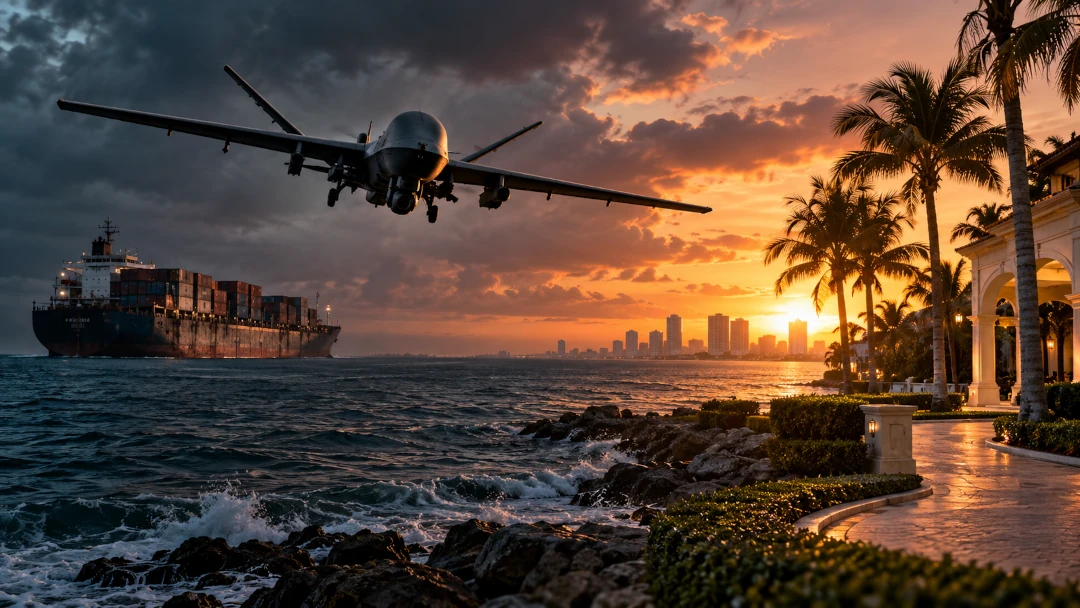
Imagine a rusting cargo ship idling in international waters off the coast of Valencia, Marseille or Naples. Inside one of its thousands of anonymous containers sits a small, cheap Russian drone. It needs no border crossing and no declaration of war. In an hour or two it could be over an airport, a port or a fuel depot. That is the scenario laid out this week by the Spanish daily El Mundo, which reported that the CIA had shared intelligence with European governments warning that Moscow may be preparing exactly such an attack against Spain, France or Italy.
Whether that specific plot is real, exaggerated or itself a piece of information warfare, the context around it is not in dispute. Russia is escalating its shadow war against Europe. America’s allies no longer trust Washington to show up. And the president of the United States has chosen this moment to roll out a welcome mat for the man responsible.
I. The Warning, and the Fog Around It
According to El Mundo’s reporting, relayed in detail by Euronews, the alert traces back to CIA Director John Ratcliffe’s unannounced August trip to Moscow. Sources close to Lithuania’s Defense Ministry told the paper that Lithuanian officials even know the weapon involved: the Gerbera, a small Russian drone weighing about 18 kilograms, with a reported range of up to 600 kilometers and an explosive payload of only four to five kilograms. It is not designed to level cities. It is designed to close an airport, start a fire, and prove that no corner of Europe is out of reach.
The paper’s analysts offered a chilling rationale for the target list: Spain, France and Italy all hold elections in 2027, and all have political movements positioned to exploit public exhaustion with the war in Ukraine. A cheap, frightening strike could pay political dividends far beyond its physical damage.
What we know, and what we don’t
The Weapon
Reported range of the Gerbera drone, which weighs roughly 18 kg and carries a 4–5 kg charge, per sources cited by Euronews. Small enough to hide in a shipping container.
The Trip
Ratcliffe spent a day in Moscow meeting Russian intelligence officials. CBS News reported he warned Russia not to attack NATO members, amid U.S. assessments that Moscow could test the alliance.
The Denials
Named target governments that publicly rejected the report. France’s Macron said Paris got no such alert; Italy’s defense minister called it unconfirmed. Spain has stayed silent.
The Precedent
Germany formally blamed Russia for an explosive-laden drone found beside a Ukrainian cargo plane at Leipzig/Halle Airport in August, and shut a Russian consulate in response.
Which brings us to the question many readers have asked: could this be a psychological operation? The honest answer is that it could, and in more than one direction. The report rests on anonymous Baltic sources, not on any on-the-record American official. The CIA has said nothing. French President Emmanuel Macron was blunt, telling interviewers that “the CIA did not inform France of this information.” Italian Defense Minister Guido Crosetto went further, dismissing the alarm as baseless and urging the press not to pour fuel on an already tense moment. A panic-inducing leak about drones from the sea would serve Moscow’s goal of frightening European voters into abandoning Ukraine just as well as a real attack would.
NATO Secretary General Mark Rutte seemed to recognize that danger, telling Euronews that Europe should remain calm, keep supporting Ukraine and “not fall into Putin’s trap, as he wants to sow panic.” But dismissing the specific plot does not dismiss the threat. Macron himself, in the same interview as his denial, said an attack on France remained possible and that Russia was intensifying “hostile and sometimes criminal actions” toward Europe. Berlin has already proven that Russian-linked explosive drones can reach a NATO airfield. The scenario is plausible precisely because the pattern is real.
II. A President Who Courts the Aggressor
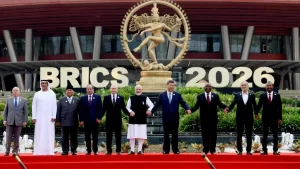
Against that backdrop, consider what Washington did the same week. On September 23, Secretary of State Marco Rubio, emerging from a meeting with Russian Foreign Minister Sergey Lavrov at the United Nations, announced plainly: “We’ve invited President Putin to the G20.” The summit will be held December 14–15 at Trump National Doral Miami, the president’s own golf resort. If Putin accepts, it would be his first in-person G20 appearance since 2019 and his first visit to the continental United States since launching his full-scale invasion of Ukraine.
Europe’s reaction ranged from disbelief to alarm. The European Union’s foreign policy chief, Kaja Kallas, said she would raise the invitation with other G20 members and called it the wrong path to normalize leaders who start wars and order the killing of civilians.
“By normalising this, believe me, we will have more of it around the world.”
— Kaja Kallas, EU High Representative for Foreign Affairs, via Al Jazeera
Polish Prime Minister Donald Tusk, whose country sits on the front line, said he would welcome the invitation if it truly brought a just peace closer, but warned that his experience told him Russia would more likely read it as encouragement to keep attacking, according to Al Jazeera.
In fairness, the administration’s record on Russia is not one-dimensional. The president recently signed the Lindsey O. Graham Sanctioning Russia Act, which grants sweeping power to sanction buyers of Russian energy and sanctions Putin personally. However, President Trump has not yet implemented the secondary tariffs or discretionary sanctions permitted under the law. At the UN, he publicly told Moscow to settle the war. And Ratcliffe’s trip, by CBS’s account, carried a warning to the Kremlin, not a gift.
But policy is judged by its whole shape, and the shape here is incoherence that consistently breaks in Moscow’s favor. Days after signing sanctions, the president pressed Ukraine to accept an energy truce and blamed Kyiv’s strikes on Russian refineries for record U.S. diesel prices, an argument experts quoted by Al Jazeera called pressure on the wrong party. Ahead of Ratcliffe’s visit, Washington asked Ukraine to pause strikes on Moscow until the U.S. plane left. Now comes a red-carpet invitation to a man under an International Criminal Court arrest warrant, at a property the president owns. Tough words, followed by concessions, followed by flattery: that is a sequence Putin has learned to exploit, and one that tells him American resolve has a price.
A month of mixed signals
III. Europe Braces, Increasingly Without Us
What does this forecast for peace in Europe? Nothing good. Russia is testing the edges of NATO with sabotage, airspace incursions and now an attributed bombing attempt on a German airport. Each time the response from Washington is muddled, the Kremlin learns that the cost of the next probe is low.
Officially, NATO’s leadership still defends America’s role. Rutte has repeatedly insisted that U.S. commitment to the alliance remains intact, and his public posture this week was one of calm. But actions speak louder than communiqués. This spring the Pentagon pulled roughly 5,000 troops from Europe, canceling an armored brigade rotation to Poland, and NATO’s own top commander, Gen. Alexus Grynkewich, told reporters that Europe should expect more withdrawals over time. Last week, NBC News reported the Pentagon is weighing a drawdown of 25,000 or more troops, along with planes, ships and weapons, despite allied warnings about Russian aggression.
Europe’s governments have drawn the obvious conclusion and are building for a future in which America may not come. EU leaders have committed to decisively ramping up defense readiness by 2030, prioritizing drone and counter-drone systems, air defense and long-range strike, while flagship projects like the Eastern Flank Watch and a European drone-defense network move from paper to procurement. Germany, after Leipzig, closed a Russian consulate and moved to tighten visas for Russians tied to hybrid operations.
European publics are moving even faster than their leaders. A May 2026 poll of nearly 19,500 people across 15 countries by the European Council on Foreign Relations found that just 11 percent of Europeans now consider the United States an ally, down from 22 percent in November 2024, while a quarter see it as a rival or adversary. The think tank titled its report “Home Alone.” Our oldest friends are no longer planning their future around American protection. They are planning around American absence.
Get Involved Today
Contribute to our mission and turn your concerns into action.
IV. An Empty Capitol
In a functioning republic, a moment like this would bring Congress into emergency session. Instead, Speaker Mike Johnson sent the House home on September 16, canceling the week’s remaining votes, and members will not return until after the November 3 midterms. Johnson told reporters, “The House has done its work.” Not everyone in his own party agreed. Rep. Ralph Norman, a South Carolina Republican, noted the House has canceled at least 63 scheduled voting days this Congress, and wrote that “the Founders did not envision taking this much time off and still getting paid.”
The early exit also conveniently pushed off a privileged resolution of impeachment against Defense Secretary Pete Hegseth, filed by Republican Rep. Thomas Massie over the Iran war, until after the election. The Senate remains in town for now, and it is there that the only serious congressional pushback has emerged.
On September 25, Sen. Jeanne Shaheen of New Hampshire, the top Democrat on the Foreign Relations Committee, and Sen. Roger Wicker of Mississippi, the Republican chair of Armed Services, led fourteen senators in a letter urging the president to rescind Putin’s invitation. The Democratic signers included Michael Bennet, Richard Blumenthal, Chris Coons, Ruben Gallego, Tim Kaine and Sheldon Whitehouse; they were joined by Republicans including Mitch McConnell, John Cornyn and Thom Tillis. The letter notes reports that Russia is helping Iran’s military target American service members, and cuts to the core of the strategic problem:
“…if President Putin and his government are not isolated on the international stage, what incentive does Russia have to agree to a ceasefire?”
— Letter led by Sen. Jeanne Shaheen (D-N.H.) and Sen. Roger Wicker (R-Miss.), via the Senate Foreign Relations Committee
That letter matters, and Democrats deserve credit for building a bipartisan coalition behind it. But a letter is not a law, and it should be said plainly that Democrats’ response to Russia’s escalation in Europe has so far been more reactive than commanding. In the House, Minority Leader Hakeem Jeffries spent the final days before recess demanding that Congress stay to address artificial-intelligence risks, a worthy fight, but no Democratic leader has yet forced a sustained public confrontation over Ukraine aid, European troop withdrawals or the depletion of the arsenal. The minority cannot schedule votes. It can still set the agenda of public debate, and on Europe it needs to do more of that.
V. The Cupboard Is Bare
Suppose the worst happens. Suppose a Gerbera does strike a Spanish port, or a sabotage campaign escalates into something NATO cannot ignore. Could the United States actually help defend Europe? The honest answer is: less than at any point in a generation, and largely by this administration’s own choices.
Missile Defense
Share of THAAD interceptors used since the Iran war began, with roughly half of Patriot interceptors gone, according to sources cited by CNN. The Pentagon receives only about 20 new Patriots a month.
Ukraine Starved
President Zelenskyy said allies delivered only about a third as many air-defense interceptors to Kyiv this year as in the same period last year, per Al Jazeera.
Oil Reserve
The Strategic Petroleum Reserve’s level after the Iran-war drawdown, its lowest since 1982, according to EnergyNow, roughly 40 percent of capacity.
Leadership
Generals and admirals Hegseth has fired or blocked from promotion, according to Military.com, in the middle of an active war.
The munitions crisis is the direct product of the war the administration launched against Iran in February. Interceptors built to defend allies, including allies in Europe, were fired in enormous numbers over the Gulf, and analysts say it will take years to rebuild them. Hegseth has publicly disputed the worst numbers, and the Pentagon insists the military has everything it needs. But the independent estimates, and the anonymous alarm of senior commanders, point the same direction. Every Patriot fired over the Persian Gulf is a Patriot that cannot protect Warsaw, Madrid or Kyiv.
The oil reserve tells a similar story. The 172-million-barrel release was coordinated with the International Energy Agency after Iran closed the Strait of Hormuz, and much of it was structured as an exchange that oil companies must repay with a premium. Past administrations, including President Biden’s in 2022, have also drawn the reserve down. But the cushion that protects Americans from the next oil shock is thinner than it has been in over four decades, and the war that emptied it was a war of choice.
Then there is the human side of readiness. Hegseth has removed senior officers faster than any defense secretary in recent memory, including the Army chief of staff, and his own Army secretary quit amid frustration over the firings. Sen. Thom Tillis, a Republican who voted to confirm Hegseth, has called on the president to replace him, accusing him of “creating a leadership void at the top of our military ranks.”
Put it together: fewer troops in Europe, emptier magazines, a thinner energy reserve, a hollowed-out command structure, and a president extending a hand to the Kremlin. We do not claim to know what is in Donald Trump’s heart, and we will not accuse him of serving a foreign power without evidence. We do not need to. The results speak for themselves, and every one of them is a result Vladimir Putin would have wished for. When a leader’s choices so reliably advance an adversary’s goals, the question of motive matters far less than the question of fitness.
VI. What It Means at Home
It is tempting for Americans to see all of this as a European problem. It is not. NATO’s mutual-defense clause, Article 5, has been invoked exactly once in its history: on behalf of the United States after September 11. An alliance that no longer trusts us is an alliance that may not stand with us the next time we need it.
The costs also show up closer to home. Americans are already paying record diesel prices, which the president has blamed on Ukraine’s strikes on Russian refineries and which analysts tie to his own war with Iran. A depleted oil reserve means less protection against the next price spike. Rebuilding the missile stockpile will cost taxpayers billions over years. And a weaker, more divided West leaves the United States more exposed in every other theater, from the Pacific to the Arctic, precisely when adversaries are watching our magazines run dry.
Security is not a slogan. It is a stockpile, an alliance, a chain of command, and a reputation for keeping our word. This administration has spent down all four.
When Judgment Itself Becomes the Emergency
The mechanism
Section 4 of the Twenty-Fifth Amendment allows the Vice President, together with a majority of either the Cabinet or “such other body as Congress may by law provide,” to declare in writing that the president is unable to discharge the powers and duties of the office. The Vice President then becomes acting president. If the president contests the declaration, Congress decides, and keeping him sidelined requires a two-thirds vote of both chambers.
Who Has Called for It
In April, after the president threatened that a “whole civilization” would die in a post about Iran, more than 85 House and Senate Democrats called for his impeachment or removal under the amendment, Axios reported. Rep. Jamie Raskin of Maryland, the top Democrat on the House Judiciary Committee and a constitutional law professor, introduced legislation to create a 17-member Commission on Presidential Capacity, the “other body” Section 4 contemplates. He said public trust in the president’s ability to do the job had dropped to “unprecedented lows.”
The Constitutional Argument
The case is not that Trump holds the wrong foreign-policy views. It is that the pattern of this presidency shows an inability to exercise the steady judgment the office requires: threats of annihilation followed by reversals; sanctions signed one week and a red carpet rolled out the next; a war that drained the very defenses our allies depend on; and a purge of the senior officers whose job is to warn a commander in chief when he is wrong. An office that commands the world’s most powerful military cannot be run on impulse. When decisions of this gravity are made erratically and against the counsel of the government’s own institutions, advocates argue, “unable to discharge” is no longer a stretch.
The Honest Barriers
The obstacles are formidable, and we will not pretend otherwise. Vice President JD Vance and the Cabinet are the president’s loyalists and have shown no inclination to act. Raskin’s commission bill cannot pass a Republican Congress, and the president could veto it. Even a successful declaration could be overridden unless two-thirds of both chambers agree. Critics, including many legal scholars, argue that the amendment was written for physical or mental incapacity, not for policy judgments, and that disagreements over Russia belong at the ballot box or in impeachment proceedings. Those objections deserve a serious hearing.
Why the Case Still Matters
Yet the barriers do not erase the duty. Section 4 explicitly invites Congress to build the machinery for exactly this kind of doubt, and Congress has never done so. Creating that commission would not remove anyone; it would ensure the republic has a lawful, bipartisan, medically grounded way to ask the question before a crisis forces it. The framers of the amendment wrote it in the shadow of a presidency cut short and a nuclear age that left no room for a commander who cannot command. The political math may be impossible today. The constitutional responsibility to prepare for the day it isn’t remains exactly where the amendment put it: with Congress.
Editorial Conclusion
We may never learn whether a drone was ever meant to leave a container in the Mediterranean. We already know what matters more: Russia is probing Europe, Europe no longer believes America will answer, and the president’s response has been to invite the aggressor to his resort while the arsenal runs dry and Congress goes home to campaign.
Deterrence is not a mood. It is the credible promise that aggression will cost more than it gains. That promise has been spent down by a war of choice, an emptied reserve, a purged command and a president who treats the man bombing Ukrainian cities as a guest of honor. Congress must return, rescind the welcome mat, rebuild the stockpile, and take up its constitutional obligation to ask whether this presidency is fit for the dangers it has invited. The security of Europe, and the credibility of American democracy itself, now depend on whether the people’s representatives are willing to do their jobs.
Sources & References
- El Mundo — Original report on the CIA warning of Russian drone attacks on Spain, France or Italy (Spanish)
- Euronews — What we know about CIA warning of Russian drone threat to southern Europe
- Euronews — Macron denies CIA warned France of Russian drone attack
- CBS News — CIA Director John Ratcliffe, during secretive trip, warned Russia not to attack NATO
- NPR — Germany blames Russia for attempted drone attack at Leipzig airport
- The Hill — Rubio says Trump extended invite to Putin for Florida G20 summit
- Al Jazeera — Trump invites Putin to Miami G20: Why that matters
- Senate Foreign Relations Committee — Shaheen, 13 bipartisan senators question Trump on Putin G20 invitation
- European Council on Foreign Relations — Home alone: Europeans are ready to defend themselves
- Defense News — More US troop withdrawals from Europe expected, NATO commander says
- NBC News — Pentagon weighs pulling nearly a third of U.S. forces from Europe
- Council of the EU — Timeline: European defence readiness
- CBS News — House cancels votes, cutting week short before adjourning until after midterms
- CNN — Nearly 80% of interceptors for a key missile defense system depleted
- Al Jazeera — US officials push back on reports of dangerously low munitions supplies
- EnergyNow — Oil stocks in US Strategic Petroleum Reserve fall to lowest level since 1982
- Military.com — Hegseth is removing military’s senior leaders faster than any defense secretary in recent history
- Axios — House Democrats file long-shot 25th Amendment bill targeting Trump
Related News