Billionaires at the Gate: Musk, the Ellisons, and the Buying of America’s News
As Paramount closes in on Warner Bros. Discovery and CNN, its executives have discussed inviting the world’s richest man into the deal. The result would place CBS News and CNN inside a financial circle of Trump-aligned billionaires and Gulf monarchies — and the institutions meant to stop it have mostly stepped aside.
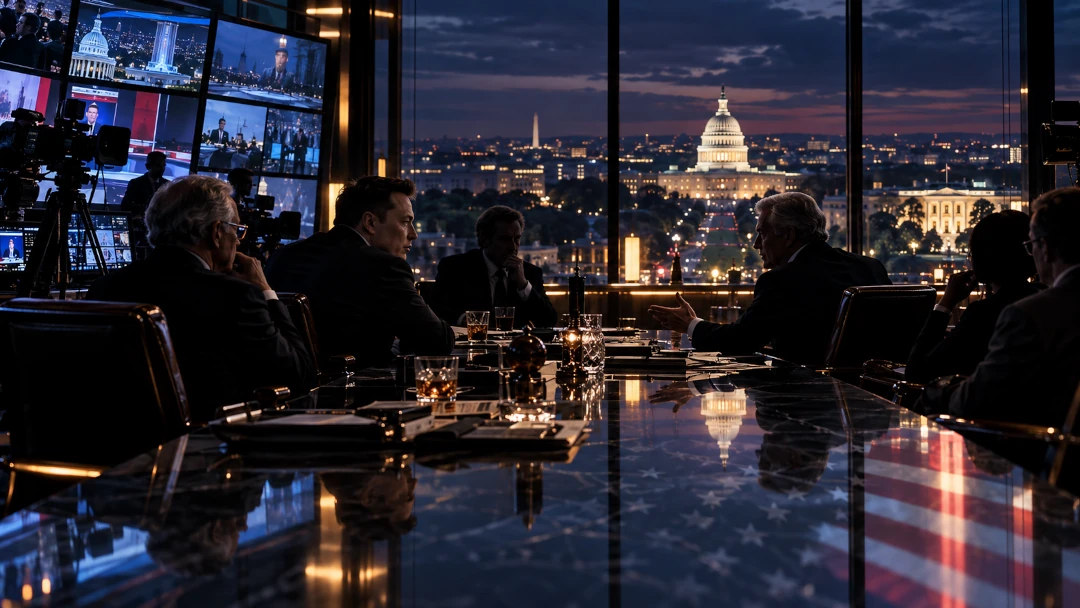
There was a time when the idea of the world’s richest man buying into the company that owns both CBS News and CNN would have been treated as a scandal. In September 2026, it arrived as a business item. According to an exclusive report in Semafor, Paramount executives have discussed asking Elon Musk to join a syndicate of equity investors in the company, and Musk is among several wealthy individuals CEO David Ellison has considered approaching. The same report notes that Musk and David’s father, Oracle founder Larry Ellison, have long been close — and that the elder Ellison has personally guaranteed more than $40 billion of the deal’s equity financing.
The talks are, by all accounts, early. The Hollywood Reporter described them as preliminary, with no size attached to any potential investment, and noted the combined company will carry more than $80 billion in debt. Paramount declined to comment. But the direction of travel is unmistakable. A merger that began as a family acquisition is becoming a club — and membership in that club is being extended to the loudest political financier in American life.
"An independent and free media is essential to ensure democracy."
I. The Deal and the Club
The architecture of this transaction matters, because it tells us who will sit around the table when decisions about America’s news are made. Paramount’s $111 billion takeover of Warner Bros. Discovery — which owns CNN, HBO, TNT and the Warner Bros. studio — is financed in large part by Larry Ellison’s personal guarantee and by roughly $24 billion from sovereign wealth funds in Saudi Arabia, Qatar and Abu Dhabi, as The Hollywood Reporter documented from SEC filings. Those foreign investors will collectively hold 49.5 percent of the combined company.
Now add Musk. Variety reports his net worth at roughly $950 billion and describes him as a one-time Trump administration official. Larry Ellison put $1 billion into Musk’s 2022 takeover of Twitter, the platform Musk has since reshaped into X. Fairness requires stating what we do not know: Paramount told regulators that the Ellison family and RedBird Capital will hold 100 percent of the voting stock, so an equity check would not automatically hand Musk a formal vote. But influence in a heavily indebted company does not flow only through ballots. It flows through who you need, who you owe, and who can walk away.
The Guarantor
Larry Ellison has personally guaranteed more than $40 billion of equity financing for the takeover, per Semafor.
The Monarchies
Saudi, Qatari and Abu Dhabi funds will hold 49.5% of the merged company after the FCC waived its 25% foreign-ownership threshold, reports Variety.
The Prospective Partner
Elon Musk, the world’s richest person, is being considered for an equity syndicate, according to Variety and Semafor. Paramount has not commented.
The Newsrooms
The combined company would hold both CBS News and CNN — with state attorneys general voicing concern about CNN’s integrity given the Ellisons’ Trump ties, per NPR.
II. The “Epstein Class” Takes the Newsroom
Rep. Ro Khanna of California helped popularize a phrase for the people now circling America’s newsrooms. He told HuffPost he began using “the Epstein class” to describe a wealthy, largely unaccountable elite that believes the rules do not apply to it. The term is a political description of a class and its impunity — not an accusation of any crime against any individual. Musk, like others whose names surfaced in connection with Jeffrey Epstein, has denied participating in Epstein’s criminal activity. But the phrase captures something real: a self-protecting circle of money, favors and access that has now purchased, or is purchasing, the machinery that tells Americans what is true.
We have already seen what that machinery does once it changes hands. In July 2025, Paramount paid President Trump $16 million to settle a lawsuit over a “60 Minutes” interview with Kamala Harris — a suit critics widely regarded as baseless — while its merger with Skydance awaited approval from Trump’s FCC. Six days later, as Variety recounted, the merger was complete. Stephen Colbert’s show was not renewed days after he mocked the settlement. Bari Weiss, a commentator with little television background, was installed as editor-in-chief of CBS News reporting directly to Ellison. By 2026, veteran “60 Minutes” correspondents including Scott Pelley had been pushed out.
The danger of consolidation is not that every story will be rewritten overnight. It is subtler and more corrosive. Editors learn which investigations are “not ready.” Anchors learn which guests trouble the owner. Coverage that inconveniences the party in power — and by extension the regulators who approve the owners’ deals — quietly thins out. When a handful of men control the largest newsrooms, the news becomes a product shaped for their interests: favorable to their politics, hostile to their opponents, and silent on themselves. That is a structural disadvantage for Democrats, yes. But far more, it is a loss for every American who needs accurate information to govern themselves.
III. The President’s Hand on the Scale
Donald Trump has not hidden his interest in who owns CNN. In December 2025, with Netflix and Paramount still bidding, he told a White House roundtable that CNN should be sold and that he would “probably” or “maybe” be involved in the decision, as NBC News reported. His remarks followed a Wall Street Journal report, cited by NBC, that David Ellison had told Trump he would make significant changes at CNN.
“The people that are running CNN right now are either corrupt or incompetent.”
— President Donald Trump, White House roundtable, December 10, 2025
The administration’s regulators then did their part. Trump’s FCC, chaired by Brendan Carr, approved a waiver allowing Gulf sovereign funds to own nearly half the combined company. The lone Democratic commissioner, Anna Gomez, dissented sharply, as Engadget reported:
“An investment this large … doesn’t just buy equity, it secures influence over what gets said and made.”
— FCC Commissioner Anna Gomez
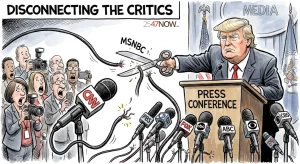
And then, days before the deal cleared its final hurdle, the president banned CNN, MS NOW and Politico from the White House. As NPR reported, former FTC commissioner Alvaro Bedoya drew the obvious line: Americans watched CNN barred from the White House, then days later learned one of the president’s closest allies would own it. What this reveals about Trump’s priorities is not subtle. A president facing a war, a cost-of-living crisis and collapsing trust has spent his political capital deciding which billionaire should own which newsroom — and punishing the newsroom that has not yet been bought.
IV. What the States and Congress Did — and Didn’t — Do
For months, the strongest line of defense was the states. California Attorney General Rob Bonta led eleven other attorneys general — from Arizona, Colorado, Connecticut, Massachusetts, Minnesota, Nevada, New Jersey, New Mexico, New York, Oregon and Washington — in an antitrust suit to block the merger. Then, on September 21, they settled. Bonta’s official announcement lists five years of separate cable negotiations, a continued free streaming service, a News Editorial Independence Board for CNN and CBS, and an independent compliance monitor. Bonta insisted the settlement is “not a vote of support for this merger.”
Critics were unpersuaded. Deadline reported that Bonta had previously preferred structural remedies like asset sales over behavioral promises that require monitoring — precisely the kind of remedy he ultimately accepted. Free Press called the deal a collection of unenforceable promises, and Bedoya told NPR that the billionaires had won. The pressure came partly from within the Democratic Party: Paramount floated moving its headquarters to Tennessee or Texas, and Governor Gavin Newsom, Los Angeles Mayor Karen Bass and gubernatorial candidate Xavier Becerra urged a compromise. Newsom has denied pressuring Bonta. The Block the Merger Coalition, as Deadline reported, called it a bad deal for independent journalism and a strong democracy.
In Congress, Democrats in the minority have used the tools they have. In February, eight senators — including Chuck Schumer, Dick Durbin, Cory Booker, Amy Klobuchar, Elizabeth Warren, Richard Blumenthal, Mazie Hirono and Peter Welch — demanded answers from Ellison about his dealings with Trump, as Variety reported. In June, Booker, Adam Schiff and Warren pressed Carr to halt closing pending a foreign-investment review, Variety reported. And in August, House Judiciary ranking member Jamie Raskin accused Ellison of “colluding” with Trump in a letter reported by CNN.
The honest ledger is this: letters, investigations and dissents have documented the problem thoroughly, but without a majority in either chamber, Democrats cannot subpoena, legislate or block. The states had real leverage — and traded it for promises. The settlement still requires a judge’s approval, and the merger is expected to close in the coming weeks.
Get Involved Today
Contribute to our mission and turn your concerns into action.
V. What Leadership Would Have Looked Like
A president committed to a free press would have recused himself from a merger involving a network he has spent a decade attacking. He would have instructed his regulators to scrutinize, not wave through, a transaction that places nearly half of America’s second-largest news conglomerate in the hands of foreign monarchies. He would not have publicly demanded that a newsroom be sold, nor banned it from the White House while its sale was pending. Instead, this president did the opposite at every turn. That is not simply bad policy. It is a pattern of placing personal grievance and the interests of allied billionaires above the constitutional role of the press — and above the public interest he swore to protect.
Can a President’s Conduct Toward the Press Speak to His Fitness?
The mechanism
Section 4 of the 25th Amendment allows the vice president, together with a majority of the Cabinet — or a body that Congress creates by law — to declare that the president is “unable to discharge the powers and duties of his office.” The vice president then becomes acting president. If the president contests the finding, Congress decides, and a two-thirds vote of both chambers is required to keep him sidelined.
Who has called for it
In April, House Judiciary ranking member Jamie Raskin introduced legislation to create the Commission on Presidential Capacity that Section 4 contemplates but Congress has never established. According to Axios, the bill drew dozens of Democratic co-sponsors, and more than 85 House and Senate Democrats had called for Trump’s impeachment or removal after his threats against Iran.
The argument
Raskin’s case rests on a documented pattern of erratic judgment. The media saga adds to that record: a president publicly steering the ownership of a news network he despises, his regulators waiving foreign-ownership limits for his allies’ financiers, and his own sudden ban of that same network from the White House. The argument is that a president unable to separate personal vendetta from the duties of office — including the duty to respect the First Amendment — is showing precisely the impaired judgment the amendment’s drafters feared.
The honest barriers
The barriers are formidable, and we will not pretend otherwise. Section 4 was written for incapacity, not for policy disagreement or abuse of power; misconduct of this kind is more naturally addressed through impeachment. Invocation requires Vice President JD Vance and a Cabinet chosen for loyalty. Raskin’s bill cannot pass a Republican Congress, and Trump would veto it. Republicans have dismissed the effort as partisan theater.
Why the case still matters
None of that makes the question illegitimate. The Constitution invites Congress to build the Section 4 body, and it has failed to do so for more than half a century. Establishing it — with physicians and former officials rather than partisans — is a sober act of constitutional housekeeping, not a coup. And documenting a president’s pattern of conduct, including his campaign against the free press, builds the record that voters, courts and a future Congress will need. Accountability deferred is not accountability denied.
VI. What Must Happen Now
The fight is not over. The court reviewing the state settlement should demand enforceable terms with real penalties before signing off. The independent monitor and the editorial independence board must publish their findings openly, not bury them in confidential reports. Congress — whoever controls it after November — should hold public hearings on the FCC’s foreign-ownership waiver, require disclosure of every investor in the combined company including any Musk stake, and establish ownership caps for national news operations. And readers should support independent, nonprofit and local newsrooms that no billionaire can buy. Musk’s potential entry is not yet a done deal. It can still be made politically costly.
Editorial Conclusion
An independent and free press is not a luxury of democracy; it is the condition of it. When the richest men on earth, a family allied with the president, and foreign monarchies pool their money to own the nation’s largest newsrooms — while that president bans the newsroom they are buying — the public’s right to know has been auctioned.
The states blinked. The FCC waved it through. The president cheered it on. What is required now is a Congress willing to break up this concentration of power, courts willing to hold these promises to account, and citizens unwilling to accept a news system owned by the people it is supposed to watch. Nothing less will preserve self-government.
Sources & References
- Semafor — Paramount weighs tapping Musk for equity investment
- The Hollywood Reporter — Paramount Exploring Whether to Recruit Elon Musk for Equity Investment
- Variety — David Ellison Mulls Tapping Elon Musk for Paramount Investment
- The Hollywood Reporter — FCC Signs Off on Middle East Investments in Paramount-Warner Bros Deal
- Variety — FCC Approves 49.5% Foreign Ownership of Paramount-Warner Bros.
- Engadget — FCC allows Gulf state wealth funds to own nearly half of Paramount-Warner Bros.
- HuffPost — The Epstein Class: Term for ‘Unaccountable’ Rich People
- Variety — Ex-’60 Minutes’ Staffers Attack Bari Weiss After Scott Pelley Fired
- NBC News — Trump says CNN should be sold as part of any Warner Bros. deal
- NPR — Paramount makes concessions to salvage $111 billion Warner Bros. Discovery deal
- California Department of Justice — Attorney General Bonta Announces Settlement in Warner Bros./Paramount Litigation
- Deadline — Paramount Settles Antitrust Suit, Set to Seal Deal for Warner Bros Discovery
- Deadline — Block the Merger Coalition Slams AG Settlement of Paramount Lawsuit
- Variety — Senate Democrats Demand Answers From David Ellison
- Variety — Democratic Senators Urge FCC to Block Paramount-Warner Bros. Merger From Closing
- CNN Business — Democrats intensify scrutiny of David Ellison amid Paramount–WBD legal battle
- House Judiciary Democrats — Raskin Introduces Legislation Establishing Commission on Presidential Capacity
- Axios — House Democrats file long-shot 25th Amendment bill targeting Trump
Related News