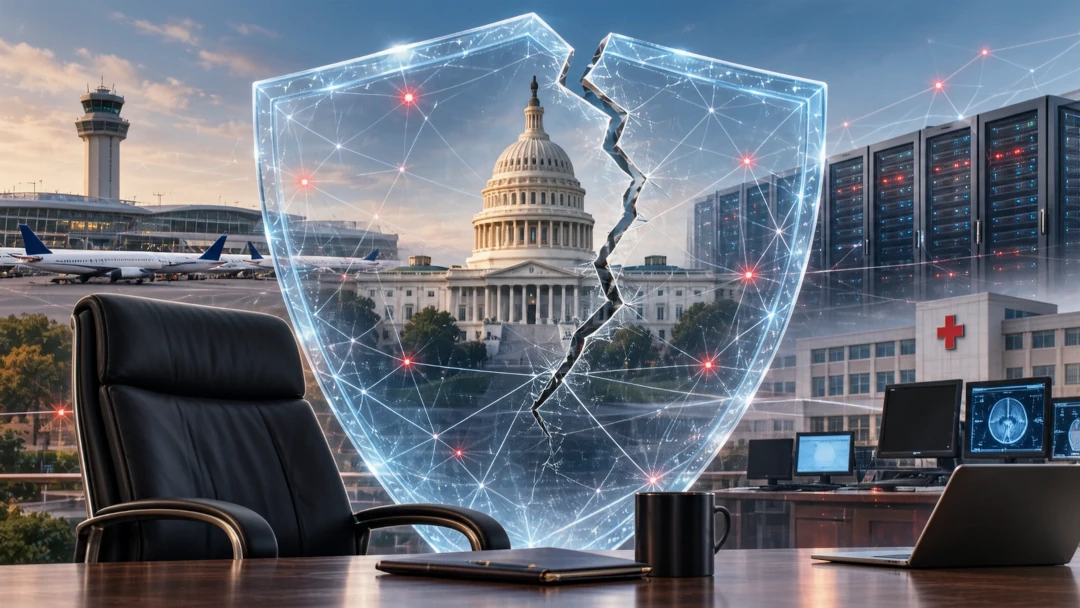
Trump fired the political loyalist he put in charge of America’s digital defenses, saying he lacked the right credentials. That was true on the day he was nominated. The reason given for the firing doesn’t hold up, and the rumor online doesn’t either. What’s left is a country whose airports, banks and spy networks all went down in the same week, while the agencies meant to protect them have been cut back hard.
Last week America got a rare look at how fragile its digital systems are. Microsoft’s workplace software went dark around the world. Every flight in the country was held on the ground. Chase customers couldn’t move their money. The National Security Agency’s classified network went offline. Apple’s services failed. Then, on Thursday night, the official who by law coordinates America’s cyber defenses was gone. Reuters reported that National Cyber Director Sean Cairncross had been fired, the administration’s first major personnel move since the outages began, and that the Pentagon’s chief information officer, Kirsten Davies, would take over on a temporary basis.
The White House’s account is short and, on its own terms, damning. A person close to the White House told Reuters that “the president fully supported firing Sean Cairncross from his position.” Another official told The Hill that Trump backed the decision because he believed Cairncross did not have the proper cyber credentials for the job. On Friday the president said it himself. Asked why he removed his cyber chief, Trump said plainly: “Because I didn’t think that person was good enough.”
So this was not a resignation, whatever some early headlines said. It was a firing, and the reason the White House gave is one the president could have read on Cairncross’s résumé in February 2025.
I. Why He’s Gone: What We Actually Know
The most detailed account of the decision came from Axios, which cited two White House sources. As summarized by Gizmodo, Axios reported that Stephen Miller, recently appointed White House chief of staff, pushed Cairncross out on the grounds that he lacked strong cyber credentials. The National Desk noted that the exit was still described as amicable. Cairncross left gracefully, saying it had been the “honor of a lifetime to serve” in the administration.
The timing is what makes this a story. NBC News reported that the departure came “in the wake of tech outages that hit both the private and public sectors,” and noted that Cairncross had played a key role in shaping the administration’s AI policy. Yet Gizmodo pointed out that no reporting has tied Cairncross’s own job to any of the failures. The White House fired him in the middle of a crisis without saying he did anything wrong in it.
The credentials argument doesn’t survive a look at the record. When Trump nominated Cairncross, a former Republican National Committee chief operating officer, Cybersecurity Dive described him as a veteran GOP operative with close ties to the president. The Senate confirmed him 59–35 in August 2025. Critics said at the time that he had never held a cybersecurity leadership role. The White House chose him anyway. Firing him now for the same thing it knew then is not accountability. It is an attempt to dodge responsibility for its own choice.
“Because I didn’t think that person was good enough.”
— President Donald Trump, asked why he fired the National Cyber Director he nominated, via The National Desk
II. The Rumor: Was the Airline Grounding an AI Hack?
Online, a more dramatic version has spread: Cairncross was fired because he failed to stop the nationwide grounding, and the grounding was really a cyberattack carried out with artificial intelligence. We take the fear behind that rumor seriously. But we hold our own side to the same standard of evidence we demand of the administration, and the evidence does not support the rumor.
The FAA said directly: “Based on all available evidence, we have no indication that this was a cyberattack or an outside nefarious actor,” as reported by Yahoo News. According to a detailed timeline compiled by Implicator, the agency traced the failure to a router that flooded its network with connection requests while it was being installed during copper-to-fiber upgrade work in El Dorado, Arkansas. Communications and radar failed at 17 of the FAA’s 22 en route centers. FAA Administrator Bryan Bedford said there was “zero evidence of anything AI-related.” Transportation Secretary Sean Duffy told NPR that outdated technology was to blame: “We have old switches, old routers.”
The intelligence community said the same under oath. At the House Homeland Security Committee’s annual threats hearing, Director of National Intelligence Jay Clayton testified with “a very high level of confidence” that the outages were not a cyberattack, and Homeland Security Secretary Markwayne Mullin said, “We’re 98% confident that there is no nefarious activity going on,” CNN reported.
Two caveats matter. First, Duffy has said investigators reproduced the FAA failure but have not yet found its root cause. Second, “98% confident” is not 100%. Americans are right to keep asking. But by every account now on the record, the rumor is false. The true story is less cinematic and more troubling: no enemy had to attack us for the systems to fail.
III. The Week Everything Broke
To see what Cairncross was facing, and what his successor inherits, look at how much failed in how short a time. Fortune reported that the Microsoft, FAA, Chase and Apple outages produced 6.4 million U.S. Downdetector reports in a single week. Reuters put the grounding’s toll at more than 18,000 flights.IV. The Real Culprit: An AI-Driven Race to Patch
If the outages weren’t an AI attack, what were they? The best-supported explanation involves AI, but on the defense side. AI tools are finding software flaws faster than organizations can safely fix them, and the rush to fix them is breaking systems. Clayton told the House committee the failures were “separate service outages associated with maintenance and technical changes,” and on Fox Business he tied the NSA outage to a patch for recently disclosed PHP vulnerabilities, according to Implicator. Gizmodo reported that, according to the Washington Sun, Wall Street executives and NSA officials gave Congress the same explanation privately.
The numbers show the strain. Fortune reported that Microsoft fixed 1,094 flaws on its November Patch Tuesday after fixing 1,474 in October. Sen. Mark Warner of Virginia, the top Democrat on the Senate Intelligence Committee, summed it up on CNN: “If you’re trying to patch 10 or 12 in a single week, you have these kind of outages.”
To be fair to the companies, their own explanations differ. Microsoft blamed a bug from a July update. Chase blamed a software bug in on-premise hardware. The FAA blamed legacy equipment. These may be separate failures. But they share one cause: critical infrastructure that is old, stretched thin and maintained under constant pressure. Coordinating a national response to exactly that kind of systemic risk is the job Congress created the cyber director to do.
Federal Cyber Defenders Cut
CISA, the nation’s civilian cyber defense agency, has lost about a third of its staff under Trump, including its counter-ransomware initiative, and was reportedly running at 38% staffing during this year’s shutdown (TechCrunch).
The Investigators Were Dismissed
The administration emptied DHS’s Cyber Safety Review Board in the middle of its investigation of China’s Salt Typhoon telecom intrusions, leaving no standing body to investigate failures like last week’s (Nextgov).
Russia’s Propaganda Machine Keeps Running
An EU assessment found that Russia’s “Operation Overload” spread fake videos impersonating Western media during France’s riots. A separate French review found that MAGA-linked accounts also pushed hostile narratives about the unrest (Reuters via BusinessWorld).
Europe Acted; Washington Fired Someone
On Nov. 16 the EU sanctioned Moscow’s Social Design Agency, which it says runs large-scale information manipulation directed by the Russian Presidential Administration (Council of the EU).
Real-World Fallout
During the Microsoft outage, hospitals reportedly switched to paper and some jails could not release prisoners. By that weekend, Costco shoppers were stocking up on water, batteries and generators (Implicator).
A Seven-Page Strategy
The administration’s March 2026 cyber strategy put offensive operations first and ran just seven pages. Cairncross himself called it a high-level statement of intent, with the operational details left for later (the strategy).
Get Involved Today
Contribute to our mission and turn your concerns into action.
V. What Trump Is Saying and What Comes Next
The president’s message has been to minimize. “They’re all separate events,” Trump said of the outages, according to The National Desk. Fox News reported that he promised to alert Americans if a broader problem emerged. On air traffic control, he has asked Congress for $50 billion to modernize the system while opposing short-term repairs, advising that the country should “spend as little as you can to keep it going until we get there.” That request faces doubt in both parties. Sen. Jim Banks (R-Ind.) said he is “not fully convinced that throwing out more money is going to solve fundamental problems.”
The administration’s choice of acting director deserves credit. Davies is a real cybersecurity professional. Newsweek notes that she led global cyber resilience at Unilever and held technology and cyber roles at Estée Lauder, Barclays-Africa Group, Hewlett Packard and Siemens before joining the Pentagon. An administration official told Axios that “Kirsten has the credentials to excel in this position and has already been Senate-confirmed.” Secretary of State Marco Rubio and Defense Secretary Pete Hegseth both praised her publicly.
Still, an acting director is a placeholder, and the problem is bigger than one person. Davies inherits a cyber agency cut by a third, no independent body to investigate failures, and a president who calls a week of nationwide outages a coincidence. A permanent director needs Senate confirmation, and the Senate changes hands in January. How the administration treats that nomination will show whether the “credentials” argument was sincere.
Congress Built This Office to Be Independent and Expert. The White House Has Treated It as Neither.
6 U.S.C. § 1500
Congress created the Office of the National Cyber Director in the William M. (Mac) Thornberry National Defense Authorization Act for Fiscal Year 2021 (§ 1752). Under the statute, the director is appointed “by and with the advice and consent of the Senate” and serves as the president’s principal adviser on cybersecurity policy and strategy (ONCD). The law also charges the director with reviewing agencies’ annual budget proposals and advising whether they fit the national cyber strategy. That duty is meant to check exactly the kind of deep cuts CISA has absorbed. Whether the office used that authority to push back on those cuts is a question the new Congress should ask under oath.Art. II, § 2, cl. 2
The Appointments Clause gives the Senate a share of responsibility for who holds offices like this one. The director serves at the president’s pleasure, so firing Cairncross was legal. But Senate confirmation exists to test whether a nominee is qualified. In 2025 the Republican-controlled Senate confirmed a nominee whose qualifications were openly questioned. Starting in January, Democrats will decide what that test means.5 U.S.C. §§ 3345–3346
The Federal Vacancies Reform Act lets the president name an officer who already holds a Senate-confirmed post, like Davies as Pentagon CIO, to serve as acting head of another such office. The act generally limits acting service to 210 days from the vacancy unless a nomination is pending (GAO). Counting from the Nov. 19 firing, that clock runs to about mid-June 2027. Congress should insist that the White House send a qualified nominee well before then, not leave the post filled by an acting official indefinitely, as this administration has done with other offices.VI. Congress Reacts: Anger, Alarm and a Bipartisan Bill
Democrats responded sharply. On the Senate floor Friday, Democratic Leader Chuck Schumer criticized the administration’s handling of the outages and called the ousted director a “political hack,” Fox News reported. At Wednesday’s hearing, Rep. Bennie Thompson of Mississippi, the Homeland Security Committee’s top Democrat, confronted Secretary Mullin for flying to the LSU–Texas football game while stranded travelers were still dealing with cancellations, KOMO News reported. Rep. James Clyburn of South Carolina pointed to the FAA’s slow spending of the $12 billion it has already received: “When you appropriate funds, and they don’t use the funds, the money is still sitting there.”
“Congress is not capable of reining this in.”
— Sen. Ron Johnson (R-Wis.), via Fox News
The concern crosses party lines. Republican Sen. Josh Hawley of Missouri asked the administration to brief lawmakers so they can “share with the American people what’s happening here,” according to Reuters. Rep. Elise Stefanik (R-N.Y.) called for regular cyber briefings for all of Congress. The quote above, from Sen. Ron Johnson, a Republican, is the most revealing response of the week: a resignation before the work has even started. Rep. Rick Larsen (D-Wash.) was the most practical voice ahead of the holidays: “I want to assure you all it is safe to fly.”
The most hopeful development is a bill. House members from both parties, including Rep. Morgan Luttrell (R-Texas), introduced legislation to create a National Cyber and AI Investigations Board inside CISA to investigate major cyberattacks, AI incidents and technology failures, Nextgov reported. The key provision: the executive branch could not abolish, suspend or merge the board without another act of Congress, and outside officials could not change or suppress its findings. It is designed so that what happened to the Cyber Safety Review Board cannot happen again.
VII. What It Means for the Average American
For most families this isn’t abstract. It meant a missed Thanksgiving connection, a paycheck stuck in a delayed transfer, a hospital back on paper charts, or a run on generators at the local Costco. Every one of those failures was preventable or survivable with enough people, enough money and someone in charge. America has been shedding all three.
And defense isn’t only technical. Russia’s influence operations are designed to turn moments like this into panic and distrust. Its networks have shown in France that they can turn real unrest into viral falsehoods within days. A country whose leaders dismiss serious failures as coincidence, while viral posts blame foreign governments or even aliens, is an easy target for the next campaign. Telling Americans the truth quickly and credibly is part of national security. This week the White House offered a firing and a shrug.
VIII. What This Says About Trump’s Priorities
The pattern goes well beyond one personnel decision. The administration put a party operative in a job Congress designed for an expert. It cut the civilian cyber agency by a third, dismissed the board that investigated breaches, and wrote a seven-page strategy built around going on offense. When the bill came due, it fired the loyalist and blamed his résumé. Critics said so in plain terms when he was nominated, and the Senate confirmed him by a 59–35 vote anyway. Nobody in the White House can say they weren’t told.
The administration’s defenders will make a fair point: the outages weren’t an attack, a qualified professional is now acting director, and modernizing air traffic control really does need money. All true. But those are the points of an administration reacting to a crisis it helped create. Leadership means building the defenses before the systems fail. On cybersecurity, this White House has consistently chosen loyalty over expertise, cuts over capacity, and messaging over the truth.
IX. What You Can Do
No single citizen can fix the nation’s networks, and the most important decisions, like who leads this office and whether CISA is rebuilt, will be made in the Senate and in budget negotiations next year. But public pressure decides whether those debates happen in the open, and some of the easiest defenses are in your own hands.
- Call your senators about the nomination. Tell them any permanent National Cyber Director must have real cybersecurity experience and must get a full, public confirmation hearing, not a group hearing with unrelated nominees. With Democrats taking the Senate in January, this is real leverage.
- Back the investigations board bill. Ask your House member to cosponsor the bipartisan bill creating an independent National Cyber and AI Investigations Board that no administration can dismiss. Last week’s failures deserve a public, independent report.
- Demand that CISA be rebuilt. Tell your members of Congress to reverse the cuts to the nation’s civilian cyber agency in the next budget. That agency is the front line protecting the systems your hospital, your bank and your town depend on.
- Don’t spread the disinformation. Before sharing a post claiming a secret AI attack or a foreign takeover, check it against official statements and reputable reporting. Panic and distrust are exactly what hostile influence operations are trying to produce.
- Prepare sensibly, not fearfully. Keep your devices updated, turn on multi-factor authentication, keep a little cash and essential documents on hand, and know your bank’s and airline’s backup contact options. Resilience starts at home. Hoarding doesn’t help.
Editorial Conclusion
Sean Cairncross was not the cause of America’s cyber crisis. He was evidence of it. A president who appoints loyalists to jobs that require expertise, cuts the agencies that defend the country, and then fires the loyalist when the systems fail is not keeping Americans safe. The country does not need another scapegoat. It needs a qualified, Senate-confirmed cyber director, a rebuilt CISA, an independent investigations board, and a government that tells the public the truth. Democracy depends on systems people can trust, and that trust is being worn down by neglect and by lies. Restoring it is now Congress’s job, and the work should start in January.
Sources & References
- NBC News — White House national cyber director is leaving the administration after series of tech outages
- Reuters / Yahoo News — Trump ousts cyber director after tech outages spark criticism
- Gizmodo — Sean Cairncross Out As National Cyber Director
- The Hill — White House lets go of national cyber director, names acting replacement
- Newsweek — Kirsten Davies Poised to Take Over as New Cyber Chief After Tech Chaos
- Fox News — Trump fires national cyber director as tech outages rattle the country (live updates)
- The National Desk — White House cyber director out after string of outages
- NPR — Old tech blamed for the ground stop that caused flight chaos: ‘It got overloaded’
- Yahoo News — FAA ground stop has exposed just how vulnerable US is to sabotage
- Implicator — Outages Rattle Americans as Spy Chief Blames Patching
- Fortune — Microsoft, FAA, Chase, and Apple outages drove 6.4 million U.S. Downdetector reports in one week
- Fortune — Flawed patches across the internet break banks and airlines
- CNN / KEYT — Mullin defends flight as he bears brunt of lawmakers’ ire during threats hearing
- KOMO News — Mullin faces questions in Congress on flight chaos, cyber threats and LSU trip
- Nextgov/FCW — Bipartisan bill would create cyber and AI review board amid series of tech outages
- Reuters / BusinessWorld — Covert Russian network exploited French riots on social media, EU report says
- Council of the European Union — Russia’s FIMI and malicious cyber activities: Council imposes sanctions
- TechCrunch — US cybersecurity agency CISA reportedly in dire shape amid Trump cuts and layoffs
- Cybersecurity Dive — Senate confirms Sean Cairncross as national cyber director
- The White House / GAO — About the Office of the National Cyber Director (6 U.S.C. § 1500); FAQs on the Vacancies Act; President Trump’s Cyber Strategy for America (March 2026)
Related News