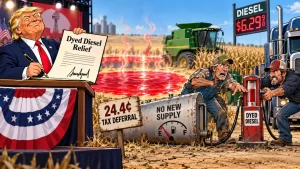
A reported 90-day ban on U.S. diesel exports is being sold as relief for farmers and truckers. Economists, the oil industry, and the president’s own Energy Secretary warn it would do the opposite: back up refineries, push gasoline higher, and leave America’s allies scrambling for fuel in the middle of a war-driven energy crisis.
President Trump has found a new way to make an energy crisis worse. Seven months into a war with Iran that has choked the Strait of Hormuz and sent fuel prices to records, the White House is reportedly preparing a plan to halt all U.S. diesel exports for 90 days, according to Politico, which cited five people familiar with the discussions. The stated goal is lower prices before November. The actual effect, if the country’s energy economists are right, would be higher prices at home, shortages abroad, and a lasting blow to America’s standing as a reliable partner.
What makes the episode so revealing is not only the policy itself but the chaos surrounding it. The president endorses the idea in front of cameras; his spokespeople call the reporting fake; his Energy Secretary tells the press a blanket ban isn’t even on the table; his Treasury Secretary says it is being studied. That is not deliberation. That is a government improvising on the world’s fuel supply with an eye on an election calendar.
I. The Plan — and the Chaos Around It
The pressure began with Republicans, not economists. Iowa Senator Chuck Grassley publicly urged the White House to embargo diesel for the sake of farmers, and GOP candidates in farm states followed, according to CNBC. Iowa is a state Trump carried three times, yet Republicans now face a genuinely competitive Senate race there. Bob McNally, a veteran energy adviser quoted by CNBC, summed up the mood in Washington bluntly: “It’s full-blown panic.”
“Let’s not send out the diesel.”
— President Donald Trump, speaking to reporters, September 22, 2026
Trump then told reporters he backed banning diesel exports and had pressed his own team to do it. What followed was a week of contradictions.
- February 2026The U.S. goes to war with Iran. Iran’s retaliation disrupts the Strait of Hormuz, and fuel prices begin their climb, as documented by the Joint Economic Committee.
- Summer 2026U.S. diesel exports hit a record near 2 million barrels per day as America becomes the world’s backstop supplier, Bloomberg reported.
- September 22Trump endorses a ban. Treasury Secretary Scott Bessent says the administration is examining whether a full or partial ban is feasible, per Axios.
- September 23Politico reports a 90-day ban is being prepared. Diesel futures and refiner shares fall; the White House dismisses the story as “fake news.” Bloomberg notes the legal path remains unclear even as Trump is said to favor acting by week’s end.
- September 23–24Energy Secretary Chris Wright contradicts the reporting, telling The New York Times that “nobody wants a full blanket ban or zero exports of diesel,” while the nation’s largest business groups send Trump a joint letter warning a ban would raise prices, according to CNBC.
Note who is warning against this: not environmental groups, not the left, but the U.S. Chamber of Commerce, the Business Roundtable, the National Association of Manufacturers, and the American Petroleum Institute. When the president’s natural allies in corporate America line up to tell him his idea will backfire, it is worth asking who, exactly, he is listening to.
II. Why a Diesel Ban Raises Your Gas Price
The central flaw in the plan is chemistry, not politics. A refinery cannot choose to make only gasoline. Every barrel of crude that goes through a distillation column comes out as a fixed mix of products — gasoline, diesel, jet fuel, and more — in roughly set proportions. Export markets absorb roughly a quarter of what U.S. refiners produce as diesel, according to ABC News (Australia). Close that outlet and the diesel has nowhere to go.
David Oxley, chief commodities economist at Capital Economics, laid out the sequence to ABC: a ban would briefly increase diesel on the domestic market, but because refiners can’t sell or store unlimited diesel, they would eventually be forced to cut their total output — including gasoline and jet fuel. His firm estimates Gulf Coast diesel storage could swell to pandemic-era highs within weeks as refinery utilization falls. In other words, the 90-day clock would run out long after the tanks filled up.
The storage trap
Surplus diesel could force U.S. refiners to cut supplies of all fuels within a few weeks, making a ban self-defeating, Capital Economics warned in analysis reported by Reuters.
The world price
Energy economist Philip Verleger told Reuters a ban could “raise world prices by as much as 100%” because diesel demand barely responds to price.
The administration’s own warning
Energy Secretary Wright has previously said an export ban would be ineffective and could raise gasoline and jet fuel prices as storage fills, per Reuters reporting.
The history lesson
Columbia University’s Center on Global Energy Policy concluded earlier this year that restricting U.S. oil exports would backfire, noting the Biden administration weighed and rejected similar ideas in 2022.
This is the cruelty at the heart of the gambit. Truckers and farmers would get a brief dip at the diesel pump — just long enough to reach Election Day — followed by tighter supply of everything the refineries make. Americans who drive a gasoline car, fly home for the holidays, or buy anything shipped by truck would pay for a headline.
III. Abandoning the Allies Who Bought American
For years, Washington told its partners to stop buying Russian fuel and to rely on America instead. They listened. After Russia restricted its own exports and the Iran war disrupted Gulf supplies, the United States became the world’s indispensable diesel supplier. The top buyers of U.S. diesel include Brazil, Chile, Mexico, Peru, Morocco, France, and the United Kingdom, according to Kpler data cited by Reuters. A 90-day ban would pull that rug out overnight.
The damage would land hardest in the Western Hemisphere. Brazil, just entering its planting season, is currently the largest buyer of American diesel, and Chile relies on it to run the mining equipment that produces much of the world’s copper, Bloomberg reported. S&P Global Energy analysts warned that because Latin America has little spare refining capacity and few alternative sources, a sudden loss of U.S. diesel would likely mean sharp price increases for consumers and businesses across the region. The Atlantic Council added that Mexico, Peru, and Ecuador have thin storage buffers and heavy reliance on U.S. supply, leaving them especially exposed.
Europe would suffer too. The Netherlands serves as a fuel logistics hub for the whole continent, and Britain has leaned on American cargoes to replace lost Middle Eastern supply. Citi analysts warned that even a partial ban could cause product shortages in Europe, South America, Australia, and Africa, according to Reuters. Verleger’s verdict was harsher: the world would stop seeing the United States as a dependable energy source.
Our allies are already bracing. In Australia — the world’s largest diesel importer in absolute terms, though it buys little directly from the U.S. — MST Marquee energy analyst Saul Kavonic called the proposal “probably the most worrying development we have seen in global fuel markets” since the war began, warning that rationing under the country’s National Fuel Security Plan could arrive within weeks, ABC News reported. Australia’s government is continuing to seek supply from partners such as Saudi Arabia. In Britain, Elizabeth de Jong, chief executive of Fuels Industry UK, used a GB News op-ed to urge the government to protect domestic refining capacity, arguing Britain cannot depend on overseas production alone. European diesel prices rose on the mere prospect of restrictions.
The lesson allies are drawing is the one Trump’s trade wars have taught them repeatedly: American commitments now expire whenever the president’s poll numbers dip. That lesson will outlast any 90-day ban.
Get Involved Today
Contribute to our mission and turn your concerns into action.
IV. What It Will Cost You
Americans are already paying for this war at the pump. The national average for diesel stood at $6.52 a gallon on Wednesday — nearly $3 more than a year ago — while gasoline averaged $4.47, up $1.30, according to AAA data reported by CNBC. A tracker cited by Grist estimates that the diesel increase alone has cost American households nearly $400 each, or more than $51 billion in total. Democrats on the Joint Economic Committee estimate Americans have spent an extra $71.5 billion on gasoline since the war began, per CNBC.
Diesel is not a niche fuel. It moves nearly everything Americans buy — groceries, building materials, medicine, the packages on the porch. When refiners cut runs and gasoline climbs, commuters pay twice: once at their own tank, and again at the checkout counter. And the ban’s boomerang runs deeper. Roughly 40 percent of U.S. agricultural imports by value come from Mexico and Latin America, the Atlantic Council notes, including tomatoes, avocados, berries, and citrus — along with Brazilian coffee and orange juice. Starve those farms of diesel during planting and harvest season, and Americans will see it on their breakfast tables.
For a family already stretched by tariffs and war-driven inflation, the arithmetic is simple: a few weeks of cheaper diesel headlines, followed by higher prices on almost everything else.
V. Who Authorized This? The Law — and Congress
The Constitution assigns the power “to regulate Commerce with foreign Nations” to Congress, not the president, in Article I, Section 8. Any presidential authority to halt private companies’ lawful export sales must therefore come from Congress. When Congress lifted the crude oil export ban in 2015, it preserved a narrow escape hatch letting the president reimpose restrictions for up to a year in a national emergency or for national security, and it left emergency powers such as the International Emergency Economic Powers Act (IEEPA) in place, which could arguably reach refined products, according to Columbia’s Center on Global Energy Policy. Axios likewise reported that Trump has emergency powers that could allow a ban.
But “could” is doing heavy lifting. Emergency statutes exist for genuine threats to national security, not to rescue a party’s Senate map. Using an emergency declaration to override private contracts and cut off allies weeks before an election is precisely the kind of executive overreach the framers feared — and precisely the kind that invites court challenges from refiners and trading partners alike. Even Bloomberg’s reporting found the legal process unclear.
Congress is divided in revealing ways. Senate Majority Leader John Thune said there are differing views in his conference, according to The Washington Times. Oil-state Republicans have openly revolted: Texas Senator John Cornyn called the idea “a gimmick,” and Alaska’s Lisa Murkowski questioned whether a short-term benefit was worth rocking global markets, Axios reported. The Hill described farm-state and oil-state Republicans clashing as Democrats gain ground in Senate races in Iowa, Kansas, and Nebraska.
“The best way to get prices down … is end the damn war.”
— Senate Democratic Leader Chuck Schumer, September 23, 2026
Democrats have named the root cause. House Democratic Leader Hakeem Jeffries attributed record diesel prices directly to what he called Trump’s reckless war of choice in Iran, and dismissed the export ban as one more Republican gimmick that ignores the source of the problem, The Washington Times reported. Vermont Senator Peter Welch told Grist that “Trump is all smoke and mirrors,” adding that a president serious about lower prices would end the war. Grist also noted, to its credit, that some Democrats have supported fuel export limits in the past — an honest reminder that the party’s objection here is to a stunt that ignores the war, not to protecting consumers.
VI. Follow the Money — and the Motive
Does Trump profit personally from this ban? The honest answer is: probably not directly — and that is its own indictment. His 2025 financial disclosure reported between $12.5 million and $45.6 million in oil and gas stocks, including refiners Valero and Marathon Petroleum, whose shares more than doubled this year as the war drove up fuel margins, according to the Joint Economic Committee Democrats’ analysis reported by CNBC. The committee estimates those holdings may have gained as much as $15.5 million in 2026. A diesel export ban would squeeze refiners’ export profits — refiner stocks fell on the Politico report — so on paper, it would cut against his own portfolio.
The pattern that matters is the one around it. The president’s accounts bought up to $3.6 million more in oil and gas shares in the first quarter of 2026, as the Iran war began. The White House says his portfolio is run by independent third-party managers, but JEC ranking member Senator Maggie Hassan put it plainly: “Trump’s corruption is clear as day.” Georgia Senator Jon Ossoff has charged that the president would rather golf and trade stocks than do the job.
So if the diesel ban isn’t about Trump’s wallet, what is it about? The reporting answers that: it is about the midterms. A president who profited as war lifted oil stocks is now willing to destabilize allied economies and risk higher gasoline prices at home for a few weeks of better headlines in farm states. The priority on display is not the country’s economy, not its alliances, and not its drivers. It is the survival of his party’s majority.
The 25th Amendment and a Pattern of Governing by Impulse
How the mechanism works
Section 4 of the 25th Amendment, ratified in 1967, allows the vice president and a majority of the Cabinet to declare that a president is “unable to discharge the powers and duties of his office,” transferring power to the vice president. If the president contests that declaration, Congress decides, and a two-thirds vote of both chambers is required to keep him sidelined. PBS NewsHour offers a clear explainer of the process.
Who has called for it
More than 70 Democratic lawmakers called for the 25th Amendment, impeachment, or both after Trump’s threat in April that a “whole civilization will die” in Iran, NBC News reported. Among them: Senator Ed Markey of Massachusetts; Senator Chris Murphy of Connecticut, who said “No President in control of his senses” would make such a threat; and Representative Ro Khanna of California. Illinois Representative Raja Krishnamoorthi urged Vice President JD Vance and the Cabinet to act, citing “a dangerous pattern of reckless escalation, erratic decision-making” and conduct raising grave questions about his fitness.
The argument this episode adds
A bad policy is not, by itself, an incapacity. But the diesel episode fits the pattern Krishnamoorthi described with unusual precision. The president publicly endorsed a measure his own Energy Secretary had warned would raise gasoline and jet fuel prices. His press office called the plan fake while his Treasury Secretary confirmed it was under study. He appeared to be setting national energy policy by musing aloud to reporters, overruling the expert judgment of his own administration and the unanimous warnings of American industry, on a timetable set by an election. Section 4 exists for a president whose decision-making has become unmoored from the ordinary machinery of governance. Critics argue that a commander-in-chief who launches a war, threatens a civilization, and then improvises on the world’s fuel supply to contain the fallout is demonstrating exactly that.
The practical barriers
There is no pretending the path is open. PBS notes that Trump retains the support of Vice President Vance, his Cabinet, and most congressional Republicans, and that invocation is highly unlikely. The amendment has never been used to remove a president against his will, and it was designed chiefly for physical or mental incapacity, not policy disagreement.
Why the case still matters
Constitutional remedies are not measured only by whether they succeed today. They establish a record, force officials to state on the record whether they believe the president is fit, and define the standard against which history will judge them. Every Cabinet secretary who privately warns that this ban will raise prices, then stays silent while the president orders it anyway, is making a choice. The 25th Amendment asks them to make that choice in the open.
Editorial Conclusion
A 90-day diesel export ban would not lower prices for Americans. It would trap fuel in refinery tanks, drive up gasoline and jet fuel, punish the allies who trusted American supply, and signal to the world that U.S. commitments now expire on the president’s political whim.
Congress must reassert its constitutional authority over foreign commerce and refuse to let emergency powers be spent on an election. The real relief Americans need will come only from ending the war that caused this crisis. And every official who knows this policy is reckless owes the country the courage to say so — because a republic cannot be run on impulse, and its leaders are sworn to the Constitution, not to one man’s midterm map.
Sources & References
- U.S. News / Reuters — Trump Administration Prepares Plan for 90-Day Diesel Export Ban, Politico Reports
- Bloomberg — US Weighs 90-Day Diesel Export Ban to Tackle Record Fuel Prices
- Yahoo Finance — ‘Let’s not send out the diesel’: Trump floats ban on US diesel exports
- Axios — Trump backs diesel exports ban, marking a shift for administration
- Investing.com — Trump admin said to mull 90-day diesel export ban; refiner stocks, futures fall
- CNBC — Big business warns Trump against diesel export ban in joint letter
- CNBC — Oil industry warns a diesel export ban will raise fuel prices as Trump weighs restrictions
- Benzinga / Reuters — Energy Secretary Chris Wright breaks rank on diesel export ban
- BOE Report / Reuters — US diesel exports ban would hurt global fuel markets, analysts say
- ABC News (Australia) — Diesel could top $4 and rationing possible if US goes ahead with ban, analyst warns
- Bloomberg — Trump’s Diesel Export Ban Push Would Threaten Fuel Supply in UK, Brazil
- Baton Rouge Business Report — Europe and Latin America brace for potential US ban on diesel exports
- Atlantic Council — A diesel export ban could disrupt US supply chains
- GB News — Donald Trump’s diesel export ban threatens Britain (Elizabeth de Jong, Fuels Industry UK)
- Columbia Center on Global Energy Policy — Why Restricting US Oil Exports Would Backfire
- The Washington Times — Democrats call diesel export ban a ‘gimmick’ that won’t solve sky-high fuel prices
- Grist — Trump is backing a diesel export ban. How much would that do?
- The Hill — Proposed diesel export ban pits GOP senators against each other
- CNBC — Trump’s oil and gas stocks gained up to $15.5 million amid Iran war, congressional Democrats say
- Yahoo Finance — Trump discloses over 1,000 new stock trades as Democrats highlight his profitable oil sector holdings
- NBC News — Dozens of Democrats call for Trump’s removal after his Iran threats
- PBS NewsHour — Could the 25th Amendment be invoked against Trump? Here’s how it works
- Office of Rep. Raja Krishnamoorthi — Krishnamoorthi Calls for President Trump’s Removal Under 25th Amendment
Related News