A Strong Jobs Number Can’t Heat Your House
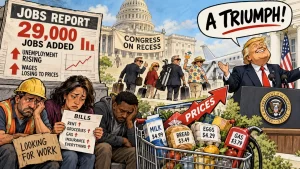
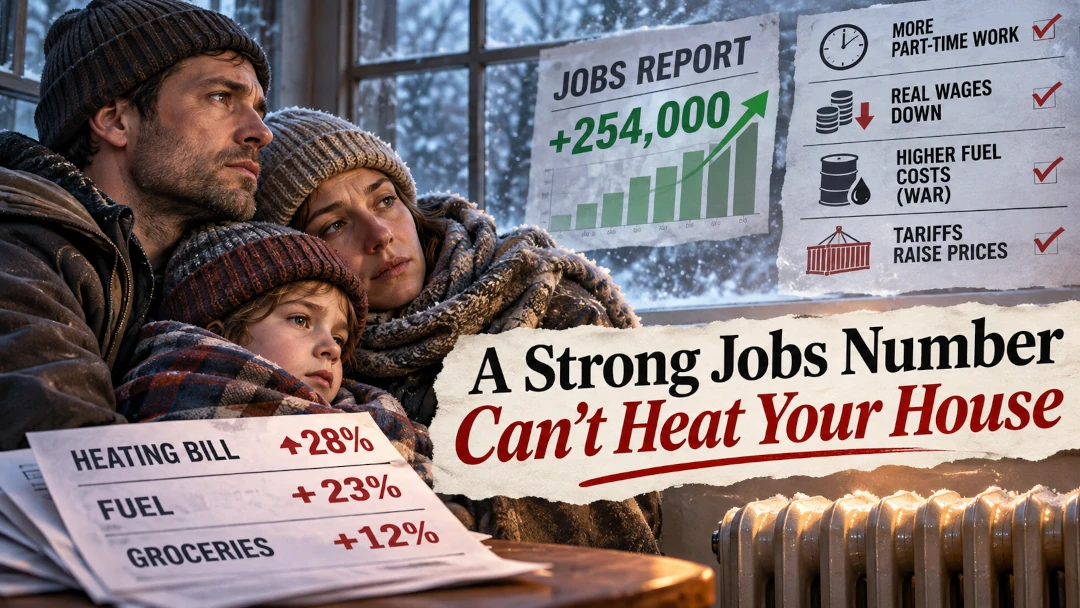
October’s payroll gain of 165,000 beat Wall Street’s forecast by a mile. But beneath it, hundreds of thousands of workers had their hours cut, paychecks are still losing the race against prices, and a war-driven energy shock and a tariff regime the courts have already trimmed once are converging on American households just as winter and the holidays arrive.
The White House will call it a blowout, and on the surface it was. According to the Bureau of Labor Statistics, employers added 165,000 jobs in October, more than three times the 48,000 monthly average of the prior year, and the unemployment rate slipped to 4.1 percent. Revisions added another 84,000 jobs to August and September. Economists polled by Reuters had expected just 65,000, CU Daily reported, in a labor market where employers had spent most of the year cautious about adding staff.
But a jobs report is not a single number, and the American family does not live on the headline. Read the full release and a different picture emerges: one of hours being cut, of growth concentrated in a handful of sectors, of a stubborn pool of people who have been out of work for more than half a year, and of paychecks that rose in dollars but fell in what those dollars can buy. Set that picture against a war with Iran now in its ninth month, heating bills climbing for millions, and tariffs still embedded in the price of nearly every imported good, and the October report reads less like a recovery than like the last good news before a hard season.
I. The Headline and the Fine Print
Start with the number that should worry every policymaker. The count of Americans working part time for economic reasons — people who want a full-time job but can’t get one, or whose hours were slashed — jumped by 339,000 in a single month to 4.8 million. The BLS breakdown is even more telling: almost the entire increase, 356,000, came from workers citing “slack work or business conditions.” That is not people choosing flexibility. That is employers trimming hours rather than headcount, the classic first move of a business that sees trouble ahead.
Meanwhile, the long-term unemployed — those jobless for 27 weeks or more — held at roughly 2.0 million, or 27.6 percent of everyone looking for work. More than one in four unemployed Americans has now been searching for over six months, a level that labor economists associate with lasting damage to earnings and careers.
Rose to 4.8 million in October, driven by employers citing slack business conditions. BLS Employment Situation
About 2.0 million people jobless 27 weeks or longer — over a quarter of all unemployed. BLS, Table A-12
Annual wage growth trailed September’s 3.7% inflation rate — the seventh straight month pay lost ground, per AP. CU Daily / AP / Reuters
Professional services (+70K), health care (+42K) and transportation (+25K, mostly couriers) carried the month. BLS establishment survey
Construction, retail, leisure and hospitality, wholesale trade and government showed little change; leisure and hospitality lost 13,000. BLS Table B-1
Black unemployment remains well above the 3.7% rate for white workers; the rate for adults without a diploma jumped to 5.8%. BLS household survey
The concentration matters. Of October’s 165,000 gain, roughly 137,000 came from just three sectors. Transportation and warehousing added jobs largely through couriers and messengers — 17,000 in October alone and 71,000 since February. Those are real jobs, but they are disproportionately gig-adjacent, variable-hour delivery positions, not the construction and manufacturing careers the administration has promised. Construction, the industry most sensitive to interest rates, shed 3,000 positions.
Then there is the paycheck. Average hourly earnings rose 0.4 percent in October to $38.00 and are up 3.1 percent over the year. But consumer prices rose 3.7 percent in the year through September, according to Trading Economics’ summary of the BLS data, driven by energy. Brian Jacobsen, chief economic strategist at Annex Wealth Management, told Reuters that wages running below inflation is “the affordability crisis in one stat,” as reported by CU Daily. Curt Long, chief economist at America’s Credit Unions, added that the strong report makes a Federal Reserve rate hike next month likely — welcome for savers, he noted, but another squeeze on anyone carrying a balance. The Fed held its benchmark at 3.75 to 4 percent last week; Reuters reports economists now expect an increase in December.
II. A Winter Priced by the Gallon
The single largest force eroding household budgets this year has a name and a start date: the war with Iran, launched by the United States and Israel on February 28. The closure of shipping through the Strait of Hormuz and attacks on Gulf energy infrastructure sent oil soaring, and Americans have been paying at the pump ever since. In mid-October, the national average for regular gasoline stood at $4.33 a gallon — 45 percent above its prewar level — while diesel was up 68 percent, the Associated Press reported. AAA said it was the first October on record with average regular gas above $4.
Moody’s Analytics chief economist Mark Zandi has put a price on the conflict: roughly $2,000 per average household, including about $1,100 in higher energy costs, $540 in higher interest rates and $360 in military costs, according to CNN. Zandi estimates the war has cost U.S. consumers some $265 billion since it began, and the AP reports he calculates the energy portion alone is still growing by about $50 a week at current fuel prices. The Pentagon, meanwhile, told lawmakers in September that the war itself had cost $45.1 billion — a figure CNN notes excludes repairs to damaged bases.
Now the heating season arrives. The picture is uneven, and honesty requires saying so. The U.S. Energy Information Administration’s Winter Fuels Outlook projects that homes heating with oil — concentrated in the Northeast — will spend about 21 percent more than last winter, even assuming milder weather, because distillate markets remain tight. Electricity prices for residential customers are forecast to rise, while households on natural gas may actually pay less thanks to healthy inventories. The National Energy Assistance Directors Association (NEADA), which represents the state officials who run heating aid, takes a gloomier view across the board: an average heating bill of about $1,030, up 8.7 percent, with heating-oil users facing a 31 percent jump and costs up nearly a quarter since 2021–22.
According to ConsumerAffairs’ summary of the NEADA analysis, about one in six households is already behind on utility bills heading into the season. The association has urged Congress to raise funding for the Low Income Home Energy Assistance Program from roughly $4 billion to $7 billion. The administration, for its part, has proposed eliminating the program entirely — first for fiscal 2026, which Congress rejected, and again for fiscal 2027, as the American Public Power Association reported.
III. The Tariff Tax Under the Tree
Retailers are putting on a brave face. The National Retail Federation forecasts November–December sales will rise 4.2 percent to roughly $1.013 trillion, the first holiday season above that mark. Read the fine print, though, and roughly half of that growth is simply higher prices, not more gifts. NRF itself expects higher-income households to do most of the heavy lifting this season, while higher food and gasoline prices put greater pressure on moderate- and lower-income shoppers — a two-track holiday that mirrors a two-track economy. Industry boosters like to call shoppers “resilient.” Resilience is a polite word for families absorbing costs they did not choose.
Shoppers know exactly why. In NRF’s own survey work, 84 percent of consumers expect higher prices this season because of tariffs. That expectation persists even though the Supreme Court in February struck down the president’s sweeping emergency tariffs. As the American Bar Association has detailed, the administration responded within hours with a 10 percent global surcharge under a little-used 1974 trade law; the Court of International Trade found it unlawful in May, and it expired in July — only to be followed the same day by new Section 301 tariffs, layered on top of Section 232 duties on steel, aluminum and vehicles that were never touched by the ruling. The legal vehicle changes. The bill to consumers does not.
“We don’t need anything that Canada has. We don’t need anything that Mexico has.”
— President Donald Trump, on the USMCA trade pact, as reported by CNN
That attitude toward America’s two largest neighbors has consequences. On July 1, the administration declined to renew the U.S.-Mexico-Canada Agreement — the very deal President Trump negotiated in his first term and once called the fairest trade agreement the country had ever signed. The pact facilitates roughly $2 trillion in annual trade; non-renewal does not end it immediately, but it leaves the continent’s supply chains in a prolonged state of review and renegotiation. The president later said he would not withdraw outright. But businesses cannot plan supply chains around a mood, and every quarter of uncertainty is priced into what Americans pay.
IV. What This Means for You — Now and in 2027
Through the end of the year
For the average household, the next eight weeks look like this: gas still above $4, heating bills higher for oil and electric customers, a likely Fed rate hike in December that pushes credit-card and home-equity rates up, and holiday prices padded by tariffs. Workers who saw hours cut in October will feel it in November paychecks just as those bills arrive. The October inflation report lands Tuesday, November 10; the November jobs report follows December 4. Neither will change the arithmetic of a paycheck growing more slowly than prices.
Get Involved Today
Contribute to our mission and turn your concerns into action.
Into 2027
Looking further out, the risks stack. A long-term unemployment share above a quarter of the jobless suggests scarring that outlasts any single month’s hiring. Involuntary part-time work is often a leading indicator: employers cut hours before they cut people. Annual USMCA reviews will keep North American supply chains on edge. And the war’s costs compound: higher energy feeds into transportation and food, higher inflation keeps rates elevated, and elevated rates freeze housing and construction. None of this is destiny — oil can fall, a war can end, tariffs can be repealed — but each of those outcomes depends on political choices, not on the jobs report.
V. The Lame Duck: Five Weeks to a Deadline
Republicans still hold the gavels until January, and the outgoing Congress returns Monday, November 9. Its one unavoidable task is funding the government, which runs out December 11; any health-care fix this year would almost certainly have to ride on that bill, STAT News reports. Beyond that, the GOP wish list is long and largely unrelated to household costs: confirming as many Trump nominees as possible before Democrats take over, possibly a third party-line reconciliation package, war funding for Iran, and a voter-ID bill. Some Republicans, including Ohio Sen. Bernie Moreno, argued before the election that if they lost both chambers they should stay in session straight through New Year’s Eve to push the agenda through, The Hill reported.
What is conspicuously absent from that list: emergency heating assistance, relief from tariffs, or any plan to end the war that is draining household budgets. Yet Democrats are not powerless. As Robert Kuttner argued in The American Prospect, the president needs a stopgap spending bill to keep his priorities funded, and that bill needs Democratic votes in the Senate. A clean continuing resolution without new Iran war money is the likeliest outcome — and the leverage it creates should be used for families, not frittered away.
VI. The Democratic Answer
Voters delivered their verdict on Tuesday. Democrats flipped at least seven Senate seats and won what NBC News projects will be their largest House majority in nearly two decades. Even Vice President JD Vance blamed the rout on the war in Iran, NBC reported. House Democratic Leader Hakeem Jeffries, now in line to become the first Black Speaker, framed the mandate in one line: “We ran on affordability, we won on affordability,” he said, promising to govern on it too.
The plan is specific. In the first week of the new Congress, according to TIME, House Democrats intend to advance legislation to rescind the president’s tariffs, restore the expired Affordable Care Act premium subsidies, reverse roughly $1 trillion in Medicaid cuts, and force a vote requiring the president to either end the Iran war or seek congressional authorization to continue it. Northeastern’s analysis notes the party’s 100-day agenda pairs those bills with a broader push on the underlying costs of health care, housing and food. Sen. Ron Wyden of Oregon, expected to chair the Finance Committee, says the first tariff target will be the levies on Canadian goods.
“Ultimately, Congress must take away the president’s ability to unilaterally and arbitrarily impose tariffs.”
— Sen. Ron Wyden (D-Ore.), via Benzinga
There are limits, and readers deserve to hear them. Democrats will not have veto-proof majorities in either chamber, NPR notes, and Jeffries has so far offered few specifics on how the party will overcome a veto. The realistic path runs through must-pass bills, the power of the purse, Republican defections from trade-dependent states, and relentless oversight. That is slower than voters want. It is also how divided government has always worked.
Who Holds the Purse, the Tariff, and the War?
Three of the forces squeezing household budgets this winter — tariffs, an unauthorized war, and the unraveling of a ratified trade pact — share a common constitutional thread: each represents the executive branch exercising power the Constitution assigns first to Congress.
- Tariffs are taxes. Article I, Section 8 gives Congress, not the president, the power “to lay and collect Taxes, Duties, Imposts and Excises” and to regulate foreign commerce. In Learning Resources, Inc. v. Trump (February 20, 2026), the Supreme Court held that the International Emergency Economic Powers Act does not authorize the president to impose tariffs. The administration’s fallback — Section 122 of the Trade Act of 1974 — is capped at 15 percent and 150 days absent congressional extension, and the Court of International Trade found its use unlawful in May. Remaining Section 232 and 301 authorities are delegations Congress can narrow or revoke.
- War requires Congress. Article I, Section 8 vests the power “to declare War” in Congress, and the War Powers Resolution of 1973 requires the president to end the use of forces within 60 days (plus a 30-day withdrawal period) absent congressional authorization. Congress has passed nonbinding war-powers measures on Iran that the president has ignored, TIME reports. The new majority can condition or cut off appropriations — the most direct check the framers provided.
- Trade agreements are law. The USMCA was implemented by an act of Congress. A 2020 Senate Finance Committee report concluded the United States cannot withdraw from a congressionally approved trade agreement without Congress’s consent, CNN noted, though the question remains legally unsettled.
Accountability path: Pass legislation reclaiming tariff authority; attach war-powers conditions to defense appropriations; require congressional approval before any USMCA withdrawal; and use oversight hearings to document the household cost of each policy. These are not partisan tools. They are the ones the Constitution wrote down.
VII. What This Says About the President’s Priorities
Strip away the rhetoric and the record of 2026 is consistent. Faced with a Supreme Court ruling that his tariffs were illegal, the president did not pause to consider what they were costing families; he found a new statute within hours, and when that expired, another. Faced with oil at $100 a barrel and gas above $4, he did not seek an exit from a war Congress never authorized; his allies are seeking more money for it in the lame duck. Faced with a winter in which heating-oil households will pay roughly a fifth more, his budget office proposed — again — eliminating the one federal program designed to keep low-income families warm. Faced with a continental trade pact he himself negotiated, he chose uncertainty.
Supporters argue the tariffs protect domestic manufacturing — which did add 19,000 jobs in October — and that confronting Iran serves long-term security. Those arguments deserve a hearing. But leadership is measured by who bears the cost of a policy and whether they were asked. On that measure, the costs of this administration’s choices are falling hardest on the households least able to absorb them: the part-timer whose hours were cut, the retiree with an oil furnace, the family whose holiday budget is half inflation. The voters noticed. On Tuesday, they said so.
VIII. What You Can Do
No household can fix a war or a tariff schedule on its own. But there are concrete steps that can blunt the next few months and make your voice count while the lame-duck Congress is still deciding what to fund.
Get ahead of the heating bill
Apply now for LIHEAP and weatherization help through your state’s energy-assistance office — funds are first-come, first-served and run out. Ask your utility about budget billing and arrearage plans before you fall behind. If you heat with oil, compare dealers and ask about price-cap or pre-buy programs. The basics still pay: seal drafts around windows and doors, service your system before the first cold snap, and set the thermostat back overnight.
Prepare for higher borrowing costs
With a December rate hike widely expected, pay down variable-rate debt such as credit cards and HELOCs first. With inflation at 3.7 percent, any savings earning less is losing value, so move emergency cash into an insured high-yield account.
Set a hard holiday ceiling
Decide the total before you shop, not at the register. Be cautious about stacking buy-now-pay-later plans that come due in January alongside peak heating bills. Prioritize experiences and domestic goods less exposed to import duties.
Protect your paycheck if your hours are cut
Many states offer partial unemployment benefits when hours are reduced; check with your state labor department. If you’re among the long-term unemployed, local workforce boards offer free retraining and placement services.
Call your members of Congress this month
The lame duck decides the December 11 funding bill. Tell your representative and senators — including those who just lost and have nothing left to fear — that you want emergency LIHEAP funding, no blank check for the Iran war, and a vote to restore Congress’s authority over tariffs. Calls during the first two weeks of the session matter most.
Most relief from the larger forces — energy prices, tariffs, the war — will not arrive before the new Congress is seated in January, and even then a presidential veto can block it. The household steps above won’t eliminate the squeeze, but they can keep a hard winter from becoming a financial emergency. Civic pressure on the lame duck is the one lever that can change outcomes before Christmas.
Editorial Conclusion
A single strong month of hiring cannot be allowed to paper over a harder truth: Americans are working more jobs for fewer hours, earning raises that buy less, and paying for a war and a tariff regime that no Congress approved. The October report is not a vindication — it is a warning. The Constitution gives the people’s representatives the power to tax, to declare war, and to make law on trade; this administration has spent the year exercising all three on its own. The new majority’s first duty is to take those powers back, and its second is to use them for the family deciding between heat and holiday gifts. Anything less betrays the mandate voters delivered on Tuesday.
Sources & References
- U.S. Bureau of Labor Statistics — The Employment Situation — October 2026
- CU Daily — U.S. Employers Added 165K Jobs in October; Analyst Sees ‘Affordability Crisis in One Stat’
- Trading Economics — US Inflation Rate Tops Forecasts (September 2026 CPI)
- Boston Globe / AP — Retail price impacts from the Iran war are uneven. But they add up for US households
- CNN — The Iran war is costing American households $2,000 each, Moody’s estimates
- U.S. Energy Information Administration — EIA expects a mixed picture for winter fuel costs this year
- ConsumerAffairs — Another costly winter is coming for US households (NEADA forecast)
- American Public Power Association — Remaining FY 2026 LIHEAP funds disbursed; LIHEAP again faces elimination in FY 2027
- National Retail Federation — Consumers remain the bright spot heading into the holidays
- National Retail Federation — Winter Holiday FAQs (tariff expectations)
- American Bar Association — IEEPA Tariffs Struck Down, Replacement Tariffs Expired
- CNN — USMCA: Trump wants to ditch his signature trade deal. It’s not that easy
- STAT News — A looming deadline to fund the government will shape Congress’ unusual lame duck session
- The Hill — GOP plan for lame-duck sprint runs into votes, rules and the calendar
- The American Prospect — Democrats’ Power in the Lame-Duck Session
- NBC Washington — Recap: Vance blames Iran war for GOP losses as Democrats retake Congress
- Northeastern Global News — What Democrats plan to do with their new congressional majority
- TIME — Inside the Democrats’ Plans to Take On Trump
- Benzinga — Trump’s Canada Tariffs to Become Democrats’ First Target, Wyden Says
- NPR — Jeffries lays out Democrats’ plans for Congress, questions remain
Related News