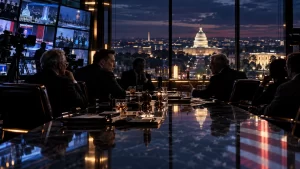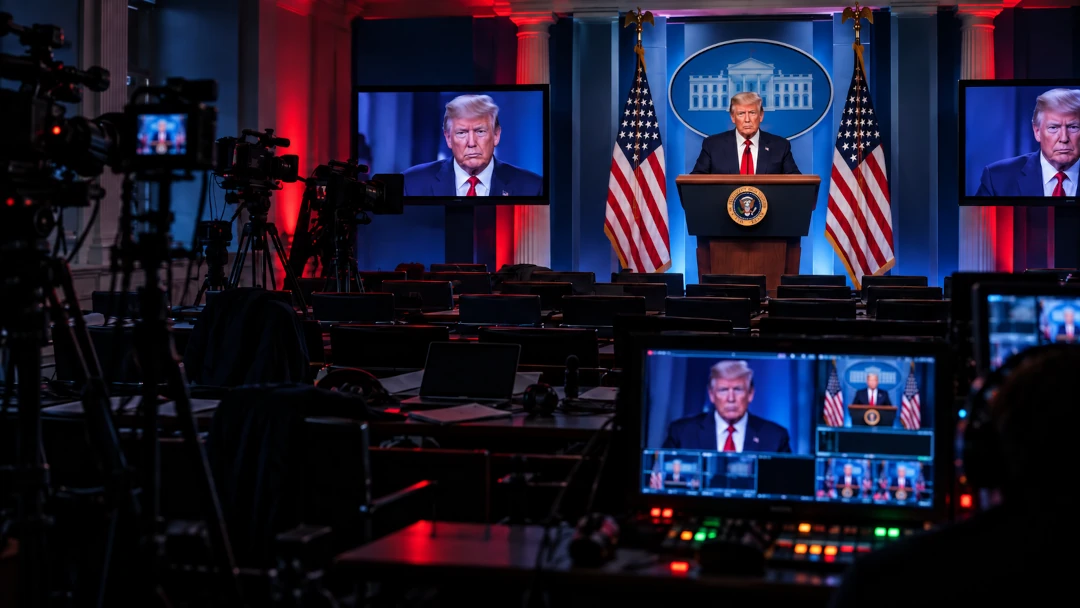
Seventy-two hours after the president expelled three news organizations from the White House, his administration switched on a round-the-clock stream of his own greatest hits. A falling president, an approaching election, and a federal judge now stand between Americans and a government that would rather narrate itself than be questioned.
There is a particular kind of government that prefers a camera it controls to a question it cannot. On Monday, September 21, the Trump White House announced that it wants to be that kind of government. At 7 p.m. Eastern, the administration switched on “Trump TV: The Essentials Station,” a continuous stream on YouTube, the White House website and the official White House app. Its first broadcast was a replay of the president’s July 3 speech at Mount Rushmore. Its purpose, in the words of White House digital strategy director Kaelan Dorr, is to air the administration’s “greatest hits, unfiltered.”
The timing was not a coincidence. It was the point. Trump TV went live three days after the president declared, by social media post, that CNN, MS NOW and Politico were banned from the White House, and on the very afternoon that America’s television networks, including Fox News, refused to supply the camera pool that has covered presidents for decades. The White House emptied the room of independent witnesses and then offered the country its own feed. Americans should be able to recognize what that is, even if the administration insists on calling it something else.
I. Ban First, Broadcast Second
The sequence began on Friday, September 18. In a Truth Social post, the president announced the ban “effective immediately,” accused the three outlets of reporting “FICTION and LIES,” and warned: “Other Fake News Media Outlets to follow.” CNBC reported that Trump said the effort was worthwhile even if it did not survive in court, an extraordinary admission that the goal was punishment, not legality. According to CNN, even members of the White House press shop were caught off guard and scrambled to learn what the order meant for daily operations. By Saturday morning, reporters from all three outlets were turned away at the gates, NPR reported, including Politico White House reporter Cheyenne Haslett.
What followed was not a retreat but an escalation. On Monday, the White House stripped CNN of its scheduled turn as the television pool network. The pool responded by standing down entirely. That afternoon, the first presidential event with no independent cameras, a ribbon-cutting for a new South Lawn helipad, was streamed on the White House website, and CNN reported that the president’s words were drowned out entirely by helicopter noise. Hours later, Trump TV launched.
What it airs
Mostly recorded speeches, bill signings and public appearances played on loop, with no conventional schedule, hosts or newscasts announced, according to NewscastStudio.
Who runs it
Unclear. Axios reported it is not known who staffs the channel or sets its programming, and that the White House labels it “CH 47,” after Trump’s two presidencies.
What it opened with
The Mount Rushmore address in which, NPR noted, Trump blamed newcomers to the country for what he described as a resurgent communist threat.
What it adds
Little that was not already public: WUSA9 observed the White House YouTube page already livestreams most speeches and briefings. What changed is the absence of anyone else’s camera.
Critics have reached for the language of North Korea and other closed states, where a single broadcaster tells the story of the leader and no one else is permitted to. The comparison is imperfect, and honesty requires saying so. Americans can still change the channel; courts still function; Fox News stood with CNN. But the resemblance is not in the scale. It is in the instinct: the belief that the public is best served by hearing the head of government only as he wishes to be heard. A White House official told NPR that calling the stream state-run media made as much sense as calling Sen. Mark Kelly’s social feed state-run. The difference is obvious. Mark Kelly has not banned the reporters who cover him.
“It is instituting an assault on the FAKE NEWS, something that has grown like Cancer…”
— President Donald Trump, Truth Social, Sept. 21, 2026, via The Hill
II. The Constitution Answers
A president is free to speak. The government-speech doctrine gives any administration wide latitude to publish its own message, and a livestream of official events, standing alone, would raise no serious constitutional issue. That is exactly why the ban matters. Trump TV is not the problem because it exists. It is the problem because it was offered as the replacement for journalists the government had just thrown out for what they wrote.
On that question the law is not murky. The D.C. Circuit has long held that once the White House opens press facilities to journalists, access cannot be denied arbitrarily and pass restrictions must come with due process. In the early hours of Thursday, September 24, U.S. District Judge Timothy Kelly, a Trump appointee, applied that precedent. He ordered the passes restored for at least 14 days, finding the revocations were made without “constitutionally adequate due process.” He wrote that he was bound by the appellate rulings “full stop.”
The administration’s defense collapsed on its own record. In court, Justice Department lawyers argued the outlets had endangered national security. But as The Hill reported, the letters citing security were sent only after the ban, and Judge Kelly called the cited stories routine and said he doubted security was the real motive, noting that Trump himself had complained about negativity, not secrets. The stories the government flagged, according to PBS NewsHour, included reporting on a leak investigation and on funding for the White House ballroom, and one Politico item traced back to a background briefing the White House itself had arranged.
Then came the most alarming detail of the week. Even after the order, some reporters were refused entry Thursday morning. MS NOW reported that its correspondent Laura Barrón-López and a producer had their passes confiscated at the gate, forcing the outlets to file a notice of noncompliance before the White House relented that afternoon. A government that must be told twice to obey a federal court is a government testing how much it can get away with.
“No president has taken this explicit of a step.”
— Katie Fallow, Knight First Amendment Institute at Columbia University, via PBS NewsHour
III. The Press and Congress Push Back
If the White House expected rival newsrooms to fight over the empty seats, it misread the industry badly. The five networks of the television pool, Fox News, ABC, CBS, NBC and CNN, issued a joint statement declaring that “No administration should restrict a news organization because it objects to its reporting.” The suspension was announced by Fox News Washington bureau chief Bryan Boughton, who chairs the pool rotation. New York Times media reporter Ben Mullin called it “an extraordinary show of solidarity from the press.” Print and public media followed: Deadline reported that The Washington Post withheld presidential photos, PBS refused administration-supplied video and NPR paused White House audio.
In court, the Reporters Committee for Freedom of the Press, the White House Correspondents’ Association and 49 news organizations, including the Associated Press, The New York Times and Reuters, filed a friend-of-the-court brief. Reporters Committee president Bruce D. Brown called the ban “a brazen violation of the First Amendment.”
Democrats have treated the episode as a test of whether the Constitution still binds the executive. Rep. Robert Garcia of California, ranking Democrat on the House Oversight Committee, wrote to White House Communications Director Steven Cheung demanding the legal and factual basis for the ban by October 5, calling it the president’s “most blatant, assault on press freedom.” California Gov. Gavin Newsom called Trump TV “truly autocratic behavior from a failed President.” Arizona Sen. Mark Kelly listed state-run media alongside prosecutions of political opponents and foreign gifts, concluding: “NONE OF THIS IS NORMAL.” Even former Rep. Marjorie Taylor Greene, once among the president’s fiercest defenders, mocked the backfire on X, according to Newsweek: a president who silences the press, she noted, ends up with no one broadcasting his speech at all.
IV. Polls, Power, and the Midterm Clock
To understand why a White House would build its own channel now, look at the numbers it cannot spin. The FiftyPlusOne polling average put the president at 34.6 percent approval on September 23, with a net rating of −28, nearly double his deficit at the same point before the 2018 wave that cost Republicans 41 House seats. A new CNN poll found him at 33 percent, the lowest of either term. The American Research Group, per Newsweek, had him at 29 percent, with 72 percent of respondents saying the economy is getting worse amid rising gas and grocery prices.
Approval average
New second-term lows from at least seven pollsters in a single week, per FiftyPlusOne.
Strongly disapprove
The highest share since the question was first asked in 2017, in the NPR poll reported by WABE.
To Election Day at poll’s release
With tens of thousands of early ballots already cast, according to Strength In Numbers/Verasight.
The president has made the midterms about himself. At a Republican midterm convention in Dallas, he told the party, “I’m asking you to pretend that I’m on the ballot.” Voters have obliged, and they are saying no. The Hill reported that political observers widely read the media standoff as an attempt to change the subject from the Iran war and the economy, both drags on his standing. Trump TV is the logical next step: if independent coverage keeps reporting on gas prices, war and falling approval, replace independent coverage with a loop of Mount Rushmore.
For the average American, the cost is concrete. The television pool exists so that one crew’s footage can feed every network, every local station and every newsroom around the world. When it goes dark, what reaches a voter in Ohio, Iowa or Texas is increasingly whatever the White House chooses to upload. A family watching the evening news to decide whether to trust this government with a war, an economy and their health care deserves the questions, not only the answers the government has rehearsed. That is doubly true in the weeks when ballots are already being cast.
V. A Pattern, Not a Tantrum
It would be comforting to see this as one bad week. It is not. The president’s hostility to the press has hardened from insult into policy, and the record is long.
- February 2025
The White House blocks the Associated Press from official events over its style guidance on the Gulf of Mexico, a move the Committee to Protect Journalists called part of an alarming pattern of retaliation. - 2025
The administration cuts $1.1 billion in public broadcasting funds for NPR and PBS stations, and Trump files a $10 billion suit against The Wall Street Journal, the ACLU documents. - 2025–2026
FCC Chairman Brendan Carr opens investigations into ABC, NBC and CBS; Paramount pays $16 million to settle a suit over a “60 Minutes” edit; and in early 2026 FBI agents search a Washington Post reporter’s home, as catalogued in a July 2026 press-freedom document published by CPJ. - September 18, 2026
Trump announces the ban on CNN, MS NOW and Politico and promises more outlets will follow. - September 21, 2026
The outlets sue; Trump attacks the assigned jurist as “a great Judge, for them” and vows to appeal. The TV pool stands down. That night, Trump TV goes live. - September 24, 2026
Judge Kelly orders access restored; some reporters are still turned away before the White House complies, NBC News reports. A ruling on a longer injunction is not expected until after October 5.
Get Involved Today
Contribute to our mission and turn your concerns into action.
Read in sequence, the list answers the question of priorities. In a season of war abroad and rising prices at home, the president has spent his days drafting social media posts about which reporters may enter his house, attacking the judge assigned to hear the case, and building a channel to replay his own speeches. Leadership in a republic means accepting that you will be questioned. This president treats questioning as a crime to be punished and an audience as something to be manufactured.
VI. The Question of Fitness
None of this is a policy dispute. Presidents of both parties have disliked their coverage; none has banned entire newsrooms for it, conceded the ban might be illegal and pressed ahead anyway, then left reporters standing at the gate after a federal judge ordered them let in. Those are not the choices of a leader weighing costs and benefits. They are the choices of a man whose need to control his image now overrides his legal counsel, his party’s electoral interest and the Constitution he swore to protect. That is why the question of fitness, and of the constitutional tools built to answer it, belongs in this conversation.
When a president can no longer tell governing from self-promotion
How the mechanism works
Ratified in 1967, the 25th Amendment governs presidential succession and inability. Section 4 allows the vice president and a majority of the Cabinet to declare in writing that the president is “unable to discharge the powers and duties of his office,” immediately making the vice president acting president. If the president contests the declaration, Congress decides, and keeping him sidelined requires a two-thirds vote of both chambers. PBS NewsHour’s explainer lays out the process in full.
Who has called for it
After the president’s April 2026 threat that “a whole civilization will die” in Iran, more than 70 lawmakers urged the 25th Amendment, impeachment, or both, among them Sen. Ed Markey of Massachusetts and Rep. Ro Khanna of California. Sen. Chris Murphy of Connecticut said, “No President in control of his senses would publicly promise to eradicate an entire civilization.” Rep. Raja Krishnamoorthi of Illinois called on Vice President JD Vance and the Cabinet to act, citing a “dangerous pattern of reckless escalation, erratic decision-making.” Earlier, in January, Reps. Yassamin Ansari, Eric Swalwell and Sydney Kamlager-Dove joined Markey after reports on Trump’s Greenland message to Norway’s prime minister.
The constitutional argument
“Unable” is not limited to a coma or a stroke. The argument advanced by these lawmakers is that inability can include a sustained incapacity to exercise judgment in the public interest. The media ban adds evidence to that record: an order the president reportedly acknowledged might not survive in court, justified after the fact with a national security rationale a Trump-appointed judge found unsupported, and enforced for hours in defiance of a court order, all while approval collapses and a war continues. Each act puts personal grievance ahead of the duties of the office.
The honest barriers
The path is nearly closed. As PBS notes, the president retains the support of Vice President Vance, his Cabinet and most congressional Republicans, and Section 4 cannot begin without them. A contested declaration would require two-thirds of both chambers. And as PBS recounts, the amendment grew out of fears about a president physically incapacitated, as John F. Kennedy might have been had he survived; opponents will argue that conduct like this belongs to impeachment or the ballot box instead.
Why the case still matters
A remedy being politically out of reach does not make the question illegitimate. The 25th Amendment exists because the framers of its text understood that a president’s condition might fail the country before his term did. Putting the case on the record, publicly and repeatedly, is how the public, the Cabinet and future Congresses learn what the evidence looks like. And in a midterm year, it tells voters precisely what is at stake in choosing who will hold the gavel of oversight in January.
Editorial Conclusion
A president who bans reporters for what they write and then launches his own channel to fill the silence is not communicating with the public. He is replacing it with an audience. A Trump-appointed judge has already found the ban likely unconstitutional, and the courts must now finish the job with a permanent injunction.
But courts cannot restore what this week revealed: a leader who, facing war and a failing economy, chose to fight the press instead. Congress must demand answers under oath, networks must hold their line, and voters must treat the fall election as what it has become, a referendum on whether Americans will continue to see their government through independent eyes. A free press is not a courtesy the president extends. It is a condition of the republic. On November 3, it is on the ballot.
Sources & References
- Democracy Docket / MS NOW — Top DOJ official threatens to fire prosecutors who refuse to pursue voter fraud cases
- The Daily Beast — Leak Exposes Donald Trump Goon’s ‘Chilling’ Election Rigging Threat
- AlterNet — DOJ wants prosecutors fired for refusing to chase Trump election claims
- Bloomberg Law — U.S. Attorney Enforcer Singh Gets DOJ Senior Leadership Promotion
- NBC News — Trump administration rolls out 5 voter fraud prosecutions ahead of midterms
- Democracy Docket / Marc Elias — Here Is Trump’s Blueprint to Rig the 2026 Midterms
- Brennan Center for Justice — The Trump Administration’s Campaign to Undermine the Next Election
- Brennan Center for Justice — The SAVE Act and the Election Power Grab
- Center for American Progress — Fact Sheet: The Trump Administration Is Interfering in the 2026 Midterms
- Campaign Legal Center — Are Trump and His Allies Laying the Groundwork to Undermine Our Elections?
- Votebeat — Judge blocks Trump’s proposed mail ballot restrictions for 2026 election
- NBC News — Judge blocks Trump’s Postal Service regulation on mail-in ballots
- Courthouse News — Democrats sue DOJ over midterm ballot seizure plans
- Democracy Docket — Dem senators ‘raise the alarm’ over DOJ pullback on voter protections
- The New Republic — DOJ Threatens Charges Against State Officials Not Caving on Voter Data
- NPR — How Democrats in Congress are preparing for Trump midterm interference
- House Judiciary Democrats — Raskin demands White House physician evaluate Trump’s cognitive fitness
- Mediaite — House Democrats File Bill to Form 25th Amendment Commission
- The Hill — 36 physicians warn of Trump’s ‘rapidly worsening’ decline
- Silver Bulletin — 2026 Generic Congressional Ballot Polling Average
- Strength In Numbers / Verasight — Trump approval hits new low of 33%; Democrats lead House vote by 10
- The Hill — New poll shows Democrats leading on generic ballot by 11 points
Related News