The President Who Said He’d Restored Free Speech Just Banned the Press
Trump’s Friday-night blacklist of CNN, MS NOW, and Politico — reportedly triggered by clips shown to him by his “human printer” aide Natalie Harp — has drawn condemnation not just from Democrats and press-freedom groups, but from Fox News itself. The president’s own appointed judge will now decide whether the First Amendment still means what it says.
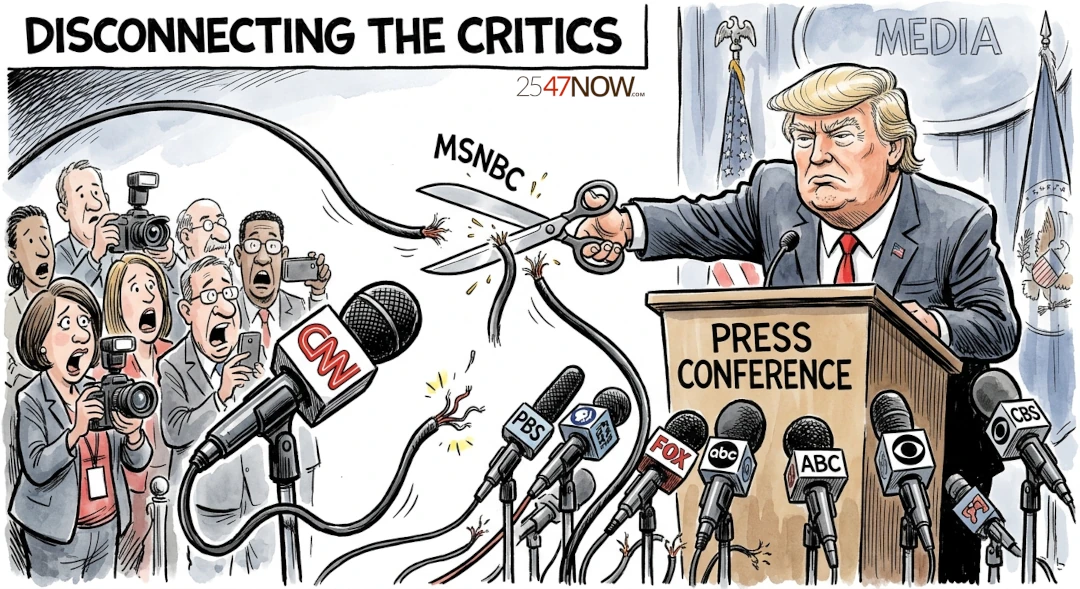
On the afternoon of Friday, September 18, 2026, the President of the United States sat down at Truth Social and announced that three of the largest news organizations in the country — CNN, MS NOW, and Politico — would be barred from the White House because their reporting had displeased him. By Saturday morning, the ban was real: journalists were denied entry to the grounds and their press credentials were physically confiscated. By Monday, all three outlets had sued in federal court. By Tuesday, the case had been assigned to a judge Donald Trump himself put on the bench. And by any reasonable measure, the “Free Speech President” — as he has spent nearly two years insisting he is — had just executed the most brazen frontal assault on the First Amendment by a sitting president in modern American memory.
The pretense, as always, was thin. In his Truth Social post, Trump did not point to a single specific story he considered inaccurate. Instead, he wrote that the outlets “shouldn’t be able to constantly write or report FICTION and LIES when they’re covering the President of the United States,” and warned darkly that “Other Fake News Media Outlets to follow.” Later, in the Oval Office, he told a Bloomberg reporter who asked whether he was trying to intimidate the press: “No, no, no, no. I dislike dishonest press, like you. I think you’re terrible.” Asked what specifically had prompted the ban, he offered only that it was “cumulative stories over the last two years. You get sick of it.”
This is not a policy dispute. This is the President of the United States confessing, on camera, that the government of the United States is now imposing a viewpoint-based penalty on protected speech. He is not hiding it. He is bragging about it.
I. The Friday Meltdown
The story of how a modern president decides to cross a bright constitutional line on a Friday afternoon is, we now know, a story about one aide with a portable printer. According to a Wall Street Journal report confirmed by CNN’s Kaitlan Collins, the president’s executive assistant Natalie Harp — a 35-year-old former One America News host known in the West Wing as the “human printer” for shadowing Trump with hard-copy printouts of flattering coverage — showed him video clips of MS NOW anchors criticizing his administration in the hours immediately before the Truth Social post. A Politico graphic he found unfavorable was also reportedly in the pile.
The Journal‘s reporting is worth reading closely. Trump has repeatedly floated banning news outlets over the past two years, and each time, aides — most notably chief of staff Susie Wiles — have talked him down to less drastic measures like selectively excluding a reporter from an Oval Office event. This time, per Politico, senior White House staffers were blindsided by the ban. Wiles was in Florida. The president had been complaining to aides that he “doesn’t have enough” allies defending him on television. And then Harp pressed play.
“Donald Trump just did what dictators throughout history have done. This is a democracy. You will not be able to manipulate the news or hide the truth.”
— Sen. Chuck Schumer, Senate Democratic Leader
The moral of that timeline is not that Natalie Harp is uniquely responsible for what happened. It is that the constitutional protections of a free press in the United States are now, in a very literal sense, at the mercy of what one loyalty-vetted staffer decides to print and play for an 80-year-old president who has grown less able to absorb news coverage he does not like. Sen. Jon Ossoff of Georgia mentioned Harp by name at a recent rally, referring pointedly to Trump’s habit of traveling “with Natalie on their apparently defenseless flying palace gifted by the Emir of Qatar” — a reference to the small group Trump chose to accompany him during a secret plane swap out of Turkey earlier this year. The White House’s furious response to Ossoff only underscored the point: this aide’s proximity to the president is now itself a matter of public concern.
II. The ‘Free Speech President’ Contradicts Himself, Again
To grasp the full absurdity of Friday’s ban, it must be placed alongside the words the president has spoken in the same office. In his March 2025 address to a joint session of Congress, Trump declared: “I’ve stopped all government censorship and brought back free speech in America. It’s back.” On Day One of his second term, he signed an executive order titled “Restoring Freedom of Speech and Ending Federal Censorship.” He has told rallies, campaigns, and cameras, over and over, that he is the most pro-First-Amendment president in living memory.
And then, in October 2025, seated in the White House during a roundtable on flag-burning, he said the quiet part out loud: “We took the freedom of speech away.” That was not a slip. That was a description of a program.
PolitiFact’s exhaustive review of Trump’s first 100 days found that his administration had already begun retaliating against The Associated Press for refusing to use the phrase “Gulf of America,” expelling foreign students for pro-Palestinian speech, and pressuring universities and law firms over disfavored viewpoints. Nico Perrino, executive vice president of the Foundation for Individual Rights and Expression — a nonpartisan free-speech group that has defended conservatives and progressives alike — told PolitiFact bluntly: “President Trump has certainly not brought back free speech in America. In fact, since Inauguration Day, we have seen some of the most significant threats to free speech in recent memory.” A federal judge ruled in the AP’s favor earlier this year, writing that “the AP’s exclusion has been contrary to the First Amendment.” Friday’s ban is not a departure from a pattern. It is the pattern, escalated.
III. Even Fox News Says No
Perhaps the most politically significant fact about this fiasco is who has refused to defend it. Fox News — the network that has served as the president’s most reliable megaphone — did not close ranks. Fox News senior White House correspondent Jacqui Heinrich, who happens to also be the current president of the White House Correspondents’ Association, issued a statement Friday night that could not have been sharper:
“The Constitution protects the freedom of the press from government interference. That protection does not depend on whether the president likes a news organization’s coverage, agrees with its reporting, or approves of the questions its journalists ask. This is about more than the rights of journalists. It is about the right of the American people to receive a full and independent account of the activities, policies and decisions of whoever occupies the nation’s highest office.”
— Jacqui Heinrich, Fox News · WHCA President
She was not alone at her own network. According to Mediaite, Fox contributor Jonathan Turley — a law professor and long-time defender of the Trump administration on other matters — called the ban “an assault on long-honored principles of a free press.” Fox’s John Roberts publicly recalled that when the Obama administration tried something similar to Fox News back in 2009, “it lasted about a half a heartbeat. I expect this one will too.” This is what the collapse of a talking point looks like in real time. When even Fox News’s own White House correspondent and its legal contributor tell you your action is unconstitutional, you are not experiencing a media-conspiracy problem. You are experiencing a Constitution problem.
The Ban
In a Friday Truth Social post, Trump declared CNN, MS NOW, and Politico banned “effective immediately” and warned “Other Fake News Media Outlets to follow.” Read the NBC News account.
The Enforcement
On Saturday morning, CNN’s Betsy Klein had her hard pass physically confiscated at the White House gate. Politico’s Cheyenne Haslett and an MS NOW reporter were also turned away. NPR reported the details.
The Trigger
Aide Natalie Harp — nicknamed the “human printer” — showed Trump MS NOW clips and a Politico graphic hours before the ban, per CNN’s reporting. Chief of Staff Susie Wiles was in Florida when it happened.
The Lawsuit
CNN, MS NOW, and Politico sued Monday morning in D.C. federal court, seeking a temporary restraining order. Judge Timothy Kelly — appointed by Trump in 2017 — set a hearing for Wednesday. CNBC has the filings.
IV. A Chronology of a Constitutional Line-Crossing
V. The Legal Wall Trump Is About to Run Into
The legal case against the president’s ban is not a close call. In an interview with Fox News Digital — again, Fox News — First Amendment attorney Aaron Terr explained the controlling principle plainly: “Once the government provides access, it then can’t condition that access on whether you’re expressing a viewpoint that the government agrees with.” Jameel Jaffer, director of Columbia’s Knight First Amendment Institute, told NBC News the ban was “pretty clearly unconstitutional.”
Judge Timothy Kelly, to whom the case has been assigned, is not an ideological wild card. Trump nominated him to the D.C. District Court in 2017. In 2018, Kelly was the judge who granted CNN correspondent Jim Acosta a temporary restraining order after the first Trump White House revoked his hard pass — ruling that the administration had denied him due process. Kelly is not a liberal jurist. He is a conservative, Federalist Society-approved Trump appointee who takes the Constitution seriously enough to have ruled against the man who put him on the bench once before. Trump seems to know this. On Monday, hours after the case was assigned, he attacked Kelly on Truth Social and preemptively announced he would appeal.
Preemptively announcing an appeal before the hearing is not the behavior of a president confident in his legal position. It is the behavior of a president who knows he is going to lose, and who has decided he does not care — because the ban is, as First Amendment scholar Gabe Rottman told NBC, “an effort to intimidate the press writ large.” Even if the courts strike down this specific ban, the message has been delivered: come after this administration in print, and your reporters will be walked out of the West Wing at gunpoint of a Secret Service pass reader. That message does not need to be legally sustainable to be politically effective — which is precisely why every news organization in America, and every American citizen who reads them, has a stake in what Judge Kelly rules on Wednesday.
Get Involved Today
Contribute to our mission and turn your concerns into action.
VI. Why This Happened Now: The Midterm Subtext
The ban did not fall out of a clear sky. It was declared in the middle of an ugly polling season for the president and his party. Recent polling has been brutal for Republicans: a November 2025 NPR/PBS/Marist survey found Democrats leading the generic congressional ballot by 14 points — the party’s widest advantage since 2017 — while Trump’s approval sagged to 39 percent, his lowest since immediately after January 6. A separate NBC News poll found 50 percent of voters wanting Democrats to control Congress against just 42 percent for Republicans — the largest such lead since the 2018 blue wave. Trump’s own team knows the House is likely lost. They fear the Senate could go too.
Silencing the reporters who cover you is what a losing incumbent does when he can no longer beat the story. It is what Viktor Orbán did in Hungary. It is what Recep Tayyip Erdoğan did in Turkey. It is what Nicolás Maduro did in Venezuela. Every one of those men also insisted, right up until the moment they stopped pretending, that they were the true defenders of free speech and their critics were the real threat. The playbook is not subtle. Sen. Bernie Sanders was not being hyperbolic when he wrote that the president wants to “control the flow of information and silence media that might hold them accountable” and that “we will not accept authoritarianism.” He was reading the manual out loud.
The midterms are seven weeks away. The most predictable consequence of this ban is not, in the short run, that CNN and MS NOW will actually be kept out — Judge Kelly will almost certainly say no. The most predictable consequence is that other newsrooms will feel the chill, that self-censorship will creep in at the margins, that reporters will pull punches on stories they used to run, and that a percentage of voters who tune in only occasionally will absorb the message that the administration’s critics have been officially designated as liars by the government. That is worth an unwinnable lawsuit to the people who ordered this.
The 25th Amendment and a President Who No Longer Recognizes the Limits of the Office
The 25th Amendment to the Constitution — ratified in 1967 after the Kennedy assassination — provides two paths for removing an incapacitated president. Section 3 is voluntary: a president temporarily transfers power to the vice president, as several have done for surgeries. Section 4 is not voluntary. It permits the vice president, together with a majority of the Cabinet (or “such other body as Congress may by law provide”), to declare in writing that the president “is unable to discharge the powers and duties of his office.” The vice president then immediately becomes acting president. If the sitting president disputes the determination, Congress decides — and a two-thirds vote of both chambers is required to keep him from resuming power.
The point of Section 4 is not to remove a president whose policies the country disagrees with. It is to remove a president who is no longer capable of exercising judgment consistent with the responsibilities of the office. It is precisely, in other words, the mechanism the Founders’ successors built for a moment like this one — a moment in which decisions of constitutional magnitude are being made in reaction to video clips shown to an 80-year-old man by a staffer with a portable printer, without the involvement of his own chief of staff, and against the explicit advice of the people who work for him.
Rep. Jamie Raskin (D-Md.), the ranking Democrat on the House Judiciary Committee, has been the most persistent voice on this question. In an April 2026 letter to White House physician Capt. Sean Barbabella, Raskin demanded a “comprehensive neuropsychological assessment” of the president, writing that Trump had “indisputably entered the realm of profound medical difficulty and concern.” Sen. Ed Markey (D-Mass.), Rep. Eric Swalwell (D-Calif.), Rep. Sydney Kamlager-Dove (D-Calif.), and Rep. Yassamin Ansari (D-Ariz.) have all publicly called for the Amendment to be invoked over the president’s escalating erratic conduct. Ansari described Trump plainly as “extremely mentally ill.” A group of doctors — cited in The Hill — warned earlier this year of Trump’s “rapidly worsening, reality-untethered, increasingly dangerous decline” and called for Section 4 to be triggered, citing his access to the nuclear codes.
The practical barriers are real, and it does no one any favors to pretend otherwise. Section 4 requires Vice President JD Vance to move first — and Vance has staked his entire political future on total loyalty to Trump. It requires a Cabinet stocked with hand-picked loyalists to countersign. If Congress ever got to vote, it would require two-thirds of both chambers, in a Congress currently controlled by Trump’s own party. The odds of the Amendment being invoked before the midterms are effectively zero. That is the honest assessment.
But the honest assessment does not end there. The barriers to invoking Section 4 do not disprove that Section 4 applies. They only prove that a Republican Party which has spent a decade replacing constitutional guardrails with personal fealty has hollowed out one of the Constitution’s most important protections. The moral and constitutional case that a president who bans the press because an aide showed him a graphic he didn’t like — a president whose own White House Physician’s Office has refused, since May, to release meaningful medical results — is no longer discharging the duties of his office is not weakened by the fact that his party won’t act on it. It is strengthened. When the mechanism fails, the argument for the mechanism becomes the argument for the party that would use it. That argument is now on the ballot in November.
VII. What This Means for the American People
Strip away the courtroom drama and the West Wing gossip and what remains is this: the President of the United States has told the American people that the coverage they receive of his administration will be curated by his government, and that news organizations who refuse to comply will be locked out. This is not an abstract press-guild concern. Every reader of this publication — every American who wants to know why gas prices are what they are, why an ongoing war in the Middle East costs what it costs, why the Cabinet is what it is, why the president spends most of his weekends at his own golf clubs — depends on reporters being physically present in the room where the president speaks. When those reporters are removed at the government’s discretion, the American public is the party whose rights are abridged. The First Amendment does not protect journalists as a professional guild. It protects citizens’ right to know.
House Democratic Leader Hakeem Jeffries put it in exactly those terms in a statement Friday night: “Freedom of speech is under attack in the United States of America. Donald Trump is weaponizing the federal government to come after Americans who disagree with him, claiming that negative coverage of him is illegal. That’s unconscionable, unacceptable and un-American.” Rep. Jamie Raskin went further, calling on media organizations to boycott the White House in solidarity if Trump continues down this path. Sen. Elizabeth Warren said the president was trying to “hide his failures” by censoring the press.
The stakes of what happens next — in Judge Kelly’s courtroom on Wednesday, in the newsrooms of every organization the president has not yet named, and, most consequentially, at the ballot box in November — are not about who wins the political news cycle. They are about whether the ordinary American voter can still count on being told the truth about what the government is doing in her name.
Editorial Conclusion
Donald Trump has been telling the country for two years that he is the greatest defender of free speech in American history. On Friday, September 18, he told us the truth: he is the greatest threat to it. A president who bans reporters because an aide showed him a video he didn’t like is not fit to hold the office. A vice president and a Cabinet that refuse to invoke Section 4 in the face of that conduct are not fulfilling their oaths. And a Congress that refuses to check either is not, in any meaningful sense, functioning.
The Constitution does not enforce itself. It relies on citizens who insist on its meaning. In seven weeks, the American voter will be asked whether the First Amendment is a real limit on presidential power or a decorative phrase in a document nobody reads anymore. There is no third answer, and there is no more time.
Sources & References
- NBC NewsTrump says he’s banning CNN, MS NOW and Politico from the White House
- NBC NewsWhite House faces mounting legal backlash after barring journalists
- NBC News · Live UpdatesLive: CNN, MS NOW, Politico sue Trump over White House coverage ban
- NPRCNN, MS NOW, Politico reporters denied access to White House
- CNBCTrump media ban lawsuit set for Wednesday court hearing
- CNN PoliticsNatalie Harp showed Trump coverage clips before he issued media ban
- HuffPostTrump’s media ban reportedly triggered by Natalie Harp
- AxiosTrump bans CNN, MS NOW, Politico — Schumer response
- MediaiteFox News personalities pummel Trump’s media ban
- The HillFox News contributors denounce Trump’s ban on CNN, MS NOW, Politico
- Fox NewsTrump’s White House media ban is “blatantly unconstitutional,” attorney says
- TimeNo, Trump did not “bring back” free speech
- CNN PoliticsAnalysis: Trump’s free speech backflip was 250 years in the making
- PolitiFactPresident Trump said he “brought back free speech.” His first 100 days tell a different story
- The Hill · OpinionConcerns grow over Trump’s mental fitness for presidency
- House Judiciary DemocratsRanking Member Raskin demands White House physician evaluate Trump’s cognitive fitness
- The Philadelphia InquirerNews outlets express solidarity after Trump bars some reporters
- SalonTrump didn’t break the press. They did that to themselves
Related News