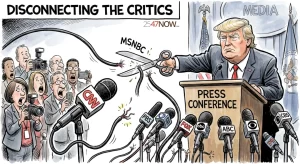
In a Sunday Truth Social spree, the president ordered his handpicked FCC chairman to punish an NBC journalist and probe pollsters whose numbers displease him. Two months from the midterms, the message to every broadcaster and survey firm in the country is unmistakable.
On the morning of Sunday, August 31, President Donald Trump did what he has done nearly every weekend of his second term: he opened Truth Social and posted through his displeasure. But two of those posts were different in kind. In them, the president of the United States instructed a nominally independent federal regulator to investigate the American press over polls he does not like and to formally punish a broadcast journalist for a phrase he found unflattering. The offending phrase, uttered by NBC’s Kristen Welker on a local affiliate, was that Trump’s midterm primary endorsements had produced “mixed results.”
“Because of this purposeful inaccuracy, she will be reported to the FCC for rebuke or punishment,” Trump wrote, addressing the Federal Communications Commission chairman he installed, Brendan Carr, directly. Minutes later, a second post: “THE FAKE POLLS USED BY OUR CROOKED MEDIA ARE OUT OF CONTROL, AND SOMETHING MUST BE DONE ABOUT IT. FCC TO THE RESCUE!”
Read plainly, these are the words of a sitting president deputizing a federal agency to investigate news organizations and independent pollsters for the content of their reporting. There is no other way to read them. And it is worth pausing, in a country that spent the last century believing the First Amendment placed such demands outside the range of the acceptable, to say clearly what this is: an escalation, one designed to work whether or not the FCC ever opens a file.
I. The Sunday Post That Was Not About One Reporter
Kristen Welker’s observation was not a slur. It was a fact. Several Trump-endorsed candidates lost their 2026 primaries, including Rep. Cory Mills and Rep. Andy Ogles, as The Well News documented. Trump’s response was to publish his own preferred statistic—98.35 percent of endorsed House and Senate candidates won—and to demand that a federal regulator sanction the journalist who noted the real record was messier than that.
The president then broadened the target. His second post ordered Carr and “the fine people of his Commission” to address what he called the “Threat to our country” posed by “Fake Polls and Commentary.” The framing matters. Trump did not accuse pollsters of fraud in the conventional sense. He accused them of publishing numbers he wishes were not true, and he called that publication itself the threat.
As MaddowBlog noted, this is the second time in fifteen months Trump has asked the federal government to investigate pollsters. In May 2025 he asked the Federal Election Commission to probe them, floating a conspiracy theory that major independent surveys are secretly coordinated by Democrats to demoralize Republican voters. That request went nowhere. He has now shifted agencies. The through-line is not the mechanism. It is the impulse: to place the machinery of the federal government between the American public and information the president dislikes.
Trump called NBC’s “Meet the Press” moderator the “Unpopular ‘Hostess’” of “Meet the Fake Press” and said she would be “reported to the FCC for rebuke or punishment” over her endorsement comment. Salon
“The fake polls used by our crooked media are out of control, and something must be done about it. FCC TO THE RESCUE!” The FCC has no jurisdiction over polling firms, universities, cable, or print. Fortune/Bloomberg
Numerous recent polls show Trump at the lowest approval of either of his terms as the Iran war stretches into a seventh month and gas prices remain elevated. Public support for the war has fallen to roughly a third. Fortune/Bloomberg
II. Brendan Carr and the Rediscovered Weapon
The FCC that Trump is addressing is not the agency the country has known for most of the past thirty years. Under Chairman Brendan Carr, appointed by Trump at the start of his second term, the commission has systematically reactivated a dormant policy—the “news distortion” rule—and turned it into a standing menace to broadcast newsrooms.
The policy dates to 1949. For most of its life it was invoked rarely and required proof of “deliberate” distortion of a “significant” factual news report, per the FCC’s own guidance. As Ars Technica reported, Carr’s two immediate predecessors—Democrat Jessica Rosenworcel and Republican Ajit Pai—both concluded that punishing stations based on the content of news programs would violate the First Amendment. Carr has broken with that consensus in public, cheerfully.
He has used or threatened the policy against CBS over “60 Minutes” editing of a Kamala Harris interview; against ABC and Disney over Jimmy Kimmel’s monologue about the killing of Charlie Kirk; against Comcast and NBCUniversal over diversity policies; against broadcasters covering the Iran war; and, in November 2025, against the BBC, PBS, and NPR over a year-old British documentary that the American public broadcasters had never aired. In every case, Carr has insisted he was not acting at the president’s direction. And in every case, the president has cheered him on.
Records obtained by researchers and reported by Poynter reveal extensive undisclosed contacts among Carr, the White House, and conservative media titans including Fox Corporation’s Lachlan Murdoch and Sinclair chair David Smith. The insistence on independence is difficult to square with the paper trail.
The bipartisan alarm is now on the record. A group of seven former FCC commissioners—five Republicans and two Democrats—joined with Protect Democracy and TechFreedom to petition the commission to eliminate the news distortion policy outright. Former Republican FCC Chairman Ajit Pai has said he could hardly think of an action more chilling of free speech than the federal government investigating a broadcast station because it disagrees with the coverage. The National Association of Broadcasters warned that the policy pushes stations toward bland, inoffensive content. Even Sen. Ted Cruz has criticized Carr’s approach.
“The FCC has no authority to punish journalists this administration doesn’t like. These threats to press freedom are dangerous. They undermine the foundation of our democracy, and they have no place in it.”
— Anna Gomez, FCC Commissioner
III. Why Polls, Why Now: A President Losing the Country
The FCC gambit is not happening in a vacuum. It is happening because the numbers are bad and every newsroom in America is reporting them. As Bloomberg and Fortune noted in reporting Sunday’s posts, Trump’s approval is at the lowest level of either of his terms. The Iran war he predicted would end in four weeks is in its seventh month. Gasoline is more than a dollar higher than when the conflict began. A February 2026 Reuters-Ipsos poll found that a majority of Americans, including thirty percent of Republicans, say the president has become erratic with age. And with the midterms less than ten weeks away, independents are breaking hard against his party in the congressional ballot.
Polling matters in an election year for reasons deeper than horse-race storytelling. Poll data tells donors where to spend, tells candidates which districts to fight for, tells voters whether their preference is popular or lonely, and tells the media which races merit coverage. A president who successfully persuades pollsters and broadcasters to withhold or soften unflattering numbers does not merely improve his political mood. He deprives the electorate of the shared informational baseline on which a functioning democracy runs.
That is the point. It has always been the point. Trump does not want the polls investigated because he believes them to be fraudulent—independent surveys by universities, Reuters, Gallup, and the major networks are among the most methodologically transparent instruments in American public life. He wants them investigated because he believes the pollsters, the networks that commission them, and the local affiliates that discuss them can be made to think twice before publishing the next set of numbers. That is not a theory of press regulation. It is a theory of intimidation.
Get Involved Today
Contribute to our mission and turn your concerns into action.
IV. The Chilling Effect Is Already Working
This is not a hypothetical harm. The chill is measurable and documented. FCC Commissioner Anna Gomez, appearing at events across the country to warn about her own agency’s conduct, has said publicly that she has heard from broadcasters telling their reporters to be careful about how they cover this administration. Matt Gertz of Media Matters told The Hill the effect is unmistakable: “Any broadcaster now has to question if anything they put out could end up getting them in a heap of legal trouble with the FCC.”
In September 2025, ABC pulled Jimmy Kimmel off the air for several days after Carr publicly warned local affiliates that continued airing of Kimmel could raise news-distortion questions. Kimmel was reinstated, but the episode is the template: the license, not the fine, is the leverage. A broadcaster does not have to be sanctioned to change its behavior. It only has to believe it might be. And when the president is publishing the target list on Truth Social every Sunday, belief is easy to manufacture.
What follows is a partial record. It is a pattern.
A pattern this consistent is not weather. It is climate. And the climate change in American broadcasting since January 2025 is a matter of public record, testified to by working journalists, sitting commissioners, former commissioners of both parties, and the industry’s own trade association.
“How can anyone be allowed to say this, working for freely given Public Airwaves? Because of this purposeful inaccuracy, she will be reported to the FCC for rebuke or punishment.”
— Donald Trump, Truth Social, Aug. 31, 2026
V. The Constitutional Question Congress Refuses to Face
The First Amendment case against what the president did on Sunday is not close and does not need extended argument. The Supreme Court has held for nearly a century that the government may not punish speakers for the content of protected speech, and the Court in Miami Herald v. Tornillo (1974) extended that principle firmly to editorial choices. What is remarkable is not the constitutional violation. What is remarkable is that the president is asking for it openly, in writing, in all-caps, with the phone numbers of the regulator he expects to comply.
That is a separate constitutional problem, and it requires a separate constitutional response.
When the pattern is the point: a President’s conduct and the question Congress cannot keep tabling.
Section 4 of the Twenty-fifth Amendment, ratified in 1967, permits the Vice President and a majority of Cabinet officers—or such other body as Congress may by law provide—to declare a sitting president “unable to discharge the powers and duties of his office” and transmit that declaration to Congress. The mechanism exists precisely for moments when the person occupying the office is no longer capable of exercising it within the constitutional limits of the office.
On April 14, 2026, House Judiciary ranking member Rep. Jamie Raskin (D-Md.) introduced legislation with fifty Democratic co-sponsors that would establish exactly such an “other body”: a seventeen-member Commission on Presidential Capacity to Discharge the Powers and Duties of Office, drawn from physicians and former senior executive-branch officials appointed by the leaders of both chambers and both parties. The bill remains before the Republican-controlled House. It has not been given a vote.
Two weeks later, on April 30, Sens. Sheldon Whitehouse and Jack Reed (D-R.I.) entered into the Congressional Record a statement signed by thirty-six physicians—neurologists, psychiatrists, and specialists in cognitive disorders from Harvard, Tufts, Columbia, and George Washington University—warning of the president’s “rapidly worsening, reality-untethered, increasingly dangerous decline” and calling for removal “with the greatest urgency.” They cited his “grandiose and delusional beliefs,” his “compulsive, manic-like late-night communications,” and his “fixation on perceived enemies.” Reps. Eric Swalwell, Sydney Kamlager-Dove, Yassamin Ansari, and Sen. Ed Markey have echoed the call.
The Sunday posts do not by themselves resolve that clinical question, and this editorial board is not equipped to pretend they do. But they fit inside a pattern the physicians named: the compulsive late-night posting, the fixation on perceived enemies in the press, the demand that instruments of state power punish citizens for saying things the president wishes were not true. A president fit to hold the office does not order the federal government to investigate a broadcaster over a five-word phrase. A president fit to hold the office does not read a poll he dislikes and treat it as a crime.
The Practical Barriers
A Republican House Speaker will not bring the Raskin bill to the floor. The Vice President and Cabinet, hand-picked for loyalty, will not invoke Section 4 on their own. Any commission bill would face a presidential veto and would require supermajorities to override. The path to actual removal, in a Congress structured as this one is, is closed.
The barriers are real. They do not negate the case. Recording, precisely and on the record, that a president has crossed the lines the Twenty-fifth Amendment was written to police is a democratic act in its own right. History will look back and ask what the Congress of 2026 saw and what it chose to do about it. The answer that the Republican majority saw all of it and did nothing is an answer, and it will be judged.
VI. What Is Actually at Stake in November
Strip away everything else and this is what remains. A president whose approval is falling has instructed a federal regulator to sanction a journalist for accurate reporting and to investigate independent pollsters for measuring public opinion he wishes were different. The regulator in question has spent nineteen months demonstrating that he will take those instructions. Ten weeks from the midterm elections, every broadcaster and every polling firm in the country now knows what publication of the wrong result may cost.
The American voter’s ability to cast an informed ballot depends on a working information environment: on newsrooms that can report a story without wondering whether the FCC will file against them Tuesday, on pollsters who can publish a number without expecting a federal subpoena, on late-night hosts and Sunday show moderators who can characterize a president’s record without being singled out from the Oval Office by name. That environment is being deliberately, visibly damaged in real time. When Peter Baker, chief White House correspondent for The New York Times, observed that the president “makes clear that he thinks it’s the government’s role to go after journalists who anger him,” he was not offering a theory. He was describing a policy.
What Sunday’s posts revealed about this presidency’s priorities is not new but is worth naming. This administration’s energy—the energy the country pays for and elected a president to spend—is being routed not toward the war it started, not toward the gas prices it promised to lower, not toward the endorsements it did not deliver, but toward the reporters and pollsters who noticed. There is a word for a leader whose first instinct in the face of unfavorable information is to have the state punish the messenger. That word is not democratic. And the country is running out of years in which it can afford to pretend otherwise.
Editorial Conclusion
When a president orders a federal regulator to punish a reporter for saying his endorsements had mixed results, and to investigate pollsters for publishing numbers he wishes were different, he is not defending himself. He is attacking the informational infrastructure the American voter needs to cast a free ballot in November.
The First Amendment does not permit this. The Federal Communications Act does not authorize it. And the Twenty-fifth Amendment exists precisely for the moment when the person occupying the office is no longer capable of exercising it within the limits the office imposes. Congress is welcome to leave the Raskin commission bill on the shelf. History will not.
The stakes are not political. They are constitutional. And they will be on the ballot in ten weeks whether the president wants them counted or not.
Sources & References
- Salon — Trump’s answer to bad press? “FCC TO THE RESCUE!”
- Fortune / Bloomberg — Trump urges FCC to probe media polling, punish NBC moderator
- MaddowBlog (MS.NOW) — Trump seeks investigation into pollsters as approval shows weak public support
- Truthout — Trump calls on FCC to punish news orgs that publish his bad polling numbers
- The Washington Times — Trump says he’ll report NBC Sunday talk-show host to FCC over primary report
- The Well News — Trump threatens NBC’s Welker with FCC investigation
- Poynter — How close is FCC chair Brendan Carr to the Trump White House?
- The Washington Post — Brendan Carr should ditch speech-chilling policy, former FCC chairs say
- NBC News — Former FCC chairs urge agency to repeal ‘news distortion’ policy
- Protect Democracy — The FCC’s News Distortion Policy should be rescinded
- Deadline — Judges consider effort to force FCC action on news distortion policy
- Ars Technica — The speech police: Chairman Carr and the FCC’s news distortion policy
- The Hill — FCC chair Brendan Carr invites bipartisan backlash
- Techdirt — Carr gets a letter documenting his First Amendment violations
- Variety — For Trump FCC Chairman Brendan Carr, outrage is the point
- U.S. Press Freedom Tracker — Brendan Carr targets news outlets as chair of the FCC
- Mediaite — House Democrats file bill to form 25th Amendment commission
- The Hill (Opinion) — Concerns grow over Trump’s mental fitness for the presidency
Related News